2025
4(84)
Hanna Golasz-Szołomicka*, Aleksandra Wolniak**
Medieval Sacrarium from Bolków Castle?
DOI: 10.37190/arc250403
Published in open access. CC BY NC ND license
Abstract
The article aims to present the results of research on the original function and form of the stone canopy located in the lapidarium of Bolków Castle.
These studies are crucial for determining whether a chapel existed in the castle during the Middle Ages, as suggested by the presence of numerous
stone relics of a sacred nature. To establish the original role of the canopy, a detailed inventory was conducted using photogrammetry, which also
included other stone elements deposited in the lapidarium, among them details of a sacral character. Additionally, comparative analyses were carried
out on medieval sacraria and lanterns of the dead from Silesia and neighbouring regions.
Key words: Bolków Castle, canopy, sacrarium, tower sacrarium
Introduction
In July 2023 and August 2024, as part of workshops or -
ganised by the ArcHist Student Research Group of the Fa-
culty of Architecture at Wrocław University of Science and
Technology, detailed studies were carried out on Bolków
Castle, located in the Jawor district of Lower Silesia. The
work included a comprehensive survey of the castle and
of the architectural details collected in its lapidarium. As
part of the research, a conceptual design for extending the
tourist route was also developed, along with an analysis of
the chronology of the castle’s construction and architectur-
al transformations based on orthophotos of the walls. The
main goal was to determine the original function of the
stone canopy located in the lapidarium, which may pro-
vide signicant evidence for the existence of a castle chapel
during the Middle Ages. This hypothesis is supported by the
presence of numerous medieval stonework elements, such
as window frames with glazing grooves, proled portals,
sandstone bases, a fragment of a half-octagonal shaft, and
a vault rib. The results of the research may signicantly ex-
pand our understanding of the architectural history of the
castle and its functions over the centuries.
State of research
The state of research on the discussed structure has been
presented based on a number of studies, the earliest of which
– Vaterländische Bilder by Karl August Müller – dates back
to 1837. Next, the inventory compiled by Hans Lutsch, Die
Kunstdenkmäler des Reg.-Bezirks Liegnitz (1891), should be
mentioned. Although imprecise in some details, it provides
information on certain elements of architectural decoration
that no longer survive today (1891, 351–353). Another im-
portant source is Heinrich Schubert’s Geschichte der Bol-
koburg bei Bolkenhain from 1895. This publication stands
out for its references to archival materials – both those still
preserved and those lost after World War II – and it also in-
cludes a chronological list of the castle’s owners and admin-
istrators. In 1903, Lutsch published Textband zum Bildwerk
Schlesischer Kunstdenkmäler, which contains an inventory
of the castle, including the now-lost sgrato decoration on
the gate. In 1911, Benjamin G. Steig and Alfred Teichmann
compiled the Chronik der Stadt Bolkenhain. The next study,
Burg Bolkenhain by Peter Lutterotti (1928), presents the re-
constructions carried out up to the 18
th
century (1928, 95).
In 1931, Adolf Schaube published Jakob Paar von Mailand,
a work concerning Silesian Renaissance architecture. In 1939,
* ORCID: 0000-0002-1125-6162. Faculty of Architecture, Wro-
cław University of Science and Technology, Poland, e-mail: hanna.go-
lasz-szolomicka@pwr.edu.pl
** ORCID: 0009-0000-2003-4417. Archikon. Architecture Studio
Anna Kościuk, Poland.
26
Hanna Golasz-Szołomicka, Aleksandra Wolniak
two studies appeared: Bodo Ebhardt’s Der Wehrbau Europas
im Mittelalter, which includes a plan and description of the
castle (1939, 471, 475), and Walter Rohkohl’s Bolken hain
in Deutsches Städtebuch, containing a short chapter de
vot-
ed to the history of the town (1939, 709, 710). After World
War II, the subject was taken up by Bohdan Guerquin in his
encyclopedia of Silesian castles (1957, 35–37). A year later,
Kurt Tillmann published Lexikon der deutschen Burgen und
Schlösser, in which he updated previous knowledge and en-
riched it with an analytical survey of the castle (1958, 104).
The most comprehensive treatment of the topic appeared in
Olgierd Czerner’s doctoral dissertation from 1963. His re-
search covered a wide scope – it provided a detailed descrip-
tion of the castle and the stages of its development, compared
the complex to similar castles, and presented architectural
details found at the site that had not been previously record-
ed. Since then, the research has not been continued, and the
topic remained closed for the following decades.
Description of the author’s research
Research methodology
In order to determine the original function of the stone
canopy, an inventory of the object and its surroundings
was carried out. The base of the canopy, measuring 67 ×
67 cm, suggests that it once covered a small structure such
as a shrine, sacrarium, or lantern of the dead. The research
began with detailed documentation of the monument using
photogrammetry, which made it possible to create a precise
digital model. The inventory included not only the canopy
itself but also stone elements located in the castle lapidar-
ium. The next stage was a comparative analysis encom-
passing medieval sacraria and lanterns of the dead from
the region of Silesia and neighbouring lands. This research
allowed for a comparison of the forms, stylistic details, and
functions of analogous objects.
Sacral architectural details
from the Lapidarium of Bolków Castle
In the chapter of his work titled Loose Architectural De-
tails (1963), Czerner describes that during the castle’s re-
search, most of the stone architectural elements from vari-
ous periods were gathered in the eastern corner of courtyard
“II”, at the foot of the museum building. The preserved frag-
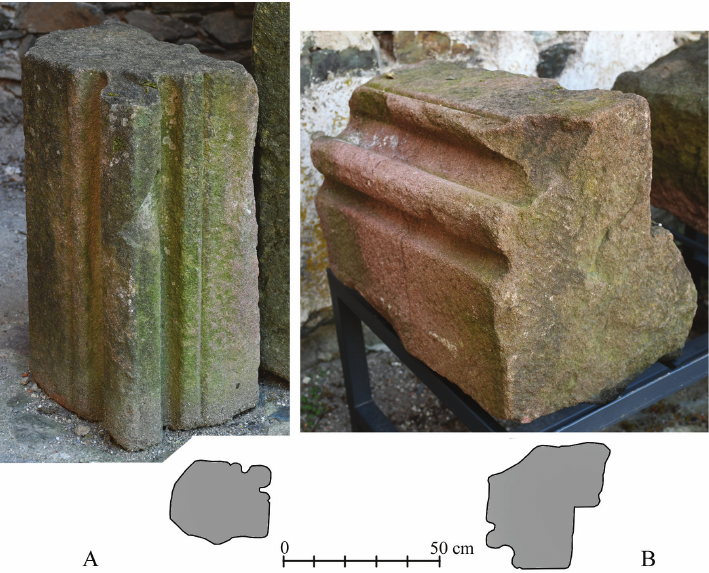
ments include parts of two portals (A, B), a window jamb,
a cornice, a square slab, and a proled shaft (Figs. 1–5).
Two examples of the portal A detail and the proled shaft
have survived. The portals were made of pink porphyry. The
stone block from portal A is characterised by a symmetrical
arrangement with a pear-shaped moulding featuring a sharp
ridge and two concave hollows on either side of the mould-
ing (Fig. 1). The author identies it as a component of an
early Gothic stepped portal, reminiscent of the southern
por tal of the church in Pogwizdów. From portal B, a block
de co rated with two mouldings and two concave hollows
has been preserved. The mouldings have circular cross-sec-
tions of dierent diameters, with the larger one having a at
pro jection. Additionally, it was observed that the stone has
a wide rebate intended for a door or gate.
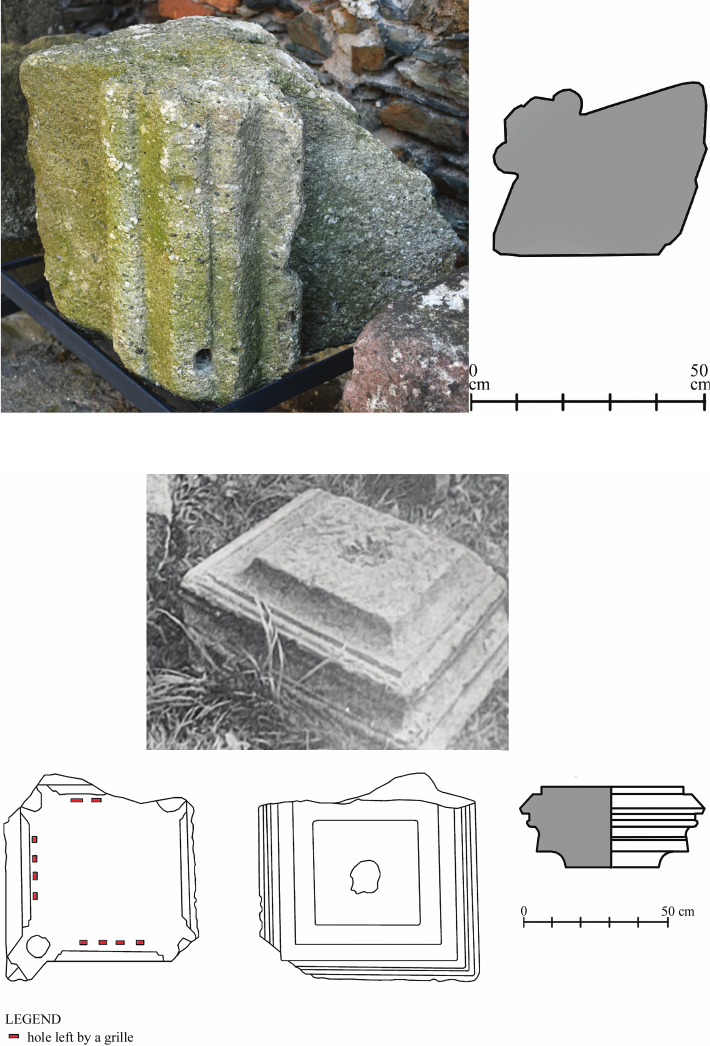
Another preserved element is a fragment of the frame of
a large 13
th
-century window opening, made of coarse-grained
sandstone (Fig. 2). It consists of two rounded mouldings with
concave recesses along the jambs, as well as an opening for
stained glass.
A square slab made of dark greenish sandstone, measuring
67 × 67 cm and characterised by a Gothic prole, has also
Fig. 1. Cross-sections of
the preserved portal fragments
most likely originating from
the castle chapel
(drawings by A. Wolniak,
photos by H. Golasz-Szołomicka)
Il. 1. Przekroje zachowanych
fragmentów portali pochodzących
najprawdopodobniej z kaplicy
zamkowej
(rys. A. Wolniak,
fot. H. Golasz-Szołomicka)
Medieval Sacrarium from Bolków Castle?
27
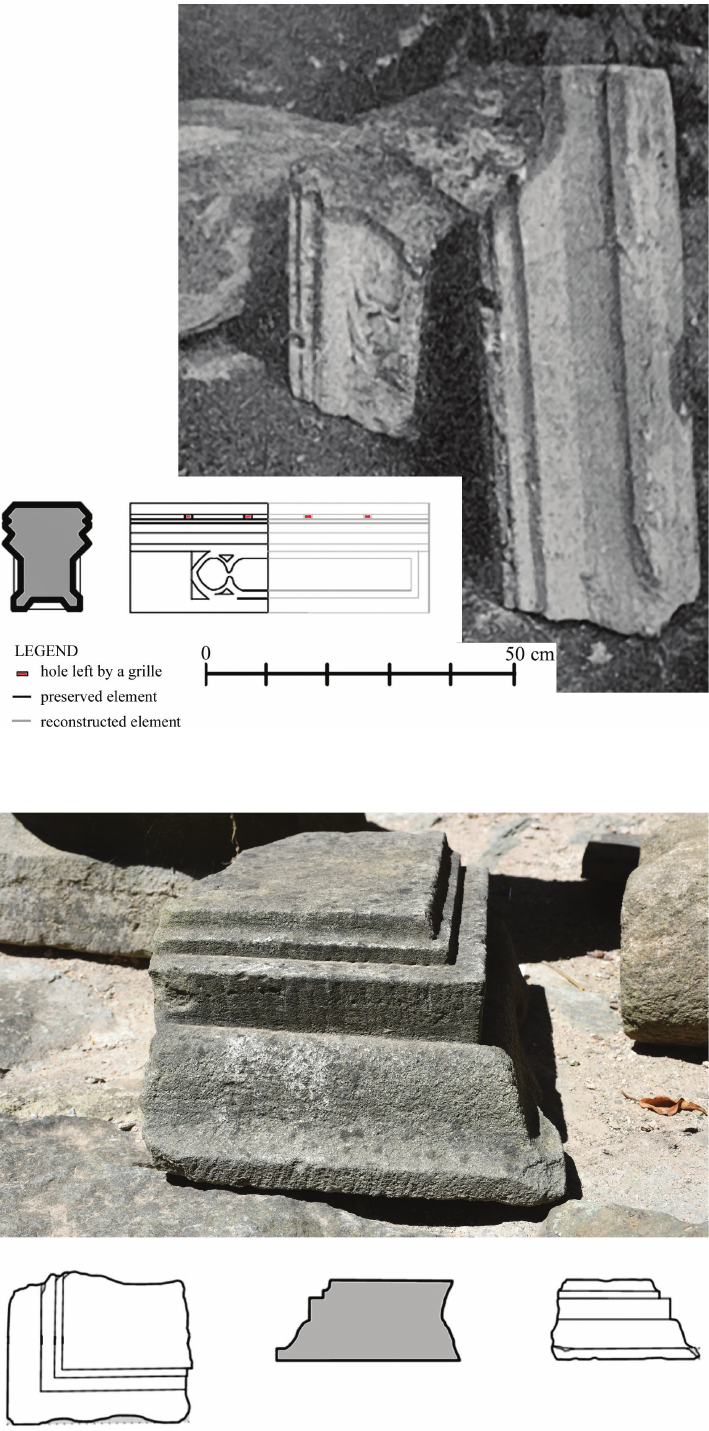
been preserved (Fig. 3). It has been identied as the base of
a sacrarium or the so-called lantern of the dead. Associated
with it is a proled shaft with a rectangular cross-section
(Fig. 4), decorated with a trefoil motif. Traces of an iron grille
and fragments of blue polychromy have been preserved on
the shaft (Fig. 4).
This raises the question of whether the discovered ele-
ments originated from Bolków Castle itself or were brought
there later, since they were not mentioned in any other schol-
arly study prior to 1963. To explore this issue, the recov-
ered details were compared with those found in the parish
church in Bolków. It was determined that they are similar in
size, prole shape, and material to the details of St Hedwig’s
Church, located at the foot of the castle hill.
The church was built in 1250 on a cruciform plan, with
a two-bay presbytery and a nave of similar size, as well as
a three-bay transept (Kozaczewski, Kozaczewska-Golasz
2009, 113–115). The transept of the building can be divid-
ed into phases, marked by three keystones featuring gural
representations referring to the reign of Henry the Bearded
(Czerner 1963). The castle’s plinth shows similarities to
that of the church’s northern and partly eastern wall, while
the detail from portal A resembles the prole of the main
en trance portal located in the church’s western façade. Ac-
cord ing to Hanna Kozaczewska-Golasz (2009), the portal is
dated to the fourth quarter of the 13
th
century.
During the workshop, fragments of stonework stored in
the lapidarium were analysed. It was found that the con-
Fig. 2. The cross-section
of a preserved window jamb
from the 13
th
century most
likely originating from
the castle chapel
(drawing by A. Wolniak,
photo by H. Golasz-Szołomicka)
Il. 2. Przekrój zachowanego
ciosu obramienia okna
z XIII w. pochodzącego
najprawdopodobniej z kaplicy
zamkowej (rys. A. Wolniak,
fot. H. Golasz-Szołomicka)
Fig. 3. The sacrarium base
(source: Czerner 1963,
drawing by A. Wolniak,
photo by O. Czerner)
Il. 3. Podstawa sakrarium
(źródło: Czerner 1963,
rys. A. Wolniak, fot. O. Czerner)
28
Hanna Golasz-Szołomicka, Aleksandra Wolniak
Fig. 4. The sacrarium shaft
and detail drawing
(source: Czerner 1963,
drawing by A. Wolniak,
photo by O. Czerner)
Il. 4. Laska sakrarium
i rysunek detalu
(źródło: Czerner 1963,
rys. A. Wolniak, fot. O. Czerner)
Fig. 5. A fragment of the lower
base of the sacrarium
(drawing by A. Wolniak,
photo by H. Golasz-Szołomicka)
Il. 5. Fragment podstawy
dolnej bazy sakrarium
(rys. A. Wolniak,
fot. H. Golasz-Szołomicka)
Medieval Sacrarium from Bolków Castle?
29
dition of the stone elements described in the dissertation
from the 1960s had changed. The base and two fragments
of columns with decorative polychromy have gone miss-
ing. Among the new or previously unrecognised elements,
a canopy was identied (Fig. 6). This element is currently
preserved and was thoroughly inventoried during the work-
shop. A question arose: is it possible that some of the ele-
ments currently located at the castle could form a complete
structure together with those no longer preserved but thor-
oughly documented in Czerner’s study?
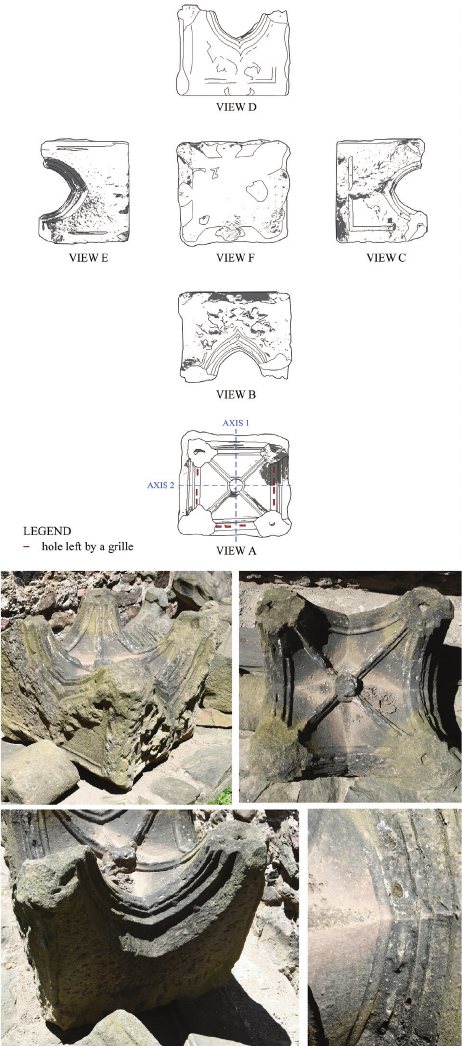
The stone canopy, made of dark greenish sandstone, bears
clear traces of structural continuity, such as holes left by iron
pins that once secured the shafts supporting the struc ture. To
describe the object in detail, it was divided into in di vi dual
views (marked alphabetically in the drawings).
View A shows the underside of the canopy, which has
a nearly square shape with sides measuring 67 cm and two
axes of symmetry intersecting at the centre (nos. 1 and 2).
In each corner, a clear trace of the shafts that once sup-
ported the structure can be seen. When compared with
the cross-section drawings of the shafts documented by
Czerner, it was noted that these elements correspond ex-
actly. The most distinct trace of a shaft cross-section is lo-
cated in the lower left corner. In each of these traces, a hole
left by an iron pin running through the centre is clearly
visible. From each shaft, ribs of a ribbed vault extend and
meet at a central keystone. Along the sides, connecting the
shafts, runs a prole of pointed arches in the form of ogees,
visible in Views B, C, D, and E as three mouldings of vary-
ing diameters, the central one being the widest. Shallow
concave grooves can be observed between the mouldings.
Behind the arch prole, near the canopy’s edge on three
sides, four rectangular recesses left by an iron grille are
visible. Identical traces also appear in Czerner’s doctoral
drawings of the shaft.
View B shows the side of the canopy – with an arcade
in the form of an ogee arch decorated with crockets and
topped with a nial. At the top of the view, starting at about
three-quarters of the canopy’s height, an expansion of the
corners can be observed.
View C shows the side of the canopy, similar to View B;
it presents sculptural decoration with an arcade in the form
of an ogee arch decorated with crockets and topped with
a nial along axis 2. On the left side of the view, along the
axis of the shaft, a recessed frame for decoration runs up
to about three-quarters of the canopy’s height. The upper
corners are not expanded.
View D shows the side of the canopy. It contains a point-
ed arch with an arcade in the form of an ogee arch decorated
with crockets and topped with a nial. As in View C, there
is a frame for decorative detail. An expansion of the upper
right corner was also observed.
The last side view, E, also with a pointed arch, does not
feature a distinct ogee arch or sculptural decoration. On
both sides, long vertical grooves and smaller recesses are
visible, suggesting that this side of the canopy was adjacent
to a wall.
View F shows the upper part of the canopy. It has a sym-
metrical form, with slight deviations, particularly in the
lower right corner. Each side features slanted projections at
the extensions of the shafts and sculptural decoration along
the symmetry axis of each side.
Ciboria, sacraria and lanterns of the dead
Before attempting a reconstruction of the sacrarium, it
was advisable to conduct comparative research in order to
become acquainted with examples of similar objects found
in Silesia and neighbouring regions, as well as to understand
their function.
Fig. 6. The rediscovered sacrarium canopy
(drawings by A. Wolniak, photo by H. Golasz-Szołomicka)
Il. 6. Odnaleziony baldachim sakrarium
(oprac. rys. A. Wolniak, fot. H. Golasz-Szołomicka)

30
Hanna Golasz-Szołomicka, Aleksandra Wolniak
Selected late Gothic sacraria in Silesia were presented by
Hans Lutsch (1903, 2001). Erika Baare-Schmidt (1937) de-
scribed the types of Gothic tabernacles in various regions of
Germany, and in more detail the late Gothic so-called sac-
rament houses, that is, tower-like forms. Although the au-
thor emphasised that a tabernacle is a place for storing the
Eucharist, she also used this term to refer to various types
of sacramental chapels, altar pyxes, choir stalls, and al -
tar
ca binets. Achim Timmermann (2005) discussed selected
15
th
-century sacrament houses from the territories of Bel-
gium, Slovakia, Hungary, and Poland. The history and types
of tabernacles in Poland, as well as the meanings of the terms
used, were presented by Antoni Rafałko (1982). Janusz Gręź-
li kowski (2012) described the development of the taberna-
cle in relation to the norms and statutes of various synods
throughout history. Agnieszka Woś-Jucker (2005), in addi-
tion to presenting the types of sacraria, focused on terminol-
ogy, explaining its various meanings over the centuries and
the corresponding terms used in foreign-language literature.
In the literature, the place where the Eucharist is kept is
referred to interchangeably as a ciborium, tabernacle, sacra-
mentarium, or sacrarium. Their etymology was discussed by
Rafałko (1982), Woś-Jucker (2005), and Bogusław Nadolski
(2006). After analysing the literature, the authors of the pres-
ent text apply the following terminology: ciborium – a can-
opy over an altar or tomb (Kozakiewicz 1969, 73; Rafałko
1982, 203; Woś-Jucker 2005, 132, 133; Nadolski 2006,
280, 281), tabernacle – an altar cabinet (Kozakiewicz 1969,
344; Rafałko 1982, 203; Woś-Jucker 2005, 134; Nadolski
2006, 1554) or a structure in which the vessels containing
the Eucharist are stored (Rafałko 1982, 203), sacramentari-
um – a liturgical book (Jougan 1992, 508; Woś-Jucker 2005,
137; Nadolski 2006, 1434), sacrarium – a place of storage
(Rafałko 1982, 203; Jougan 1992, 508; Woś-Jucker 2005,
136–138).
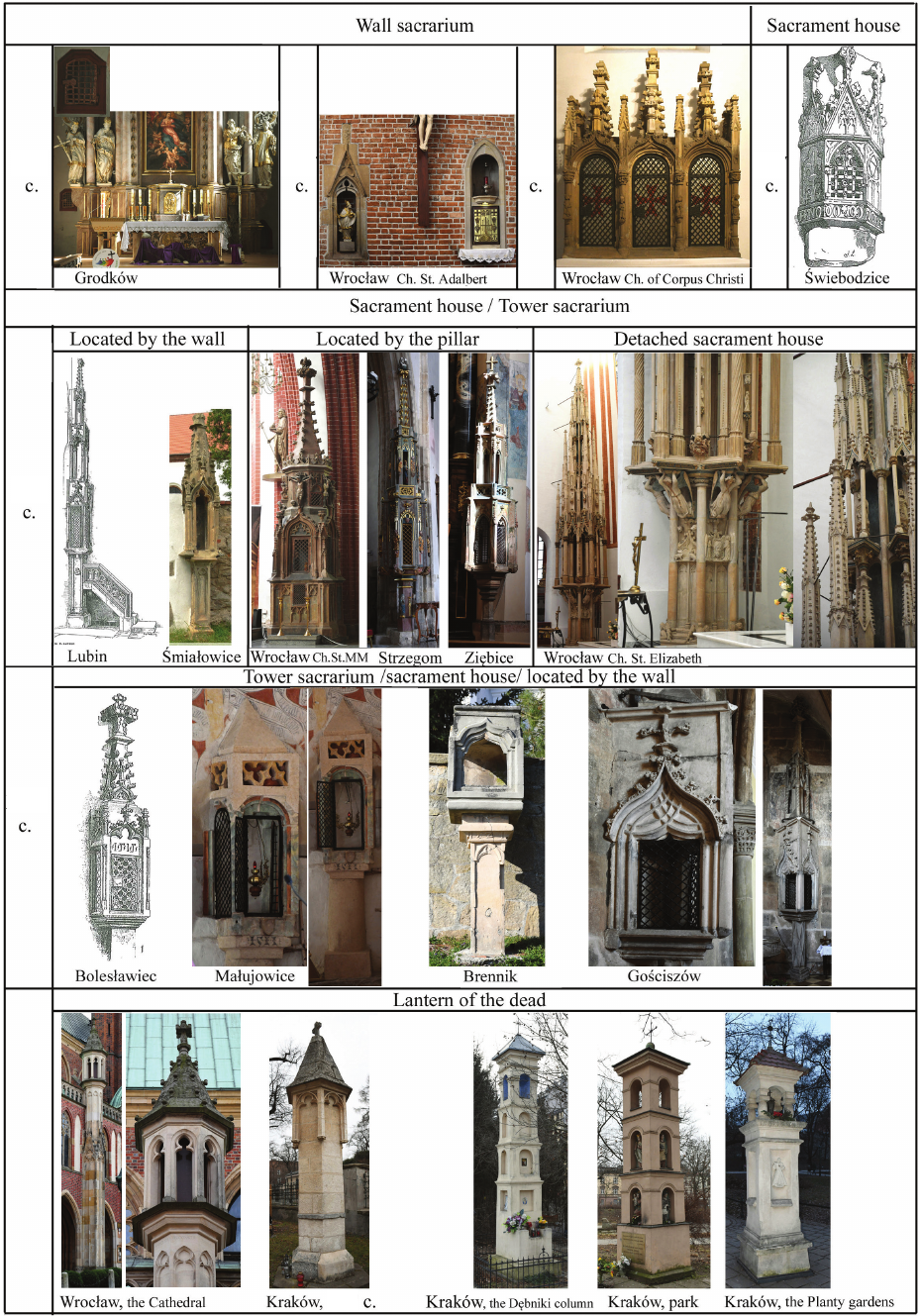
In the Catholic Church after 313 AD, the Eucharist was
kept in sacristies, in wall niches known as wall sacraria, or
on altars. In Poland, sacraria located in sacristies were still in
use in the 16
th
century, and in Silesia even into the 17
th
centu-
ry (Gręźlikowski 2012; Rafałko 1982). At the turn of the 12
th
and 13
th
centuries, with changes in the liturgy, the sacrarium
was moved to the presbytery, taking the form of a wall niche
closed with doors or a grille, with both doors and a grille
(in northern Poland), or with a grille alone (in Silesia; Woś-
Jucker 2005). The preserved niches took on simple forms
or were topped with a trefoil arch (Grodków, parish church,
13
th
century; Rafałko 1982), with a rounded arch and a gab-
let (Wrocław, Church of St Adalbert, 1295–1330)
1
(Fig. 7).
Over time, the niche was tted with a box that could be
pulled out beyond the wall face and supported by a pillar.
In this way, a tower-shaped sacrarium was created – the so-
called Eucharistic house.
In Poland, from the 15
th
to the mid-16
th
century (Rafałko
1982
2
), tower-shaped sacrament houses were also built – ei-
1
In some churches, two sacrament houses have been preserved,
which may have been used to store the Eucharist and the holy oils
(source: www.wroclaw.dominikanie.pl).
2
Rafałko lists documented sacrament houses dated to the 15
th
cen-
tury. However, Lutsch dates the sacrament house in Świebodzice to the
ther attached to walls or pillars, or as free-standing struc-
tures – on square or polygonal plans. They were topped
with tall spires reecting the ground plan of the structure.
In Świebodzice (Church of St Francis, 1352; Lutsch 2001),
a sacrament house was erected on a plan of a half-hexagon,
decorated with tracery and a grille with rosettes, and covered
with a roof featuring gables (wimpergs). In Lubin (Parish
Church of Our Lady of Częstochowa, 15
th
c.; Lutsch 2001),
Śmiałowice (15
th
c.; Pilch 2011), Małujowice (Church of
St James, 1511; Lutsch 2001), Bolesławiec (Church of St
Hedwig, 1515; Lutsch 2001), Wrocław (Church of St Mary
Magdalene, 1410; Pilch 2011; or 1375–1380; Timmermann
2005), and in Brennik (1521), sacrament houses were built
in the form of rectangular cabinets decorated with grilles on
three sides. In Gościszów (Parish Church of Our Lady and
St John the Baptist), a late Gothic sacrament house (Pilch
2011) has been preserved, designed on a triangular plan (set
diagonally in relation to the eastern wall of the chancel), dec-
orated with a canopy arch and a pointed arch. In Strzegom
(Church of Sts Peter and Paul, 1420; Timmermann 2005),
a sacrament house was built on a concave octagonal plan, de-
corated with gural sculpture and grilles on each side. In the
Church of St Elizabeth in Wrocław, in 1455 (Lutsch 1903),
a free-standing sacrament house was constructed on the plan
of an eight-pointed star, supported by a pillar adorned with
co lumns, reliefs, and sculptural brackets. Co lumns were
plac ed on the arms of the star, connected by pointed arches
and topped with pinnacles. The entire structure was rein-
forced with anchors and connected to the wall.
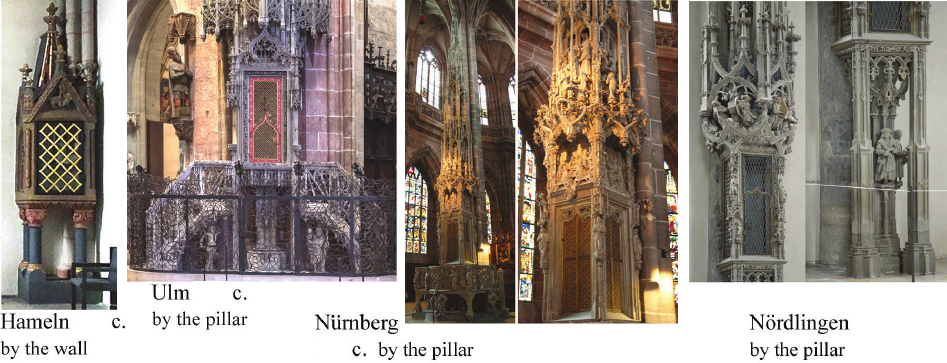
Similar sacrament houses were built in Germany, Bel-
gium, and Slovakia. In Germany, up to the 15
th
century, wall-
mounted sacrament houses were constructed, while from
the 15
th
to the mid-16
th
century (Baare-Schmidt 1937), tow-
er-shaped sacrament houses were built against walls or pil-
lars, on square or polygonal plans, topped with multi-story,
openwork spires (Fig. 8). In Slovakia and Belgium, 15
th
-cen-
tury sacrament houses were built on octagonal or star-shaped
plans and featured tall nials (Timmermann 2005). In some
buildings, the cornice of the nial was rotated by 45 degrees.
In the churches of Lower Silesia discussed above, sac-
rament houses were built on the east-south (Świebodzice,
Małujowice, Wrocław – Churches of Corpus Christi and
St Mary Magdalene, Ziębice) or north side of the chancel
(Gościszów, Strzegom, Wrocław – Church of St Elizabeth,
Śmiałowice). In German churches, they were usually placed
against the eastern wall or in the northern part of the chan-
cel, except in Hameln, where the sacrament house was lo-
cated in the east-southeast corner of the chancel.
In the Middle Ages, other tower-like structures known as
“lanterns of the dead” (Fig. 7) were also built. These were
usually located on the northern side of churches, near ceme-
teries. They consisted of an upper section open with arcades,
supported by a pillar or pedestal. Such structures could feature
rich decoration in the form of columns, pointed arches, and
rosettes (examples include: Wrocław – Cathedral, 14
th
–15
th
century; Wrocław – Convent of the Sisters of Notre Dame;
mid-14
th
century, which suggests that tower-shaped forms may have al-
ready appeared in the 14
th
century.
Medieval Sacrarium from Bolków Castle?
31
Fig. 7. Selected sacraria in Silesia (elaborated and photo by H. Golasz-Szołomicka, drawings of the sacraria in Świebodzice, Lubin,
and Bolesławiec: after Lutsch 1903, https://bibliotekacyfrowa.pl/dlibra/publication/edition/133925)
Il. 7. Wybrane sakraria na Śląsku (oprac. i fot. H. Golasz-Szołomicka, rys. sakrariów w Świebodzicach, Lubinie, Bolesławcu:
Lutsch 1903, https://bibliotekacyfrowa.pl/dlibra/publication/edition/133925)
13
th
15
th
16
th
14
th
14
th
14
th
15
th
32
Hanna Golasz-Szołomicka, Aleksandra Wolniak
Fig. 8 Selected tower sacraria in Germany (source: Hameln – https://www.kirchbau.de/bildorig/h/hameln_bonifatius_innenb1163x1550_michael_
durwen.jpg, License CC BY-SA 4.0 (a fragment of the original photo was used), accessed February 23, 2025,
Ulm – https://commons.wikimedia.org/wiki/File:Ulm_M%C3%BCnster_Sakramentshaus_01.jpg, Uoaei1, License CC BY-SA 4.0
(a fragment of the original photo was used), accessed February 30, 2025, Norymberga, Nördlingen – photo by H. Golasz-Szołomicka)
Il. 8. Wybrane sakraria wieżowe w Niemczech (źródło: Hameln – https://www.kirchbau.de/bildorig/h/hameln_bonifatius_innenb1163x1550_
michael_durwen.jpg, License CC BY-SA 4.0 (wykorzystano fragment oryginalnego zdjęcia), dostęp 23.02.2025,
Ulm – https://commons.wikimedia.org/wiki/File:Ulm_M%C3%BCnster_Sakramentshaus_01.jpg, Uoaei1, License CC BY-SA 4.0
(wykorzystano fragment oryginalnego zdjęcia), dostęp 30.02.2025, Norymberga, Nördlingen – fot. H. Golasz-Szołomicka)
Kraków – Church of St Martin, 14
th
century; the Dębnik col-
umn in Krakowski Park and the Planty gardens).
In summary, medieval sacrament houses appeared in
two
main types: wall-mounted, in the form of a niche, and
tower-shaped, either free-standing or built against a wall.
Unlike the lanterns of the dead, sacrament houses of both
types were enclosed with doors and grilles – or, in the case
of Silesia, with grilles alone. A close examination of the
canopy from Bolków Castle, which conrms the presence
of openings for grilles, indicates that it must have covered
a sacrament house rather than a lantern of the dead. It was
a late Gothic, wall-mounted, tower-type sacrarium, en-
closed with grilles on three sides.
An attempt at reconstructing
the Sacrarium from Bolków Castle
An interesting discovery described by Czerner (1963) is
the base of a sacrament house (Fig. 3), or possibly a so-
called lantern of the dead, whose dimensions and material
match perfectly with the recently found canopy. Its proles
still display Gothic cross-sections, similar to the associated
proled rectangular shaft (composed of two elements), dec-
orated with a trefoil motif, on which holes for a grille and
traces of blue polychromy are visible (Fig. 4). Neither the
base nor the shaft was found during the workshops, but both
were carefully described in the doctoral dissertation.
Thus, a concept was developed to t the previously de-
scribed elements together and reconstruct the sacrament
house. Czerner’s drawings of the base and shafts (Figs. 3, 4)
were analysed. After tracing and scaling them and overlay-
ing them onto views of the canopy obtained from a photo-
grammetric scan (Fig. 6), it was found that the elements t
together. The precise drawings of the missing elements al-
low for their replication and the reconstruction of their orig-
inal appearance. Since the shafts documented by Czerner
were already damaged, an attempt was made to determine
their original height. Based on the preserved traces of the
grille, the distances between these points, and the known
number of bars in the grille, a probable original height of the
shafts was calculated. Unfortunately, the black-and-white
photographs do not allow for identication of the original
polychrome colours observed in the 1960s.
During the analysis of Czerner’s drawings depicting the
base of the sacrarium (Fig. 3), a distinct trace of the pillar
on which it once stood was observed. The most challeng-
ing task was determining its height and adjusting the pro-
portions of the entire sacrarium. To reconstruct its original
appearance, similar examples of this type of Gothic liturgi-
cal furnishing were sought in Lower Silesia and the former
German Empire. Many Gothic sacraria come primarily from
large urban centres such as Wrocław (Church of St Mary
Magdalene) or Strzegom (Minor Basilica of Sts Peter and
Paul). These examples are characterised by highly sculptur-
al treatment and a richness of detail (Fig. 7). The recovered
canopy, however, lacks such decoration, which suggests
look ing for analogous examples in smaller towns that did
not have the nancial resources to commission the work of
a master sculptor.
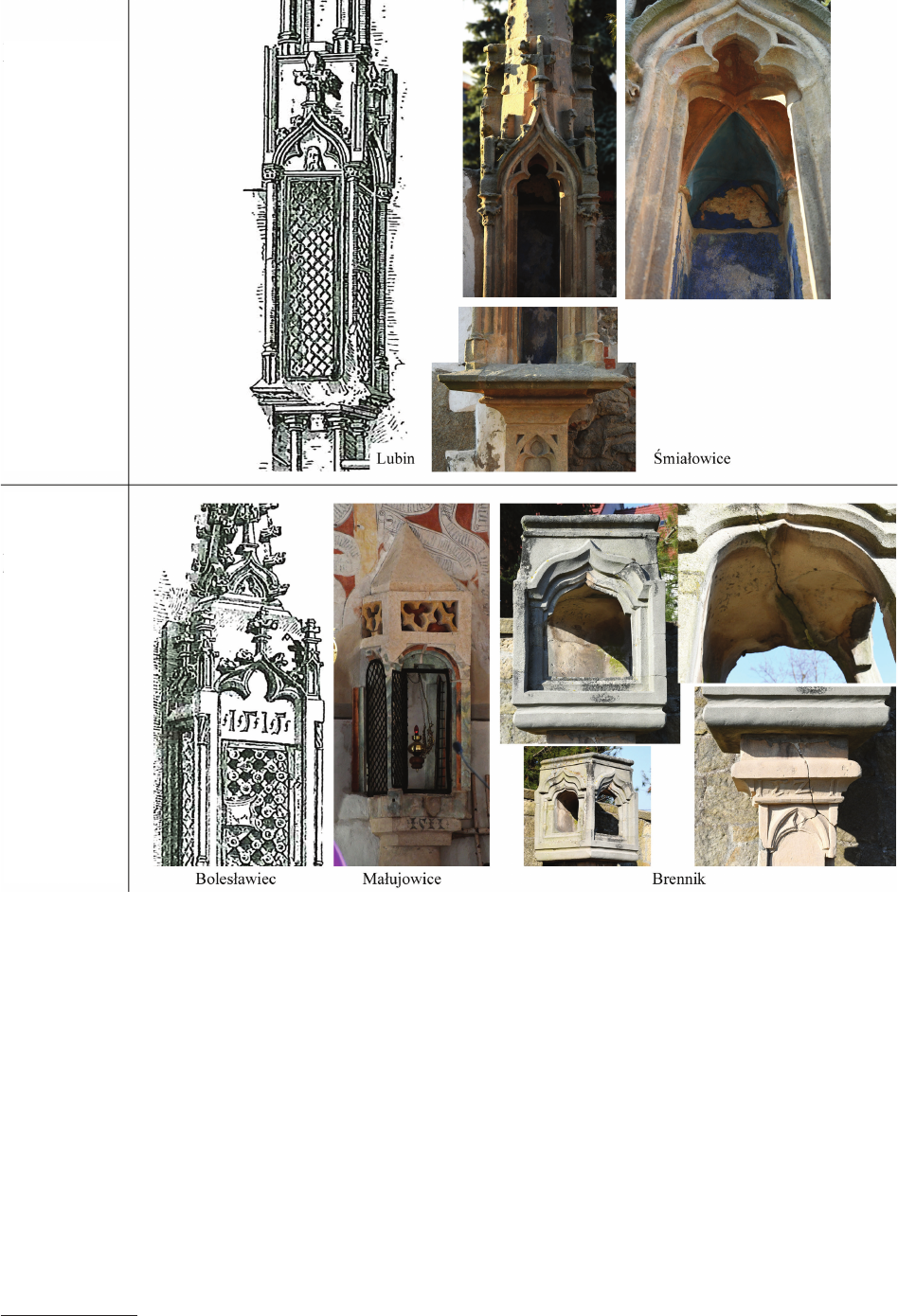
The sacrarium in Bolków is similar in design to those
found in Lubin, Śmiałowice, Bolesławiec, Małujowice, and
Bren nik (Fig. 9). These have a quadrilateral cabinet with
one blind wall supported by a slender single pillar. Only
in Śmia łowice and Brennik is the support decorated with
a trefoil within a pointed arch. The upper part of the cabi-
net, adorned with a pointed arch featuring crockets and an
ad ditional trefoil, appears in Lubin, Śmiałowice, and Bo-
le sła wiec. Walls with open arches on three sides are used
in Śmiałowice, Brennik, and Małujowice. The sacraria in
Lubin, Śmiałowice, and Bolesławiec are crowned with tall
15
th
15
th
15
th
16
th
c.
Medieval Sacrarium from Bolków Castle?
33
After analysing examples from both smaller and larger
urban centres, a decision was made to include an additional
base beneath the column in the design for displaying the
preserved stone elements. The justication for this solution
was the discovery of a stone detail found beneath the castle
walls (Fig. 5). Initially, it had been identied as a fragment
of a cornice; however, after a renewed analysis, it was pro-
posed to reinterpret the piece, supplement it with stonework,
and use it as a stabilising base for the sacrarium.
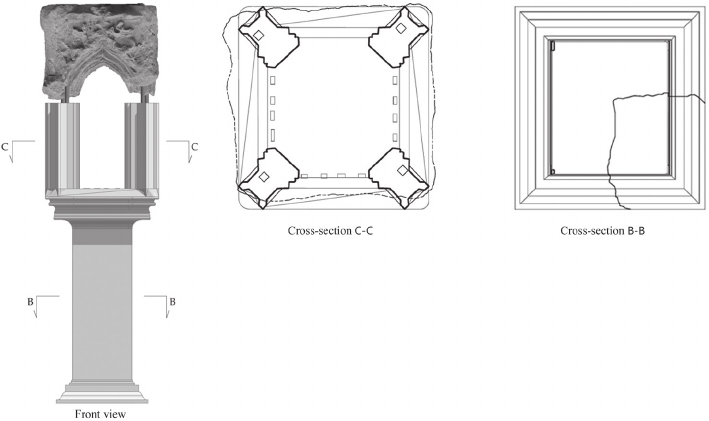
In the design (Fig. 10), the primary goal was to highlight
the existing elements by using the same material – a dark
greenish sandstone – while contrasting it in colour with the
preserved details. An additional challenge was to connect
the new and historical fragments in a way that would not
gables, while in Małujowice a low, tent-like roof – similar
to the coverings of lanterns of the dead – was used. Among
the churches in Germany, the sacrarium in Hameln stands
out, featuring a quadrilateral cabinet supported on columns
(Baare-Schmidt 1937
3
).
The sacrarium in Brennik served as a model for the re-
construction of the sacrarium in Bolków Castle due to the
similarity in the way the cabinet was mounted. Its column
height, supporting the base, was adopted for the recon-
struction.
3
Baare-Schmidt dates the sacrarium to the 15
th
century, but the ar-
chitectural details of the cabinet suggest the 2
nd
half of the 13
th
century.
Fig. 9. Selected 15
th
- and 16
th
-century Polish sacraria (elaborated and photos by H. Golasz-Szołomicka, drawings of the sacraria in Lubin
and Bolesławiec: after Lutsch 1903, https://bibliotekacyfrowa.pl/dlibra/publication/edition/133925)
Il. 9. Wybrane polskie XV- i XVI-wieczne sakraria (oprac. i fot. H. Golasz-Szołomicka, rys. sakrariów w Lubinie i Bolesławcu: Lutsch 1903,
https://bibliotekacyfrowa.pl/dlibra/publication/edition/133925)
15
th
c.
16
th
c.
34
Hanna Golasz-Szołomicka, Aleksandra Wolniak
References
Baare-Schmidt, Erika. Das spätgotische Tabernakel in Deutschland: ein
Beitrag zur Entwicklungsgeschichte der Zierarchitektur. G.H. Nolte,
1937.
Czerner, Olgierd. “Zamek w Bolkowie jako jeden z przykładów grupy
średniowiecznych założeń obronnych z wieżą z ostrzem.” In Prace
Komisji Historii Sztuki, edited by Tadeusz Broniewski. Vol. 3. Zakład
Narodowy im. Ossolińskich Wydawnictwo PAN, 1963.
Ebhardt, Bodo. Der Wehrbau Europas im Mittelalter; Versuch einer Ge-
samt darstellung der europäischen Burgen. Deutsche Verlags ge sell-
schaft, 1939.
Gręźlikowski, Janusz. “Przechowywanie i kult Eucharystii w ustawodaw
-
stwie synodalnym Polski przedrozbiorowej.” Prawo Kanoniczne 55,
no. 1 (2012): 99–159.
Guerquin, Bohdan. Zamki śląskie. WBiA, 1957.
Jougan, Władysław Alojzy. Słownik kościelny łacińsko-polski. Wydaw nic-
two Archidiecezji Warszawskiej, 1992.
Kowalewski, Marian. Mały słownik teologiczny. Księgarnia Św. Wojciecha, 1960.
Kozaczewski, Tadeusz, and Hanna Kozaczewska-Golasz. Portale trzyna-
stowiecznej architektury na Śląsku. Ocyna Wydawnicza Politechniki
Wrocławskiej, 2009.
damage the original stonework. It was decided to make
use of the existing holes observed on the underside of the
canopy, located where traces of the supporting shafts were
found. The design proposes deepening these holes to insert
square-section rods that would support the canopy; their
continuation would run through newly carved stone shafts
down to the base. This solution would ensure the structur-
al stability of the piece. Furthermore, maintaining a slight
gap between the canopy and the contemporary elements
would allow viewers to distinguish the historical details
from the reconstructed parts.
Conclusions
The conducted research formed the basis for the ex-
hibition design of the studied monument: a late Gothic
wall-mounted tower-type sacrarium, dated to the late 15
th
–
early 16
th
century. The other previously mentioned stone
elements of a sacred nature display Early Gothic features,
allowing them to be dated to the late 13
th
–early 14
th
cen-
tury. The sacrarium most likely constituted part of the fur-
nishings of the medieval castle chapel.
Thanks to the research workshops and the comparative
ana lysis of selected Gothic sacraria from Lower Silesia,
it was possible to expand the knowledge of the original
furnishings of the chapel. Although the current ndings
do not allow for a complete reconstruction of the original
nial, they do provide valuable clues and make it possible
to formulate hypotheses regarding its original appearance.
These analyses have enriched previous research, including
the studies of Olgierd Czerner, and have led to new and
intriguing discoveries. Their results may not only facilitate
future reconstructions but also enhance the attractiveness
of Bolków Castle for visitors. Each new element uncovered
during the research contributes to a better understanding of
the history of this unique place, which – despite numerous
studies and publications – still conceals many secrets.
Translated by
Bogusław Setkowicz
Acknowledgements
The work was carried out as part of the project of the National Programme
for the Development of Humanities, module: National heritage, registra-
tion number NPRH/DN/SP/495215/2021/10.
Our research would not have been possible without the invaluable support
of the castellan of Bolków Castle, who made the site available for scientic
work.
Fig. 10. Proposed display
of the sacrarium: front view,
section C-C and section B-B
(elaborated by A. Wolniak)
Il. 10. Propozycja ekspozycji
sakrarium: widok z przodu,
przekrój C-C i przekrój B-B
(oprac. A. Wolniak)
Medieval Sacrarium from Bolków Castle?
35
Streszczenie
Średniowieczne sakrarium z Zamku Bolków?
Celem autorek artykułu było przedstawienie wyników badań dotyczących pierwotnej funkcji i formy kamiennego baldachimu znajdującego się w la-
pidarium zamku Bolków. Badania te mają kluczowe znaczenie dla ustalenia, czy w średniowieczu na zamku istniała kaplica, na co wskazuje obecność
licznych reliktów kamieniarskich o sakralnym charakterze. W celu określenia pierwotnej roli baldachimu przeprowadzono jego szczegółową inwentaryza-
cję z wykorzystaniem fotogrametrii, obejmującą również inne elementy kamieniarskie zdeponowane w lapidarium, w tym detale o charakterze sakralnym.
Dodatkowo dokonano porównawczych analiz średniowiecznych sakrariów i latarni umarłych ze Śląska oraz sąsiednich regionów.
Słowa kluczowe: zamek Bolków, baldachim, sakrarium, sakrarium wieżowe
Kozakiewicz, Stefan, ed. Słownik terminologiczny sztuk pięknych. Pań-
stwo we Wydawnictwo Naukowe, 1969.
Lutsch, Hans. Die Kunstdenkmäler des Reg. Bezirks Liegnitz. Verlag von
Wilh. Gottl. Korn, 1891.
Lutsch, Hans. Register zum Verzeichnisse der Kunstdenkmäler Schlesiens.
Verlag von Wilh. Gottl. Korn, 1903.
Lutsch, Hans. Schlesien Kunstdenkmäler. Vol. 2. Flechsig, 2001.
Lutsch, Hans. Textband zum Bildwerk Schlesischer Kunstdenkmäler. Bres-
lau, 1903.
Lutterotti, Peter “Burg Bolkenhain zu Beginn des XVIII Jahrhundrets.”
Wan derer im Risengebirge 7 (1928): 95.
Müller, Karl August. Vaterländische Bilder oder Geschichte und Beschrei-
bung sämmtlicher Burgen und Ritterschlösser Schlesiens beider Antheile
und der Grafschaft Glatz. Druck und Verlag von Carl Flemm ing, 1837.
Nadolski, Bogusław. Leksykon liturgii. Pallotinum, 2006.
Pilch, Józef. Leksykon zabytków architektury Dolnego Śląska. Wydaw nic-
two Arkady, 2011.
Rafałko, Antoni. “Dzieje tabernakulum w Polsce.” In Studia z dziejów
litur gii w Polsce, edited by Wacław Schenk, vol. 4. Wydawnictwo To-
wa rzystwa Naukowego KUL, 1982.
Rohkohl, Walter. Bolkenhain, Deutsches Städtebuch. Stuttgart, 1939.
Schaube, Adolf “Jakob Paar von Mailand.” Schlesische Zeitung. Unter-
haltungs Beilage 165 (1931).
Schubert, Heinrich. Geschichte der Bolkoburg bei Bolkenhain. Georg Krie-
ger, 1895.
Steige, Benjamin Gottlib, and Alfred Teichmann. Chronik der Stadt Bol-
ken hain. Schubert, 1911.
Tillmann, Kurt. Lexikon der deutschen Burgen und Schlösser. Vol. 1. Hier-
se mann Verlag, 1958.
Timmermann, Achim. “‘Altissimum ac pretiosum’ – the Vienna Cathedral
Lodge and Late Medieval Sacrament House Design in East Central
Europe.” Umění 53, (2005): 539–50.
Woś-Jucker, Agnieszka. “Średniowieczne sakraria w Polsce: kwestia ter-
minologii.” Roczniki Humanistyczne 53, no. 4 (2005): 131–47.