2010
Nr 2(28)
Małgorzata Doroz-Turek*
Monastic architecture in culture – monastic design
as a specic type of ecclesiastical architecture exemplied by
the monasteries of the order of the Canons Regular
of St. Augustine in Silesia
Order is a special environment whose character and
form of life is also connected with special architecture ex-
clusively typical of order. In the Middle Ages, however, in
Europe and of course in Poland too, monks and monaster-
ies, despite their specic character, were rather common
in social life. Today they still exist but what is left of their
everyday activities is only an imposing memory in the
form of old abbey churches taken over and redened by
new celebrants and huge convents which were liquidated
by revolutionary laws and adapted for other purposes [1,
p. 53]. Apart from their use and function, their architec-
ture also changed over the centuries; usually there are no
remains of the original form or what is preserved is only
its fragments in the fabric which was added later. Despite
the passage of time and changes in monastic architecture,
its signicance in culture is still great.
Research conducted in the years 2003–2007 by the
author on monastic architecture of the Canons Regular of
St. Augustine in Silesia and its ndings enabled the for-
mulation of a few conclusions. One of them regards the
location of Silesian canonry, the other regards architec-
tural form – layout and construction of the church and the
monastery, third regards architectural elements.
As regards the location of the canonry, the shortest
monastic rule providing principles of the monastic life did
not directly indicate the place of location of the abbey of
that order. We know, however, that while writing the ca-
nonical rule St. Augustine prepared it for clerics living in
towns close to bishop who had to somehow combine their
community life with ministry, preaching and organiza-
tion outside the walls of the monastery. Such activities to
a large extent determine the way of its functioning as well
as the scope of activities of the monks and the frequency
of contacts with the world outside [See 6, p. 50].
The selection of the place for construction of mon-
asteries of the Canons Regular was quite important. The
analyzed abbeys of the Canons Regular in Silesia were at
rst founded away from larger settlements. Then, howev-
er, they were moved to bigger towns which later became
city centers. The reason of that translocation could be
both low rate of settlements and the lack of prospects for
growth of the order as well as the scope of activities car-
ried out by the canons, including not only canonical but
also liturgical and ministerial tasks and later even charity.
This kind of operations made sense in larger populations.
After moving to Wrocław the monks were located close to
bishop, duke and the trading center. This provided better
conditions for the order to function and grow. In Żagań,
they settled to the south-east close to the market square, in
the place of original stronghold.
The order started to operate in Silesia when an abbey
was founded. At rst the monks lived rather austere life; it
was the case with the canonry on Ślęża Mt. and in Wrocław
as well as with already existing parish churches in Now-
ogród Bobrzański (St. Bartholomew parish church) and in
Żagań (Holy Virgin Mary church). The reasons behind the
selection of the location of the order of the Canons Regu-
lar of St. Augustine on top of Ślęża Mt. were ideologi-
cal. They wanted to develop an important cultural center
1
This is how the Belgian researcher Ludo Millis denes monasticism,
especially of the Canons Regular [6].
Specic spiritual ideal and the aim of perfection as a way of life
1
*
College of Enterprise and Administration in Lublin.
20 Małgorzata Doroz-Turek
in the place of former pagan center whose traditions in
the rst half of the 12
th
century must have been still very
strong in Silesia [15, pp. 12–13]. In regards of the founda-
tion of the canonry in Nowogród Bobrzański, it was con-
nected with colonization conducted in this area by Henryk
the Bearded. The canons were supposed to fulll specic
tasks in developing new areas [14, p. 45].
Little is known about the pattern of architecture fol-
lowed by the Canons Regular of St. Augustine because,
unlike the Benedictine Rule, the Augustinian Rule does
not provide any guidelines as to how the architecture of the
canonical monastic abbey should be organized and look
like; more can be learned from such normative sources
as principles regulating monastic life in specic abbeys
and monastic traditions collected in chronicles. Due to the
lack of such guidelines in its rule the order of the Canons
Regular of St. Augustine probably followed the generally
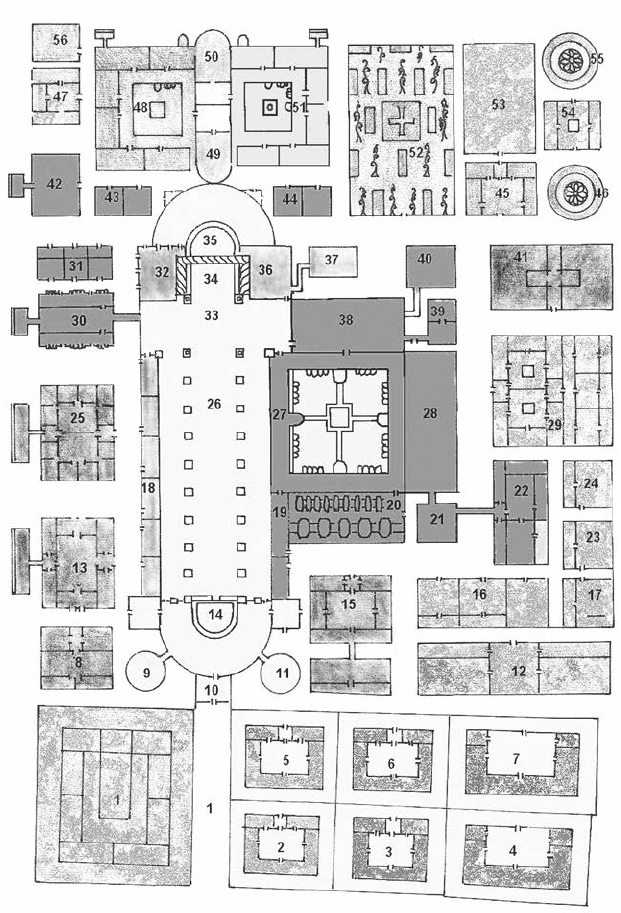
known plan of the Abbey of Saint Gall (Fig. 1), which was
used as a template for the abbeys which were created; the
plan did not, however, determine but only indicated what
Parts
Ecclesiastical Monastic community
9 – tower of
St. Gabriel
10 – porch
11 – tower of
St. Michael
14 – western altar of
St. Peter, ambulatory
with gallery rst oor
19 – reception room
for monastery guests
26 – church
33 – stairs above crypt
34 – tomb of St. Gall
35 – chancel above
crypt with high altar
of the Virgin Mary
32 – sacristy, library,
scriptorium
36 – sacristy, vestriary
rst oor
37 – preparation of the
Holy Bread and Oil
20 – storage of vine
and ale, pantry rst
oor
21 – kitchen
22 – monastic kitchen,
bakery, brewery
27 – cloister with
arcades
28 – dining hall -
refectory, wardrobe
above
30 – abbot’s house
31 – dining hall,
cellar, kitchen
38 – dormitory
39 – bathroom
40 – privy
Farming
1 – main entrance,
coach house
2 – servants’ lodging
3 – pigsty
4 – stable for horses
5 – sheep pen and
shepherds’ lodging
6 – goat pen
7 – stable for cows
8 – bakery and
brewery for visitors
12 – stable for horses
and cattle
13 – house for visitors,
servants’ quarters,
boxes for horses
15 – house for
pilgrims, bedrooms,
bathrooms, servants,
brewery, kitchen,
bakery
16 – coopery, joinery,
malt granary
17 – lime kiln
18 – lodging for
visiting monks,
lodging of day school
masters, lodging of
guest masters
29 – workrooms for
craftsmen, stores
41 – granaries
42 – house for blood-
letting
43 – kitchen and
lavatorium, lavabo
44 – novitiate kitchen
and bathroom
45 – gardener’s house
46 – poultry yard
47 – medical quarters
and chemist
48 – hospital with
cloister
49 – patients’ chapel,
hospital chapel
50 – novitiate church
51 – novitiate with
cloister
52 – cemetery and
orchard
53 – monks’ vegetable
garden
54 – poultryman’s
lodging
55 – medical herbs
56 – geese and
pigeons
Fig. 1. Diagram of the Abbey of Saint Gall
Monastic architecture in culture – monastic design as a specic type of ecclesiastical architecture exemplied by the monasteries... 21
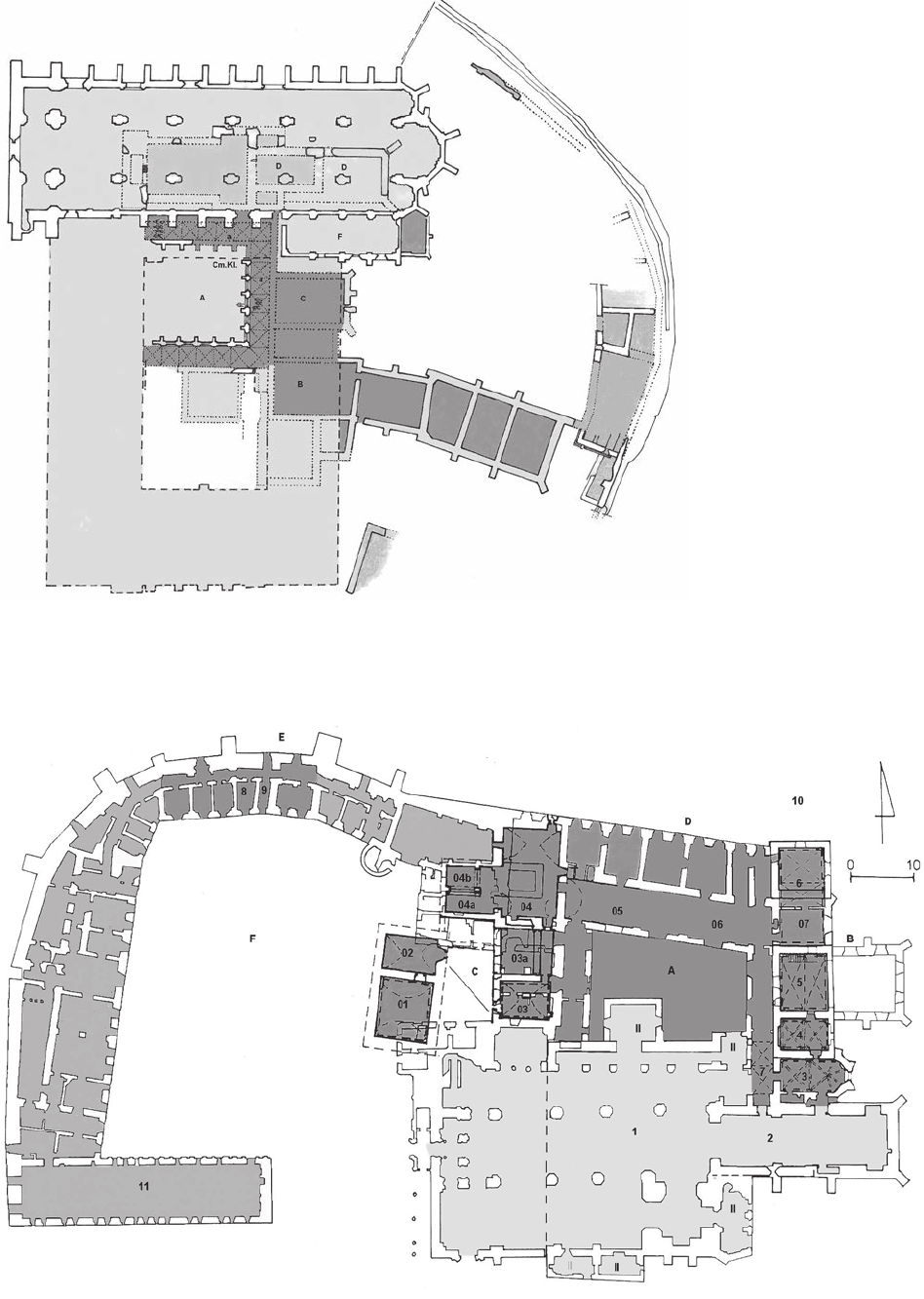
Fig. 2. Plan of the Abbey in
Wrocław on Sand Island:
ecclesiastical part – D (church,
choir) and F (sacristy), residential
part – A (garth, cloister),
B (refectory) and C (chapter-
-house) and farming part
Fig. 3. Plan of the Abbey in Żagań: ecclesiastical part – 1, 2 (church, chancel) and II (chapels), residential part – A (garth), B (east wing:
7 – cloister, 3 – chapel with dormitory upstairs, 4 – sacristy, 5 – chapter-house; 07 – workshops (brethren chamber 10 – privy-bathroom)), C (west
wing: 01 and 02 – house and later palace of the abbot, 03 – not dened function (?), 03a – summer refectory, 04 – winter refectory) and D (north
wing: 05 and 06 – cellarium), E – monastery school: 8 – cells, 9 – solitary, F – internal courtyard and farming. Clausura: 04 – kitchen with hearth
and stove: 04a – hearth, 04b – kitchen. Within the walls: 11 – granary
22 Małgorzata Doroz-Turek
an ideal monastic design should look like. The order fol-
lowed the model plan in respect of the general layout of
the design development and – with the exception of the
basic spaces – it adapted the layout for its needs. So, just
like the plan of the Abbey of Saint Gall, the monastery
of the canons was supposed to respect the provisions of
the monastic rule, liturgical order and management of the
monastic holdings. A few zones (at least three) can be dis-
tinguished within the whole monastic layout on the basis
of their symbolic and subjective signicance, Figs. 1–3.
The most exquisite examples of the analyzed monastic
buildings included churches, which have been preserved
in the best condition, and clausura buildings of which
only remains have survived.
Layout and construction
The church with the organization of its interior was an
important place for the Order of the Canons Regular of
St. Augustine that, as a community, devoted themselves to
spiritual life. Soon, in order to develop the proper monas-
tic community, monks began to build their temples which
in the 11
th
–12
th
/13
th
centuries were exclusively monastic.
Is seems that they intended to build huge structures. An
extraordinary program was approved to build an abbey
of the Canons Regular of St. Augustine on Ślęża Mt. It
is believed on the basis of numerous sculptures of lions
that it was planned to build either a few separate chapels
or a large-size temple with a different form; for unknown
reason this plan was not executed.
The surveyed churches were built in different ways.
The least is known about the original buildings which
we know only from remnants which were replaced with
other elements which have survived until today. Around
the middle of the 12
th
century, rst a small temple, but
with rich functional program, was built on Sand Is-
land in Wrocław for the monks who were moved from
Ślęża. The Romanesque church, built from stone slabs,
had a chancel with a couple of chapels or aisle annex-
es, a transept, a three-aisled main body of the building
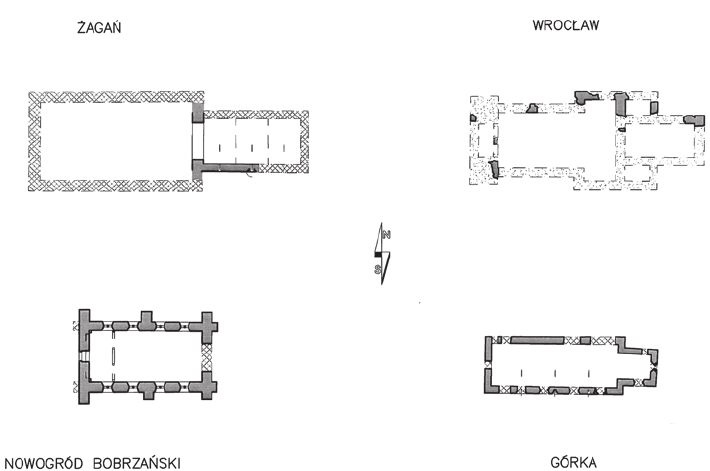
and two towers from the west, Fig. 4. Unfortunately, the
building has not survived until our times, however, the
fragments of stonework and sculptures which have been
preserved testify to the great scale and artistic skills of
these designs [2, pp. 195–198]; [4, pp. 360–376]; [8, pp.
34, 277]. In regards of the monastery, no original monas-
tic buildings, which must have been constructed mainly of
wood, have been preserved until today [11], [12], [7, pp.
81–84].
In the second half of the 12
th
century, stone Roman-
esque buildings were also erected in Górka. A small-
size structure built from granite slabs from Sobótka had
a square choir, adjoining an elongated rectangular, resi-
dential section from the east, Fig. 4; the material used
can testify not so much of the time when the structure
was built as of the same construction workshop as in the
case of Wrocław. In the following century, the structure
was completely adapted for ecclesiastical purposes, its
residential section was converted into the main body of
the building which was connected through a rood arch
opening with choir. It was possible as a residential sec-
tion with a tower and a porch was added from the west.
At that time in the 13
th
century, the church was also ex-
tended by adding a sacristy, and north aisle in the fol-
lowing medieval stage, in the 15
th
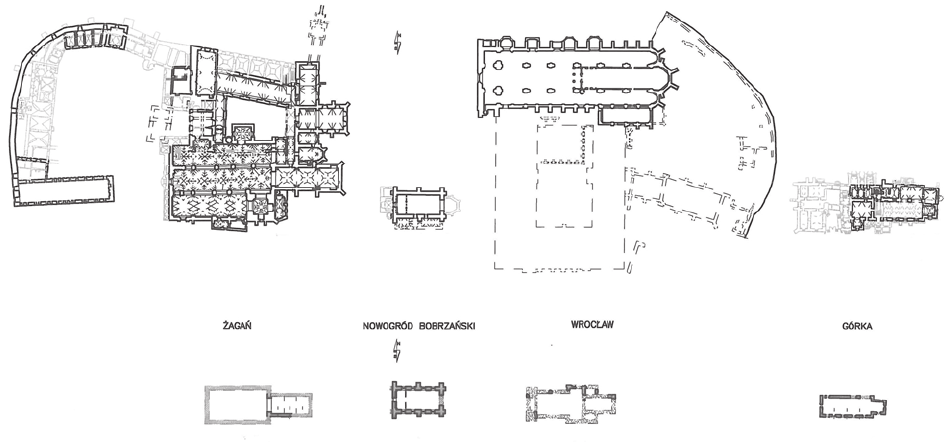
century, Fig. 5 [7, pp.
171–179].
In the 13
th
and 14
th
centuries, in connection with the
change of the function of the church and the role of lit-
urgy, the necessity of opening of the temple of the Order
of the Canons Regular of St. Augustine to the city and
laymen, and consequently in connection with the need
Fig. 4. Original form of monastic
churches (by the author on the
basis of research)
Monastic architecture in culture – monastic design as a specic type of ecclesiastical architecture exemplied by the monasteries... 23
for more space, around the middle of the 13
th
century, at
the latest in its second quarter, an extension of the mo-
nastic church in Wrocław began. It was an early Gothic
extension built with bricks which were already used at
the beginning of the 13
th
century in Silesia. The bricks
of unied size were laid in the same characteristic Flem-
ish double stretcher bond (monk bond). The rectangular
chancel with a diagonal buttress was added then from the
east; its remnants suggest that the chancel of the original
church was extended to the east by about 10 m in the clear
of the wall, Fig. 5 [7, pp. 76, 85–86], [4, pp. 360–376], [2,
pp. 195–198, Fig. 3]; [1, p. 274].
In the rst half of the 13
th
century, the monastic church
in Nowogród Bobrzański was built also from bricks laid
in Flemish double stretcher bond. This building could
originally be a single-aisled church or a bigger monastic
church was planned. Probably, out of the planned three-
aisled basilica with chancel, only the choir was built on an
elongated rectangular plan, which since the Middle Ages
was used as a nave. Its interior had vertical windows with
slightly pointed arches, Fig. 4 [7, pp. 241–244].
In the 1330s, in the place of the original church in
Wrocław, the construction of a new ecclesiastical struc-
ture began, however, its main body was not completed.
The building was also supposed to be a three-aisled struc-
ture but originally there was an idea to erect piers between
aisles exclusively with circular cross sections, spaced
from one another half the distance between existing pil-
lars. The works began from the west, from the porch, next
from the north-west side wall of north elevation and pil-
lars between aisles with at least ve bays, with the idea
of connecting them with the remains of the Romanesque
church [1, pp. 276–278], [7, pp. 89–90].
The works continued. However, around the middle
of the 14
th
century the plans to build a Gothic temple
changed a little. The spatial layout was changed by re-
moving every second pier, changing the remaining ones
from columns to pillars on an elongated octagon plan in
the direction of the east-west and by introducing a three
support vault with nine cells in the aisles, and stellar vault
in the nave. This is how the Gothic ecclesiastical struc-
ture, which is twice bigger than the Romanesque one and
with richer functional program, was constructed. This is
a three-aisled brick hall basilica – both the main body of
the church and the chancel. Its east part comprises three
apses, and the facade from the west has two towers, Fig. 5
[7, pp. 90–94].
At the beginning of the 15
th
century, during the con-
struction of the new temple in Wrocław or after construc-
tion of the church, the sacristy was built by the two east
bays of the south aisle. Probably a structure with ve bays
on an elongated rectangular plan was built from bricks
laid in Flemish bond. In the second half of the 15
th
cen-
tury, inside the 14
th
-century temple, the choir was built
from the middle of the hall of the Gothic church. A rood
screen could have been built in the place of earlier east
choir from the 3rd quarter of the 14
th
century. Most prob-
ably the parapets additionally separating the monastic
choir and the nave from the aisles come from that time
too; surely there were Gothic stalls along them. Since the
end of the 14
th
century chapels were added to the church
between buttresses from the north.
In the rst half of the 16
th
century, the extension of
the parish church in Żagań began. Like in Wrocław the
original church in Żagań was replaced with a bigger ec-
clesiastical structure. The construction of the temple con-
tinued over a few stages in the Middle Ages. Works began
from the east, extending rst the stone chancel, partly
adapting the walls of the original choir or extending the
original stone design. A bigger main body of the building,
already made from bricks, originally with a hall structure,
was added to the chancel from the west. The construction
of the nave, in the place of former one, began from the
north. As a result an aisle and a nave with pointed arch
windows and buttresses with offsets were built. A tower,
whose original height is unknown, was built in the south-
Fig. 5. Developments of medieval architecture of monastic buildings: reconstruction and preserved elements
(by the author on the basis of research)
24 Małgorzata Doroz-Turek
east corner. Construction work connected with the chan-
cel, the main body of the building and the tower continued
still in the second half of the 14
th
century, Fig. 5 [7, pp.
294–296].
At the turn of the 14
th
and 15
th
centuries, the construc-
tion of the church stopped; at that time three Gothic chap-
els were added to the ecclesiastical structure, two from the
north side of the church and one – porch from the south to
the tower at ground level.
After 1439, the tower, which had collapsed, was rebuilt
– at least from the level of the aisles of the main body of
the building upwards, in its present form of Gothic style.
The construction of the main body of the building
continued over the following medieval stage. In the 16
th
century, the main body of the building was extended and
the hall structure of basilica was replaced in two stages.
During the rst stage two bays of south aisle were built, in
the second stage – the construction continued with build-
ing west facade and then two bays of the three-aisled main
body of the building from the east adding them to the part
which was already constructed. The new part was built
with a taller nave, and the nave in the existing main body
of the building was lifted, creating a pseudo-basilica inte-
rior [7, pp. 296–301].
The constructions of the surveyed ecclesiastical struc-
tures were completed at different times. The Gothic tem-
ple in Wrocław was built in the 14
th
century and its con-
struction was completed already at the beginning of the
14
th
century, whereas the temple in Żagań was built in
stages – from the 14
th
until the 16
th
century.
After construction of the temple, which is the axis and
the main element of Silesian monasteries, the monastic
space assigned for the members of the order was devel-
oped.
The Canons who were at rst located in temporary
residential buildings e.g. rectory, like other orders, in or-
der to create a monastic community began the construc-
tion of proper monastery. The construction of monastic
buildings would begin after or during the construction
of the temple. Adjoining one of the longer sides of the
temple, the buildings, enclosed in a tetragon on a plan re-
sembling a rectangle, were constructed gradually. First,
the east wing, connected with the chancel of the church,
was built to the south (Wrocław) or to the north (Żagań),
then, parallel to the temple’s axis – north or south and
west wing, closing the sides of the garth.
As a rule, the basic monastic buildings were built
rst – such as chapter-house and dormitory, comprising
the east wing and refectory – in the south (Wrocław) or
west wing (Żagań). The chapter-house was built close to
the chancel, right behind the chapel – both in the original
monastery in Wrocław and in Żagań. The dormitory was
located upstairs in the east wing, a.o. above the chapter-
house. In time the abbot would move to separate quarters
or a separate building; such an abbot house was surely
constructed in Żagań, in the west wing. Later the monks
were also assigned separate cells which were located in
the annexed monastic buildings. In Wrocław, around the
14
th
/15
th
century, the monastery was extended to include
a part where dormitory was located, whereas in Żagań the
extension took place rst at the end of the 14
th
century
and then in the 15
th
century. Another important room was
refectory which was usually located in the south or north
wing, depending on the location of the monastic buildings
in relation to the church; in Wrocław the refectory was
located in from south-east and it was extended; in Żagań
Abbey, at rst there was only a winter refectory from
north-west, later also winter refectory – in west wing, in
the 14
th
and 16
th
centuries.
Important rooms shared by the Canons in the mon-
astery also include the places where the monks worked
such as scriptorium and the library located near it. Both
functions had their rooms both in Wrocław Abbey and in
Żagań, in east wings. They were built in the rst stages of
construction of the monasteries and extended in the fol-
lowing ones.
Furthermore, on the area of the clausura there was
a little monastic hospital – inrmary and internal school
connected with the activities conducted by the order; other
rooms included parlatory - locutory, workshops, treasury,
solitary, etc.
In Wrocław, most probably during the construction of
the church in the second half of the 12
th
century, some
monastic buildings were built from the south. However,
their specic form or layout is unknown; most probably,
they were made of wood.
The masonry part of the monastery was most prob-
ably constructed in the rst half of the 13
th
century, in
early Gothic stage. A cloister with buttresses was built
from bricks – rst laid in Flemish double stretcher bond
– most probably together with other buildings compris-
ing the wings around the garth; thus that brick bond was
in the lower sections of the cloister walls. At that time
the south wing building was constructed, which is evident
by the remnant of the wall – a section of north wall of
the structure located there whose function has not been
determined.
It is believed that the destroyed monastic buildings
were rebuilt in the second half of the 13
th
century and in
the rst half of the following century. The rebuilding in-
cluded the cloisters of the monastic garth; the walls of the
cloister in their upper section were rebuilt with bricks laid
in Flemish bond.
The rebuilding was connected with extension of the
monastic buildings which was conducted during the con-
struction of the Gothic temple as well as after its comple-
tion, in the following stages of that medieval stage. At that
time probably two structures comprising east wing were
built from bricks laid in Flemish bond. The preserved part
of that structure has a diagonal buttress in its north-east
corner and two straight buttresses by east wall. As regards
the function of that structure, its location in the monastery
layout and its architecture, most probably it was a chap-
ter-house.
South of the chapter-house another huge structure was
constructed; its west segment had basements and its east
single space segment which was the basements, whose
side walls have single straight buttresses and east wall
has diagonal buttresses in the corners; the structures were
built from bricks laid in Flemish bond. The function of
Monastic architecture in culture – monastic design as a specic type of ecclesiastical architecture exemplied by the monasteries... 25
the building, due to its prominent location and rich de-
tails, including traceries, is believed to be the monastic
refectory.
At the end of the 14
th
and in the 15
th
century, the monas-
tic complex was extended east to include facilities accom-
modating the needs of the order. These building activities
were connected with the construction of a structure that
most probably housed a dormitory; that building was con-
structed at the latest right after construction of the church.
During the same Gothic stage, a curtain-wall was built
to the north from the north-east buttress and the Gothic
river bank wall. The space between the curtain-wall and
the river bank wall is believed to have been developed in
the following Gothic stage: this included construction of
transverse walls with arches lled with Gothic bricks with
a frog made with ngers laid in Flemish bond. It appears
that these could have been utility rooms necessary for the
monastery to function.
It is believed that the structure housing bakeries and
the monastic brewery was built during the extension of
the monastery in the beginning of the 15
th
century. The
structure, located at the south-east corner of the Baroque
monastery, was built from Gothic bricks with a frog made
with ngers laid in Flemish bond. The brick headers in the
external face of the structure are glazed.
In Żagań, the following were built by the middle of the
14
th
century: chapel, sacristy, chapter-house and dormitory
above these rooms, comprising east wing and the abbot
house from the west as well as winter and summer refecto-
ries. Sacristy and chapter-house were located in the structure
of the preserved original stone stronghold, whereas the new
ones were built from bricks. It is also known that around the
middle of the 14
th
century a monastery school and library
with scriptorium operated by the monastery. Their locations
are, however, unknown; most probably they were located,
like later ones, in the east wing.
In the second half of the 14
th
century, at the end of
east wing, a structure was built for workshops, with base-
ment underneath used as a utility room, and upstairs bed-
rooms for the monks which were connected with the ex-
isting ones. Privy was located to the north of the monastic
complex by the moat. That structure, located in some dis-
tance, was connected with east wing. At this construction
stage a kitchen with hearth was built in west wing of the
monastery; a brick granary was also built to the west of
the church. A little later, most probably at the end of the
second half of the 14
th
century, north wing, enclosing the
four-sided garth in the form of a narrow south passage of
present north wing was constructed. In the second half of
the 14
th
century, the complex also had an operating physi-
cian room, bathroom and vestiary that might have been
located by the granary, in the place of present monastery
school wing.
In the rst half of the 15
th
century, the room in east
wing where chapter-house was previously located was en-
larged by addition from the east of a structure on a square-
like plan. A larger ground level room assumed the func-
tion of St. Ann Chapel that still exists today. Above St.
Ann Chapel, upstairs a library was organized.
Most probably at the beginning of the 15
th
century or
later at the turn of the 15
th
and 16
th
centuries, the area
west of the complex was leveled. After the area was lev-
eled a new structure was erected there or building with
chapter-house was adapted for the Canons. The brick
structure could have at least two or three stories and rich
architecture, which is indicated by the preserved Gothic
gable wall.
In the second half of the 15
th
century, the rebuilding
of the destroyed monastery continued. The vaults in St.
Ann Chapel and in the library were repaired and during
the rebuilding of the destroyed south part of east wing its
upstairs was rebuilt as taller in the form of a gallery open
to the chancel.
The structure which is preserved in the walls of ear-
lier monastery school, where probably the dormitory for
the monks was moved, is dated from the rst half of the
15
th
century: made of brick, annexed to the stone defen-
sive wall. Maybe that structure was built in two stages
during the medieval construction stage. At the turn of the
15
th
and 16
th
centuries, the interiors of common bedrooms
were divided into smaller separate cells. A school for nov-
ices was built and the old bathroom was converted into
a new palace of bishop or a new structure was built in the
place of former bathroom; its location was most probably
in the middle section of the monastery school. Most prob-
ably at the beginning of the 16
th
century, another leveling
of the area was conducted to the west of the complex.
Consequently, previous ground level became basements.
The summer refectory, located by the chapter-house, was
probably moved to today’s ground level. Between the two
refectories there was a corridor with a deep well. Further-
more, the leveling of the area enabled the consolidation
of all earlier structures with new ones to create west wing
connected at the level of today’s ground level of the clois-
ter. An enclosed internal monastic courtyard was designed
then too from the west.
Elements of architecture
From the middle of the 13
th
century, ribbed vaults
were used in the monastic buildings of the Canons Reg-
ular. Probably such a vault was introduced in the 13
th
-
-century cloisters in Wrocław monastery and it was used
in the cloister of the 14
th
-century monastery in Żagań.
In Żagań, the 14
th
-century vault has pointed arches and
its ribs have a single scotia molding. They were supported
on corbels with geometric or even organic form (heads).
The vault had bosses (Żagań). It is unknown what kind of
roong material was used in the Romanesque church on
Sand Island or in the original structure in Górka.
In the 14
th
and 15
th
centuries, along with the change in
form of churches to Gothic style, new vaults were intro-
duced. In the second half of the 14
th
century, vaults which
26 Małgorzata Doroz-Turek
were used included asymmetric vaults with three piers
(Wrocław) which comprised three bays with three ribs
in each bay, stellar vaults with diagonal ribs (Wrocław)
as well as, at the turn of the 15
th
and 16
th
centuries, net
ribbed vaults with three sections divided by ribs (Żagań).
A little later – stellar and net vaults based on a dome and
lunette construction was also used (Żagań).
The ribs in vaults with three piers are made of brick
segments going from stone bases, supported on sculp-
tured bosses (Wrocław).
The stellar vault has stone ribs supported on oral
and gural (Wrocław) or geometric corbels (Żagań). The
bosses on the vaults were circular: church (Wrocław) and
monastery (Żagań).
The ribs used in the analyzed examples of vaults in
the 14
th
century had double ogee molds (Wrocław), in
the following centuries and single or double scotia mold
(Żagań).
Basically two materials were used to build monastic
complexes: stone and brick, depending on the region and
time of construction. However, in regards of architectur-
al details, they were usually made of stone; in the 12
th
XII century, granite – lions from Ślęża Mt. (Górka), sand-
stone – Romanesque tympanum or granite – twin base
(Wrocław). Also in the 14
th
century, all architectural ele-
ments of decoration on elevations were made of stone,
like inside church (Wrocław), e.g. molded cornice of the
pedestal or buttress gablets.
The walls of the 12
th
and 13
th
century churches were
divided by windows: one window on the axis of east wall
of the chancel and windows on side elevations of the main
body of the building (Górka, Nowogród Bobrzański). Lat-
er churches had a much more extensive division of the
walls. Both inside and outside in the 14
th
, and later in the
15
th
century, the plane of the walls was divided by verti-
cal windows; outside this vertical articulation of the solid
was emphasized by buttresses. In the 13
th
century, the
buttresses braced around the main body of the structures,
were rectangular (Nowogród Bobrzański) but already in
the second half of that century diagonal buttresses ap-
peared (Wrocław, Żagań). The buttresses had one or two
offsets and they terminated above half of the height of the
elevations, below the roof line (Nowogród Bobrzański)
as well as with three offsets (Żagań). In the 14
th
century,
the buttresses had four offsets and shaped stone caps and
triangular gablets (Wrocław). The buttresses from the end
of the 15
th
century were also crowned with triangular gab-
lets but their form was already simple band projection of
the wall of the same thickness (Żagań). They had some
architectural detail in the form of horizontal division by
a small offset, made of bricks arranged as headers. Fur-
thermore, two of the buttresses feature blanks with point-
ed arches, framed with shaped ceramic sections; one of
the buttresses – rst from the west – does not have those
details.
The composition of the temple interior can be de-
scribed only on the basis of those Gothic structures which
have survived until today. The nave of the church opens
to the aisles with molded pointed arches by arcades on pil-
lars (Wrocław, Żagań), in Wrocław with at lesenes with
concave edges from the aisles. The ‘archaic’ division (into
two) of side bays by lesenes can be seen in south aisle,
whereas in north aisle, where there are no lesenes, the
division was made by repetition of colors and texture of
bricks. Apart from the vertical division there is also a hor-
izontal division into two sections introduced by geometric
corbels (Żagań – chancel), or gural and oral with full
gural sculptures of apostles and prophets (Wrocław);
these sculptures were placed in the upper half of the pil-
lars from the side of the nave; from the side of the aisles
they are placed on consoles.
The most exquisite elements of the buildings include
church portals. The oldest portals in Silesian temples
of the Canons, these from the 12
th
century, had simple
forms (Górka), but the main entrance portal with sim-
ple closure was crowned with the foundation tympanum
(Wrocław). Later portals from the 14
th
and 15
th
centuries
have pointed arches with richly molded jambs and sculp-
tural decorations (Wrocław, Żagań). The elongated open-
ings have jambs with roll moldings, double ogees and
scotias (Wrocław). The main portal is crowned with a tall
Gothic ornate gable with crockets and lials; the eld of
the Gothic ornate gable is lled with a bland tracery with
motifs of mouchettes and quatrefoils; the portal also fea-
tures sculptural decorations.
The south portal, framing former passage from the
church to the monastic cloisters from south aisle is a lit-
tle less exquisite. The roll moldings, double ogees and
scotias, going from the offset pedestal, have a section of
gural and oral low reliefs on the impost frieze, between
which there are small gures of prophets with long robes
and banderols, two on each side.
The side, north entrance, Gothic portal is simpler than
the main and south portals. Like west and south portals,
this portal has no sculptured decorations. Two portals
crowned with pointed arches connected with the construc-
tion of sacristy are a little younger; one of them connects
south aisle with sacristy, the other connects sacristy with
east wing of the monastery. First of them is framed with
a molded jamb made of stone slabs placed on low rectan-
gular pedestal. The mold consists of a double ogee, scotias
and cuts emerging from an interesting ‘organic’ form.
Few original windows have survived until today. The
12
th
-century Romanesque windows include two rem-
nants, both with stone framing made of granite slabs and
crowned with a semicircular arch, splayed on both sides
(Górka) and a remnant of a semicircularly crowned brick
window, (Żagań).
The only original fragments of Gothic windows in-
clude the shape of pointed arches in Nowogród Bobrzańsk
and traces of windows crowned with pointed arches on the
wall in Żagań. There is only one small window crowned
with pointed arch and tracery in the passage between
chancel and chapel in the monastery and a rich Gothic
brick detail in the gable wall, in the attic space of west
wing (Żagań).
Most medieval windows with the 14
th
century mostly
original tracery decorations have survived in Wrocław.
The two and three light windows with pointed arches,
splayed on both sides have rich tracery decorations made
Monastic architecture in culture – monastic design as a specic type of ecclesiastical architecture exemplied by the monasteries... 27
of stone. The traceries have four forms: qarterfoil, trefoil,
mouchettes and a combination of trefoils and mouchettes.
The tracery mullions divide the window vertically into
three lights or two lights in the chancel.
In general very few architectural details have been
preserved in the monastic complexes, but their existing
remains demonstrate that their form was elaborate. Apart
from the above-mentioned portal, connecting the church
with original cloisters, the portal connecting sacristy with
the rooms in east wing of the monastery was connected
with the monastery in Wrocław. The portal is crowned with
a pointed arch, has more elaborate jambs placed on pedes-
tals, interwoven in corners and a keystone. Furthermore,
the details included a fragment of the column uncovered
in the south-east corner of the garth, that is the wall col-
umn base and shaft drum made of sandstone; the detail is
believed to have been made in the early-Gothic stage. The
column with hexagonal sandstone base and green serpen-
tinite shaft, which was found in the modern excavation
made during research within east cloister, probably comes
from the same time or the following Gothic period. Be-
tween the buttresses in the garth walls there are cavities
below windows splayed from the side of the cloister, also
from the side of the garth. Furthermore, one of the mo-
nastic buildings, whose remains were discovered on the
island, features double walled-up window openings with
splayed reveals on both sides and low parapets, with some
remains of sandstone traceries.
In Żagań, a portal with pointed arch, or actually its
remnant, has been preserved in the passage between the
chancel and the chapel. Above the door opening, an old
walled-up passage with pointed arch was uncovered.
A well preserved detail of exceptionally rich Gothic ga-
ble in the attic space comes most probably from medieval
times. The Flemish brick bond wall is crowned with a tri-
angular gable with numerous window openings, molded
brick framing and decorated traceries. In the same place,
in north-east corner, a decorated brick chimney has been
preserved in the form of a rounded shaft with pilasters
crowned with volutes with a molded cap.
General notes
The preserved monastic buildings are the creation of
humankind and they develop the cultural landscape that
preserves the achievements of people who lived there
in the past. The monastic complexes that have survived
for centuries, as material legacy of the society, are the
landmarks of a given region and have been listed in the
register of monuments and are protected by the City or
Province Conservator of Listed Monuments in order to
assure their proper protection. On the commission of the
Conservator of Listed Monuments, or within the scope
of the authors own research, the monastic complexes and
their fragments are surveyed and their drawings are made
in order to document the various condition of the build-
ings of their remains. The detailed measurements and
drawings made during research of the history of monastic
complexes e.g. of architectural details and their dating are
the basis of analyses of other buildings. Furthermore, the
measurement documentation is sometimes the only trace
of the construction elements which are discovered after
many years and, unlike reconstructions which sometimes
change original designs, is permanent scientic research.
The surveys which have been conducted can also in the
future become basis of conservation projects and any ren-
ovation work conducted on the area of monasteries.
On the basis of research conducted by the author of
monastic complexes of the Canons Regular of St. Au-
gustine in Silesia, described in the doctoral dissertation
[7], a few polemical comments to the publications by re-
searchers of the complexes covered in the dissertation can
be presented; the comments regard primarily the dating of
the structures.
In regards to the monastic complex in Górka, research-
ers distinguish only one medieval construction stage, the
following activities supposedly took place in modern
times [14, p. 62], [16, pp. 694–695], [9].
Research conducted by the author indicates that be-
tween the rst Romanesque stage and the next one, which
is described in the literature on the subject [7, pp. 161–168]
to have taken place only in the 16
th
century, there were at
least two, or possibly three, more medieval construction
stages. Dated back to the rst half of the 13
th
century, the
complex could be built already in the second half of the
12
th
century. In the 13
th
century, sacristy was annexed to
the chancel; in the 15
th
century, an aisle was annexed to
the main body of the building. Still in late Gothic, at the
latest at the beginning of the 16
th
century, the complex
was extended to include basements, also under the former
porch.
In regards to the monastic complex in Wrocław, there
are no common construction stages of the church and the
monastery. Olgierd Czerner researching the complex [4,
p. 360–366]; [2, pp. 195–198, Fig. 3]; [1, p. 274] dates the
church separately, whereas Jerzy Romanow on the basis
of this research dates the monastery separately [11], [12].
Research conducted by the author enabled the formula-
tion of a hypothesis that the monastic complex was built
in three medieval construction stages, further divided into
separate stages. Apart from the original, Romanesque
stage of the church construction, Czerner put forward
a hypothesis of an early-Gothic stage and two Gothic
stages of the construction of that temple. It was possible
then to distinguish, after the Romanesque stage, an early
Gothic, and after that a Gothic stage, further divided into
three stages of the extension of the monastic complex.
In regards to the monastic complex in Nowogród
Bobrzański, the literature on the subject presents contra-
dictory hypotheses as to the original shape and changes in
the architecture of the complex. The author distinguished
two medieval construction stages. It is possible that in the
rst half of the 13
th
century a small, single space monas-
28 Małgorzata Doroz-Turek
tic church was build on a rectangular plan from bricks
laid in monk bond but it is also possible, as suggested by
Stanisław Kowalski, that originally only part of its three-
aisled design was executed, namely the chancel which is
located within the walls of present main body of the build-
ing [10, pp. 11–19]. There is, however, no research or hy-
potheses regarding the monastery. The author supposes
that in the Middle Ages an addition, which is known from
the 19
th
-century survey drawings, was annexed from the
south. Apart from that other monastic buildings must have
been constructed then too. It is possible that the structure
adjoining the temple in the Middle Ages was built in the
place of present rectory. Archival sources indicate that at
the turn of the 15
th
and 16
th
centuries an abbot house was
built in Nowogród Bobrzański.
Researchers date the construction of the Gothic church
in Żagań back to three Gothic stages, taking into account
the construction of the main body of the building only in
two stages. North aisle and south aisle with its east part
and the tower which greatly differ are believed to have
been built in the same stage. The chapels, which were
built in different periods, were supposedly built in those
stages too. Research conducted in situ demonstrated that
the church was built in at least four Gothic construction
stages, its main body in three. The medieval monastic
structures were built along with the church. Individual
parts, whose number, as demonstrated in research, was
greater than that presented in the literature on the sub-
ject, were added in the following construction stages, over
a few centuries – 14
th
–16
th
.
References
[1] Czerner O., Znalazłem tylko dwa kręgi. O starszej fazie budowy goty-
ckiego kościoła Najświętszej Marii Panny na Piasku we Wrocławiu,
[in:] Nie tylko zamki – szkice oarowane Profesorowi Jerzemu
Rozpędowskiemu w siedemdziesiątą piątą rocznicę urodzin, Wrocław
2005, pp. 273–278.
[2] Czerner O., Resztki romańskiego kościoła pw. Panny Marii we
Wrocławiu, [in:] Śląsk około roku 1000, Wrocław 2000, pp. 195–
198.
[3] Czerner O., Chór kapłański i lektorium kościoła NP. Marii na Piasku
we Wrocławiu w X i XIX wieku, [in:] Kwartalnik Architektury i Ur-
banistyki 1965, z. 3–4, pp. 181–205.
[4] Czerner O., Studia nad romańską i gotycką architekturą kościoła
Najświętszej Marii Panny na Piasku we Wrocławiu, [in:] Biuletyn
Historii Sztuki 1962, R. 24, z. 3–4, pp. 360–376.
[5] Człowiek średniowiecza, edited by Le Goff Jacques, translated by
M. Radożycka-Padelti, Warsaw 1996, p. 53.
[6] Derwich M., Monastycyzm w dawnych społeczeństwach europejskich,
Zarys problematyki, [in:] Klasztor w społeczeństwie średniowiecznym
i nowożytnym, M. Derwich, A. Pobóg-Lenartowicz (eds.), Opole 1996,
pp. 43–53.
[7] Doroz-Turek M., Średniowieczna architektura klasztorna kanoni-
ków regularnych św. Augustyna na Śląsku, doctoral dissertation,
Wrocław University of Technology, Faculty of Architecture, Wrocław
2009.
[8] Małachowicz E., Wrocław na wyspach. Rozwój urbanistyczny i ar-
chitektoniczny, Wrocław 1992, pp. 34, 277.
[9] Karta Ewidencyjna Zabytków Architektury i Budownictwa: Zespół
Klasztoru Augustianów, Sobótka–Górka. The card was made by
B. Adamska in July 2000.
[10] Klasztor Augustianów w Żaganiu, zarys dziejów, S. Kowalski (ed.),
Żary 1999.
[11] Romanow J., Romanow M., Opactwo kanoników regularnych św.
Augustyna na Piasku we Wrocławiu w świetle badań archeolo-
gicznych, [in:] Średniowieczne i nowożytne nekropolie Wrocławia,
R. Wachowski (ed.), Wrocław 2008.
[12] Romanow J., Klasztor NM Panny na Piasku we Wrocławiu, Badania
archeologiczne w latach 1982–1986, Wrocław. Maszynopis w archi-
wum PSOZ we Wrocławiu, 1987.
[13] Pobóg-Lenartowicz A., A czyny ich były liczne i godne pamięci: konwent
klasztoru kanoników regularnych NMP we Wrocławiu do początku
XVI w., University of Opole, Faculty of Theology, Series: From the
History of Christian Culture in Silesia, No. 40, Opole 2007.
[14] Pobóg-Lenartowicz A., Kanonicy regularni na Śląsku: życie kon-
wentów w śląskich klasztorach kanoników regularnych w śred nio-
wie czu, University of Opole, Opole 1999, pp. 45, 62.
[15] Świechowski Z., Architektura do połowy XIII wieku na Śląsku,
Warsaw 1955, Figs. 472–534, pp. 12–13, 62–63, 78–79, 80–87.
[16] Sztuka polska, przedromańska i romańska do schyłku XIII w.,
M. Walicki (ed.), PWN, 1971, pp. 694–695.
Architektura monastyczna w kulturze – zespół klasztorny jako specyczny typ architektury sakralnej
na przykładzie klasztorów zakonu kanoników regularnych św. Augustyna na Śląsku
W artykule przedstawiono znaczenie architektury monastycznej
w kulturze na podstawie części zamykającej pracę doktorską pt.
Średniowieczna architektura klasztorna kanoników regularnych św. Au-
gustyna na Śląsku, napisanej na Wydziale Architektury Politechniki
Wrocławskiej (pod kierunkiem prof. Ewy Łużynieckiej). Świadectwo
dorobku kulturowego ukazano na tle zespołów klasztornych kanoników
regularnych św. Augustyna na Śląsku i wyników badań architektonicznych
spisanych w oparciu o wyniki prac badawczych w latach 2003–2008 na
czterech założeniach.
Zachowane założenia klasztorne są wytworem ludzkim składającym
się na krajobraz kulturowy, który przechowuje świadectwo działalności
jego dawnych mieszkańców. Obiekty klasztorne które przetrwały wieki,
jako materialny dorobek społeczeństwa będący znakiem tożsamości
danego regionu, zostały wpisane do rejestru zabytków i są pod opieką
Miejskiego albo Wojewódzkiego konserwatora zabytków w celu
zapewnienia im odpowiedniej ochrony. Na zlecenie konserwatora za-
bytków bądź w ramach autorskich prac są wykonywane badania wraz
z inwentaryzacyjnymi rysunkami budowli i ich fragmentów, mające na
celu udokumentowanie znajdujących się w różnej kondycji obiektów
czy pozostałości po nich. Wykonywane podczas badania historii założeń
architektonicznych, drobiazgowe pomiary i rysunki, np. detali archi-
tektonicznych i ich datowanie są podstawą do analiz innych obiektów.
Oprócz tego dokumentacja pomiarowa jest czasami po wielu latach jedyną
pozostałością odkrywanych elementów i w odróżnieniu od zmienianych
niekiedy rekonstrukcji jest elementem stałym opracowania naukowego.
Wykonane inwentaryzacje mogą być także w przyszłości podstawą
projektów konserwatorskich oraz wszelkich prac rewaloryzacyjnych
prowadzonych na terenie klasztorów.
Key words: Silesia, monastic architecture, order of the Canon Regular
of St. Augustine
Słowa kluczowe: Śląsk, architektura monastyczna, kanonicy regularni
św. Augustyna