
2026
2(86)
DOI: 10.37190/arc260209
© by the Author/Authors. Licensee WUST.
Published in open access. CC BY-NC license.
Abstract
Public art is an established instrument of urban planning, serving placemaking, the humanisation of space and destination marketing. This article
examines one design strategy within contemporary monumental sculpture: the multiplication of spatial forms, understood as the deliberate replication
of modular compositional elements to achieve aesthetic, perceptual and functional eects. Written from within the practice, it reects on realised pub-
lic commissions by Mirosław Struzik – Dandelions (Dubai, 2017), Bubble Trees in the Clouds (College Station, 2025) and Jellysh Shrub (Taiwan,
2024) – together with two photovoltaic sculpture concepts, Solar Butteries (2012) and Solar Poplars (2022). The analysis situates the strategy at
the intersection of the serial logic of modern sculpture and research on the biophilic appeal of repeated organic form, and identies three operative
mechanisms: the scaling of natural motifs, fractal modular replication, and perceptual multiplication through reective surroundings. The constraints,
reception and risks specic to monumental public commissions are also discussed. The trajectory of the works indicates an evolution from purely
aesthetic applications towards sculptures integrating utilitarian, energy-generating functions.
Key words: public art, monumental sculpture, multiplication of forms, modularity, agrivoltaics, placemaking
Introduction
Art plays an important role in urban planning and ar-
chitectural design processes, and many artists specialise in
creating and realising works for public spaces (CODAworx
2025; Frazier Britt 2014; UNESCO 2024; Polat, Gökçen
2022). The integration of art into urban and architectural
projects – new developments, renovations, green space de-
sign, spatial development plans – is a recognised and stan-
dardised practice in public policies worldwide, implement-
ed through programmes such as “Percent for Art” (Polat,
Gökçen 2022).
Among the objectives pursued through investment in
works of art and the involvement of artists in design pro-
Design philosophy
Mirosław Struzik*, Jakub Skowron**
Multiplication of forms in contemporary monumental sculpture
cesses at early stages, the following should be noted: place-
making, i.e., the creation of a unique character of place, the
building of identity and landmarks, and of natural meeting
points; the humanisation of space, consisting in the trans-
formation of sterile environments into spaces conducive to
social interaction and user well-being (Mikuni et al. 2024;
Trupp et al. 2025); the improvement of the aesthetics of the
surroundings; and the marketing function – the generation
of measurable ROI through tourism, social media and place
branding, where sculptures serve as attractions in destina-
tion marketing strategies (McClimon 2023).
Experience from the realisation of projects in public spaces
across diverse cultural contexts demonstrates that a well-con-
ceived and well-executed sculpture can full these objec-
tives and more, often introducing additional, po sitive and un-
expected eects at the site of installation (CODAworx 2025;
Polat, Gökçen 2022).
One of the signicant phenomena within contemporary
monumental sculpture is the multiplication of spatial forms
* ORCID: 0009-0006-1720-9371. Struzik Art, Ltd., e-mail: ms@
struzik-art.com
** ORCID: 0009-0003-3436-1007. Faculty of Philology, Universi-
ty of Opole, Poland.
104 Mirosław Struzik, Jakub Skowron
– the deliberate replication of modular compositional ele-
ments in order to achieve specic aesthetic, perceptual and
functional eects.
The serial arrangement of repeated modules is not, in it-
self, new to sculpture; it carries a substantial theoretical gene-
alogy. In her account of modern sculpture, Rosalind Krauss
showed how the serial progression of identical, mass-repli-
cable units displaces the traditional hierarchical, centre-fo-
cused composition, denying any single internally dictated
point of focus (Krauss 1977). Her subsequent reading of the
grid identied regulated repetition as a structure that implies
continuation beyond its own boundaries, presenting the vis-
ible work as a fragment of a larger, potentially innite eld
(Krauss 1979). The works discussed here extend this logic
out of the gallery and into public space, where replication
operates at architectural scale. A second and complementary
body of research concerns why such patterns are perceived
as pleasing: studies in the perception of fractal and nature-de-
rived patterns report a consistent aesthetic preference for the
scale-invariant, repeating structures characteristic of natural
forms, and associate exposure to them with measurable re-
ductions in physiological stress (Taylor 2006; Spehar, Taylor
2013). The intersection of these two lines of enquiry – the
serial logic of modern sculpture on one side, the biophilic
appeal of repeated organic form on the other – provides the
conceptual ground for the strategy examined below.
This article presents an analysis of that strategy draw-
ing on the work of Mirosław Struzik, who for over
twenty
years has been realising monumental stainless-steel instal-
lations with RGB lighting for public spaces around the
world. Although written in the third person, it is an account
from within the practice rather than external critical com-
mentary: the works analysed are the author’s own, and the
text sets out the design reasoning behind them. It is oered
as a reection on practice, not as an empirical study; its
method is correspondingly the retrospective analysis of
completed commissions, examining the formal, spatial and
functional decisions that recur across them.
The author
Mirosław Struzik was born in 1956 in Żarów, Poland. In
1989 he graduated from the Academy of Fine Arts in Wro-
cław, in the Faculty of Graphics, Painting and Sculpture, spe-
cialising in sculpture, with the degree of Master of Fine Arts.
Be
fore completing his studies, he had already worked for
eight years in design studios, where he was granted seve ral
invention patents; he also studied industrial design. He now
creates sculpture primarily for public space. In 2005 he re-
ceived the Sugarman Foundation Award (USA). In 2020 he
was named one of CODAworx’s “25 Creative Revolutiona ries”
and received a Platinum A’ Design Award in the Arts, Crafts
and Ready-Made Design category for his Bubble Forest.
Design and implementation method
Struzik’s method begins with the direct study of nature,
and specically with the observable structures in the ora of
the surrounding environment, which he documents exten-
sively through macro photography. These observations are
transposed into an organic, abstract idiom and worked up as
scale models. The physical maquettes are then 3D-scanned,
after which development continues in the digital domain: the
resulting models are placed within three-dimensional recon-
structions of the actual sites for which the works are intend-
ed – either supplied by the architects working for the client,
or built from scratch by the artist’s team. Within these site
models, realistic lighting simulations are produced in order
to design the lighting systems and their control programs.
Photorealistic renderings, both still images and video, are
prepared with accurate lighting simulation and discussed
with the client. Only once these are approved does the team
proceed to fabrication, always in coordination with struc-
tural engineers, electronics engineers, lighting spe cialists
and architects. The process is correspondingly com plex, de-
manding the coordination of large, multidiscipli nary teams.
Finished works are shipped to the client in parts – frequent-
ly in forty-foot sea containers – and assembled and installed
on site, either by the STRUZIK ART LTD team or by spe-
cialist workers engaged locally.
Selected realisations
Dandelions – Burj Khalifa, Dubai, United Arab
Emirates, 2017
The Dandelions concept originated in 2013 on the oc-
casion of the realisation of an outdoor sculpture in front of
a corporate client’s headquarters. This work was included on
CODAworx’s TOP 100 public art list for 2013. Subsequent
iterations of the concept gained international recognition,
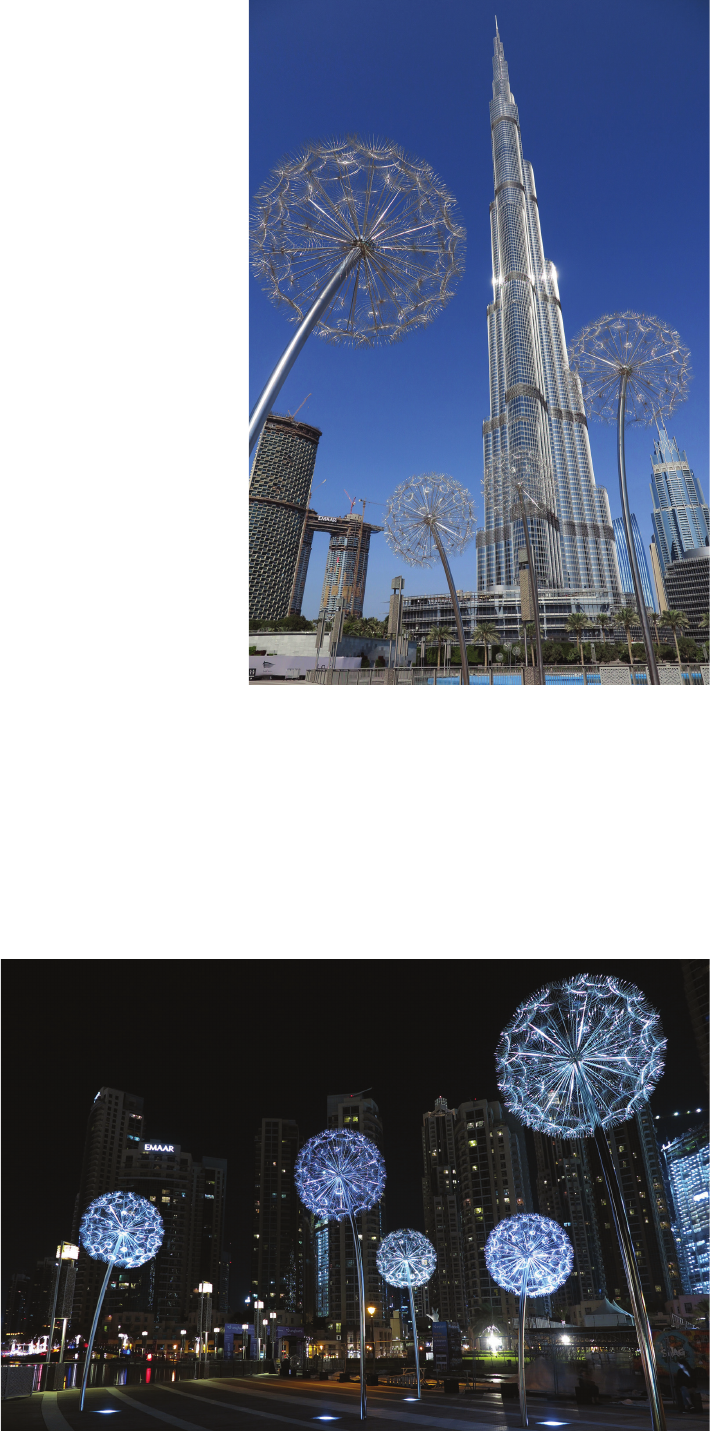
resulting in a commission from Emaar (2017) for a set of 14
elements complete with lighting and installation services for
the public space adjacent to the Burj Khalifa tower in Dubai
(Struzik 2017) (Figs. 1, 2). The sculpture was fabricated and
installed on site by the STRUZIK ART team.
The spatial relationship between sculpture and architec-
ture was based on the principle of contrast harmony: the
linear geometry of the surroundings was juxtaposed with
the curved forms of organic abstraction. The scaling of
plant motifs from the micro to the macro scale produces an
eect of cognitive surprise – a transposition of the observer
into an altered scale of perception. The dandelion head it-
self was generated through serial replication: a single mod-
ule – a seed with its pappus – is repeated to produce the
recognisable form of the whole.
Bubble Trees in the Clouds
– ILCB, Texas A&M University, College Station,
Texas, 2025
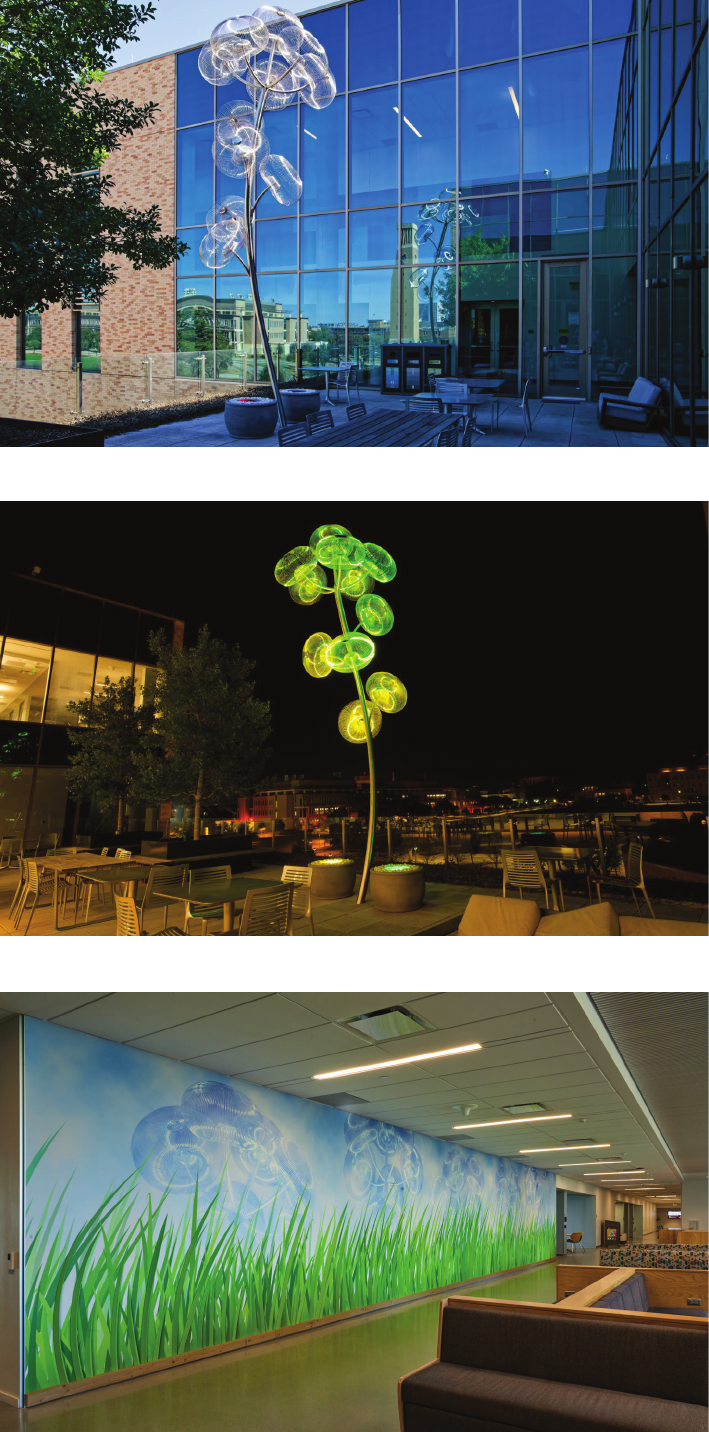
The Bubble Trees in the Clouds installation was com-
missioned by Texas A&M University and comprises a steel
sculpture on the terrace of the Interdisciplinary Life Scienc-
es Building (ILCB) together with a wall-mounted installa-
tion inside the building. Both are based on a concept devel-
oped during the creation of the Bubble Forest sculpture of
2019 (Struzik 2019). It is a unique composition in which
the exterior sculpture is complemented by a wall element
visible in the background behind the glazing (Figs. 3–5).
Multiplication of forms in contemporary monumental sculpture 105
Fig. 1. Dandelions, 2017, Burj Khalifa, Dubai, daytime view
(photo by M. Struzik)
Il. 1. Dandelions, 2017, Burj Khalifa, Dubaj, widok dzienny (fot. M. Struzik)
The contrast harmony between the organic morphology
of the sculpture and the simple geometry of the architecture
is here reinforced by the visual reduplication of the form in
the repeated reections across the glass façades surround-
ing the terrace. The same modular repetition governs both
the free-standing terrace sculpture and the graphic element
on the interior wall. In the sculpture it takes the form of
eleven recurring bubble structures, while on the wall the
motif is reproduced in graphic form.
Jellyfish Shrub
– Academia Sinica Campus South,
Tainan, Taiwan, 2024
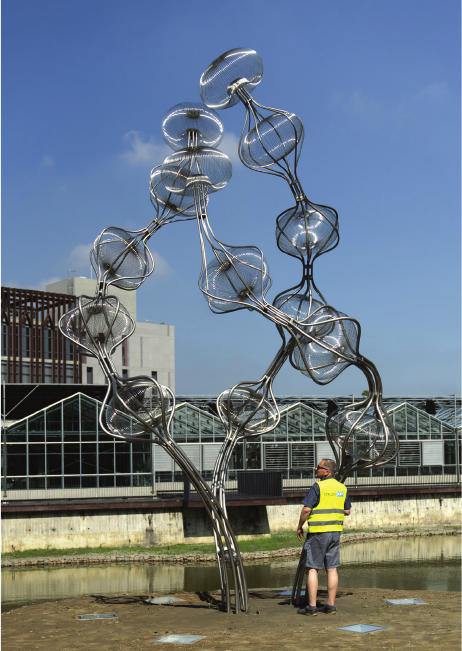
Jellysh Shrub is a realisation commissioned by Aca de-
mia Sinica, Taiwan’s foremost research institution (Stru-
zik 2024). The project was designed specically for a site
adjacent to a plant biology research centre, where experi-
mental greenhouses and a body of water are situated. The
form of the sculpture references the process of photo-
synthesis and is inspired by the production of oxygen by
plants, including aquatic species. The concept unites art
and science in the context of the biological sciences depart-
ment (Figs. 6–8).
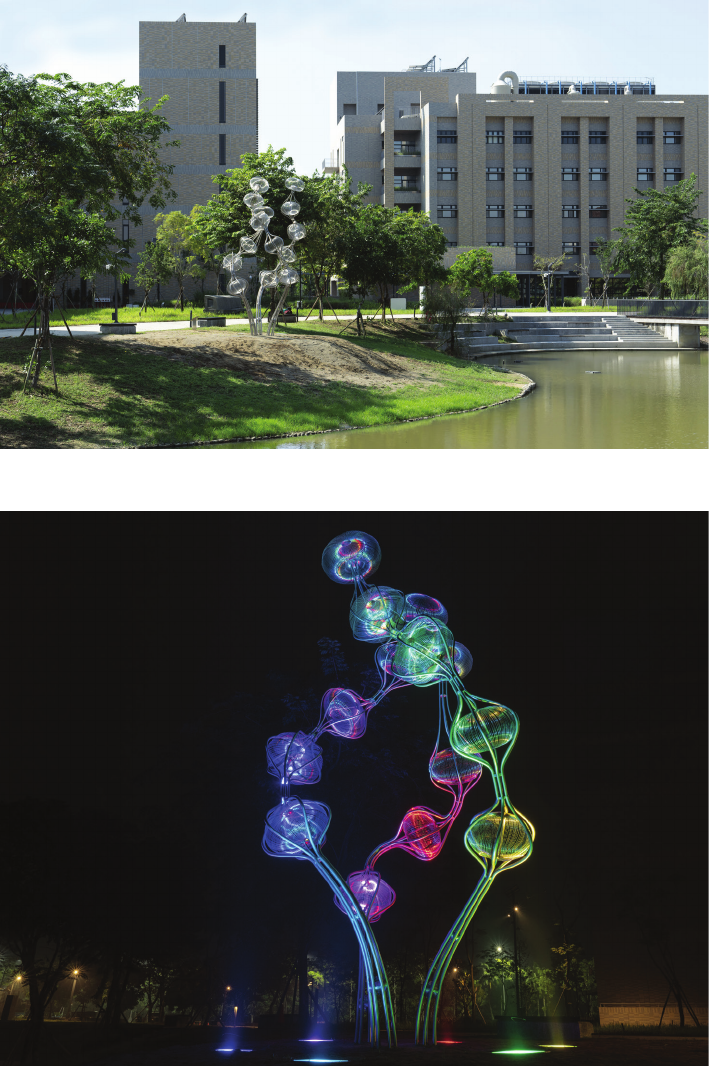
The compositional eect is enhanced by a dynamic RGB
lighting system that transforms the static sculpture into
a dynamic spectacle after sunset. The same modular princi-
ple governs the work – the bubble form recurs throughout
the sculpture – but here it also operates in the relationship
between the installation and its surroundings. This is par-
ticularly evident at night, when the illuminated sculpture is
reected in the glass walls of the surrounding greenhouses
and in the surface of the water.
Photovoltaic sculpture concepts
The combination of art and technology opens up pos-
sibilities for exploring serial composition through sculp-
Fig. 2. Dandelions, 2017,
Burj Khalifa, Dubai,
nighttime view
(photo by M. Struzik)
Il. 2. Dandelions, 2017,
Burj Khalifa, Dubaj,
widok nocny
(fot. M. Struzik)
tures that serve extra-artistic functions. The integration
of photovoltaic cells into the structure of the work creates
modular agrivoltaic installations capable of powering their
own lighting or generating energy for the surrounding area.
106 Mirosław Struzik, Jakub Skowron
Fig. 3. Bubble Trees in the Clouds,
2025, ILCB, Texas A&M University,
College Station, TX,
daytime view
(photo by M. Struzik)
Il. 3. Bubble Trees in the Clouds,
2025, ILCB, Texas A&M University,
College Station, Teksas,
widok dzienny (fot. M. Struzik)
Fig. 5. Bubble Trees in the Clouds,
2025, ILCB, Texas A&M University,
College Station, TX,
wall art part of the installation
(photo by M. Struzik)
Il. 5. Bubble Trees in the Clouds,
2025, ILCB, Texas A&M University,
College Station, Teksas,
element naścienny instalacji
(fot. M. Struzik)
Fig. 4. Bubble Trees in the Clouds,
2025, ILCB, Texas A&M University,
College Station, TX,
nighttime view
(photo by M. Struzik)
Il. 4. Bubble Trees in the Clouds,
2025, ILCB, Texas A&M University,
College Station, Teksas,
widok nocny
(fot. M. Struzik)
Multiplication of forms in contemporary monumental sculpture 107
Fig. 6. Jellyfish Shrub, 2024, Academia Sinica Campus South, Tainan,
daytime view (photo by J. Skowron)
Il. 6. Jellyfish Shrub, 2024, Academia Sinica Campus South, Tainan,
widok dzienny (fot. J. Skowron)
Photovoltaic sculptures demonstrate that green energy can
contribute to an attractive urban landscape, oering alterna-
tives to conventional rooftop panels. Installations designed
in the spirit of agrivoltaics can support water retention in
the soil and the biodiversity of ora and fauna by limiting
the exposure of the ground to direct radiation.
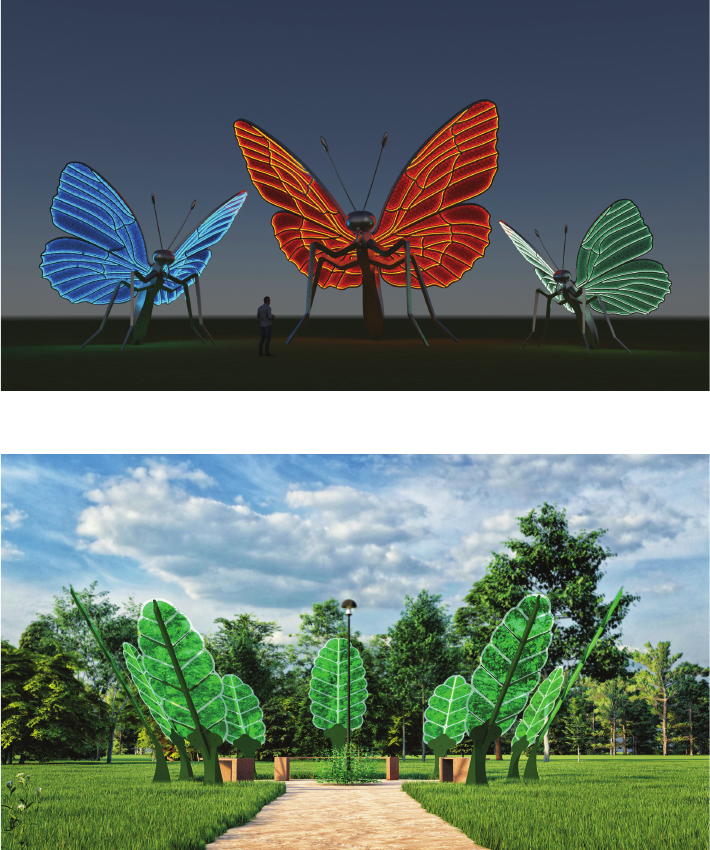
• Solar Butterflies, 2012
Solar Butteries is a modular, innitely repeatable sculp -
ture project developed by Mirosław Struzik, Tadeusz Zdano-
wicz and Tomasz Pultowicz. The project was created as part
of a competition for the revitalisation of former port areas in
New York and was subsequently developed to the stage of
a commercial product ready for implementation. The con-
cept envisages deployment either as a single element or as
a fractal composition scaling to larger areas. As a product
of this type, Solar Butteries is designed for installation in
larger groups, where the repeated form creates the eect of
a ock of butteries. The project was recognised at the Land
Art Generator Initiative 2012 competition (Land Art Gener-
ator Initiative 2012) (Fig. 9).
• Solar Poplars, 2022
Solar Poplars is a product line concept for photovoltaic
panels inspired by the morphology of the poplar tree, de-
veloped in collaboration with ASCA and JBG by Mirosław
Struzik, Jakub Skowron, Has Hermann Issa and Olivier
Portier. The system constitutes a discreet agrivoltaic in-
stallation ready for deployment, which can be incorporat-
ed into existing urban energy systems and serve practical
functions (enhancing biodiversity, noise attenuation) as
well as educational and informational ones – presenting to
the public new possibilities for the application of photovol-
taic solutions in ways that do not compromise the aesthet-
ics of the urban fabric. Solar Poplars was conceived for
mass installations, where groups of repeated modules form
a solar forest. The project was recognised at the Land Art
Generator Initiative 2022 competition (Land Art Generator
Initiative 2023) (Fig. 10).
Limitations, criticism and risk
A reection written by the author of the works it discuss-
es cannot claim full critical distance, and none is asserted
here. It is nonetheless possible – and, for an honest account
of the practice, necessary – to set out the constraints, haz-
ards and points of friction that condition monumental pub-
lic sculpture, independently of any aesthetic judgement of
the individual works.
Constraints
Large-scale public installations are realised inside a dense
framework of regulation and physical limitation. Legal and
administrative requirements are frequently demanding:
contracting with a public authority in the United States,
for example, may require a foreign company rst to obtain
a Certicate of Authority to Transact Business in the rele-
vant state – a registration granted only after rigorous pro-
cedures before the state corporation commission, a require-
ment the author encountered when contracting with a public
client in Virginia. Projects involving cast foundations in
the ground typically require a building permit. Structural
codes vary sharply by location: some jurisdictions (Taiwan
among them) prescribe the wind speeds a sculpture must
withstand, others the seismic forces it must resist. Dura-
bility requirements form a further category of constraint:
clients frequently demand that a sculpture withstand harsh
atmospheric conditions, and contracts often stipulate that
the work must retain its original appearance for a minimum
of twenty years. The author’s response to this requirement
is material: the most durable materials available are used,
which in the majority of his sculptures means 316L stainless
steel. Proximity to airports brings strict limits on upward-di-
rected lighting. Pedestrian circulation must always be ac-
counted for – the Dubai Dandelions, for instance, stand in
a setting through which some ninety-four million visitors
pass each year – which in turn dictates that sharp edges be
kept above reach and that forms be shaped so as not to invite
climbing. These constraints are not incidental: they shape
the work from the concept stage onward.
Reception
Public art always carries the risk of adverse public recep-
tion. In the present practice no serious criticism of this kind
108 Mirosław Struzik, Jakub Skowron
Fig. 8. Jellyfish Shrub, 2024,
Academia Sinica Campus South,
Tainan, nighttime view
(photo by J. Skowron)
Il. 8. Jellyfish Shrub, 2024,
Academia Sinica Campus South,
Tainan, widok nocny
(fot. J. Skowron)
has been encountered, a circumstance the author attributes
less to chance than to a deliberate choice of subject matter:
the works draw on universal natural motifs – ora, growth,
light – that are legible and positively received across cultur-
al contexts, and they deliberately avoid contentious themes.
This is a curatorial position rather than an avoidance of dif-
culty, and it is consistent with the placemaking objectives
set out at the outset.
Risk
Two principal sources of risk attend monumental public
commissions. The rst is engineering risk: the possibility
that an artistic vision expressed in sketches proves impos-
sible to realise as drawn – because the structure would not
stand, or because of the limits of available technology – so
that concept and feasibility must be reconciled through
close work with engineers. The second is commercial risk,
structural to international practice rather than particular to
any one project: delayed or defaulted client payment, and
exposure to currency movements. The pronounced fall of
the US dollar against the Polish złoty over the past year,
for example, materially eroded the economics of work for
American clients, especially on commissions priced before
the shift. Such risks are inherent to the eld, and managing
them is part of the discipline of public sculpture.
Fig. 7. Jellyfish Shrub, 2024,
Academia Sinica Campus South,
Tainan, daytime view (photo by
J. Skowron)
Il. 7. Jellyfish Shrub, 2024,
Academia Sinica Campus South,
Tainan, widok dzienny (fot. J.
Skowron)
Multiplication of forms in contemporary monumental sculpture 109
Fig. 9. Solar Butterflies,
three variations – concept
rendering (modelled in 3D
and rendered by T. Pultowicz)
Il. 9. Solar Butterflies,
trzy warianty, render koncepcyjny
(modelowanie 3D i renderowanie:
T. Pultowicz)
Fig. 10. Solar Poplars – concept
rendering (modelled in 3D
and rendered by T. Pultowicz)
Il. 10. Solar Poplars, render
koncepcyjny (modelowanie 3D
i renderowanie: T. Pultowicz)
Conclusions
The analysis of the realisations and concepts discussed
above makes it possible to identify three principal mech-
anisms by which forms are multiplied in Struzik’s work.
First, the scaling of natural motifs – the transposition
of organic forms (dandelions, bubbles, jellysh) from the
micro to the macro scale, which generates an eect of cog-
nitive surprise and builds a harmonious contrast with the
geometric architecture of the surroundings.
Second, fractal modular replication – the design of ele-
ments as units capable of being repeated and scaled in com-
positions of varying size. This mechanism is visible across
all the works discussed: in the Dandelions owers composed
of repeated seeds, in the eleven recurring bubble structures
of Bubble Trees in the Clouds, in the modular bubbles of Jel-
lysh Shrub, and in the photovoltaic concepts – in the ock
of Solar Butteries and the solar forest of Solar Poplars.
Third, perceptual multiplication – the deliberate use
of the properties of the surroundings (glass façades, wa-
ter surfaces, building glazing) as a medium for the optical
replication of the sculpture. This mechanism is particularly
pronounced in the Bubble Trees in the Clouds and Jellysh
Shrub realisations, where reections in glass façades and
on the water surface, intensify the impact of the composi
-
tion, especially after dark.
In every case examined, this replication serves the prin-
ciple of contrast harmony: the organic, biomorphic forms of
the sculpture contrast with the linear geometry of the archi-
tecture, and their recurrence amplies this eect, making the
sculpture the dominant compositional accent of the space.
Summary
The multiplication of forms constitutes a coherent and
consistently applied design strategy in the work of Mi ro-
sław Struzik. This strategy evolves from purely aesthetic
ap pli cations (Dandelions, Bubble Trees) towards solutions
in tegrating utilitarian functions (Solar Butteries, Solar
Pop lars), signalling the potential of public sculpture as a ve-
hicle for sustainable development technology.
Translated by
Jakub Skowron
110 Mirosław Struzik, Jakub Skowron
CODAworx. CODAreview 2025: The Power of Public Art – Data, Eco-
nomic Growth, Policy, and Placemaking. CODAworx, 2025.
Frazier Britt, Meredith. “The Intersection of Public Art and City Plan-
ning.” Americans for the Arts Blog. Published September 4, 2014.
Accessed September 15, 2025, at https://blog.americansforthearts.
org/2019/05/15/the-intersection-of-public-art-and-city-planning.
Krauss, Rosalind E. Passages in Modern Sculpture. Viking Press, 1977.
Krauss, Rosalind E. “Grids.” October 9 (Summer 1979): 50–64.
Land Art Generator Initiative. “Buttery.” Land Art Generator Initiative,
2012. Accessed September 23, 2025, at https://landartgenerator.org/
LAGI-2012/ms071256/.
Land Art Generator Initiative. “The Solar Poplars.” Land Art Generator
Initiative, 2023. Accessed September 23, 2025. https://landartgenera-
tor.org/LAGI-2022/2023/03/01/the-solar-poplars/.
McClimon, Timothy J. “The Economic Impact of Local Arts and Culture
Businesses.” Forbes, October 16, 2023. Accessed September 15, 2025,
at https://www.forbes.com/sites/timothyjmcclimon/2023/10/16/the-
economic-impact-of-local-arts-and-culture-businesses/.
Mikuni, Jan, Margot Dehove, Linda Dörrzapf, et al. “Art in the City Re-
duces the Feeling of Anxiety, Stress, and Negative Mood: A Field
Study Examining the Impact of Artistic Intervention in Urban Pub-
lic Space on Well-Being.” Wellbeing, Space and Society 7 (2024):
100215. https://doi.org/10.1016/j.wss.2024.100215.
Polat, Bengi, and Şebnem Gökçen. “Public Art and Percent for Art Stra -
tegy: Evaluation of Selected Western Cities and Possible Scenarios
for the Case of Izmir-Turkey.” Prostor 30, no. 2 (2022): 188–99.
https://doi.org/10.31522/p.30.2(64).5.
Spehar, Branka, and Richard P. Taylor. “Fractals in Art and Nature: Why
Do We Like Them?” In Proceedings of SPIE 8651. Human Vision
and Electronic Imaging XVIII. 865118. SPIE, 2013. https://doi.org/
10.1117/12.2012076.
Struzik, Mirek. “Dandelions Dubai.” Struzik Art. Published 2017. Ac-
cessed September 23, 2025, at https://struzik-art.com/en/project/dan-
delions-dubai.
Struzik, Mirek. “Bubble Forest.” Struzik Art. Published 2019. Accessed Sep-
tember 23, 2025, at https://struzik-art.com/en/project/bubble-forest.
Struzik, Mirek.. “Jellysh Shrub.” Struzik Art. Published 2024. Accessed
September 23, 2025, at https://struzik-art.com/en/project/jelly-
sh-shrub.
Taylor, Richard P. “Reduction of Physiological Stress Using Fractal Art
and Architecture.” Leonardo 39, no. 3 (2006): 245–51.
Trupp, MacKenzie D., Claire Howlin, Anna Fekete, Julian Kutsche, Joerg
Fingerhut, and Matthew Pelowski. “The Impact of Viewing Art on
Well-Being – A Systematic Review of the Evidence Base and Sug-
gested Mechanisms.” The Journal of Positive Psychology 20, no. 6
(2025): 978–1002. https://doi.org/10.1080/17439760.2025.2481041.
UNESCO. UNESCO Framework for Culture and Arts Education.
UNESCO, 2024. Accessed September 15, 2025, at https://www.
unesco.org/sites/default/files/medias/fichiers/2024/02/WCCAE_
UNESCO_Framework_EN_0.pdf.
References
Streszczenie
Multiplikacja form przestrzennych w sztuce Mirosława Struzika
Sztuka publiczna jest uznanym narzędziem planowania urbanistycznego, służącym kształtowaniu miejsc, humanizacji przestrzeni oraz marketingowi
destynacji. Artykuł analizuje jedną ze strategii projektowych stosowanych we współczesnej rzeźbie monumentalnej: multiplikację form przestrzennych,
rozumianą jako celowe powielanie modułowych elementów kompozycyjnych w celu osiągnięcia efektów estetycznych, percepcyjnych i funkcjonal-
nych. Tekst, napisany z perspektywy praktyki twórczej, stanowi reeksję nad zrealizowanymi projektami publicznymi Mirosława Struzika – Dandelions
(Du baj, 2017), Bubble Trees in the Clouds (College Station, 2025) i Jellysh Shrub (Tajwan, 2024) – a także dwiema koncepcjami rzeźb fotowoltaicz -
nych: So lar Butteries (2012) i Solar Poplars (2022). Analiza sytuuje omówioną strategię na przecięciu serialnej logiki rzeźby nowoczesnej oraz badań
nad biolnym oddziaływaniem powtarzalnych form organicznych, wyróżniając trzy mechanizmy operacyjne: skalowanie motywów naturalnych, frak-
talną replikację modułową oraz multiplikację percepcyjną poprzez reeksyjne otoczenie. Omówiono również ograniczenia, odbiór i ryzyko właściwe
monumentalnym realizacjom publicznym. Trajektoria omówionych prac wskazuje na ewolucję od zastosowań czysto estetycznych ku rzeźbom integru-
jącym funkcje użytkowe, generujące energię.
Słowa kluczowe: sztuka publiczna, rzeźba monumentalna, multiplikacja form, modularność, agrowoltaika, placemaking