2021
4(68)
DOI: 10.37190/arc210408
Łukasz Orlicki*
Papal bull of Benedict XIII (1394–1417) from Grodno Castle
Introduction
One of the results of archaeological research which was
conducted in Grodno Castle in 2017 was the discovery of
a cultural property of special value, i.e., a papal bull. The
article presents the results of the conducted queries as well
as comparative and typological analyses of this papal bull.
The analyses were aimed at identifying the author and at
determining potential circumstances in which this papal
bull appeared in Grodno Castle.
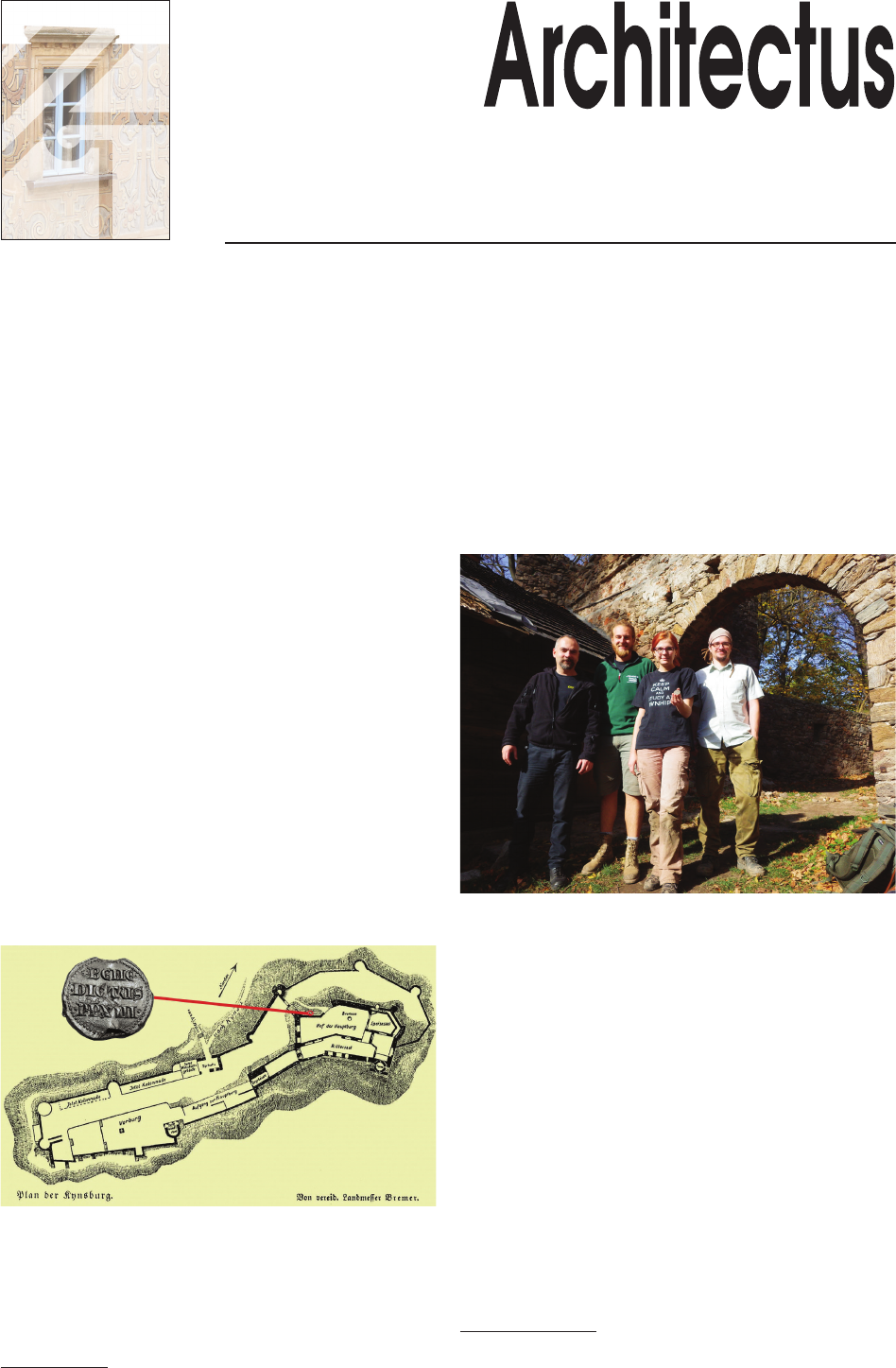
The papal bull was discovered during the subsequent
stage of archaeological research conducted under the su-
pervision of Dr. Paweł Konczewski in the zwinger area on
October 20, 2017 (Fig. 1). In April 2016, the study was
initiated by the Historical and Regional Research Institute
– the publisher of the monthly “Odkrywca” and the quar-
terly “Archeologia Żywa” [2], [3]
1
(Fig. 2).
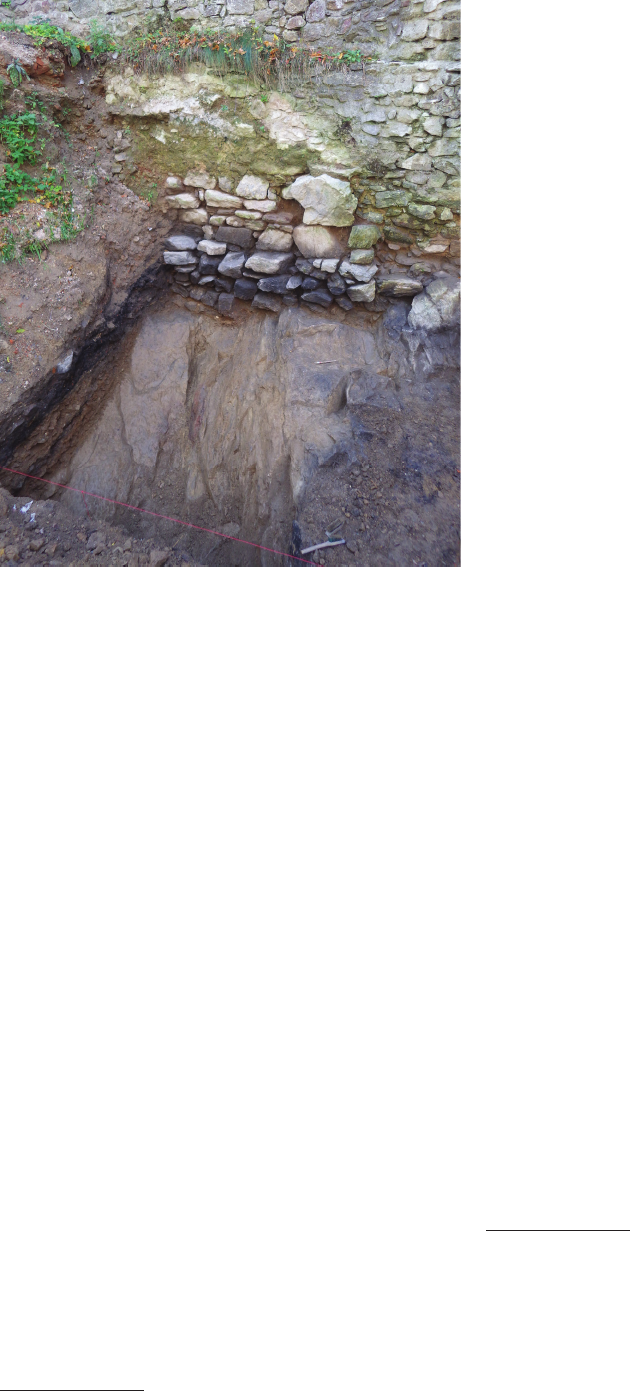
The cultural property was discovered right next to the
wall of the upper castle in the lowest layer of the burnt
site, which according to researchers, dates back to the 15
th
century (Fig. 3)
2
. It is a round, heavy, and lead object with
a diameter of 3.9 cm. After it had been taken out of that
place and cleaned, the obverse featured the image of two
1
This article is a changed and completed version of quoted works.
2
The issue of dating the layer in which the papal bull was found
is discussed in more detail in the articles by Paweł Konczewski and Ra-
dosław Biel.
Fig. 1. Bremer’s plan of Grodno Castle with marking the place where
the papal bull of Benedict XIII was discovered (source: [1, p. 2])
Il. 1. Plan Bremera zamku Grodno z oznaczeniem miejsca odnalezienia
bulli Benedykta XIII (źródło: [1, s. 2])
Fig. 2. From left: Łukasz Orlicki, Jacek Milczarski,
Dorota Mikołajczyk, Radosław Biel
after the discovery of the seal on October 20, 2017
(photo by Ł. Orlicki)
Il. 2. Od lewej: Łukasz Orlicki, Jacek Milczarski,
Dorota Mikołajczyk, Radosław Biel
po odnalezieniu pieczęci 20 października 2017 r.
(fot. Ł. Orlicki)
* ORCID: 0000-0003-0356-7494. Redakcja „Odkrywcy”, Kaszub-
ska 4, 50-214 Wrocław, e-mail: orlickigemo@gmail.com
84 Łukasz Orlicki
bearded heads and clear inscription SPASPE. In connec-
tion with the name on the other side – BENEDICTUS XIII
– this undoubtedly indicated the discovery of an artifact
not often found during archaeological research, i.e., a pa-
pal bull – a personal papal seal.
The state of research on papal seals
The subject of papal bulls – papal seals as artifacts ob-
tained during archaeological research which is carried out
in Poland and Silesia is still insuciently well recognized.
Until relatively recently, cultural properties of this type
were considered extremely rare, however, this condition
is changing dynamically. In the text by Zbigniew Misiuk
from 2013 [4], only eight such artifacts were mentioned.
In turn, already in 2018, Borys Paszkiewicz in the article
entitled Bulla papieża Benedykta XI [Papal bull of Pope
Benedict XI] lists 22 of them in total [5]. The latter re-
searcher also points out that the avalanche increase may be
connected with the fact that so far these cultural properties
have not been recognized in the discovered mobile materi-
al [5]. Therefore, even an attempt at estimating the number
of such nds in the territory of Poland is dicult. Accord-
ing to the author, at present this number amounts to over
30 copies and is certainly only a part of the total number
of papal bulls which should be in the area of our country
3
.
3
The author’s estimates are based on tracking information pub-
lished on online news services.
To compare – in Great Britain the number of papal bulls
reported by detectorists only by November 2021 was 515
and did not take into account those discovered during ar-
chaeological research [6].
In the event of discovering new cultural properties,
eld researchers and explorers often limit themselves to
short press releases published in online news and social
networking services
4
or entries in databases such as the
Portable Antiquities Scheme [6], [7]. They less frequent-
ly devote longer publications to specic copies (such as
the already cited [4], [5]) and there are only few synthetic
studies for a given region (e.g., [8]). At the same time,
a completely separate category of publications are sphrag-
istic works, which by denition do not deal with eld
nds. As regards this type of studies, the most important
synthetic study of papal bulls is a four-volume work by
Camill Serani entitled Le monete e le bolle plumbee pon-
ticie del Medagliere Vaticano [9], however, the article
by Francesco de Lasala [10] is much more often cited be-
cause it is widely available
5
.
Papal bulls
In Lain, the word “bull” means “ball, water-bubble” or
“tumor”. This expression was used to describe the charac-
teristic round papal seal axed with a hemp cord or, more
rarely, a silk one at the bottom of a document which was
issued by the oce of the Holy Father. As early as in
the Middle Ages, the term papal bull was used to dene
the entire document leaving the papal chancellery and
to which a seal was attached [11]. In the 2
nd
half of the
15
th
cen tury, this term was fully established and for the
rst time a collection of major papal documents entitled
“bullarium” was published by Roman carnist and historian
of law Laertio Cherubini [12]. Papal bulls were of various
character, ranging from ocial, ceremonial documents
which were connected with a specic stance of the pope
– such as the famous Gniezno papal bull of 1136 which
abolished the authority of the Archbishopric of Magde-
burg over the Polish church or papal bull Ad extirpanda
issued by Pope Innocent IV in 1252 concerning the use of
tortures in inquisition processes against heretics – through
a huge number of legal documents conrming privileges
for universities, churches, monasteries, approval of the
abbot, and ending with private privileges issued at the re-
quest of interested persons, letters of safe conduct (Latin
salvus conductus) for envoys and recipients of many other
cases in which medieval society required acceptance from
the spiritual head of the Catholic Church
6
. Regardless of
the importance of the document leaving the papal oce,
4
An exemplary comparison of such press releases is presented by
Paszkiewicz in his article [5].
5
In a number of publications it is mentioned in the bibliograph-
ic list as Tipologia dei sigilli dei papi or Typology of the papal seals.
The author is not sure until what time it was available on the Pontical
Gregorian University website, but at present it is available thanks to the
Internet Archive service exclusively [9].
6
Like, for example, Bulla Ex commisso nobis a Deo, promulgated
on July 7, 1136, in Pisa, or Ad extirpanda, papal bull of Innocent IV, pro-
mul gated on May 15, 1252 [12].
Fig. 3. Probing excavation No. 5 at the wall of the upper castle
(photo by Ł. Orlicki)
Il. 3. Wykop sondażowy nr 5 przy murze zamku górnego
(fot. Ł. Orlicki)

Papal bull of Benedict XIII (1394–1417) from Grodno Castle 85
its preparation was very careful and required the partic-
ipation of many people such as notaries, referendaries,
proofreaders and editors. Each document had to be signed
by the pope’s oce by axing his personal seal. Lead
papal bulls were attached to documents until the mid-18
th
century, when they began to be replaced with red seals
imprinted in wax, keeping traditional papal bulls for more
sumptuous and representative occasions.
Practically throughout the whole history of the Church,
a papal bull–seal contained the same unchanging elements
from the early Middle Ages to the present day. On one side
of the lead seal there are St. Peter’s and St. Paul’s bearded
heads which are presented in prole, between which there
is a papal processional cross. Above them there is Latin
inscription “SPASPE”, which means the abbreviation of
the words Sanctus Petrus (Saint Peter) and Sanctus Paulus
(Saint Paul). On the reverse there is a Latin name of the
pope and letters “PP”, meaning pastor pastorum – “shep-
herd of shepherds”.
Identification of the issuer of the papal bull
from Grodno Castle
Identifying legibly preserved papal seals is not a com-
plicated problem due to the clearly visible name of the
pope. However, in the case of the seal which was found in
Grodno Castle (German: Kynsburg), the situation was ex-
ceptional
7
. The name of Benedict XIII, which appears on
the seal, might have referred to two people, i.e. the Pope
of Avignon obedience Pedro Martinez de Luna (1342
–1422) at the turn of the 15
th
century, who was practical-
ly unconnected with the lands of Silesia, or Pietro Fran-
cesco Orsini (1650–1730) who ruled in the 18
th
century.
The latter, as a modest Dominican, although he came from
one of the most inuential Italian families, made a stun-
ning career by becoming Archbishop of Manfredonia at
the age of 25 only. In 1724 he was elected Pope, taking
initially the name of Benedict XIV, which he changed
to Benedict XIII, thus emphasizing that his predecessor
was not ocially recognized by the Vatican as the head
of the Catholic Church. The ponticate of Pope Pietro F.
Orsini lasted six years [15, pp. 411–413]. During those
years, he issued various types of documents for Polish,
Silesian, and Czech dioceses, inter alia, for the monastery
in Henryków
8
. At the same time, he issued many archi-
val regulations and instructions regarding preservation of
documents and contributed to the canonization of John of
Nepomuk, a popular Bohemian saint in Silesia [16].
The papal bull which was found during the archaeolog-
ical research in Grodno Castle was in the late medieval
layer, which allowed us to accept a more likely hypothe-
sis, namely that it belonged to the rst Benedict XIII (Pe-
dro de Luna). The full identication of the papal bull was
7
Grodno Castle was mentioned in sources as Kinsperch, Kinsberg,
Kinnigsperg, Kunigsperg, and even Königsberg. In the interwar period
the name was Kynsburg [13].
8
Bull of Benedict XIII (Pietro Francesco Orsini) conrming con-
sent to the use of ponticals and the granting of lower orders to monks
by the abbot of Henryków [14].
achieved by comparing external features as well as style
of the found artifact and the preserved seals of both popes.
As mentioned above, in the Middle Ages, the appear-
ance of a papal bull, apart from the name of the pope, was
almost identical, however, changes in architecture and
art brought by the Renaissance, and then the Baroque,
were reected even in the conservative form of the papal
seal. Only a few decades after the death of the rst Bene -
dict XIII, images of St. Peter and St. Paul began to change.
The papal chancellery also introduced changes to the font
and arrangement of inscriptions on the seal. These chang-
es can already be seen in the seal of Sixtus IV from the
1470s. Subsequent ponticates brought further evolution
and changes in style
9
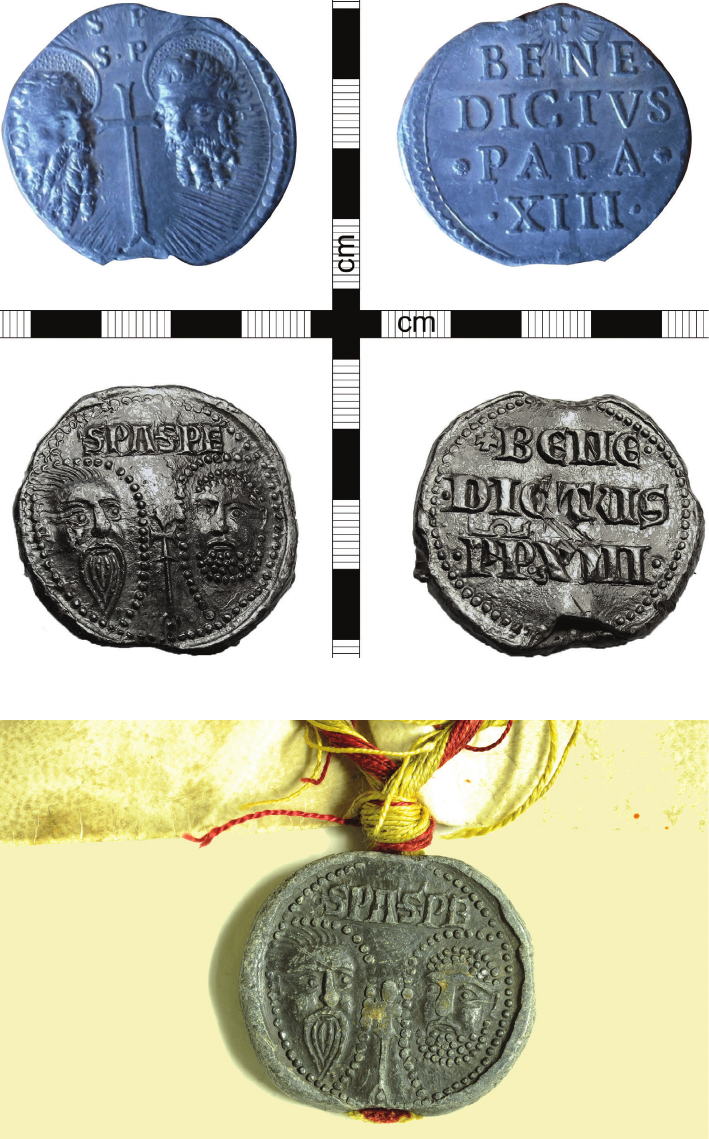
. The seal of Benedict XIII, i.e., Fran-
cesco Orsini, which was preserved on the document from
1725, showed both the reverse and the obverse of the papal
bull in a changed baroque convention signicantly dier-
ent from the medieval style (Fig. 4). However, the com-
parison of the papal bull found in Grodno Castle with the
photographs of the well-preserved seals of Benedict XIII,
i.e., Pedro de Luna (found in the document conrming the
rights of the oldest Scottish University in St. Andrews from
1413 and the papal bull stored in the Carthusian monastery
in Valldemossa) conrmed the hypothesis of the medieval
origin of the seals (Fig. 5). On this basis, it can be assumed
that the seal from Grodno Castle was attached to the doc-
ument which was issued by the “antipope”, or rather the
Pope of Avignon obedience, namely Benedict XIII
10
. This
is an exceptional situation. Under the walls of the Silesian
castle, which did not yet belong to the most signicant
knightly seats at the beginning of the 15
th
century, a seal
was abandoned, or perhaps a document issued by the pope,
who during those years was fully recognized by the king-
doms of France, Naples, Scotland, Aragon and Castile only.
“El Papa Luna”
Pedro Martinez de Luna was born in around 1342 in
Illueca in the Kingdom of Aragon to a signicant noble
family related to the royal house. At the age of nine, he be-
came a subdeacon, taking obligatory ordinations for can-
didates for the priesthood. As a young man and candidate
for the clergy, he was to take part in the Castilian-Ara-
gonese war. Thanks to his family’s eorts, he quickly be-
gan his church career, studying and teaching canon law
and receiving holy orders in 1366. In 1375 he was ap-
pointed a cardinal deacon.
9
Conclusions regarding changes in the style of the representa-
tions were drawn on the basis of a comparative analysis which was car-
ried out by the author.
10
The term antipapa (Latin antipapa) means a person appointed
to the papal throne without taking into account all the requirements of
canon law, who most often remains a competitor of the rightful pope.
However, this term does not reect the full essence of the events which
took place during the Western Schism, and the very assessment of the
activity and role of “antipopes”, in particular Benedict XIII, evolved
over the
centuries. At present, the most appropriate term for Benedict XIII
is the Avignon Pope obedience. A review of historians’ opinions such as
A. Fran zen, G. Mollat, L. Suarez Fernandez, on the role of Benedict XIII,
was included in the work by Ovidio Cuella Esteban [17, Vol. 1, pp. 19, 20].
86 Łukasz Orlicki
Fig. 5. Papal bull of
Pedro de Luna from 1413,
which is kept at St. Andrews’
Scottish University
(source: courtesy of the
University of St. Andrews
Libraries and Museums)
Il. 5. Bulla Pedra de Luny
z 1413 r. przechowywana
w szkockim uniwersytecie
St. Andrews
(źródło: dzięki uprzejmości
University of St. Andrews
Libraries and Museums)
Fig. 4. Comparison of the style
of seals of two popes bearing
the name of Benedict XIII.
At the top, the 18
th
-century papal
bull of Pietro Francesco Orsini
(source: courtesy of Vcoin.com).
At the bottom, the 14
th
/15
th
-
century papal bull of Pedro de
Luna discovered in Grodno Castle
(photo by Ł. Orlicki)
Il. 4. Porównanie stylistyki
pieczęci dwóch papieży
noszących imię Benedykta XIII.
U góry XVIII-wieczna bulla
Pietra Francesca Orsiniego
(źródło: dzięki uprzejmości
Vcoin.com).
U dołu odnaleziona na zamku
Grodno XIV/XV-wieczna bulla
Pedra de Luny
(fot. Ł. Orlicki)
Three years later, the Catholic Church suered one of
the greatest crises in its history, i.e. the Western Schism.
After the death of Pope Gregory XI, the cardinals elected
Italian Archbishop of Bari as his successor who took the
name of Urban VI. The political awkwardness and dif-
cult temperament of the new pope led to the situation
in which most of the cardinals met a few months later
and decided to annul the election, appointing to the papal
throne Ro bert de Genève from France as Clement VII.
A real war began between the two competitors. It culmi-
nated in the Battle of Marine where the French merce-
naries of Cle ment VII capitulated to the Italian condot-
tieri serving Urban VI. Clement went to French Avignon,
where he still considered himself the rightful heir to the
throne of St. Peter. Apart from France, he was supported
by Scotland, Sabaudia, Naples and, after some hesitation,
Castile and Aragon. The kingdoms of England, Portugal,
most of the lands of the Holy Roman Empire and the
kingdoms of Central Europe, i.e., Poland and Hungary
remained faithful to the Roman obedience. The then Ro-
Papal bull of Benedict XIII (1394–1417) from Grodno Castle 87
man (1378–1400) and Bohemian (1378–1419) King Wen-
ceslaus IV of Luxembourg also remained faithful to the
Roman obedience.
After the death of Clement VII in 1394, he was suc-
ceeded by Pedro de Luna who took the name of Bene-
dict XIII. Thus, he began the hottest period of the schism,
which determined fates of the Avignon popes. The color -
ful history of his life and struggles with successive Roman
popes as well as the successive antipope who worsened the
chaos abounded in dramatic events, including a four-year
siege in Avignon and a six-month defense of the palace,
during which Benedict XIII was lightly wounded in the
shoulder. Pedro de Luna showed consistency and stub-
bornness, believing – truthfully – that of all the “popes
and anti-popes” who lived in his time, he was the only
cardinal appointed by the undoubtedly last Pope Gregory
XI. Ultimately, the dynamically changing political situa-
tion resulted in the fact that France and Castile withdrew
their support for him. In 1408, he moved his seat to Per-
pignan, the capital of the Kingdom of Majorca, where he
remained in oce until 1417 and waited for the decision
of the Council of Constance to end the schism. He spent
the last years of his life in the Kingdom of Aragon in Pe-
niscola Castle. After his death, in 1423, the body of Pedro
de Luna was moved to the place of his birth. His tomb
was plundered during the Napoleonic Wars. Only the skull
survived [15], [17].
The gure of Pope Pedro de Luna, almost unknown
in Poland, is very popular in the countries which recog-
nized him. First of all in Spain, France and Scotland. The
coat of arms of St. Andrews’ Scottish University still has
an inverted crescent moon – the personal coat of arms of
Benedict XIII. In France and Spain, he became the hero
of many publications [17], [18], including non-scientic
ones. For example, Spanish author Vicent Melià i Bom-
boí tries to connect Benedict XIII with the Order of the
Dragon, which was founded by Sigismund of Luxem-
bourg (King of Rome, Hungary and the future emperor).
Famous Polish knight Zawisza Czarny was also supposed
to be a knight of this order [19].
Sigismund of Luxembourg actually met Pedro de Luna
in Perpignan, staying there from September to November
in 1415 [20]. Most probably, Zawisza Czarny was in his
retinue. According to Jan Długosz, during the tournament,
he was supposed to defeat a mysterious knight called John
of Aragon in front of Benedict XIII, Sigismund of Luxem-
burg, and King Ferdinand I of Aragon [21].
The memory of Pedro de Luna remains strong in Spain,
especially in the regions which are connected with the last
period of his life. The Association of Friends of Pope Luna
(Asociacion Amics del Papa Luna) is located in Peniscola.
It collects documents and inspires scientic publications
about the life and activities of the Pope, and also conducts
activities aimed at the rehabilitation of Pedro de Luna in
the light of canon law. In December 2019, this Associ-
ation presented detailed documentation to the Vatican’s
Congregation for the Doctrine of the Faith, which was ap-
proved by Cardinal Luis Francisco Ladaria on December
21, 2019 [22].
Grodno Castle
and a papal seal?
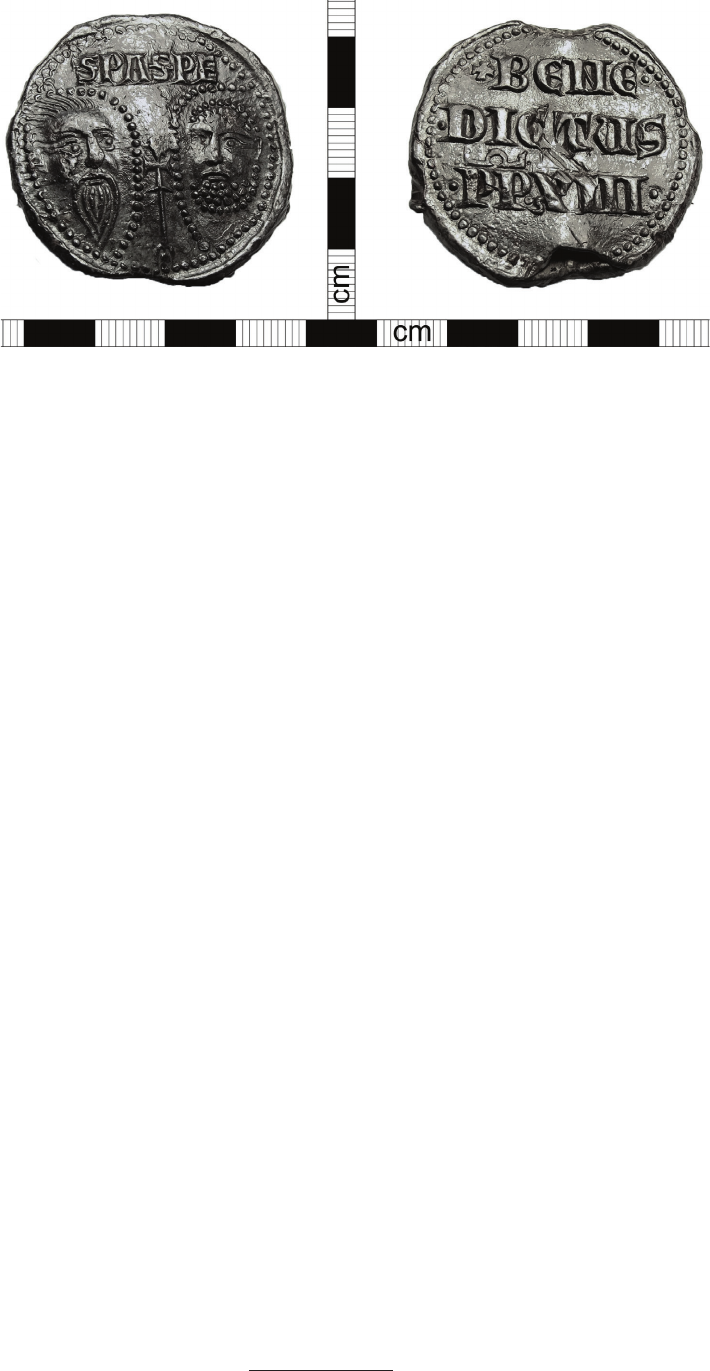
The issue concerning the circumstances in which the
lead seal of Benedict XIII (Fig. 6) was on the premises of
Grodno Castle, or with what specic document it is con-
nected, in fact remains impossible to explain unequivoc -
ally
11
. From the Middle Ages, the papal curia and chan -
cellery acted in many cases in a purely reactive way.
A client – a ruler, bishop, city council, monastery, chapter
or private person – submitted a supplication (request) along
with an oce fee. The supplication could concern the ap-
proval or acquisition of a privilege, election for a position,
indulgence of sins, obtaining a benece and many other
matters in which the response of the papal chan cellery was
expected. This type of correspondence might have also con-
cerned a specic person, after whose death the document
lost its validity and became worthless [23]. The number
of Benedict XIII’s documents preserved to this day varies,
depending on the location and the state of research on the
legacy of Pedro de Luna. In the Paris
Archives Nationales
11
I express my thanks to Professor Marek Daniel Kowalski (Ja -
giellonian University) and dr. Stanisław Jujeczko (University of Wro-
cław) for their research advice, information and discussion.
Fig. 6. Papal bull
of Benedict XIII (1394–1417)
from Grodno Castle
after conservation.
On the left: obverse,
on the right: reverse
(photo by Ł. Orlicki)
Il. 6. Bulla Benedykta XIII
(1394–1417) z zamku Grodno
po konserwacji.
Po lewej: awers,
po prawej: rewers
(fot. Ł. Orlicki)

88 Łukasz Orlicki
there are only 44 published documents issued by the oce
of Benedict XIII [24]. About 25,000 papal bulls of Pedro
de Luna are kept in the Vatican Secret Archives, of which
4,480 documents connected with the area of present-day
Spain have been published [17].
In the case of the oce of Benedict XIII, we are deal-
ing with a specic situation when it comes to the area of
the then lands of Silesia, under the reign of the Bohemi-
an Crown. The turn of the 15
th
century is the time of the
aforementioned Western Schism, which primarily con-
cerned the Church, at the same time introducing a division
between countries. Both the Kingdom of Bohemia, which
was part of the Holy Roman Empire, and the Kingdom of
Poland, adjacent to Silesia, recognized Roman or Pisan
obedience, not submitting to the Popes of Avignon. The
confusion over the schism resulted even in the fact that
in some regions of Upper Hungary – today’s Slovakia
– cler gymen were not required to be consecrated by any
of the popes who were in conict with each other [25]. So
far, no document regarding Polish lands issued by Bene-
dict XIII has been located in archives, private collections
and publications [26]. A similar situation occurs among
papal bulls issued with reference to German territories
[27]. In the territory of the Czech Republic, among the
documents published in collections, there are eight which
are connected with the pope we are interested in. Howev-
er, none of them could have had his seal. Five documents
constitute supplications which are connected with benets
in France. The others were issued by the cardinal cham-
berlain and as such were sealed with his own wax seal [28,
pp. 721–725].
However, it should be remembered that the lack of
known to us and identied papal bulls of Benedict XIII
concerning the region of Poland, Silesia and Bohemia,
which might have appeared in Grodno Castle, does not
prove that such documents did not exist.
Identification of the document
accompanied by the stamp
The document, together with the seal found in Grodno
Castle, might have left the papal chancellery at various
times during the ponticate of Benedict XIII. The most
likely of them are the rst months and years immediate-
ly after being elected pope in 1394. Pedro de Luna must
have sent various letters calling for delity to individu-
al representatives of the Church and secular authorities.
Although in Silesia such letters have not survived, after
being delivered to the addressees, they might have been
ignored or destroyed. The second probable period when
a larger number of Benedict’s documents could have
reached the region of Silesia, Bohemia and Poland might
be year 1404, after the death of the Pope of Roman obedi-
ence, Boniface IX. According to Ovidio Cuella Esteban,
an expert on Pedro de Luna’s correspondence, it was one
of the few moments when Benedict XIII, respected for
his steadfastness and defense, began to be recognized by
some Italian, German, Hungarian and even Polish dioces-
es [17, Vol. 1, p. 12]. The pope himself even thought of an
armed expedition to Rome.
However, this streak of good luck did not last long. As
a result of another reshue of political parties, Pedro de
Luna moved his seat to the Kingdom of Majorca and the
probability of issuing documents concerning Poland or
Silesia decreased signicantly. Of course, there is a pos-
sibility that the seal from Grodno Castle was attached to
a much more important document which was sent out
throughout the Christian world. For example, the papal
bull of 1408 calling the council of Perpignan or ocial
papal bull Etsi doctoribus Gentium of 1415, restricting the
rights of Jews and resulting from a long dispute organized
by Benedict in Tortosa [29].
At the time when Pedro de Luna was elected Pope,
Grodno Castle along with the entire Świdnica and Jawor
Principality was already under the reign of the Bohemian
Crown, which happened in 1392 after the death of Duch-
ess Agnes, widow of Bolko II. The history of the castle at
that time is not entirely clear. Its owners were probably
knights from the Scho-Heinz family, then his brother Ul-
rich, after whose death in 1412 the castle was to be taken
over by the von Mühlheim family, or in fact its branch
called Puschke (Pastuchów) after the name of its estate.
The latter soon became known as robber knights who
were known for enforcing tolls due to them and some-
times dealing with ordinary robberies. After the death of
Benedict XIII, Grodno Castle was still in the hands of this
family. Then it was taken over by other knightly fami-
lies with an equally bad reputation [1], [13]. There is no
indication that any of these knights was trying to obtain
any letter of Benedict XIII. However, it is not ruled out.
Perhaps the document was taken by of one of the robber
knights during numerous plundering raids, for which suc-
cessive lords at Grodno Castle became famous in the 15
th
century, or perhaps it found its way to the castle as a re-
sult of one of the Hussite military expeditions. Of course,
there are many hypotheses, speculations or possible paths
through which the seal found its way to the castle walls
from distant Avignon or Aragon
12
. It is worth remember-
ing that regardless of them, nding Pedro de Luna’s seal
in this part of Europe is a unique discovery.
Summary
Despite the unusual fact of the existence of two popes
in the history of the Catholic Church bearing the name of
Benedict XIII, on the basis of the analyses carried out,
we can certainly assume that the issuer of the papal bull,
which was discovered during the archaeological research
conducted in 2017 in Grodno Castle, was Pedro de Luna
who was in oce under this name at the turn of the 15
th
century. This is indicated rst of all by the results of com-
parative analyses of the style of representations on papal
bulls from the 15
th
century and on later cultural proper-
12
One of the most daring speculations is the possibility of receiv-
ing the document by one of the knights accompanying Sigismund of
Luxemburg on his visit to Benedict XIII in Perpignion. One of them was,
after all, the aforementioned Zawisza Czarny, who later visited Lower
Silesia many times in the service of Sigismund, while at the same time
being captured by the Hussites [30].
Papal bull of Benedict XIII (1394–1417) from Grodno Castle 89
ties. These ndings are conrmed by the results of the
stratigraphic analysis of the context in which this artifact
was found.
The identication of the document is much more prob-
lematic and thus the way in which this papal bull could get
to Grodno Castle. All of the proposed hypotheses seem to
be equally probable. Certainly, the solution to this prob-
lem requires further research and potential discoveries of
new, hitherto unknown papal bulls of this pope will be
crucial for the whole process. Therefore, potential discov-
erers must bear in mind that the context of their discovery,
i.e. its location, depth or accompanying cultural properties
should be documented as precisely as possible.
Translated by
Bogusław Setkowicz
References
[1] Schaetzke V., Die Kynsburg. Ein Beitrag zur Burgenkunde. – 2. und 3.,
verb. und verm. Au., Verlag L. Heege, Schweidnitz 1927.
[2] Orlicki Ł., Zamek Grodno – Zagadka papieskiej pieczęci, “Odkryw-
ca” 2017, nr 12, 4–10.
[3] Biel R., Orlicki Ł., Raz jeszcze o bulli papieskiej odkrytej na Zam-
ku Grodno, “Archeologia Żywa” 2019, nr 3, 20–23.
[4] Misiuk Z., Bulla papieska z Kunowic, pow. słubicki. Przyczynek
do interpretacji niektórych zabytków z późnego średniowiecza
i początku XVI wieku, “Archeologia Środkowego Nadodrza” 2013,
t. 10, 155–165.
[5]
Paszkiewicz B., Bulla papieża Benedykta XI, [in:] J. Piekalski, K. Wa-
chowski
(red.), Rytm rozwoju miasta na kulturowym po gra niczu,
Studium strefy placu Nowy Targ we Wrocławiu, cz. 2, “Wra ti slavia
Antiqua”, t. 23, Uniwersytet Wrocławski, Instytut Archeo lo gii,
Wro cław 2018, 713–718.
[6] Object type: bulla, Portable Antiquities Schema 2021, https://nds.
org.uk/database/search/results/q/bulla/objectType/BULLA [ac-
cessed: 29.11.2021].
[7] Bartels M., Papal Bullae: a message from above? Interpretations
of the papal lead seal (11
th
–16
th
c.) in archaeological contexts in
and around the Netherlands, [in:] C. Rinne, J. Reinhard, E. Roth-
-Heege, S. Teuber (Hrsg.), Vom Bodenfund zum Buch. Archäo
logie durch die Zeiten. Festschrift für Andreas Heege, Beltz Bad
Langen salza, Bonn 2017, 315–334.
[8] Bailey G., Finds Identied, Greenlight Publishing, Witham 2000.
[9] Serani C., Le monete e le bolle plumbee ponticie del Medagliere
Vaticano, Vol. 1–4, U. Hoepli, Milano 1908–1928.
[10] De Lasala F.J., Typology of the Papal Seals, Internet Archive 2003,
https://web.archive.org/web/20070819214818/http://www.unigre.
it/pubblicazioni/lasala/Papal Seals.pdf [accessed: 29.11.2021].
[11] Feldkamp M.F., Bullen von Nuntien und Legaten. Zum Sprachge-
brauch des Terminus “Bulle” in der frühen Neuzeit, “Römische
Historische Mitteilungen” 1993/1994, Bd. 34/35, 133–138.
[12] Cherubini L., Bullarium Sive Collectio Diversarum Constitutio-
num multorum Pontif. A Gregorio Septimo Usque Ad S.D.N. Six-
tum Quintum Ponticem Opt. Max: Cum rubricis, summariis, lucu-
brationibus et quadruplici Indice, Vol. 2, Roma 1586, https://play.
google.com/store/books/details/Bullarium_Sive_Collectio_Diversarum_
Constitutionum?id=gh7qEafAGQsC [accessed: 29.11.2021].
[13] Schubert H., Burg Kinsberg in Schlesien. Beschreibung und Ge
schichte derselben nach urkundlichen Material bearbeitet, Verlag
von Max Woywod, Breslau 1886.
[14] Dokumenty Klasztoru w Henrykowie, nr 253, Archiwum Archi-
diecezjalne we Wrocławiu.
[15] Kelly J.N.D., Encyklopedia papieży, Państwowy Instytut Wydaw-
niczy, Warszawa 2006.
[16] Lenort F., Z dziejów organizacji i zasobu archiwum archidiece
zjalnego w Poznaniu, “Archiwa, Biblioteki i Muzea Kościelne”
1967, t. 15, 5–90, doi: 10.31743/abmk.6537.
[17] Esteban O.C., Bulario Aragonés de Benedicto XIII, t. 1–4, Insti-
tución Fernando el Católico, Zaragoza 2003–2009.
[18] Hutton L.J., Don Pedro de Luna (1328–1423), habilitador del
Rena cimiento en España, [in:] A.D. Kosso, J. Amor y Vázquez,
R.H. Kosso, G.W. Ribbans (pub.), Actas del VIII Congreso de la
AIsociación Internacional de Hispanistas, del 22 al 27 de Agosto
de 1983, Vol. 2, Ediciones Istmo, Madrid 1986, 13–19.
[19] Melià i Bomboi V., El Papa Luna: El hombre que miro jamente
a los ojos del Dragon, Antinea, Vinaròs 2012.
[20] Pieradzka K., Dwie polskie relacje kronikarskie o soborze w Kon
stancji, [in:] J. Garbacik et al. (oprac.), Mediaevalia. W 50. rocz
ni cę pracy naukowej Jana Dąbrowskiego, PWN, Warszawa 1960,
238–239.
[21] Joannis Dlugossii Senioris Canonici Cracoviensis Opera omnia,
T. 13, Historiae Polonicae libri XII, T. 4, A. Przeździecki (cura),
Cracoviae 1877.
[22] La rehabilitación del Papa Luna, “Las Provincias”, 11.02.2019,
www.lasprovincias.es/comunitat/rehabilitacion-papa-luna-
20190211232314-ntvo.html [accessed: 29.11.2021].
[23] Kowalski M.D., Transliteracja nazw osobowych i miejscowych
w edycji późnośredniowiecznych źródeł proweniencji papieskiej,
[in:] K. Borowiec, D. Masłej, T. Mika, D. Rojszczak-Robińska
(red.), Jak wydawać teksty dawne, Rys, Poznań 2017, 127–144.
[24] Les actes ponticaux originaux des Archives Nationales de Paris
(1198–1415), t. 1–3, B. Barbiche (ed.), Biblioteca apostolica vati-
cana, Citta’ Del Vaticano 1975, 1978, 1982.
[25] Rábik V., Le Ordinazioni Dei Chierici Provenienti dal territorio
Della Slovacchia, “Slovak Studies” 2015, 1–2, 54–72.
[26] Bullarium Poloniae. 3, 1378–1417, I. Sułkowska-Kurasiowa, S. Ku-
raś (oprac.), KUL, Lublin 1998.
[27] Göller E., Repertorium Germanicum, Bd. 1, Weidmann, Berlin 1916.
[28] Acta Summorum Ponticum: res gestas Bohemicas aevi praehussi
tici et hussitici illustrantia, J. Eril (ed.), Academia, Praha 1980.
[29] Millet H., La Concile de Perpignan (15 novembre 1408 – 26 mars
1409): compte – rendu du colloque international, Perpignan, 24–
26 janvier 2008, “Cristianesimo nella storia” 2008, Vol. 29, Iss. 1,
219–229.
[30] Możejko B., Szybkowski S., Śliwiński B., Zawisza Czarny z Gar-
bowa herbu Sulima, WiM, Gdańsk 2015.
Acknowledgements
This research was funded by the Institute for Historical and Sightseeing
Research, publisher of “Odkrywca” and “Living Archaeology” magazine.
90 Łukasz Orlicki
Abstract
Papal bull of Benedict XIII (1394–1417) from Grodno Castle
The article aims at discussing a unique cultural property, which is the papal bull of Pope Benedict XIII that was discovered during the archaeo-
logical research conducted in Grodno Castle in 2017, as well as at determining the potential connections, as a result of which this cultural property
found its place in Lower Silesia. The number of papal bulls which are discovered in contemporary Poland has been growing signicantly from year
to year. They are not only visually impressive artifacts, but above all good dating proofs due to the name of their issuer on each of them. In the case
of identication of the papal bull discovered in Grodno Castle, initially there was a problem connected with the fact that in the history of the Catholic
Church there were two popes bearing the name of Benedict XIII, i.e. Pedro de Luna who was in oce at the turn of the 15
th
century and Francesco
Orsini who ruled in the 18
th
century. Thanks to the source query and the comparative analysis, the issuer of the copy from Grodno Castle is undoubt-
edly the rst of them – in historiography referred to as the Pope of Avignon obedience and colloquially as an anti-pope, due to the schism prevailing
in the Church at that time. At the same time, it was ruled out that this cultural property might have been placed on the secondary deposit due to the
analysis of the stratigraphy of the context layers in which it was discovered. On the basis of the query, the article also presents several hypotheses
about a possible way the papal bull got to Lower Silesia. The conclusion which can be drawn from the research is the need to conduct further studies,
not only on this particular cultural property, but rst of all, in a broader aspect of papal bulls in Poland.
Key words: Grodno Castle, Middle Ages, papal bull, Benedict XIII, Pedro de Luna
Streszczenie
Bulla Benedykta XIII (1394–1417) z zamku Grodno
Artykuł ma na celu omówienie unikatowego zabytku, jakim jest bulla papieża Benedykta XIII odkryta w trakcie badań archeologicznych prowa-
dzonych na zamku Grodno w 2017 r., a także ustalenie potencjalnych powiązań, na skutek których zabytek znalazł się na terenie Dolnego Śląska.
Z roku na rok liczba bulli odkrywanych na obszarze współczesnej Polski znacząco wzrasta. Są one nie tylko wizualnie imponującymi artefaktami,
ale przede wszystkim dobrymi datownikami, z racji imienia swojego wystawcy znajdującego się na każdej z nich. W przypadku identykacji
egzemplarza odkrytego na zamku Grodno natraono początkowo na problem związany z faktem występowania w historii Kościoła katolickiego
dwóch papieży noszących imię Benedykta XIII – Pedra de Luny pełniącego urząd na przełomie XIV i XV w. oraz Francesca Orsiniego sprawują-
cego władzę w wieku XVIII. Dzięki przeprowadzonej kwerendzie źródłowej i analizie porównawczej bezsprzecznie jako wydawcę egzemplarza
z zamku Grodno można wskazać pierwszego z nich – w historiograi określanego mianem papieża obediencji awiniońskiej, a potocznie antypapieża,
ze względu na panującą wówczas w Kościele schizmę. Jednocześnie wykluczono, że zabytek mógł znaleźć się na złożu wtórnym z racji analizy
stratygrai nawarstwień kontekstu, w którym go odnaleziono. W oparciu o przeprowadzoną kwerendę w artykule zaprezentowano też kilka hipotez
dotyczących sposobu, w jaki bulla trała na Dolny Śląsk. Wnioskiem płynącym z przedstawionych badań jest potrzeba przeprowadzenia dalszych
studiów, nie tylko nad tym konkretnym zabytkiem, ale przede wszystkim w szerszym aspekcie bulli papieskich na terenie Polski.
Słowa kluczowe: zamek Grodno, średniowiecze, bulla papieska, Benedykt XIII, Pedro de Luna