
2026
3(87)
Rafał Strojny*, Natalia Przesmycka**
Participatory design of healthcare spaces:
The case of the University Children’s Hospital in Lublin
DOI: 10.37190/arc260309
© by the Author/Authors. Licensee WUST.
Published in open access. CC BY-NC license.
Abstract
This article presents the process of participatory design of healthcare spaces using the University Children’s Hospital in Lublin as a case study.
The focus was on developing design guidelines for outdoor spaces that support the needs of paediatric patients, their families, and medical sta. The
starting point was the observation that existing hospital grounds often do not meet the contemporary requirements of users or the principles of ther-
apeutic environments. The authors’ goal was to determine whether the use of participatory methods and Evidence-Based Design principles enables
a more eective identication of users’ needs and leads to the development of more appropriate spatial solutions.
The study was conducted in 2024–2025 using an action research methodology that combined diagnosis, co-design, evaluation, and the prepara-
tion of solutions for implementation. The process included an analysis of existing spaces, design workshops involving children, the development of
design alternatives, and their evaluation. Participants in the workshops included patients from the rehabilitation ward, parents, and medical sta. The
methods employed included interviews, preference surveys, and drawing exercises conducted on prepared oor plans and visualizations of the spaces.
The results indicate that users primarily expect spaces that ensure safety, comfort, and the opportunity to rest, with recreational functions coming
second. Elements related to nature, greenery, sensory stimuli, and opportunities for activity and social integration were of particular importance.
Young patients preferred bright colours, organic spatial forms, and solutions that enable a multisensory experience of the space. The ndings suggest
that participatory design of healthcare environments can improve the identication of users’ needs and support the development of more responsive,
user-friendly, and functional hospital spaces.
Key words: children’s hospital design, child-centred participation, healthcare architecture
Introduction
Contemporary healthcare facility design increasingly
takes into account not only functional and technological re-
quirements but also the impact of the built environment on
users’ well-being, comfort, and recovery process. Outdoor
spaces play a particularly important role, as they can pro-
mote rest, reduce stress, and foster social integration among
patients, their caregivers, and sta. In the case of children’s
hospitals, these spaces are of particular importance due to
the varying stages of development among patients, their
limited independence, and their dependence on parents or
caregivers, which translates into specic physical, emotion
-
al, and social needs. Despite growing awareness of the con-
cept of a “healing environment”, existing hospitals often
lack appropriately adapted outdoor areas, and the existing
green infrastructure does not meet the actual needs of users.
The subject of the research presented in this article is the
outdoor spaces at the University Children’s Hospital in Lu-
blin (USD) – the largest facility of its kind in southeastern
Poland. The hospital was built in the 1980s, and its archi-
tectural form is typical for facilities of this type: the rst
two oors house general functions (diagnostic, education-
al, oce, and outpatient clinics), while the hospital wards
are located on the upper oors of the building. To provide
additional light to specic areas within the building, there
are atria and courtyards that vary in terms of accessibility,
layout, and proportions. The main entrance is a high-trac
area and the rst point of orientation for parents and pa-
tients. For these reasons, the University Children’s Hospital
* ORCID: 0000-0002-2451-9152. Faculty of Civil Engineering
and Architecture, Lublin University of Technology, Poland, e-mail:
r.strojny@pollub.pl
** ORCID: 0000-0003-0049-1500. Faculty of Civil Engineering
and Architecture, Lublin University of Technology, Poland.
90 Rafał Strojny, Natalia Przesmycka
in Lublin can be considered, in many respects, a represen-
tative example of hospital buildings constructed in the sec-
ond half of the 20
th
century, which are currently grappling
with the challenge of modernization and adaptation to con-
temporary needs.
The reason for undertaking this study was the need to
develop spatial solutions that support the daily functioning
of hospital users and better address their functional, social,
and recreational needs. Another important motivation was
the conviction that the design of healthcare spaces should
be based not only on expert knowledge but also on the ex-
periences and preferences of users. Consequently, the ob-
jective of the study was to develop design guidelines for
the outdoor spaces of a children’s hospital based on design
workshops, surveys, and participatory activities involving
patients, parents, and medical sta.
The hypothesis was that design workshops conducted us-
ing a participatory model and in accordance with the prin-
ciples of Evidence-Based Design enable a more eective
identication of users’ needs and lead to the development of
more appropriate spatial solutions for the hospital environ-
ment. It was also assumed that involving users in the co-de-
sign process reveals needs that are dicult to identify using
standard design methods alone. However, actively engag-
ing end users is still not a widespread design practice. The
study combined qualitative and quantitative methods and
was grounded in action research methodology, the detailed
process of which is presented later in this article.
State of research
Participatory design is not only a practical approach but
also a research tool that ts within the eld of architectur-
al research. Research on healthcare architecture indicates
that the physical environment of medical facilities can in-
uence patients’ well-being, stress levels, comfort of use,
and the course of recovery. A classic point of reference re-
mains the study by Roger S. Ulrich (1984), which demon-
strated the benecial eect of views of greenery on patients
following surgical procedures. Authors of subsequent pub-
lications have expanded on this line of research, pointing
out that design decisions regarding lighting, noise, contact
with nature, spatial orientation, and privacy can be signi-
cant for the quality of care and the safety of users (Devlin,
Arneill 2003; Ulrich et al. 2008).
In this context, Evidence-Based Design (EBD) – which
involves making design decisions based on empirical data
and veried research – plays a signicant role. D. Kirk Ha -
milton and David H. Watkins (2008) emphasized that EBD
does not mean the mechanical application of universal mod-
els, but rather requires the interpretation of research ndings
in relation to a specic program, location, and user groups.
In the case of children’s hospitals, it is therefore particular-
ly important to combine expert knowledge with an under-
standing of the local needs of patients, parents, and sta.
The most important nding from the systematic reviews
conducted between 2009 and 2018 by Emelie P. Bock and
co-authors (2021) was that new or renovated hospital envi-
ronments were generally rated more highly than older facil-
ities by children, parents, and sta alike. At the same
time,
these authors emphasized that although the concept of EBD
has been well developed in relation to the design of hos-
pitals for adults, knowledge regarding paediatrics remains
limited. Children have dierent needs than adults
– the
hospital environment should not only support treatment but
also emotional, social, and cognitive development.
Equally important for the development of research on
healing environments is the concept of “therapeutic land-
scapes”. Wilbert M. Gesler (1992) noted that the therapeu-
tic nature of a space stems not only from its physical char-
acteristics but also from social relationships, experiences,
and the meanings attributed to the place. With regard to gar-
dens and outdoor spaces in medical facilities, Clare Cooper
Marcus and Naomi A. Sachs (2013) emphasized the impor-
tance of designing recovery spaces tailored to dierent user
groups and their subsequent evaluation. Research by San-
dra Whitehouse and co-authors (2001) on a garden at a chil-
dren’s hospital showed that such spaces can be perceived
as supporting stress reduction, energy restoration, and user
satisfaction. Magdalena Jamrozik-Szatanek (2017) high-
lighted the role of broadly dened recreational spaces as
important elements of the therapeutic environment in chil-
dren’s hospitals. The researcher divided these spaces into:
rooms specically dedicated to rest, recreation, and play,
and multifunctional areas, with atria appearing in both cat-
egories. Agata Gawlak (2019) highlighted the importance
of a hospital’s public areas – including lobbies, hallways,
reception desks, waiting rooms, the entrance area, and the
building’s immediate surroundings – in shaping its image.
In these areas, it is possible to incorporate elements of
nature and art, as well as other features that reduce stress
and improve well-being. The importance of contact with
nature has also been conrmed by research in environmen-
tal psychology. Rachel Kaplan and Stephen Kaplan (1989)
described the restorative potential of natural environments,
while Stephen R. Kellert, Judith H. Heerwagen, and Martin
L. Mador (2008) developed the concept of biophilic design,
highlighting the need to incorporate natural elements into
the built environment.
Research on participation and co-design constitutes a se-
parate line of inquiry. Henry Sano (1999) emphasized the
importance of methods of public participation in design and
planning, while Elizabeth B.N. Sanders and Pieter J. Stap-
pers (2008) described the shift from designing “for the user”
to designing “with the user”. In the case of children, the
concept proposed by Roger A. Hart (1992) is also signi-
cant; he distinguished between apparent participation and
actual co-decision-making. In Polish research on healthcare
facilities, Piotr Springer and Agata Gawlak (2025) present-
ed ways to use statistical methods to assess users’ preferenc-
es and their willingness to participate in the design process.
The study involved medical sta from selected hos pitals
as well as caregivers of patients in the emergency room of
a paediatric hospital and conrmed the usefulness of a sys-
tematic analysis of user needs during the planning and de-
sign phases of a project.
Haohua Zheng and co-authors (2024) presented a more
ad vanced approach to designing children’s hospitals, pro-
posing a model based on the integration of the Analytic Hie-
rarchy Process (AHP), Quality Function Deployment (QFD),
Participatory design of healthcare spaces: The case of the University Children’s Hospital in Lublin 91
and the Theory of Inventive Problem Solving (TRIZ),
which
enables the systematic translation of children’s needs into
specic spatial solutions. This model involved identifying
user needs while taking into account the psychological and
physiological characteristics of children, es tablishing a hie-
rarchy of these needs, translating them into technical re -
qui rements, and resolving design conicts. The ndings of
Zheng and colleagues suggested that the use of theoreti-
cal models can support the creation of more child-friendly
medical environments, taking into account, among other
things, personalization, attractive visual information sy s-
tems, and the impact of colour schemes (Zheng et al. 2024).
Zheng and colleagues emphasized, however, the need for
further research on the evaluation of actual implementa-
tions in order to develop a system for designing children’s
hospitals based on user feedback. A team of researchers
from the Silesian University of Technology, led by Elżbie-
ta Niezabi towska (Niezabitowska et al. 2015), also recog-
nized the role of students’ conceptual and theoretical stud-
ies as architectural research related to design.
The results of research to date thus point to the need to
combine EBD, participation, workshop methods, and the
design of therapeutic outdoor spaces. There is still a lack
of analyses that take children’s perspectives into account,
and it is necessary to develop methods of co-design and
participatory design (Bock et al. 2021). Full processes in
which identifying user preferences, exploring design alter-
natives, conducting survey evaluations, and preparing for
implementation form a single, coherent research-and-de-
sign cycle are described relatively rarely.
Methods
The study was conducted in 2024–2025 at the University
Children’s Hospital in Lublin. The scope of work included
the analysis and development of a concept for the hospital’s
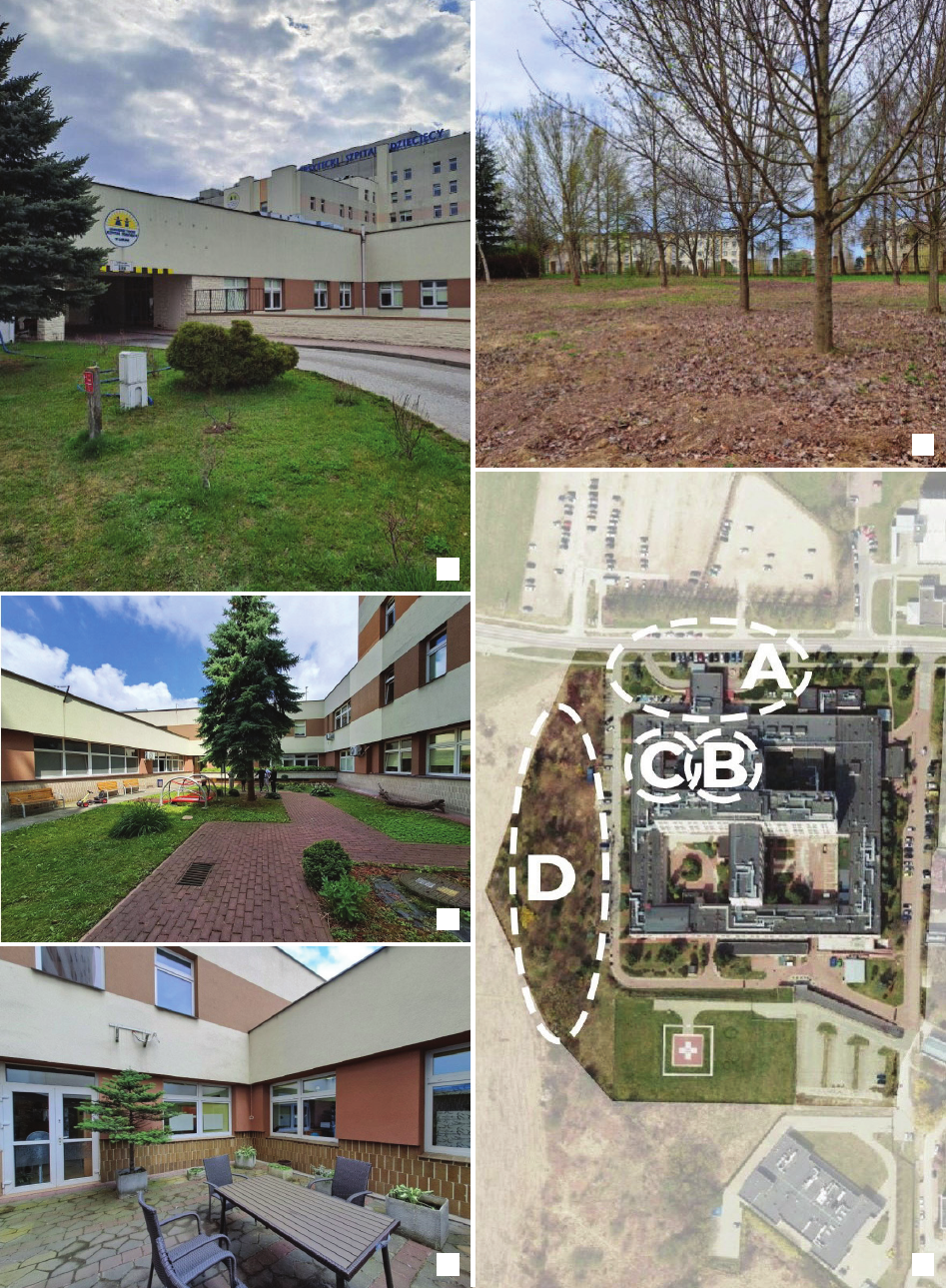
outdoor spaces, particularly the entrance area, atria, and the
hospital park (Fig. 1). The research process was based on the
action research methodology, which combines diagnosis,
co-design, evaluation, and the preparation of solutions for
implementation. The research was conducted in accordance
with the principles of EBD and a participatory approach,
which involves the active engagement of users in the design
process. Qualitative and quantitative methods were used,
including a spatial inventory, interviews, design workshops,
preference surveys, and an analysis of design alternatives.
The research process was divided into three stages: (1) di-
agnosis and context analysis, (2) design workshops with
patient participation, including a preference survey, and (3)
development and evaluation of design alternatives.
The rst stage involved assessing the spatial and func-
tional context through an analysis of existing outdoor areas
and interviews with hospital management and sta. This
made it possible to identify the main organizational and
functional issues and to select the spaces requiring design
intervention.
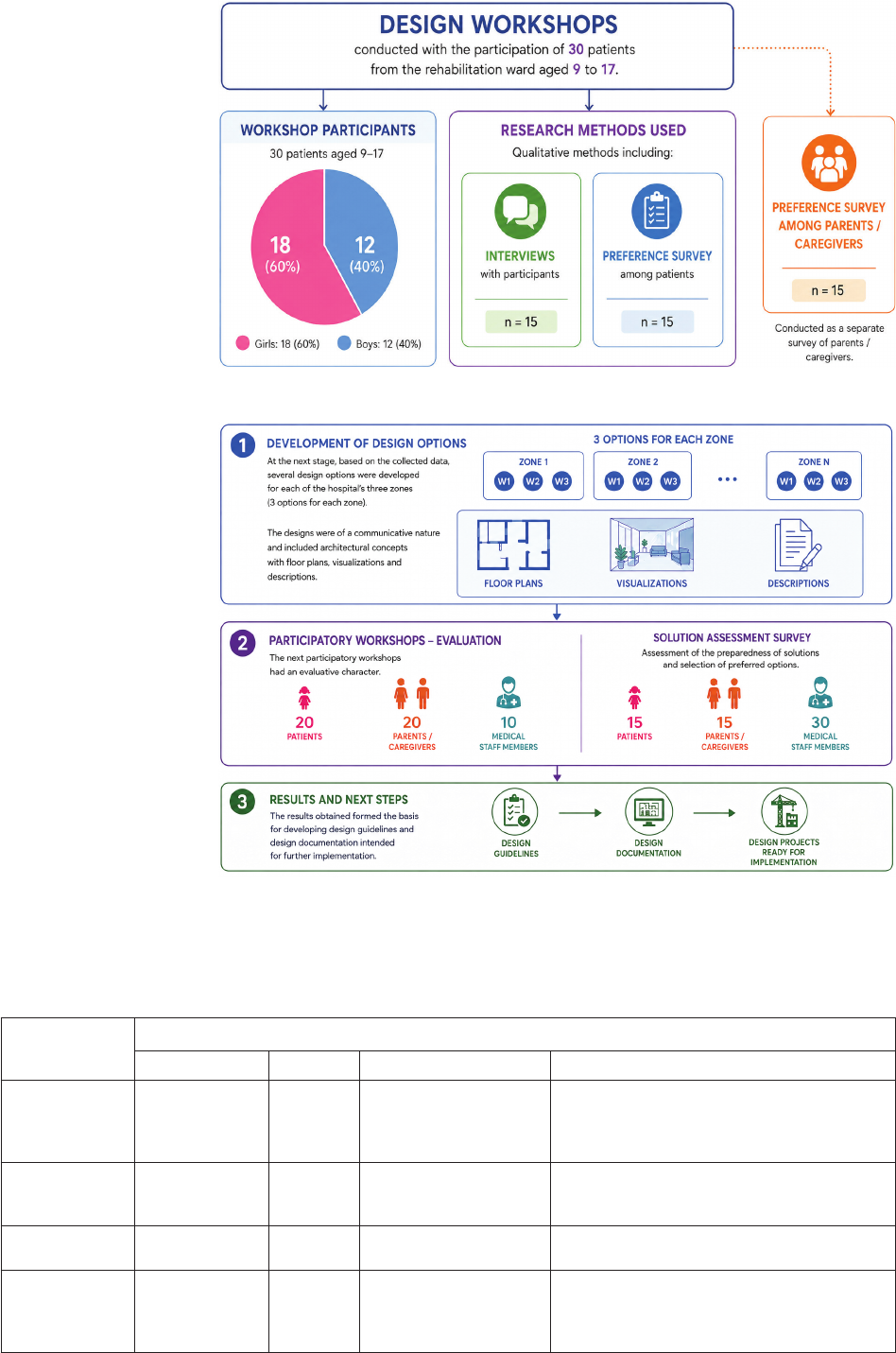
“Design workshops”, or stage two (Fig. 2), were con-
ducted with the participation of 30 patients from the reha-
bilitation ward aged 9 to 17 (18 girls, 12 boys). As part of
the workshops, interviews were conducted with 15 patients,
and a preference survey was administered to another 15 pa-
tients. After the workshops concluded, a preference survey
was additionally conducted among 15 parents or guardians
of the patients. A total of 45 people participated in the sec-
ond stage of the research activities, although parents and
guardians did not participate directly in the design work-
shops. The drawing activities were carried out on prepared
oor plans and visualizations of the space. For patients who,
due to health reasons, were unable to draw on their own,
architecture students participating in the study acted as their
“personal assistants”, carrying out the drawing task accord-
ing to the child’s instructions. Preferences regarding colour
schemes, spatial forms, furnishings, recreational functions,
and the sensory impact of the space were examined.
Involving parents in the research was very important
given the contemporary approach to their role in the treat-
ment and rehabilitation process. The role of family mem-
bers in a children’s hospital is much more signicant than
in hospitals for adults. Caregivers are increasingly taking
an active role in their child’s treatment and remain in the
hospital continuously, in some cases for quite a long time
(Del Nord 2006).
In the third stage of the project, based on the collected data
(Fig. 3), several design variants were prepared for individu-
al areas of the hospital (3 variants for each of the analysed
spaces). The design proposals were presented as clearly illu-
strated architectural concepts comprising oor plans, visuali-
zations, and descriptions.
First, evaluative participatory workshops were conduct-
ed with 50 participants: 20 patients, 20 parents, and 10 sta
representatives. Following the workshops, a separate eva-
lu a tive survey was conducted among a dierent group of
respondents, comprising 15 patients, 15 parents, and 30 me -
dical sta members. The purpose of the survey was to
evalu ate the proposed solutions and select the preferred de-
sign options. Both activities were part of the third stage of
the research and served to verify the developed concepts.
The results obtained formed the basis for formulating de-
sign guidelines and developing solutions intended for im-
plementation.
Results
Initial status – diagnosis
As a result of the rst stage of the study, four spaces
were selected for further analysis and design development:
the main entrance area (1), the atrium for children and par-
ents (2), the atrium for sta (3), and the area of undevel-
oped tall vegetation – the park (4). Table 1 presents their
basic characteristics and the constraints resulting from the
current local zoning plan.
First workshop
• User preferences regarding spatial elements
In order to conduct workshops with children of various
ages and health conditions, it was necessary to prepare in-
troductory materials that would facilitate eective commu-
nication. During the workshops, the children were shown
92 Rafał Strojny, Natalia Przesmycka
Fig. 1. The area of the University Children’s Hospital in Lublin covered by the study and design project: a) entrance area,
b) atrium for children and parents, c) staff atrium, d) park adjacent to the hospital, e) location map of the spaces covered by the study
(photo by R. Strojny, map: R. Strojny based on google maps)
Il. 1. Obszar Uniwersyteckiego Szpitala Dziecięcego w Lublinie objęty badaniem i opracowaniem projektowym: a) strefa wejściowa,
b) atrium dla dzieci i rodziców, c) atrium dla personelu, d) park przy szpitalu, e) schemat usytuowania przestrzeni objętych opracowaniem
(fot. R. Strojny, mapa: R. Strojny na podstawie google maps)
a
b
c e
d
Participatory design of healthcare spaces: The case of the University Children’s Hospital in Lublin 93
Fig. 2. Diagram of
the second stage of the study
(elaborated by N. Przesmycka)
Il. 2. Schemat przebiegu
drugiego etapu badań
(oprac. N. Przesmycka)
Fig. 3. Diagram of
the third stage of the study
(elaborated by N. Przesmycka)
Il. 3. Schemat przebiegu
trzeciego etapu badań
(oprac. N. Przesmycka)
Table 1. Summary of the basic characteristics and constraints of the analysed outdoor spaces at the University Children’s Hospital in Lublin
(elaborated by N. Przesmycka)
Tabela 1. Zestawienie podstawowych cech i uwarunkowań analizowanych przestrzeni zewnętrznych Uniwersyteckiego Szpitala Dziecięcego
w Lublinie (oprac. N. Przesmycka)
Space
Characteristics
accessibility area [m
2
] tall vegetation site furnishings / local zoning plan notes
1. Main entrance
area
publicly accessible;
public space
2900 none
Benches, an unused fountain, an informal smoking
area, and retaining walls. According to the local zoning
plan, the main pedestrian and bicycle route is to pass
through this area and connect with the route in Area 4.
2. Atrium
for children
and parents
accessible during
specified hours
500
one tree – an approximately
30-year-old spruce
wheelchair-accessible swing
3. Staff atrium
accessible
to staff only
80 none none
4. Undeveloped
area of
tall vegetation
publicly accessible;
public space
5200
approximately
30-year-old self-seeded trees
– lindens, maples, and ashes
No site furnishings. A well-worn informal path crosses
the area. According to the local zoning plan, part
of the site is designated for development,
with provision for a dedicated public space.
94 Rafał Strojny, Natalia Przesmycka
examples of solutions based on geometric and organic
spa tial design. A total of 87.5% of respondents preferred
organic forms, whereas 12.5% preferred geometric forms.
This trend was conrmed by further observations: among
the motifs the children “liked,” rounded, uid forms based
on curved lines predominated.
The children were then asked to draw or indicate the
desired elements within the atrium space. To this end, sim-
plied oor plans and sketches of characteristic views of
the spaces under study were provided for the children to
complete on their own. Children who, for various reasons,
were unable to draw or write on their own were assigned
an assistant – an architecture student – who acted as the
“child’s hand” without suggesting any solutions. Analysis
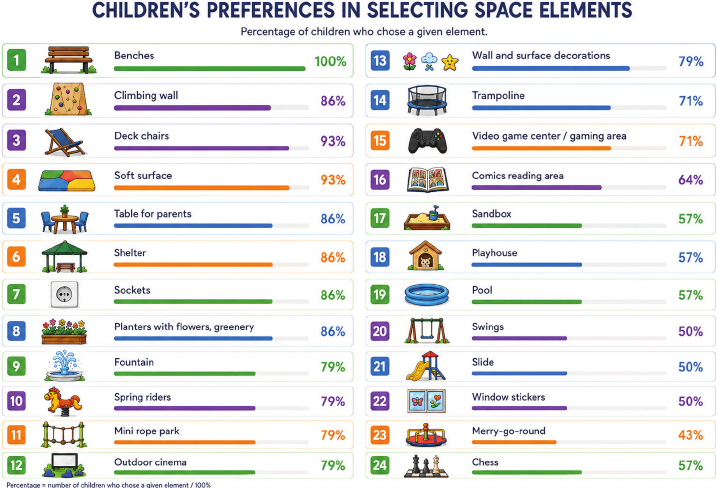
of the results revealed a clear predominance of elements
related to user comfort and spatial safety. The most import-
ant elements (as indicated by the children themselves) were
considered to be basic amenities such as benches, soft sur-
faces, a covered area, and tables for parents (Fig. 4). Inter-
estingly, these elements were chosen by the children over
playground equipment (swings, slides, merry-go-rounds,
etc.). Among the “organizational” suggestions regarding the
space were also: an outdoor movie theatre, a games area,
and a cat house. Subsequently, all submitted proposals were
compiled, and their importance was veried in a survey in
which participants again indicated their preferred elements
of the space.
The results indicate that users primarily expect condi-
tions conducive to rest, safety, and the presence of a care-
giver. Recreational elements appear further down the list.
This is consistent with the ndings from EBD research,
which emphasize the importance of opportunities for rest,
a sense of control over the space, and social support in re-
ducing stress among users of medical facilities (Ulrich et
al. 2008). Similarly, Marcus and Sachs (2013) and White-
house et al. (2001) highlighted the important role of seating
areas, shelter from the elements, and spaces that facilitate
recovery within the hospital environment. The workshop
results thus conrm that children’s needs are not limited to
play but also include comfort and passive rest.
• The importance of recreational and social functions
In addition to the basic elements, recreational and social
functions also played a signicant role. Among the most
frequently mentioned were simple play equipment, such as
swings, slides, and merry-go-rounds, as well as more com-
plex features, such as a mini-adventure course, an outdoor
movie theatre, and game areas. Importantly, some of these
suggestions – such as an outdoor movie theatre or food
service areas – go beyond the standard solutions typically
found in healthcare facilities. During the discussion, many
children pointed out the need for a food service option in
the studied space – such as a stand selling ice cream, ke-
babs, or pizza – but because these options were not feasible
within the project constraints, this expectation was not in-
cluded in the list of preferences.
These results are consistent with research on paediatric
environments, which emphasizes the importance of play,
activity, and social interaction for reducing stress and sup-
porting children’s emotional and social development during
hospitalization (Del Nord 2006; Jamrozik-Szatanek 2017;
Bock et al. 2021). From an EBD perspective, these func-
tions can promote positive distraction and social support
(Ulrich et al. 2008). Requests for an outdoor movie theatre
or a dining area thus point to the need to normalize every-
day experiences, although they do not constitute indepen-
dent evidence of the therapeutic impact of these solutions.
• The role of sensory stimuli
An important aspect highlighted by study participants
was the impact of the space on the senses. Respondents
noted the signicance of water features (fountains, pools),
scents (owers, grass, food aromas), and the sounds of na-
ture (birdsong and rustling leaves). At the same time, they
Fig. 4. Children’s preferences
in selecting elements
of the space – summary
(elaborated by N. Przesmycka)
Il. 4. Preferencje dzieci
w wyborze elementów
przestrzeni – zestawienie
(oprac. N. Przesmycka)
Participatory design of healthcare spaces: The case of the University Children’s Hospital in Lublin 95
more dicult to reconcile the types of spaces (enclosed,
open) preferred by children of dierent ages, as interests,
goals, and activities that can be planned in a given envi-
ronment change with age. Children’s prior experiences with
a specic type of space are also particularly important, as
memories of the social and individual activities undertaken
there inuence environmental preferences and the evalua-
tion of a place (Del Nord 2006).
The results obtained are consistent with studies indicating
that children more often choose bright and saturated colours,
although these preferences depend on age, gender, and prior
experiences (Boyatzis, Varghese 1994; Child, Hansen and
Hornbeck 1968; Del Nord 2006). However, the aesthetic
preferences reported cannot be equated with the therapeutic
eects of specic colours. Research in the eld of EBD indi-
cates that the perception of colour also depends on the inten-
sity and hue of light, contrast, the function of the space, and
the overall level of environmental stimulation (Lindahl et al.
2023). The participants’ preferences were therefore treated
as one of several design considerations and were assessed
alongside the need to ensure visual comfort, limit sen-
sory overload, and accommodate children of dierent ages.
Second workshop – evaluation
• Results of the evaluation of design alternatives
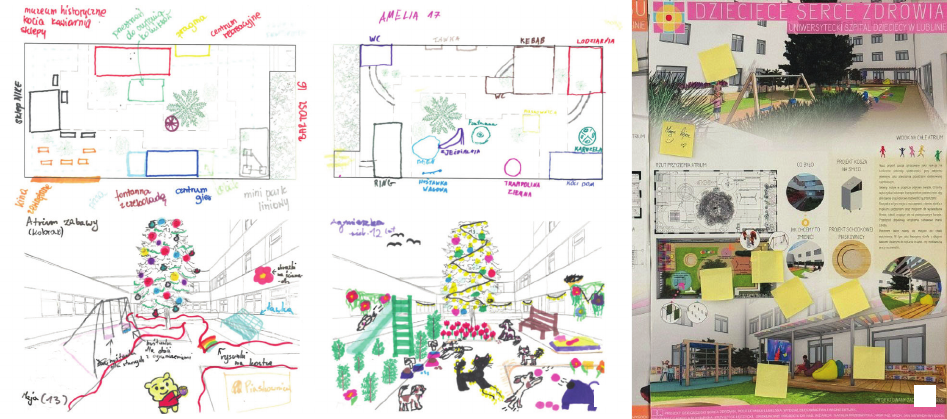
Based on the rst workshops (Fig. 6a, b), design con-
cepts were developed that clearly illustrated solutions for
the four selected spaces. Eorts were made to incorporate as
many of the children’s suggestions from the rst workshops
as possible, nding a place for them in various spaces: the
main entrance area (1), the atrium for children and parents
(2), the atrium for sta (3), and the area of tall, undevel-
oped greenery – a park with a playground (4). The design
ferences emerge – girls are more likely to choose pink and purple, while
boys are more likely to avoid pink than to actively prefer blue (LoBue,
DeLoache 2011).
emphasized the role of greenery, art, and the presence of
animals as features perceived by participants as contribut-
ing to well-being.
The results obtained are consistent with research on the
restorative eects of nature and the design of therapeutic
environments. Ulrich et al. (2008) indicated that contact
with nature and positive environmental stimuli can reduce
stress, while Kaplan and Kaplan (1989) emphasized the
restorative potential of natural environments. Marcus and
Sachs (2013) and Whitehouse et al. (2001) also highlighted
the importance of vegetation, water, and multisensory ex-
periences in hospital spaces. The workshop ndings thus
support the call for integrating natural and artistic elements
while maintaining a balance between stimulation and op-
portunities for quiet and rest.
• Formal preferences – colours and shapes
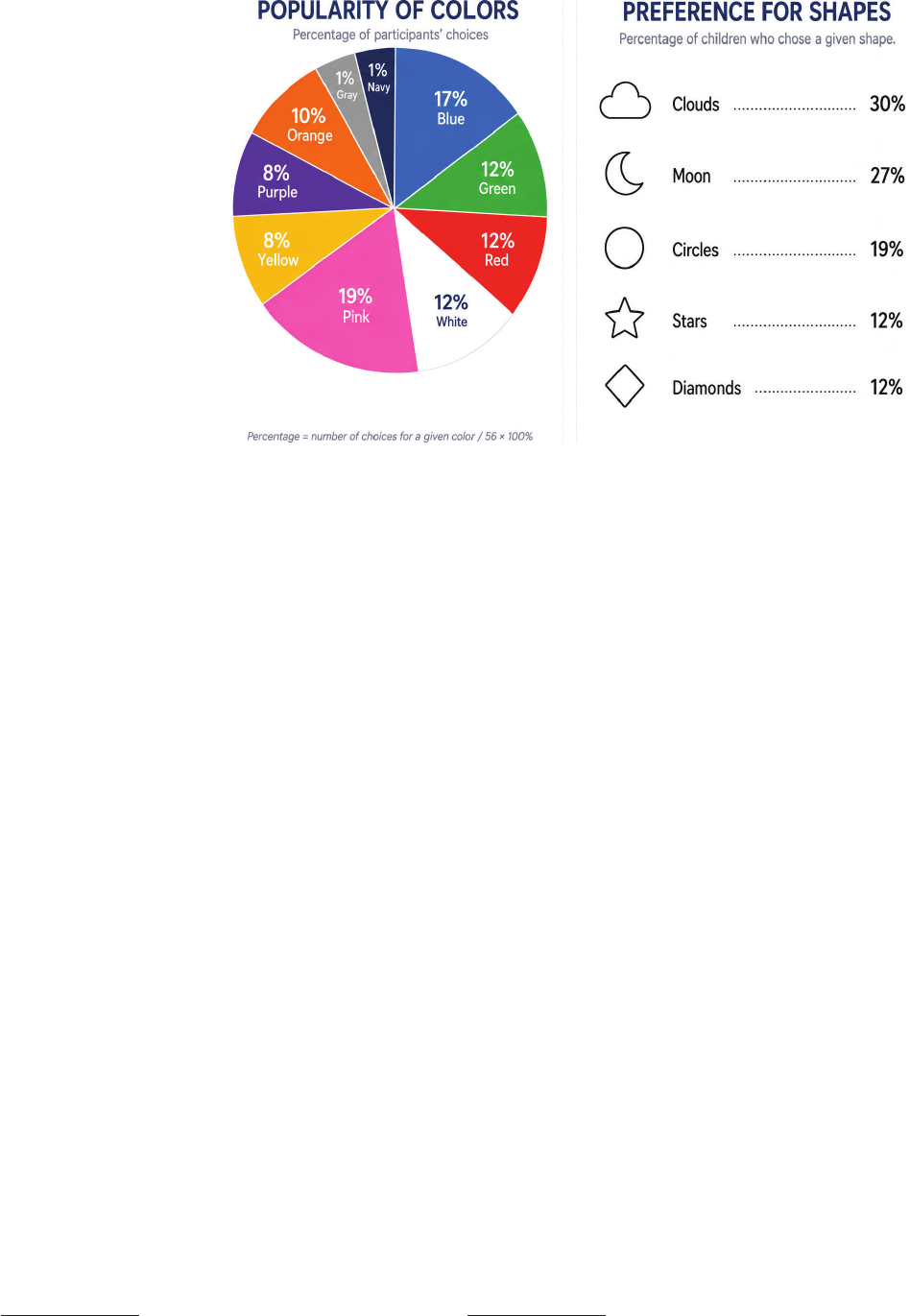
An analysis of aesthetic preferences revealed a clear pre -
ference for bright and vivid colours, such as pink, blue, and
green. None of the children selected brown or black. In terms
of spatial forms, organic and uid shapes dominated, being
preferred signicantly more often than geometric patterns
(Fig. 5). This nding is consistent with broader, earlier stud-
ies showing that children more often choose bright, vivid
colours (blue, red, pink) and are less fond of dark or neu-
tral colours (brown, grey, black) (Boyatzis, Varghese 1994).
However, children’s colour preferences are not xed. Re-
search suggests that younger children prefer more intense
and warmer colours, while interest in cooler and more sub-
dued colours increases with age (Child, Hansen and Horn-
beck 1968). In light of these ndings, greater variation in
colour preferences could be expected within the present
group of children aged 9–17 than in the preschool-age
groups described in some earlier studies
1
. It proves even
1
A frequently studied aspect of children’s color preferences con-
cerns gender-related dierences in preferences for pink and blue. The
results show that around the ages of 2–3, more pronounced gender dif-
Fig. 5. Popularity of
selected shapes and colours
(elaborated by N. Przesmycka)
Il. 5. Popularność wybranych
kształtów i kolorów
(oprac. N. Przesmycka)
96 Rafał Strojny, Natalia Przesmycka
concepts were printed on presentation boards, with three
alternatives presented and discussed for each space. The
presentations were followed by a discussion. Each partic-
ipant (patients, parents, sta) could select their preferred
concepts and provide qualitative comments on the pro-
posed solutions (Fig. 6c). As a result of the evaluation stud-
ies, preferred variants were identied for each space. The
concepts presented below received the highest ratings.
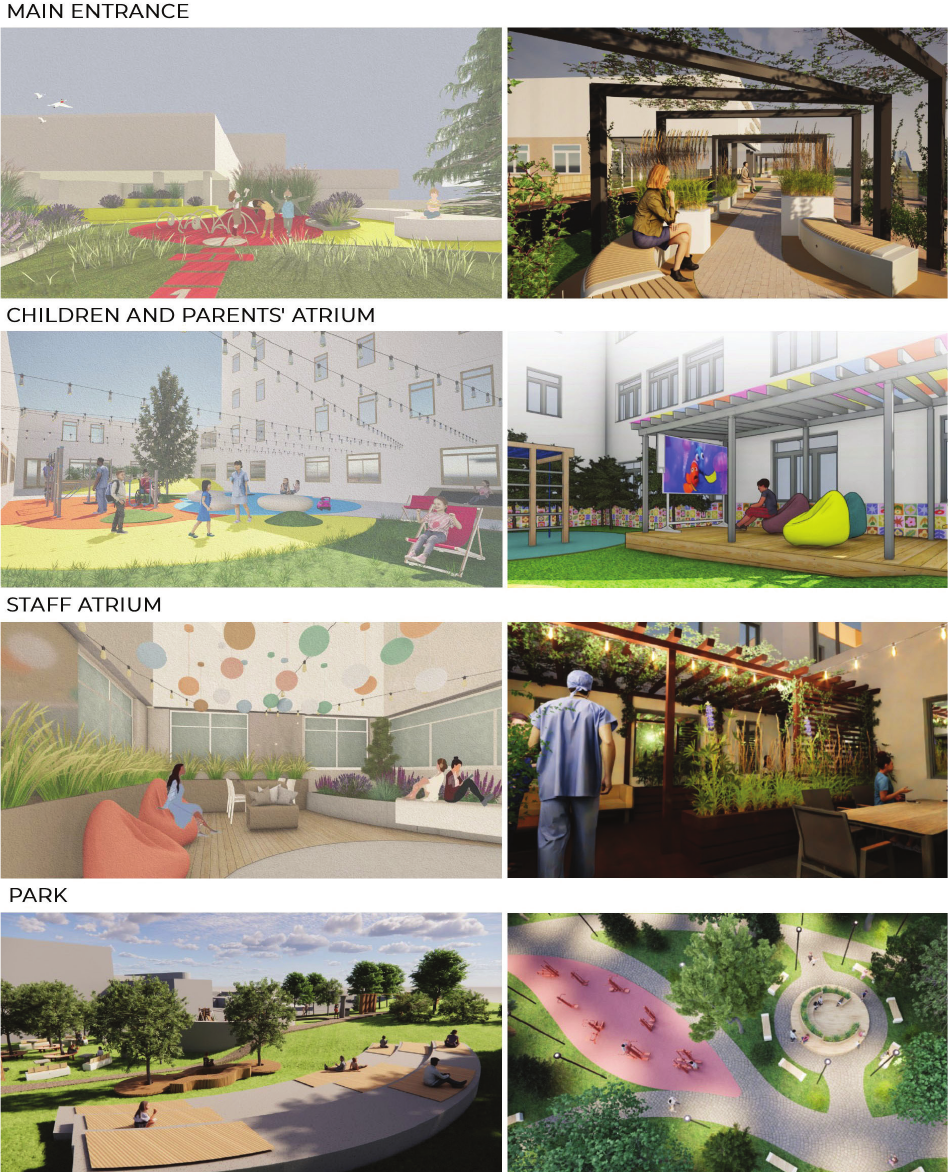
The selected design concept for the main entrance area
aimed to emphasize its prominent and welcoming charac-
ter while transforming part of the space into an additional
waiting area. An intimate and contemplative atmosphere
was sought through the introduction of site furnishings and
landscape elements, including benches, a pergola, planters
with ornamental plants, and the restoration of the fountain.
An important element was the variety of surface materials.
The use of colour in this space was limited due to its formal
character.
The concept selected for further development – a large
atrium for children and parents – featured a clear spatial
layout based on preserving the existing tree and introduc-
ing varied surfaces: a covered wooden terrace, exible sur-
faces around the play equipment, and a sunken sandbox.
Seating areas were integrated into the low walls separating
the technical zone and arranged under the canopy. Several
playground structures were proposed (a rocker, a swing),
as well as those that can simultaneously support rehabilita-
tion (climbing frames, balance beams). The terrace canopy
incorporated colourful, translucent elements, allowing the
space to be used even in inclement weather.
Among the presented park development concepts, the
participants selected the version based on minimal interfer-
ence with the site, incorporating natural materials (wood),
and featuring a clear functional layout: an entrance area,
zones for active recreation and passive rest, and play-
grounds. An important element was the variety of seating
options: ranging from classic benches to amphitheatre-style
seating and the option to sit directly on the ground.
The smallest of the spaces studied – the sta atrium
– was treated as a relaxation area with access restricted
exclusively to this group of users. To reduce the atrium’s
perceived height, elements were designed to partially cov-
er and shade it, while also serving as a support structure
for climbing plants. Due to underground utilities and the
resulting inability to plant directly in the ground, planting
was limited to ornamental vegetation in planters. Despite
the complete exclusion of patients and their families from
using this area, it is visually “accessible” from the general
circulation spaces for all user groups, hence the desire to
incorporate attractive forms of decorative greenery.
The process of selecting design alternatives demonstrat-
ed the usefulness of the research method, enabling a transi-
tion from general preferences to specic design decisions.
The use of design alternatives proved to be not only a de-
sign tool but also an essential element of the research pro-
cess, allowing users to evaluate realistic spatial solutions.
• Implementation
Based on the concepts and following an evaluation con-
ducted during the second participatory workshop, specic
design guidelines were formulated. Based on the presented
concepts, the hospital administration identied two areas
for implementation: the main entrance and the patient atri-
um. Students from the “Architecture of Health” Research
Fig. 6. Selected drawings by children from the workshops: a) one vision of the space, including an outdoor movie theatre, b) another vision
of the space with an area for animals and food service facilities, c) one of the design concepts selected for implementation by the largest group
of patients and parents, created by architecture students G. Kucharska and K. Łęczycki – one of the methods used to select the concept involved
sticking yellow sticky notes with comments onto the design boards (photo by R. Strojny)
Il. 6. Wybrane rysunki dzieci wykonane podczas warsztatów: a) jedna z wizji zagospodarowania przestrzeni, obejmująca kino plenerowe,
b) wizja przestrzeni z miejscem dla zwierząt oraz zapleczem gastronomicznym, c) jeden z projektów wybranych do realizacji przez największą
grupę pacjentów i rodziców, autorstwa studentów architektury G. Kucharskiej i K. Łęczyckiego – jedną z metod wyboru koncepcji
było umieszczanie żółtych karteczek samoprzylepnych z komentarzami na planszach projektowych (fot. R. Strojny)
a b c
Participatory design of healthcare spaces: The case of the University Children’s Hospital in Lublin 97
Fig. 7. Selected design variants for each space – the entrance area, the atrium for children and parents, the atrium for staff, and the park adjacent
to the hospital (elaborated by P. Pasik, N. Łukasiewicz, M. Łęcka, K. Marchewka, W. Moczoł, K. Łęczycki, G. Kucharska, I. Bulavina, M. Kołodziejczyk)
Il. 7. Wybrane warianty projektów dla każdej przestrzeni – strefy wejściowej, atrium dla dzieci i rodziców, atrium dla personelu oraz parku przy
szpitalu (oprac. P. Pasik, N. Łukasiewicz, M. Łęcka, K. Marchewka, W. Moczoł, K. Łęczycki, G. Kucharska, I. Bulavina, M. Kołodziejczyk)
Club at the Faculty of Civil Engineering and Architecture
of the Lublin University of Technology developed detailed
design plans, which were submitted to the hospital. Based
on these plans, tenders will be announced as funding be-
comes available. Regarding the area of tall greenery adjacent
to the hospital – the hospital park zone – the hospital com-
missioned a design, including playground equipment, from
a manufacturer (Stowarzyszenie Przyjaciół USzD 2025)
in
98 Rafał Strojny, Natalia Przesmycka
parallel with the conceptual work. The presented solution
was not subject to consultation or broader discussion. The
centrepiece of the playground will be a slide shaped like
a lighthouse. The project’s creators explain the idea as fol-
lows: The light of a lighthouse always serves as a guide
to a safe place, despite the turbulence and storms at sea.
And often, the healing process is like a vast ocean of raging
waves, from which a majestic tower with a light emerges –
the child’s return to health (Pop 2024; Szczebiot 2025). The
colours preferred by children are usually bright, saturated
hues with positive emotional associations; however, eec-
tive design of therapeutic spaces requires balancing visual
appeal with the need to limit sensory overload. This latter
condition is quite dicult to meet if the design relies on
the selection of ready-made elements (such as playground
equipment) while limiting the use of natural building ma-
terials. The analysed playground design does not provide
dedicated areas or amenities for passive recreation and rest,
nor does it reference the natural elements present in the
park in any way. Fundraising eorts for the playground’s
construction are currently ongoing.
Conclusions
The described process involves pre-design analyses
aimed at developing optimal solutions for the design of
healthcare spaces, in which identifying user preferences, ex-
ploring design alternatives, conducting survey evaluations,
and preparing for implementation formed a single, coherent,
planned research-and-design cycle.
The ndings were consistent with previous research indi
-
cating that the physical environment can shape patients’ ex-
periences and that paediatric users have specic age-related
and developmental needs. The present study did not assess
clinical or psychological outcomes; rather, it identied us-
ers’ preferences and translated them into design consider-
ations. The participatory process indicated that involving
users can help identify needs that may be dicult to capture
using standard design methods alone. The results indicate
that children expected hospital outdoor spaces to provide,
above all, safety, comfort, and opportunities for rest, while
play-oriented and recreational features were of secondary
importance. Sensory elements, contact with nature, physical
activity, and the creation of environments that facilitate the
normalization of daily experiences during hospitalization
were also important to participants.
The methodology employed – which included identify-
ing user preferences, developing design alternatives, eval-
uating them, and preparing solutions for implementation
– demonstrated the usefulness of the participatory model for
identifying user needs and translating them into design al-
ternatives. The research ndings indicate that design carried
out in collaboration with users can contribute to the devel-
opment of more responsive, user-friendly, and health-sup-
portive hospital environments that meet the actual needs of
children, parents, and medical sta.
Acknowledgments
The authors would like to thank the administration and sta of the Uni-
versity Children’s Hospital in Lublin for enabling this research, as well as
the students of the “Architecture of Health” Research Club for preparing
the graphic materials and providing organizational support for the study.
References
Bock, Emelie P., Stefan Nilsson, Per-Anders Jansson, et al. “Literature
Review: Evidence-Based Health Outcomes and Perceptions of the
Built Environment in Pediatric Hospital Facilities.” Journal of
Pe diatric Nurs ing 61 (2021): e42–e50. https://doi.org/10.1016/j.
pedn. 2021.04.013.
Boyatzis, Chris J., and Reenu Varghese. “Children’s Emotional Associ-
ations with Colors.” The Journal of Genetic Psychology 155, no. 1
(1994): 77–85. https://doi.org/10.1080/00221325.1994.9914760.
Child, Irvin L., Jens A. Hansen, and Frederick W. Hornbeck. “Age and Sex
Dierences in Children’s Color Preferences.” Child Development 39,
no. 1 (1968): 237–47. https://doi.org/10.2307/1127374.
Del Nord, Romano, ed. Lo Stress ambientale nel progetto dell’Ospedale
pediatrico indirizzi tecnici e suggestion architettoniche. Motta Ar-
chitettura, 2006.
Devlin, Ann S., and Allison B. Arneill. “Health Care Environments and Pa-
tient Outcomes: A Review of the Literature.” Environment and Behavior
35, no. 5 (2003): 665–94. https://doi.org/10.1177/0013916503255102.
Gawlak, Agata. Architektura szpitala: izba przyjęć w szpitalu pediatrycz-
nym. Wydawnictwo Politechniki Poznańskiej, 2019.
Gesler, Wilbert M. “Therapeutic Landscapes: Medical Issues in Light of
the New Cultural Geography.” Social Science and Medicine 34, no. 7
(1992): 735–46. https://doi.org/10.1016/0277-9536(92)90360-3.
Hamilton, D. Kirk, and David H. Watkins. Evidence-Based Design for
Multiple Building Types. Wiley, 2008.
Hart, Roger A. Children’s Participation: From Tokenism to Citizenship.
UNICEF International Child Development Centre, 1992.
Jamrozik-Szatanek, Magdalena. “Przestrzenie rozrywki jako ważny ele-
ment uzdrawiającego środowiska w szpitalach pediatrycznych.” In
Badania interdyscyplinarne w architekturze: BIWA 2. Monograa
konferencyjna. T. 3: Potrzeby osób starszych, edited by Beata Komar,
Anna Szewczenko. Wydział Architektury Politechniki Śląskiej, 2017.
Kaplan, Rachel, and Stephen Kaplan. The Experience of Nature: A Psy-
chological Perspective. Cambridge University Press, 1989.
Kellert, Stephen R., Judith H. Heerwagen, and Martin L. Mador, eds. Bio-
philic Design: The Theory, Science and Practice of Bringing Build-
ings to Life. Wiley, 2008.
Lindahl, Jeanette, Hans Thulesius, Helle Wijk, David Edvardsson, and Ca-
rina Elmqvist. “The Perceived Support From Light and Co lor Before
and After an Evidence-Based Design Intervention in an Emergency
Department Environment: A Quasi-Expe ri men tal Study.” HERD 16,
no. 2 (2023): 109–24. https://doi.org/10.1177/19375867221150215.
LoBue, Vanessa, and Judy S. DeLoache. “Pretty in Pink: The Early Devel-
opment of Gender-Stereotyped Colour Preferences.” British Journal
of Developmental Psychology 29, no. 3 (2011): 656–67. https://doi.
org/10.1111/j.2044-835X.2011.02027.x.
Marcus, Clare C., and Naomi A. Sachs. Therapeutic Landscapes: An Ev-
idence-Based Approach to Designing Healing Gardens and Restor-
ative Outdoor Spaces. Wiley, 2013.
Niezabitowska, Elżbieta, Magdalena Jamrozik-Szatanek, Aleksandra Bry-
zek, et al. Szpitale dziecięce: metodologia okołoprojektowych badań
architektonicznych na przykładzie opracowań studenckich. Wydaw-
nictwo Politechniki Śląskiej, 2015.
Participatory design of healthcare spaces: The case of the University Children’s Hospital in Lublin 99
Pop, Patrycja. “Chcą zbudować plac zabaw dla małych pacjentów w Lu-
blinie. Przyjdź na koncert i dołóż cegiełkę do tego pomysłu.” Radio
Eska Lublin. Published December 10, 2024. Accessed May 20, 2026,
at https://lublin.eska.pl/chca-zbudowac-plac-zabaw-dla-malych-pac-
jentow-w-lublinie-przyjdz-na-koncert-i-doloz-cegielke-do-tego-po-
myslu-aa-3454-sb1v-cKXG.html.
Sanders, Elizabeth B.N., and Pieter J. Stappers. “Co-creation and the New
Landscapes of Design.” CoDesign 4, no. 1 (2008): 5–18. https://doi.
org/ 10.1080/15710880701875068.
Sano, Henry. Community Participation Methods in Design and Plan-
ning. Wiley, 1999.
Springer, Piotr, and Agata Gawlak. “Correlations and statistical analyses in
evaluating user preferences in participatory design of healthcare facili-
ties.” Architectus, no. 4 (84) (2025): 167–74. https://doi.org/10.37190/
arc250416.
Szczebiot, Agnieszka. “Plac zabaw przy Uniwersyteckim Szpitalu Dziecię-
cym w Lublinie.” Published March 18, 2025. Accessed May 20, 2026,
at https://szkolaprzyszpitalna.pl/plac-zabaw-przy-uniwersyteckim-sz-
pitalu-dzieciecym-w-lublinie/.
Ulrich, Roger S. “View Through a Window May Inuence Recovery
from Surgery.” Science 224, no. 4647 (1984): 420–1. https://doi.org/
10.1126/science.6143402.
Ulrich, Roger S., Craig Zimring, Xuemei Zhu, et al. “A Review of the Re-
search Literature on Evidence-Based Health care Design.” HERD 1,
no. 3 (2008): 61–125. https://doi.org/10.1177/193758670800100306.
Stowarzyszenie Przyjaciół USzD. “Utworzenie placu zabaw dla pa-
cjentów przy Uniwersyteckim Szpitalu Dziecięcym w Lublinie.”
Uni wersytecki Szpital Dziecięcy w Lublinie. Published December
18, 2025. Accessed May 20, 2026, at https://www.uszd.lublin.pl/
stowarzyszenie-przyjaciol-uszd/utworzenie-placu-zabaw-dla-pa-
cjentow-przy-uniwersyteckim-szpitalu-dzieciecym-w-lublinie,-
news,28,1596.php.
Whitehouse, Sandra, James W. Varni, Michael Seid, et al. “Evaluating
a Children’s Hospital Garden Environment: Utilization and Con-
sumer Satisfaction.” Journal of Environmental Psychology 21, no. 3
(2001): 301–14. https://doi.org/10.1006/jevp.2001.0224.
Zheng, Haohua, Lingying Liu, Qi Zhang, Yihan Wang, and Yangyang
Wei. “Children’s Hospital Environment Design Based on AHP/QFD
and Other Theoretical Models.” Buildings 14, no. 6 (2024): 1499.
https://doi.org/10.3390/buildings14061499.
Streszczenie
Partycypacyjne projektowanie przestrzeni ochrony zdrowia
na przykładzie Uniwersyteckiego Szpitala Dziecięcego w Lublinie
W artykule przedstawiono proces partycypacyjnego projektowania przestrzeni ochrony zdrowia na przykładzie Uniwersyteckiego Szpitala Dziecię-
cego w Lublinie. Skoncentrowano się na opracowaniu wytycznych projektowych dla przestrzeni zewnętrznych wspierających potrzeby pacjentów pe-
diatrycznych, ich rodzin oraz personelu medycznego. Punktem wyjścia była obserwacja, że istniejące przestrzenie przyszpitalne często nie odpowiadają
współczesnym wymaganiom użytkowników oraz założeniom środowisk terapeutycznych. Celem autorów badania było sprawdzenie, czy zastosowanie
metod partycypacyjnych oraz założeń Evidence-Based Design umożliwia skuteczniejsze rozpoznanie potrzeb użytkowników i prowadzi do opracowania
bardziej trafnych rozwiązań przestrzennych.
Badania przeprowadzono w latach 2024–2025, wykorzystując metodologię action research łączącą diagnozę, współprojektowanie, ewaluację oraz
przygotowanie rozwiązań do wdrożenia. Proces obejmował analizę istniejących przestrzeni, warsztaty projektowe z udziałem dzieci, opracowanie
wariantów projektowych oraz ich ewaluację. W warsztatach uczestniczyli pacjenci oddziału rehabilitacji, rodzice oraz personel medyczny. Zastosowano
wywiady, badania preferencji oraz działania rysunkowe realizowane na przygotowanych wcześniej rzutach i wizualizacjach przestrzeni.
Uzyskane wyniki wskazują, że użytkownicy oczekują przede wszystkim przestrzeni zapewniających bezpieczeństwo, komfort i możliwość odpo-
czynku, a dopiero w dalszej kolejności funkcji rozrywkowych. Szczególne znaczenie miały elementy związane z naturą, zielenią, bodźcami sensorycz-
nymi oraz możliwością aktywności i integracji społecznej. Młodzi pacjenci preferowali jasne kolory, organiczne formy przestrzenne oraz rozwiązania
umożliwiające wielozmysłowe doświadczenie przestrzeni. Na podstawie uzyskanych rezultatów potwierdzono, że partycypacyjne projektowanie śro-
dowisk ochrony zdrowia pozwala lepiej identykować potrzeby użytkowników i może prowadzić do tworzenia bardziej przyjaznych, terapeutycznych
oraz funkcjonalnych przestrzeni szpitalnych.
Słowa kluczowe: projektowanie szpitali dziecięcych, partycypacja dzieci, architektura ochrony zdrowia