2010
Nr 2(28)
Sacral architecture of the previous centuries strictly
referred to the contemporary style existing in a given cul-
tural area and constituted a typological determinant of
a given region and at the same time, it represented the level
of ‘culture in architecture’. Social and economic changes
and civilisation progress which took place after World War
II as well as cultural changes in the territory of Western
Pomerania, which resulted from immigration of ‘New Set-
tlers’ to the regained territories, became a determinant for
new cultural norms. The factors which undoubtedly inu-
enced the change of sacral structure forms were the Reso-
lutions of the Second Vatican Council, regulations of the
‘Canon Law’ Code and established by the Polish Episco-
pate Conference on 25
th
January 1973 ‘norms of proceed-
ings in church art issues in the territory of the whole state
2
.
First of all, ‘a principle of originality’ in the plan forma-
tion as well as in the form of the post-council church by
applying modern aesthetic conventions was emphasized
*
West Pomeranian University of Technology in Szczecin, Depart-
ment of Modern Architecture, Design Theory and Methodology, Faculty
of Civil Engineering and Architecture.
1
John Paul II the Vatican, dated 4
th
April 1999: Letter to artists.
2
Szymski A., Kanon formy architektonicznej w kościele katolickim,
Wydawnictwo Uczelniane Politechniki Szczecińskiej, Szczecin 2000,
p. 381. All documents of the Council, see: „The Second Vatican Council:
constitutions, decrees, declarations”, Pallotinum, Poznań, 1986, Edi-
tion III.
there’
3
[4]. The established norms in the documents re-
ferred not only to the way of erecting new sacral structures
and parish buildings as well as utility buildings, but they
also specied the rules of an appropriate location choice
of a sacral structure in the urban scale. Undoubtedly, the
established norms have had their reection in the character
of newly created structures both built in the areas of new
city housing estates and in the country.
As a rule, in the period of the Polish People’s Republic
dictatorship, the location of sacral structures within the
territory of newly built housing estates was not taken into
consideration at all.
In spite of this situation, a lot of churches were built.
However, it was in political authorities’ interest to hinder
any realization of sacral structures in places which were
particularly meaningful, which, among other things, re-
sulted in restrictions in the possibilities of exposing aes-
thetic values of the composition and made artists agree
with this situation whose solution was a compromise
itself. Unfortunately, this compromise did not always
correspond with the artist’s assumptions and images.
However, this kind of art gave architects one of the pos-
sibilities of individual approach to a particular design
and allowed them to cross the limits of typical design-
ing which dominated and was widely spread at that time.
3
Szymski A., Kanon formy architektonicznej..., op. cit.
Dorota Janisio-Pawłowska*
Place and time – new forms of sacral architecture
(examples of chosen structures from Western Pomerania
– as a determinant of new cultural norms)
In order to communicate the message entrusted to His Church by Christ,
the Church needs art. Art must make perceptible, and as far as possible
attractive, the world of the spirit, of the invisible, of God. It must there-
fore translate into meaningful terms that which is in itself ineffable. Art has
a unique capacity to take one or other facet of the message and translate it
into colours, shapes and sounds which nourish the intuition of those who
look or listen
1
.
John Paul II, the Vatican, dated 4
th
April 1999: Letter to artists
96 Dorota Janisio-Pawłowska
The artists could also apply untypical and innovative so-
lutions.
At present, we can observe numerous multi-layer dif-
ferences between the architect – the creator of the future
structure in a new architectural form, the parish priest, i.e.
the investor who has his own vision of the church and
then his superior, the ordinary of diocese who does not
always agree with other persons involved in the invest-
ment process. A compromise must be worked out among
these persons. Moreover, we must take into account the
obvious fact that the church as a cubature structure has to
comply with many regulations referring to the construc-
tion law as well as it is subject to the assessment of the
ofcial body who is a verier of this law – in this case it
is the District Urban Commission, The City Architect who
forces his ‘own point of view’ regarding the spatial order.
[4, pp. 421–422].
Sacral structures, which were built in the territory of
Western Pomerania as well as in the area of Szczecin after
the Second Vatican Council, were subjected to an analy-
sis. It should be indicated that after 1971
4
over twenty new
structures of religious worship of the Roman-Catholic rite
and several parish churches of other rites – which are poorer
in the form as well as in the cubature in comparison to the
Roman-Catholic equivalents – have been built in the area of
this city agglomeration. The aim of the present study is the
analysis of the chosen structures from the above mentioned
area. Many a time these structures inuence the existing
architecture in their surroundings in a negative way and this
is mainly caused by changes which are introduced without
the architect’s knowledge and agreement. The exemplary
structures have been chosen from different parts of the city
– some of them are situated in the historical area, while the
others in the territory of the new housing estates.
4
In June, 1971 the Parliament adopted the act ‘on the transfer of
ownership of some property for the good of the Roman-Catholic Church
legal persons as well as some other churches and religious organizations’;
this legal act regulated the right to make decisions as to erecting buildings
on the particular territories.
General presentation of chosen churches in Szczecin and the surroundings
In the years 1974 – 2000 in the territory of the existing
and new districts as well as housing estates of Szczecin,
new parish churches were built, respectively: in the area
of Pogodno district, Książąt Pomorskich housing estate,
Śródmieście district, Słoneczne and Bukowe housing es-
tates. However, in the suburbs and in the country, sacral
development consisted mainly in renovating the existing
churches and chapels which had been destroyed during
the war. Moreover, residential or utility buildings, which
temporarily satised the need for a place of warship, were
adapted too because there were no funds to build new
structures. In the country, new churches were built only
after 1980 [5, pp. 253–265].
Chosen sacral structures in the territory of Szczecin:
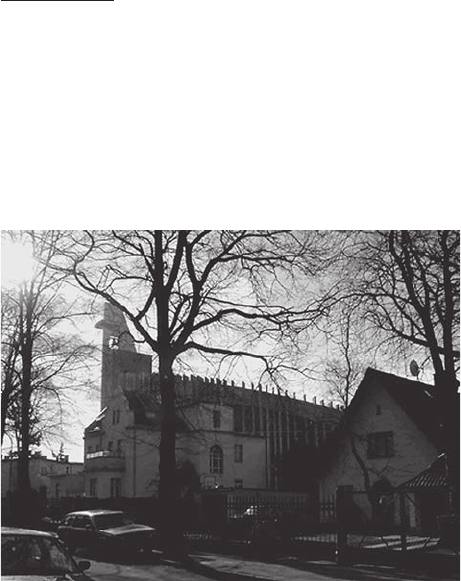
Holy Cross Church, designed by architect Z. Abra-
chamowicz 1974, H. Wieniawskiego Street in Szczecin,
Pogodno District (Fig. 1).
The church was built under the pretext of the develop-
ment of the existing church which was situated in the pre-
war villa district and was one of the rst realisations after
World War II. The new church was based – as the central
foundation – on the projection of a circle. The old church
was built on the rectangle plan – it now performs the func-
tion of the chapel
[2, p. 21]. The architectural composition
of the new church, which was based on shaping the form
by means of a pavilion roof based on a contrastively dif-
ferent structure of the external walls – integrated totally
the forms of the old and new churches. The old church
was frontally divided with the wall joined with the new
structure and covered with one pavilion roof. Only after
entering the courtyard can we see the original southern
façade of the old church nave [2]. The external walls at
the presbytery and opposite sides are built of columns
and they are completely openwork lled with colourful
stained-glass. The other walls are full (only with small
windows in the basement) with a clear curve of the roof,
which distinguished the church from the nearest sur-
roundings. The structure presents a unique situation of the
so called forced location which was overwhelmed by the
buildings standing there for years. The design is an indi-
vidual approach to the church structure whose originality
determines a connection with the place, but this does not
reect its character and places it in the row of the street
frontage.
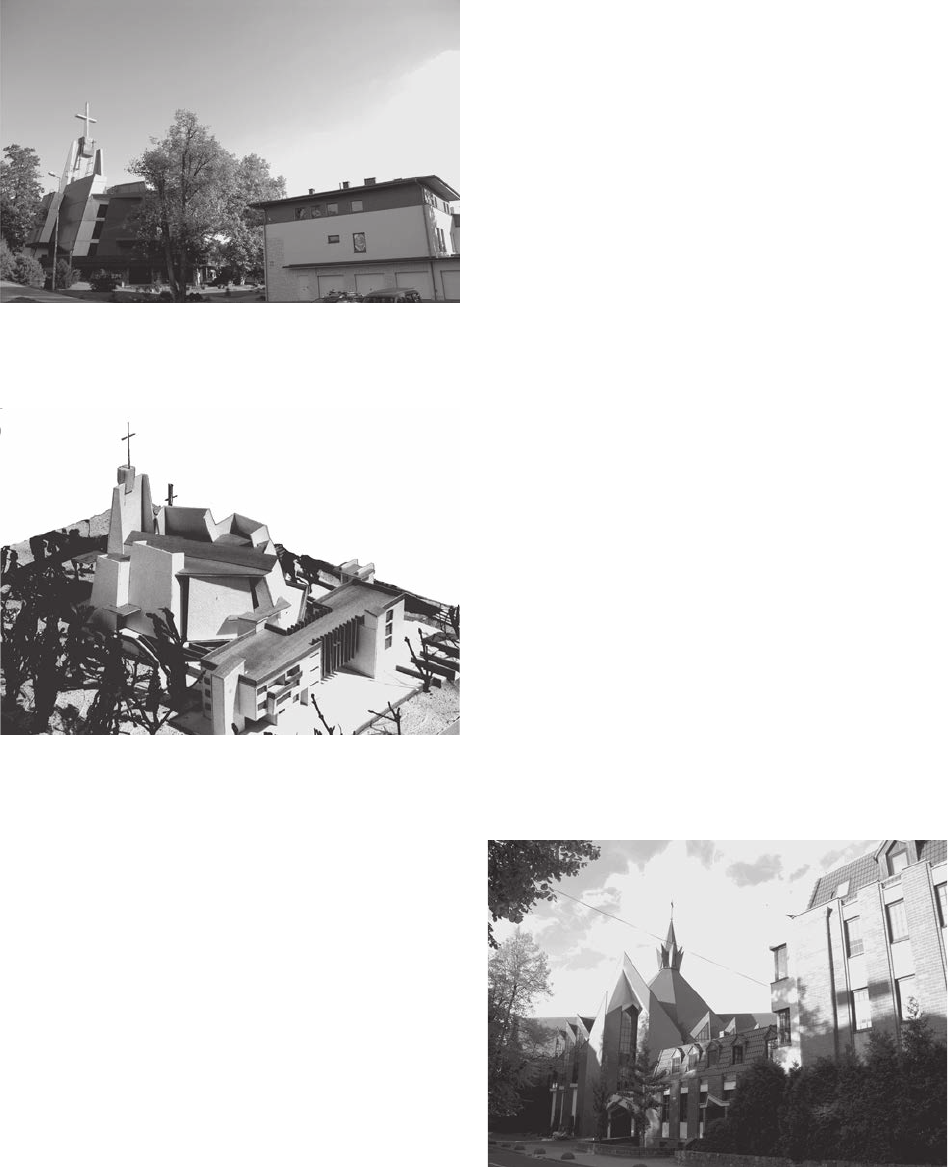
Resurrection of the Lord Church, project – archi-
tect A. Szymski, 1988 (basic structure), Książąt Po-
morskich Housing Estate in Szczecin (Fig. 2, Fig. 3 –
model).
The church was traditionally situated on the axis east–
west on the outskirts of the new housing estate. A dynamic
structure was achieved thanks to inclinations of trapezoid
Fig. 1. Holy Cross Church, designed by architect Z. Abrachamowicz.
Photo by author
Place and time – new forms of sacral architecture (examples of chosen structures from Western Pomerania...) 97
would give the visual impression of a solid foundation. The
development of this church shows lack of understanding of
the architect’s concept, his architectural assumptions and
directives. It should also be mentioned that the original
design of the parish building in the proposed arrangement
was changed into an ‘ordinary’ villa-type house with some
garages, which was designed by another author; this new
form did not correspond to the entire arrangement in any
way. It must be said that nothing destroys the architect’s
work more efciently than supplementary packaging and
the form of ‘reection’ which is not always true.
St. Dominique Church of Dominican Friars, de-
sign – architect W. Zaborowski, 1996–2000 (now, the
interior is being completed), Oar Katynia Square in
Szczecin (Fig. 4).
The complex of sacral development consists of
a church and monastery building which belong to Do-
minican fathers. The church building, which was built on
the Greek cross plan with a traditional orientation east –
west, is made of brick. A roof with a construction made
of wood glued together and covered with copper consti-
tutes a curiosity and rarity for the structures of this type
in our times. In spite of changing the previous steel struc-
ture, the present structure blends with the church interior
in a much better way. The façade was lined with clinker
tiles in the tone which corresponded with the monastery
building facades. The complex of buildings constitutes an
inseparable whole – it creates a united formation with the
surrounding residential buildings and has the same form.
The whole complex, which was designed and built with
relation to the historical tradition, was accepted by the in-
vestor who is going to realize the whole complex of sacral
structures along with the interior [1, pp. 191–206].
Fig. 2. View from Przyjaciół Żołnierza Street, Parsonage and Divine
Mercy Church. Photo by author
Fig. 3. Model – north–west view of the catechistic-ofce-residential
complex, from collections of A. Szymski – design’s author
Fig. 4. Dominique Church of Dominican Fathers, Oar Katynia
Square, Szczecin. Photo by author
planes connected with the chapel in the shape of a round
‘tent’. The effect of installing the skylight in the ceiling
gave southern light directed at the nave while the side
skylights collect light from various sides [4, pp.467–471].
Colourful play of lights creates a unique, calm and atmos-
phere. The church blends in with high blocks of ats of
the housing estate and dominates with its interesting ar-
chitecture. The change from the original Resurrection of
the Lord Church into Divine Mercy Church undoubtedly
inuenced the nal appearance of the church structure.
The initial concept of the building form was supposed to
resemble a cracking rock massif which symbolised the
act of resurrection. However, changes of parish priests
and their new ideas regarding the nal appearance of the
structure as well as nancial limitations resulted in chang-
es of the original assumptions. In spite of this, a general
structure of the church preserved its form. Działoszyński
Travertine lining was supposed to be a façade material
(with the nal effect of golden colour patination) but it
was replaced by a trapezoid sheet in red colour, which
absolutely does not correspond with the nature of the
structure.
Apart from this, the formal idea of the design was not
put into effect completely – the whole form of the structure
was supposed to grow from irregular granite blocks, which
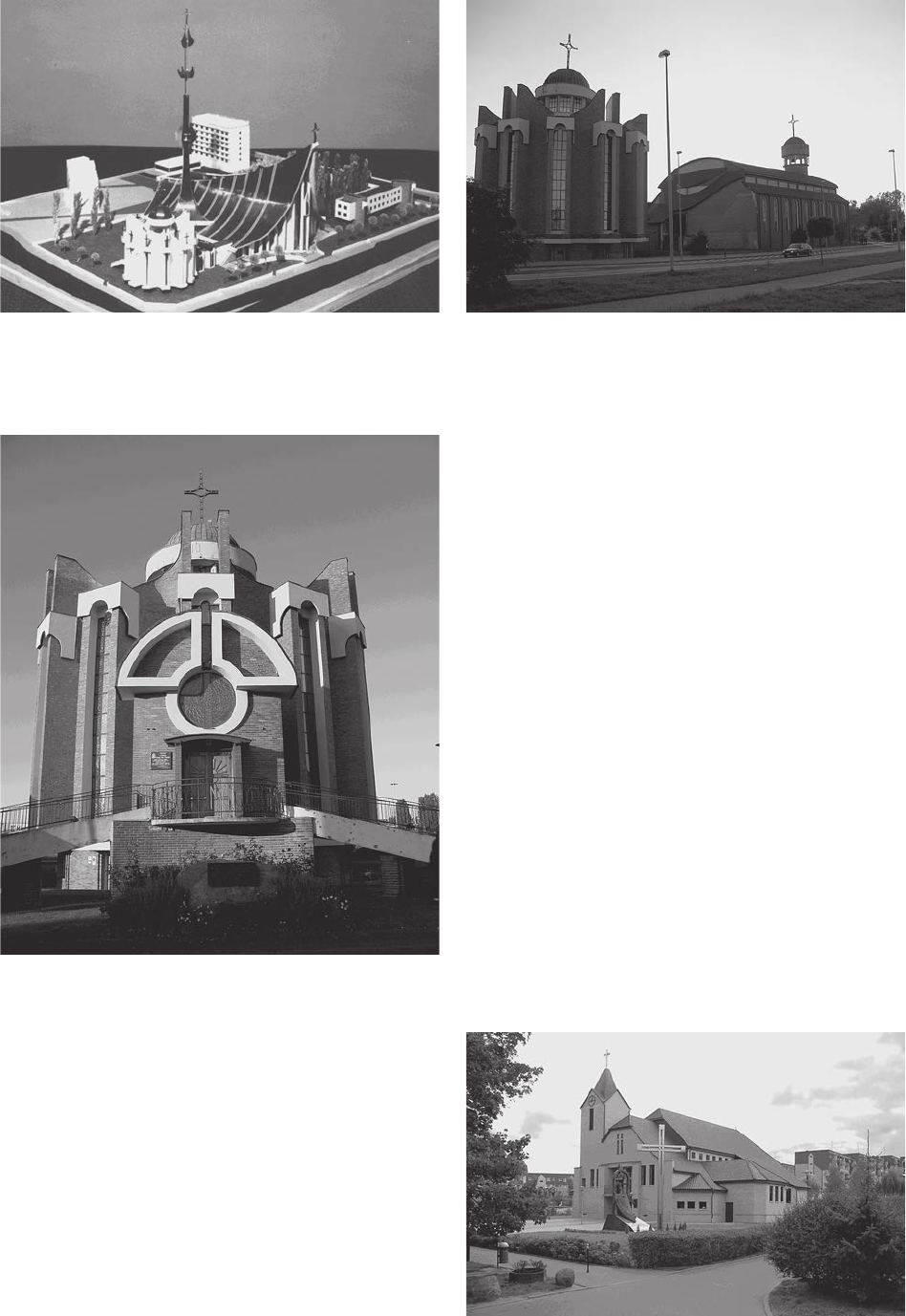
Fatima Mother of Jesus Chapel at Immaculate
Heart of Blessed Virgin Mary Church, design – archi-
tect A. Szymski, architect M. Rozwarski, 1987–1988,
Słoneczne housing estate in Szczecin (Fig. 5 – model,
Fig. 6, 7).
The Chapel, which is situated by the main exit route
from Szczecin, with its concise structure, refers to the ro-
98 Dorota Janisio-Pawłowska
tunda which relates to the past as well as to the future
(Fig. 5). The use of natural light which enters the interior
of the structure from almost each side of the world through
stained-glass windows provides interesting light effects.
The main building material of the sanctuary is brick and
concrete which give the impression of a solid foundation
of the whole building. The main entrance, which is situat-
ed a little above the ground level, creates the atmosphere
of grandness and seriousness, while the undeveloped area
around the chapel makes an impression that the founda-
tion is not completed. The chapel interior, which is lled
with strange light and warm colour, intensies the sacrum
atmosphere (Fig. 5). The whole foundation (Fig. 5) was
supposed to consist of a complex of sacral buildings but
unfortunately, only the chapel was realised out of the pre-
sented architect’s vision. The sanctuary already by anoth-
er author (M. Rozwarski) was built some time later and it
has a completely different character. It does not refer to
the original idea in anything and does not create a compo-
sitional entirety with the chapel.
Jesus Good Shepherd Church, design – architect
Anna Zaniewska, Bukowe housing estate, Szczecin
(Fig. 8).
Construction of the church started on 4
th
July 2000.
Now, it is totally nished along with the interior details.
The structure of the church was accomplished by the tow-
er and the whole structure, which is dubiously founded
in the cultural landscape, does not shock with innovative
solutions. The main material is brick which connects the
past with the tradition. It is easy to guess the function of
the building and the structure really performs its role of
the house of God very well. The door is a real curiosity –
heavy and full of religious symbols – shows the relation
between God and man as well as between earthliness and
eternity.
One of the churches located in the territory of Western
Pomerania:
Fig. 5. Model – Fatima Mother of Jesus Chapel and Immaculate Heart
of Blessed Virgin Mary Church, Słoneczne housing estate, Szczecin,
from collection of A. Szymski – design’s author
Fig. 6. Fatima Mother of Jesus Chapel and Immaculate Heart of
Blessed Virgin Mary Church, Słoneczne housing estate, Szczecin.
Photo by author
Fig. 7. Fatima Mother of Jesus Chapel at Immaculate Heart of Blessed
Virgin Mary Church, Słoneczne housing estate, Szczecin.
Photo by author
Fig. 8. Jesus Good Shepherd Church,
downloaded from: http //szczecin.kuria.pl/
Place and time – new forms of sacral architecture (examples of chosen structures from Western Pomerania...) 99
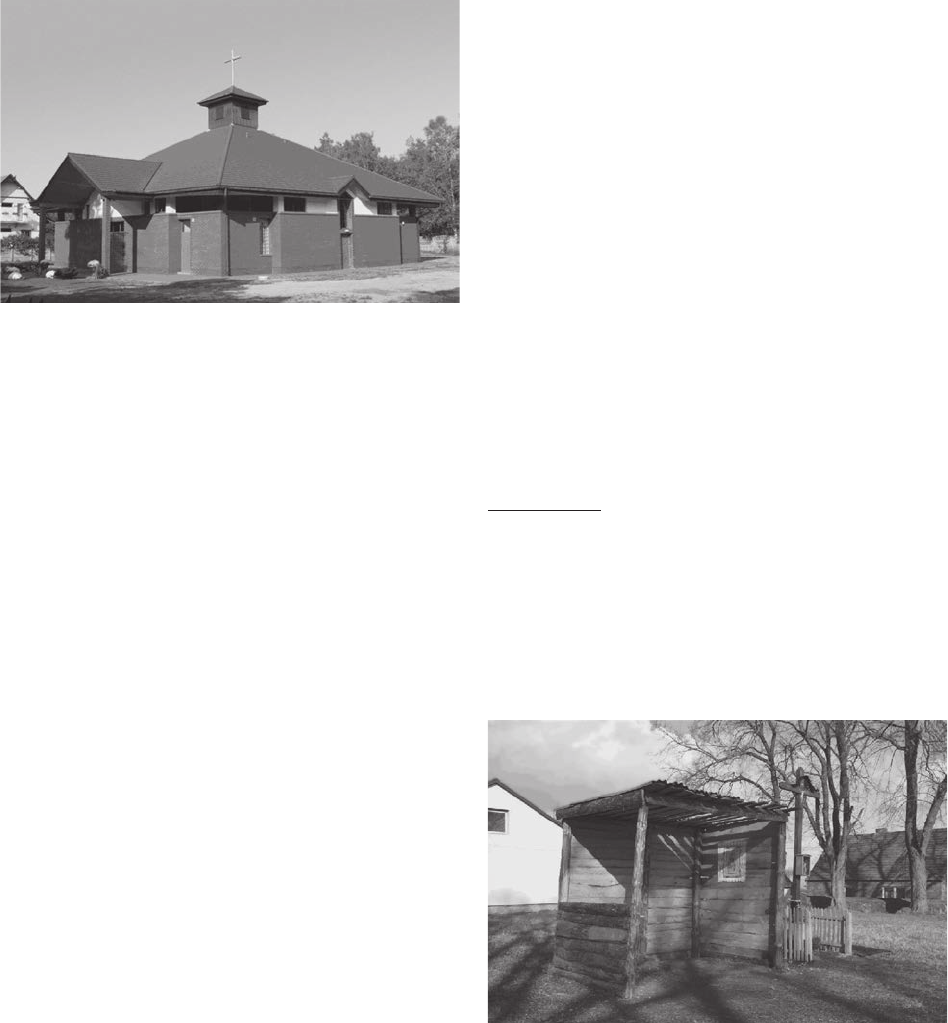
Father Pio Church, circa 2003, unknown author,
Pniewy, Western Pomerania District (Fig. 9).
The church, which has a very simple structure, was
built on the plan similar to the square. The hip roof has
a small arcade which underlines the main entrance. The
whole church was built according to the traditional tech-
nology which is typical of residential buildings, i.e. bricks,
clinker lining, roong tiles. The only element which shows
the character and intended use of the building is the cross
which is situated on top of a ‘small tower’ xed on the
roof. The whole structure blends in perfectly with the ex-
isting cultural landscape – scattered residential buildings
in a roadside village. However, does it really meet peo-
ple’s expectations at present? Is it perceived as a symbol
of sacrum?
According to Professor Konrad Kucza-Kuczyński In
Poland, 97% of all structures, which are built and treat-
ed as sacral architecture, presents non-architecture. Ugly
churches are built with people’s and priests’ consent be-
cause average of our aesthetic tastes shows that we value
richness of forms, decorations and materials above the
simplicity which is recommended by The Second Vatican
Council
5
.
The above example makes us aware that not only
splendor and wealth but also excessive simplicity may
lead to the creation of non-architecture which becomes
barely recognizable and although it expresses nothing, it
is still desired.
5
Konrad Kucza-Kuczyński, kierownik Pracowni Architektury
Sakralnej na Politechnice Warszawskiej, downloaded 9
th
October 2010
from http://rp.pl/artykul/2,350242_Kościół _in_style_hight_tech_.html,
p. 4.
Fig. 9. Father Pio Church, Pniewy district, Bukowe housing estate,
Szczecin, downloaded from: http //szczecin.kuria.pl/
Fig. 10. Beginnings of the parish in Dołuje, 2006,
downloaded from: http //szczecin.kuria.pl/
Summary
Modern sacral forms are the result of search and re-
spect for differentiated reception of art. Creating one
common view which, in fact, constitutes a specic spa-
tial form built in an intended place, is a great challenge
for the architect. Sacral buildings, which have been built
in the territory of Western Pomerania after World War II,
in their majority can be said to be a form of manifesta-
tion of individualism. The vision and a certain kind of
symbolism were connected with a timeless form and
building material as well as with innovative technologi-
cal possibilities and new materials. Looking for a con-
nection between place and time with new forms of sacral
architecture as a determinant of cultural norms being
created we must state that nowadays sacral buildings do
not possess a permanent, typical or established character
– every time different forms are created, which depend
on time, situation and nancial possibilities as well as on
the relations of the Church with congregation. Modern
church, at least apparently, gives the architectural envi-
ronment complete freedom in looking for a new canon in
working out a vision of a modern church form. However,
a mystery of sacrum (as it is traditionally understood by
the church hierarchy in the Roman-Catholic Church)
requires from an architect – according to Bishop Mar-
ian Duś – not only a talent but also mystical sensitivity
and a creative responsibility for introducing the atmos-
phere which is conducive to concentration and praying
[3, p. 2].
The idea of building a sacral structure gives unlimited
possibilities and the cross itself determines the character
of such a place. The choice of an architect means the en-
trance to the creation of the church, however, a question
arises – what kind of church?
The time, place and image, which the architect
presents by telling a story about God referring in his
opinion to our spirituality, give the effect in form of
a new sacral architectural structure. However, is there
any context of place and time for this type of architec-
ture nowadays or is it only the architect’s desire of self-
realisation, who does not care about many centuries cul-
tural landscape and goes beyond the accepted ‘norms
of culture’ for this type of structures in a newly created
space?
100 Dorota Janisio-Pawłowska
References
[1] Budownictwo sakralne i monumentalne ’2000, Dział Wydawnictw
i Poligrai Politechniki Białostockiej, Białystok 2000, pp. 191–206.
[2] Nekanda-Trepka J., Książka o Parai Św. Krzyża, Szczecin 2006,
p. 21, 9
th
October 2010 downloaded from http://www.krzyz.yoyo.pl/
Ksiazka_o_Parai_Sw_Krzyza.pdf/.
[3] Szymski A., Architektura sakralna przełomu wieków XX/XXI a chrze-
ścijańska idea sacrum, p. 2, 9
th
October 2010 downloaded from http:
//kgpipp.geo.uni.lodz.pl/space7/szymski.pdf/.
[4] Szymski A., Kanon formy architektonicznej w Kościele katolickim,
Wydawnictwo Uczelniane Politechniki Szczecińskiej, Szczecin 2000,
pp. 421–422.
[5] Szymski A., Rzeszotarska-Pałka M., Ignaczak-Felińska J., Pawłow-
ski W., Wieś Pomorska wczoraj i dziś, Wydawnictwo Walkowska,
Szczecin 2006, pp. 253–265.
Miejsce i czas – nowe formy architektury sakralnej (przykłady wybranych obiektów
z terenu Pomorza Zachodniego jako wyznacznik tworzących się nowych norm kulturowych)
Architektura sakralna minionych stuleci ściśle nawiązywała do stylu
obowiązującego ówcześnie w danym obszarze kulturowym i była wy-
znacznikiem typologicznym danego regionu, a jednocześnie świadczyła
o poziomie „kultury w architekturze”. Przemiany społeczno-gospodarcze,
postęp cywilizacji, który nastąpiły po II wojnie światowej, oraz zmiany
kulturowe na terenie Pomorza Zachodniego, które były efektem napływu
na ziemie odzyskane „Nowych Osadników”, stały się wyznacznikiem
dla tworzących się nowych norm kulturowych. Czynnikiem mającym
mającym niewątpliwie wpływ na kreację form sakralnych były uchwały
II Soboru Watykańskiego, przepisy kodeksu ‘Prawa Kanonicznego”
oraz ustalone na Konferencji Episkopatu Polski 25.01.1973 r. „normy
postępowania w sprawach sztuki Kościelnej obowiązujące na terenie
całego kraju. Poddając kwerendzie obiekty sakralne na terenie Pomorza
Zachodniego i samego miasta Szczecina należy zaznaczyć, iż po II
wojnie światowej tylko w granicach tej jednej aglomeracji miejskiej
powstało ponad dwadzieścia nowych obiektów kultu religijnego obrzędu
rzymskokatolickiego
W pracy omówiono przykłady z różnych terenów Szczecina zarówno
usytuowane w historycznym obszarze miasta, jak również na terenie
nowo powstałych osiedlach mieszkaniowych . Wskazując na stopień ich
powiązania z zastanym krajobrazem kulturowym wraz z oceną spójności
pomiędzy zamierzeniem projektowym a faktyczną realizacją.
Key words: church, sacral architecture Słowa kluczowe: kościół, architektura sakralna