2026
3(87)
Radosław Kimsza*, Giuseppe Midili**
Post-conciliar sacred architecture: between theory and practice
– a case study
DOI: 10.37190/arc260303
© by the Author/Authors. Licensee WUST.
Published in open access. CC BY-NC license.
Abstract
The post-conciliar sacred architecture in Poland remains a eld of research requiring further investigation from the perspectives of both the history
and theory of architecture and the theological and liturgical reection. The aim of this article was to identify the fundamental urban planning and ar-
chitectural principles derived from the documents of the Catholic Church relating directly or indirectly to the sacred architecture and to examine their
application through the case study of the Church of Our Lady of Fatima in Białystok, designed by the architect Andrzej Nowakowski. The research was
conducted within two paths: rst – using the critical analysis of the Church documents and the second – the architectural analysis of the chosen building.
The study examined, among other aspects, the church’s location, orientation, the form, bell towers, the portal and the entrance zone, materials, lighting,
acoustics, and accessibility. The analysis demonstrates that the building fulls a lot of the recommendations associated with the post-conciliar sacred
architecture, particularly with regard to liturgical functionality, accessibility, and the hierarchical organization of the space, retaining numerous refer-
ences to traditional forms of church architecture. The church thus represents an example of the search for a balance between the contemporary liturgical
requirements and the historical heritage of ecclesiastical architecture.
Key words: sacred architecture, sacred space, architectural theory, post-conciliar architecture
Introduction
The post-conciliar sacred architecture of the Catholic
Church in Poland constitutes an important yet still insu-
ciently explored eld of research, both from the perspective
of the history and theory of architecture and from that of
theological and liturgical reection. From a normative per-
spective, the space of a church or chapel should, through
its architectural and structural solutions, express theologi-
cal content and semiotic meanings while at the same time
remaining functionally subordinated to the requirements of
the liturgy.
The liturgical reform of the Second Vatican Council i n-
tro duced fundamental changes in the understanding of the
space of celebration, confronting architects with new chal-
lenges related both to the design of new buildings and to the
adaptation of existing structures to reformed norms (Schloe-
der 1998). One of the key issues was the absence of a sin
-
gle, systematically developed body of technical and archi-
tectural guidelines analogous to the post-Tridentine treatise
Instruc
tiones fabricae et supellectilis ecclesiasticae, prepared
at the initiative of Cardinal Carlo Borromeo (Krasny, Kurzej
2013, 2021; Nadrowski 2000, 60). Attempts by local Churches
to develop such norms did not result in the establishment of
universally binding principles.
The aim of this article is to identify the fundamental ur-
ban planning, architectural, and theological-liturgical prin-
ciples shaping post-conciliar sacred architecture and to
con front them with design practice through a case study of
the Church of Our Lady of Fatima in Białystok. The study
therefore addresses the relationship between the normative
theory of sacred architecture, as derived from Church doc-
uments, and its concrete architectural realization.
* ORCID: 0000-0002–8504–5616. Faculty of Architecture, Bia -
łystok University of Technology, Poland, e-mail: r.kimsza@pb.edu.pl
** ORCID: 0009-0009-4418-5952. Pontical Liturgical Institute,
Rome, Italy.
28 Radosław Kimsza, Giuseppe Midili
State of research
Contemporary Church documents primarily formulate
theo logical and liturgical principles, leaving considerable
scope for interpretation regarding formal and stylistic solu-
tions (Giles 1999, 18).
Consequently, no uniform stylistic canon of sacred ar-
chitecture emerged after the Second Vatican Council. This
phenomenon is reected in the considerable diversity of ar-
chitectural realizations, ranging from modernist and mini -
malist approaches to designs that consciously reinterpret
hi storical models of sacred space.
In the Polish context, a noteworthy contribution to the stu -
dy of sacred architecture is Architektura VII Dnia [Seventh-
Day Architecture] (Cichońska, Popera and Snopek 2016),
which analyzes Catholic sacred buildings erected during
the period of the Polish People’s Republic (PRL). Another
important contribution to the research on the contempo-
rary sacred architecture is Cezary Wąs’s monograph Anty-
nomie współczesnej architektury sakralnej [Antinomies of
Contemporary Sacred Architecture] (Wąs 2016), which
addresses tensions between tradition and modernity while
highlights the complexity of contemporary formal and con-
ceptual explorations in church architecture.
However, a signicant research gap appears to concern
the later period of the development of Polish sacred archi-
tecture, particularly from an architectural-theological per-
spective. The present study addresses this gap through an
analysis of the Church of Our Lady of Fatima in Białystok
(1999–2011), designed by Andrzej Nowakowski. To date,
this church has not been the subject of a comprehensive
theological and architectural study.
Methods
An in-depth analysis of documents of the Catholic Church
(relating directly and indirectly to the sacred architecture)
was conducted, using the method of critical source analy-
sis and a hermeneutical approach, taking into account their
theological and liturgical context. The analysis emphasizes
the possibility to identify and systematize the fundamental
principles of an urban, architectural, and theological nature.
Subsequently, using comparative and interpretative analy-
sis, an attempt was made to identify the application of these
principles within a specic architectural design solution.
Results
The analysis covers the identication of ways in which
the fundamental urban planning, architectural, and theolog-
ical-liturgical principles are reected in a specic design
solution. The results are presented with reference to the
successive elements shaping the architecture of the church
under study, taking into account both their functional and
compositional dimensions, as well as their symbolic sig-
nicance and relationship to the tradition of the sacred ar-
chitecture.
Location
The primary criterion for selecting the location of a Ca-
tholic church is its accessibility to the community of the
faithful, understood as the principle of “communal central-
ity” (Codex, canons 1214–1215). This principle implies lo-
cating a place of worship within the compact structure of
a residential area and ensuring the pedestrian accessibility
while avoiding its spatial isolation (Bergamo, Elberti and
Los 1994).
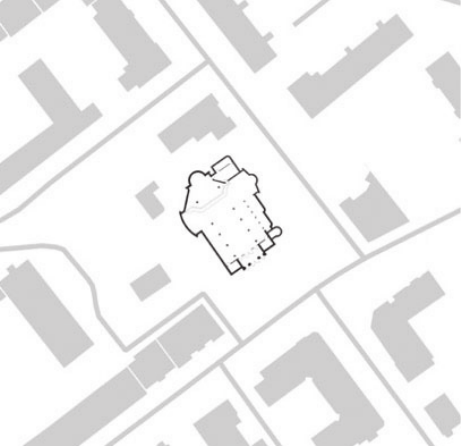
The Bojary district of Białystok, where the church under
study is located, is characterized by a diverse urban struc-
ture comprising both historic and contemporary deve lop-
ment. The church is situated in its central part, which cor-
responds to the principle of accessibility. At the same time,
however, its relationship with the surrounding environment
reveals signicant limitations in terms of the urban the
composition (Fig. 1).
The building is not connected to clearly dened visual
axes or directional systems within the public space. There
is also no clearly dened forecourt or square that would
organize the perception of the church and integrate it into
the urban structure of the district as an element of public
and symbolic signicance. Consequently, the church does
not function as a spatial landmark; its visual impact is lim-
ited to its immediate surroundings, and its visibility within
more distant visual relationships remains restricted.
From the perspective of the criteria derived from the
Church documents and the tradition of locating churches
within their urban context, this situation may be interpreted
in dierent ways. On the one hand, the principle of accessi-
bility and integration within the structure of the local com-
munity has been fullled. On the other hand, the lack of
clear spatial and symbolic distinction weakens the church’s
function as a sign of the presence of the sacred within the
Fig. 1. The church of Our Lady of Fatima in Białystok:
urban context
(elaborated by K. Fuszara-Matyszewska, 2026)
Il. 1. Kościół pw. Matki Bożej Fatimskiej w Białymstoku,
kontekst urbanistyczny
(oprac. K. Fuszara-Matyszewska, 2026)
Post-conciliar sacred architecture: between theory and practice – a case study 29
urban environment. This may indicate both limitations re-
sulting from planning conditions and the existing urban
fabric, as well as a deliberate departure from the model of
the church as a dominant urban landmark in favor of a more
“inclusive” approach, integrated into its spatial context.
In this sense, the church under study may be situated at
the intersection of two paradigms: the traditional one, in
which the church constitutes a clearly identiable landmark
within the structure of the city, and the post-conciliar one,
which emphasizes its integration with the everyday living
space of the community.
Orientation of the church
The orientation of a church is one of the classical issues
in the sacred architecture, rooted both in the theological
tradition and building practice. Historically, the prevailing
principle was ad orientem, according to which a sanctuary
was located on the eastern side, facing the rising sun-a sym-
bol of Christ, the Resurrection, and the Parousia. Although
the documents of the Second Vatican Council do not estab-
lish explicit norms regarding the geographical orientation
of a church, neither do they abolish this tradition, leaving
it within the sphere of recommendations of symbolic and
cultural signicance (Hani 1994, 45).
In the post-conciliar approach, the emphasis shifted from
cosmic orientation to congregational orientation,
under-
stood as the organization of space around the liturgical
assembly and the altar as its focal point (Ogólne wprowa
-
dzenie 2004, no. 299). Consequently, the signicance of
geogra phical orientation became secondary to the clarity
of the functional and liturgical arrangement and the active
participation of the faithful (Ratzinger 2012, 69).
The church under study does not unambiguously follow
the principle of ad orientem. As a consequence of the sur-
rounding street layout, the church is oriented along an axis
running approximately from northwest to southeast. This
means that the sanctuary faces roughly southeast rather
than due east. It may therefore be said that the church is not
oriented in the strict, classical sense, although its sanctu-
ary is partially directed towards the east. This arrangement
reects a broader tendency in the contemporary sacred ar-
chitecture to subordinate the spatial organization to urban
and functional conditions. The compositional axis of the
building results primarily from the geometry of the site and
its relationship with the surrounding development rather
than from a symbolic orientation towards cardinal points.
From the theoretical perspective, this situation may be
interpreted as a manifestation of a transition from a sym-
bolic-cosmic model to a communal-liturgical one. Whereas
in the traditional approach orientation served as a vehicle
for theological meanings rooted in Christian cosmology, in
the post-conciliar architecture its role is partly assumed by
a spatial arrangement centered on the altar and by relation-
ships between the celebrant and the assembly.
This does not, however, imply a complete loss of signif-
icance for orientation. In the case under study, the absence
of a clearly dened orientation may be interpreted as weak-
ening of the symbolic dimension of space, particularly in
the context of the tradition of the sacred architecture. At the
same time, local site conditions must be considered, as they
often determine, in architectural practice, a departure from
canonical orientation.
Consequently, orientation should be regarded as a com-
plementary category rather than an absolute design prin-
ciple: as a potential bearer of meaning whose presence or
absence inuences the perception and interpretation of sa-
cred space.
Form
The analysis of the church’s form can be further devel-
oped by referring to the classical typologies of the sacred
architecture, among which the longitudinal (axial) and
central plans are of fundamental importance. The former
is based on an axial and directional organization of space,
leading from the entrance towards the sanctuary and there-
by emphasizing the processional dimension of the liturgy.
The latter, by contrast, organizes space around a single cen-
tral point-most commonly the altar-thus emphasizing the
communal and assembly-oriented character of the celebra-
tion (Kieckhefer 2004, 84).
This principle is further reinforced by Inter Oecumenici,
which states that, in the construction of new churches and
the adaptation of existing ones, the consideration should
be given to their suitability for the celebration of liturgical
rites and to enabling the active participation of the faithful
(Święta Kongregracja Obrzędów 1964, no. 90).
The Church of Our Lady of Fatima in Białystok does not
represent a pure realization of either of these models. Built
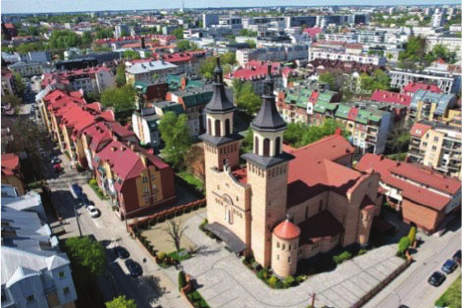
on a Latin-cross plan, the church has a three-aisled pseudo-
basilican layout with side chapels (Fig. 2). On the one hand,
a clearly dened directional axis organizes the movement
of the faithful and the relationship between the entrance
and the sanctuary, thereby placing the building within the
basilican tradition. On the other hand, the expansion of the
space at the intersection of the nave and transept, togeth-
er with the emphasis on the assembly gathered around the
Fig. 2. Aerial view of the church of Our Lady of Fatima in Białystok
(photo by Padre, source: https://mbfatimskiej.archibial.pl/galeria/5-
budynek-kosciola -z-nbsp-gory; accessed: September 5, 2026)
Il. 2. Kościół pw. Matki Bożej Fatimskiej – widok z lotu ptaka
(fot. Padre, źródło: https://mbfatimskiej.archibial.pl/galeria/5-budynek-
kosciola -z-nbsp-gory; data dostępu: 5 września 2026)
30 Radosław Kimsza, Giuseppe Midili
may be described as transitional, reecting broader tenden-
cies in the sacred architecture at the end of the 20
th
and the
beginning of the 21
st
century, which sought to strike a bal-
ance between the heritage of tradition and requirements of
contemporary liturgy.
Bell towers
The bell tower is one of the most recognizable elements
of the sacred architecture, serving both functional and sym-
bolic purposes. In the ecclesiastical tradition, the tower
has carried vertical symbolic meanings, pointing towards
transcendence while also functioning as a landmark within
the urban structure. At the same time, the function of bells,
associated with the rhythm of liturgical and social life, en-
dowed the tower with a communicative dimension (Hani
1994, 73).
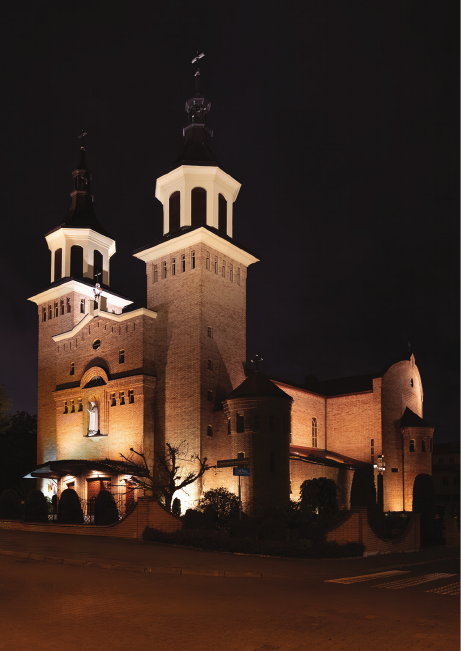
In the Church of Our Lady of Fatima in Białystok, the
function of bell towers is performed by two symmetrical
towers anking the façade (Fig. 3). This solution refers to
the traditional scheme of a twin-towered façade found in
Western European architecture, although it has been rein-
terpreted through a simplied formal language.
In their lower sections, the church towers are rectangular
in plan, while their upper sections transition are into octag-
onal prisms. Their walls are pierced by rectangular open-
ings with semicircular arches. The towers are crowned with
decorative domes and lanterns, whose stylistic form clear-
ly-albeit in a simplied manner-refers to late Renaissance or
Baroque solutions. The proportions of the towers emphasize
verticality, thereby reinforcing the symbolic dimension of
“ascending”. At the same time, the use of brick as the prima-
ry material integrates them into the coherent architectural
language of the entire building, reducing formal contrast.
From the urban perspective, the role of the bell towers as
spatial landmarks remains limited. Despite their height and
prominent compositional position alongside the façade,
their visual impact is constrained by the surrounding devel-
opment and the absence of connections with major visual
axes. Consequently, their function as orienting elements
within the urban space is weakened.
From the typological perspective, the use of a twin-tow-
er arrangement may be interpreted as a deliberate reference
to tradition, intended to reinforce the building’s recogniz-
ability as a church. At the same time, the reduction of a dec-
orative detail and the simplication of form correspond to
the post-conciliar tendency towards a more synthetic use of
architectural expression.
The evaluation of this solution remains ambiguous. On
the one hand, the bell towers eectively establish a vertical
accent and introduce a symbolic element into the composi-
tion of the building. On the other hand, their limited urban
visibility and the lack of a stronger relationship with public
space mean that their potential as landmarks and signs of
the sacred is not fully realized.
Consequently, the bell towers of the church under study
may be regarded as elements that are formally and symbol-
ically justied, yet whose impact is partially neutralized by
the spatial context and the manner in which they are inte-
grated into the surrounding urban structure.
altar, indicates an attempt to achieve a partial centralization
of the spatial arrangement.
The external form, however, does not clearly express
this typological duality. The absence of a readily legible
cor respondence between the internal layout and the ex
-
ternal form means that an observer receives no clear in-
dication of the organization of the liturgical space. Unlike
traditional basilicas, in which the external form distinctly
articulates the division between the central nave and the
side aisles, or centrally planned churches, characterized by
a compact and symmetrical form, the building under study
employs a more complex and heterogeneous composition
of volumes.
From the critical perspective, this hybrid arrangement
may be interpreted as an attempt to reconcile two para-
digms: the traditional model, based on axiality and spatial
hierarchy, and the post-conciliar model, emphasizing the
communal character of the liturgy and the congregation’s
focus around the altar. This solution potentially provides
greater functional exibility and a richer spatial experience;
however, it also carries the risk of losing compositional
clarity and weakening symbolic legibility.
In the case under study, hybridity does not result in
a complete typological synthesis but rather in the coexis-
tence of two spatial orders that do not always remain in
a harmonious relationship. Consequently, the church’s form
Fig. 3. Twin-towered façade of the Church of Our Lady of Fatima
in Białystok (photo by M. Nowakowski, 2026)
Il. 3. Dwuwieżowa fasada kościoła pw. Matki Bożej Fatimskiej
w Białymstoku (fot. M. Nowakowski, 2026)
Post-conciliar sacred architecture: between theory and practice – a case study 31
Portal
The church portal constitutes an important element of
the architectural composition, serving both functional and
symbolic purposes. In the tradition of the sacred archi-
tec ture, the entrance to a church has been interpreted as
a threshold (limen) between the realms of the profane and
the sacred, an understanding reected in its distinctive for-
mal and iconographic articulation (Hani 1994, 87; Waw-
rzyniak 1996, 70).
Although the Church documents do not formulate de-
tailed regulations concerning the design of portals, they
emphasize the signicance of the entrance area as a place
of preparation for participation in the liturgy. The portal,
to gether with a possible vestibule or narthex, functions as
a transitional zone, enabling a shift in the perception of
space and introducing the faithful into the sacred realm
(McNamara 2009, 39–50).
In the church under study, the portal is clearly distin-
guished as a dominant compositional element of the build-
ing, although not as emphatically as in the historical styles
of the sacred architecture. The entrance to the church is
distinctly emphasized within the structure of the façade,
ensuring its legibility at both the architectural and urban
scales. The emphasis on the entrance axis, together with the
forecourt and the entrance zone, gives the act of crossing
the threshold a certain symbolic potential, although this po-
tential does not appear to have been fully developed, possi-
bly for economic reasons.
From the compositional perspective, the portal does
not play a decisive role in organizing the perception of the
building, nor does it constitute a clear culmination of the
approach axis. Unlike historical solutions, in which the en-
trance was often strongly articulated through form, scale,
and detail, its expression in the church under study remains
restrained and subordinate to the overall composition of
the building.
The evaluation of this solution may therefore be ambi-
guous. On the one hand, the reduced expressiveness of the
portal corresponds to the post-conciliar tendency towards
the reduction of formal hierarchies and the greater inte-
gration of sacred space with its surroundings. On the oth-
er hand, weakening the visual prominence of the entrance
may contribute to the loss of a clearly articulated boundary
between the secular and the sacred space, a distinction that
traditionally possessed considerable symbolic and func-
tional signicance in church architecture.
Consequently, the portal of the Church of Our Lady of
Fatima may be interpreted as an element characterized by
a minimalist semantic expression, serving a predominant-
ly functional rather than symbolic role associated with the
idea of transition and entry into the realm of the sacred.
Entrance zone
In the tradition of sacred architecture, the relationship
between a church and its surrounding space has played an
important role, including its relationship with the cemetery
as a place of remembrance and of continuity within the com-
munity of the faithful. Historically, such space constituted an
integral element of the sacred complex, forming a transitio -
nal zone between the profane and the sacred (Rabiej 2018).
In the case under study, the absence of a direct relation-
ship between a church and a cemetery reects contempo-
rary practice, largely determined by sanitary regulations,
which se parates liturgical and funerary functions. The role
of the tran sitional zone is assumed by the space in front of
the church entrance, formed at the ground level.
The location of the church entrance at the ground level
promotes accessibility and the ease of movement, respond-
ing to contemporary functional requirements and the prin-
ciple of inclusivity. At the same time, however, it limits the
symbolic potential associated with the sequence of entry,
reducing the experience of a gradual transition from secular
to sacred space.
Consequently, the entrance zone is primarily functional
in character, while its symbolic signicance remains re-
duced in comparison with traditional solutions, in which
the process of approaching the church constituted an im-
por tant element of the spatial composition and the liturgical
experience.
In addition to liturgical and symbolic requirements, con-
temporary sacred architecture should also take into account
functional aspects related to accessibility and circulation.
Although the Church documents do not formulate detailed
design standards in this respect, the principle of universal
accessibility to places of worship follows from the pastoral
character of the church as a space intended for the entire
community of the faithful.
An important element of site development is the provi-
sion of an adequate number of parking spaces to ensure the
ecient accommodation of participants in liturgical cele-
brations and parish events. The location of parking facili-
ties should reconcile functional requirements with the need
to preserve the dignity and legibility of the sacred space, so
that transport infrastructure does not dominate the architec-
tural and symbolic character of the complex.
The location of the parking area in the immediate vicin-
ity of the church ensures ecient access to the building;
how ever, the limited size of the site has resulted in a re-
duced number of parking spaces. This solution is sucient
for the everyday functioning of the parish, as a signicant
proportion of the faithful reach the church on foot from the
surrounding residential area. The limitations of the park-
ing sy stem become apparent during events attracting larger
num bers of participants, particularly funerals, when de-
mand for parking spaces exceeds the capacity of the site.
Con se quent ly, the functional organization of access and
parking may be assessed as adequate at the local scale but
insucient during periods of increased demand.
Accessibility for persons with disabilities also consti-
tutes an important criterion of evaluation. The contem-
porary design standards require the elimination of archi-
tectural barriers through the appropriate design of access
routes, ramps, and entrances. In the building under study,
the entrance to the church is located at the ground level, fa-
cilitating the access for persons with reduced mobility and
corresponding to the principles of universal design.
From the functional perspective, these solutions should
be assessed positively. They full the principle of univer-
32 Radosław Kimsza, Giuseppe Midili
sal accessibility to sacred space without compromising its
fundamental compositional and symbolic values. Conse-
quently, both the organization of parking facilities and the
provision of accessibility for persons with specic needs
constitute important elements of the contemporary under-
standing of the sacred architecture as a space open to the
entire community of the faithful.
Materials
The selection of materials in the sacred architecture of
the Catholic Church constitutes an important component
of architectural expression, closely related to the liturgi cal
function and symbolic signicance of space. In the post-
conciliar approach, materials do not serve merely structural
and aesthetic purposes but also participate in communicat-
ing theological content and shaping the perce p tion of the
sacred.
The documents of the Second Vatican Council empha-
size the need to preserve “noble beauty” (nobilis pulchri-
tudo) rather than mere sumptuousness or decorative excess
(Sacrosanctum Concilium 2002, no. 124). This implies a pre
-
ference for authentic, durable materials whose inherent qua -
lities and structural properties remain legible. Such an ap-
proach involves leaving imitation in favor of revealing
the properties of matter-its texture, weight, and the way it
changes over time. This principle has been applied in the
Church of Our Lady of Fatima both in its external form and
in its interior.
In the tradition of the sacred architecture, particular sig-
nicance has been attributed to materials such as stone,
wood, and brick, which, owing to their durability and natural
origin, symbolize stability, rootedness, and the relationship
between creation and the Creator. Stone, present in biblical
symbolism (Pismo Święte, 1 Pet. 2:5), may be interpreted
as a sign of the permanence of the Church. Wood, through
its associations with the Old Testament Tree of Life (Pismo
Święte, Gen. 3:22), the Ark of the Covenant (Pismo Święte,
Exod. 25:10–22), and above all the Cross, carries Paschal
connotations fullled in the Resurrection of Jesus Christ.
In the building under study, traditional materials consti-
tute a fundamental component of the architectural composi-
tion. The external form of the church is constructed primar-
ily of brick, while the interior is nished in neutral plaster.
At the symbolic level, an important role is played by white
Carrara marble, used in the sculptural elements of the sanc-
tuary, the chapels terminating the transept, and the Stations
of the Cross, thereby reinforcing the semantic hierarchy of
the space.
From the liturgical perspective, the dierentiation of
ma terials between particular zones of the interior is espe-
cial ly signicant. The sanctuary is distinguished both by
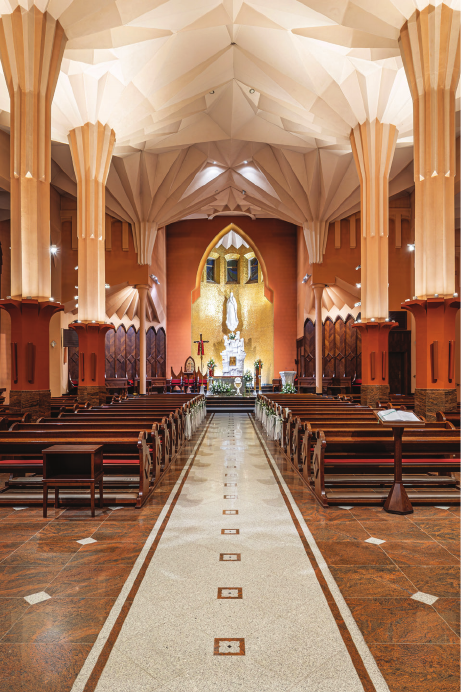
an elevated oor level and by the use of materials charac-
terized by dierent colors and a higher degree of rene-
ment-namely, marble ooring contrasting with that of the
nave and gold mosaic, deeply rooted in Christian symbol-
ism (Fig. 4). This treatment corresponds to the principle
of a clearly articulated hierarchy within liturgical space
(Ogólne wprowadzenie 2004, no. 295).
In the Church of Our Lady of Fatima, however, a certain
tension can be observed between the aspiration towards
material authenticity and formal expression. On the one
hand, the materials employed remain legible and consis-
tent with the principle of the “truthfulness of materials”.
On the other hand, their juxtaposition and manner of appli-
cation occasionally produce eects of considerable formal
intensity that do not always fully correspond to the ideal of
“noble beauty”.
Consequently, the selection of materials should be in-
terpreted not merely in technological or aesthetic terms,
but as an integral element of the theological and liturgical
composition, co-shaping the experience of the sacred space
and the manner in which it is perceived by the community
of the faithful.
Windows and natural and artificial light
Light is one of the fundamental means of shaping the sa-
cred space, serving both functional and symbolic purposes.
In the Christian tradition, it has been interpreted as a sign of
the presence of God, truth, and transcendent reality (Barrie
2016; Wierzbicka 2026, 13). Although the Church docu-
ments do not establish detailed norms regarding the form
and placement of windows, they emphasize the need to cre-
Fig. 4. The interior of the Church of Our Lady of Fatima in Białystok,
view towards the sanctuary (photo by M. Nowakowski, 2026)
Il. 4. Wnętrze kościoła pw. Matki Bożej Fatimskiej w Białymstoku
– widok w kierunku prezbiterium (fot. M. Nowakowski, 2026)
Post-conciliar sacred architecture: between theory and practice – a case study 33
From the compositional perspective, the solutions em-
ployed correspond to the post-conciliar understanding of the
sacred architecture, in which light is treated as an integral
element in the formation of the liturgical space. At the same
time, the relatively restrained use of glazing distinguishes
the church under study from many contemporary examples
in which light becomes the dominant means of architectural
expression.
Consequently, the system of natural and articial light-
ing contributes to a clearly articulated structure of the sa-
cred space, reinforcing its liturgical and symbolic functions
without allowing formal eects to become excessively
dominant.
Acoustics
Acoustics constitutes one of the fundamental, though
often
underestimated, elements of the sacred architecture.
Its importance arises directly from the requirements of the
liturgy, in which spoken word, singing, and music play an
essential role in communicating religious content and fos-
tering the communal character of celebration (Telatycka
2025, 639). The contemporary Church documents empha-
size the need to provide conditions that enable the full and
conscious participation of the faithful in the liturgy, which
ate a space conducive to prayer and liturgical celebration
(Sacrosanctum Concilium 2002, no. 124).
In the church under study, the system of window open-
ings is subordinated to the overall composition of the build-
ing. The windows are relatively modest in size and arranged
rhythmically in the upper sections of the walls, allowing for
an even distribution of daylight without excessively open-
ing the interior to its surroundings. This solution promotes
concentration on the liturgy and reinforces the sense of the
sacred space as distinct from the external world.
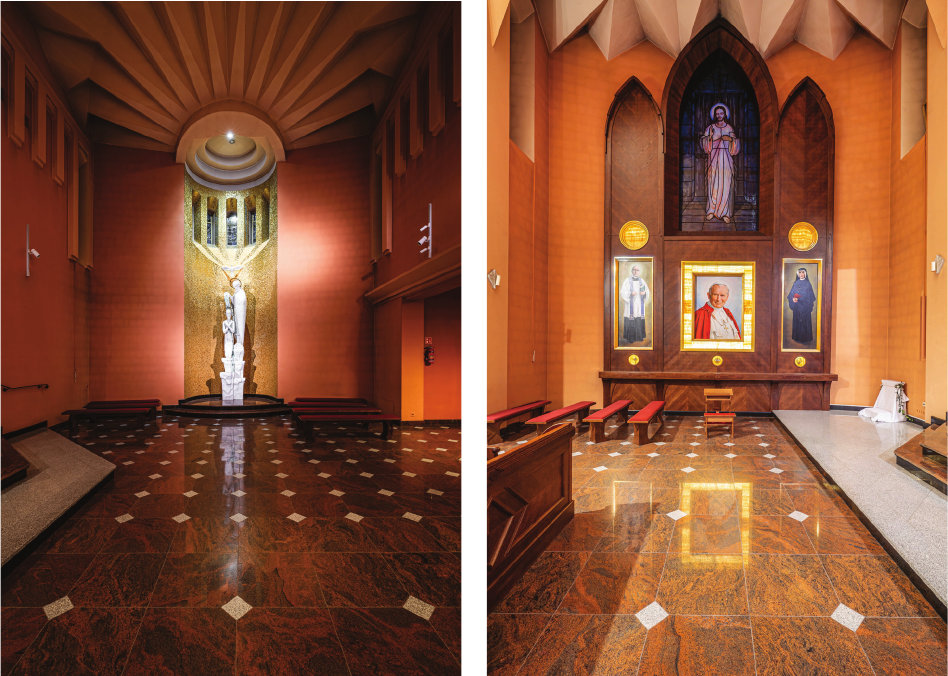
The particular importance is attached to the natural light
reaching the sanctuary. The appropriate direction and inten-
sication of illumination in this part of the interior reinforce
its liturgical signicance and contribute to the spatial hier-
archy. In this case, light functions not only as a practical
necessity but also as an element that generates symbolic
meaning (Figs. 5, 6).
Articial lighting performs a complementary role in re-
lation to natural illumination. Its purpose is to provide ap-
propriate conditions for the celebration of the liturgy and
to emphasize the most important elements of the liturgical
furnishings, such as the altar, ambo, and tabernacle. In the
building under study, articial lighting does not dominate
the space but contributes to its atmosphere by accentuating
selected functional zones.
Fig. 5. The church of Our Lady of Fatima in Białystok: side chapel
on the southern axis of the transept (photo by M. Nowakowski, 2026)
Il. 5. Kościół pw. Matki Bożej Fatimskiej w Białymstoku – kaplica
boczna w osi południowej transeptu (fot. M. Nowakowski, 2026)
Fig. 6. The church of Our Lady of Fatima in Białystok: side chapel
on the northern axis of the transept (photo by M. Nowakowski, 2026)
Il. 6. Kościół pw. Matki Bożej Fatimskiej w Białymstoku –
kaplica boczna w osi północnej transeptu (fot. M. Nowakowski, 2026)
34 Radosław Kimsza, Giuseppe Midili
The analysis of the building’s form revealed its hybrid
character. The church combines features of the tradition-
al longitudinal arrangement, derived from its Latin-cross
plan and the basilican character of the nave, with central-
izing tendencies associated with the concentration of space
around the altar and the liturgical assembly. This solution
may be interpreted as an attempt to reconcile the historical
continuity of form with the requirements of contemporary
liturgy. At the same time, the lack of complete correspon-
dence between the organization of the interior and the ex-
ternal composition of the building limits its typological and
symbolic clarity.
The important element of the façade composition con-
sists of the two bell towers, which constitute a clear ref-
erence to the traditional model of the church architecture.
Their vertical proportions and simplied forms, drawing
on historical solutions, reinforce the recognizability of the
building as a church. At the same time, the limited visibility
of the building within the urban structure means that the
potential of the bell towers as spatial landmarks and ori-
enting elements remains only partially realized. They may
the refore be regarded as an example of the deliberate use of
a traditional motif within the simplied formal language
of contemporary architecture.
The portal and entrance zone primarily full a com-
municative function, although they retain the potential to
symbolically mark the transition between secular and sa-
cred space. The portal has been clearly distinguished with-
in the structure of the façade, while the entrance forecourt
forms a basic sequence leading towards the interior of the
church. Its form, however, remains relatively restrained in
comparison with historical solutions in the church architec-
ture. Consequently, the symbolism of the threshold and the
transition into the sacred space is present but has not been
fully developed through architectural means.
With regard to accessibility and the organization of the en-
trance zone, the functional solutions should be assessed pos-
itively. The entrance, located at the ground level, minimizes
architectural barriers and corresponds to contemporary prin-
ciples of universal design. The location of the parking area
in the immediate vicinity of the church provides basic ve-
hicular access; however, the limited size of the site results in
an insucient number of parking spaces during celebrations
attended by larger numbers of worshippers. The function-
al capacity of the complex is therefore adequate for every -
day use but limited during periods of increased demand.
The analysis of materials conrmed the important role
of architectural materiality in shaping the identity of the
church. The use of brick in the external form, together with
marble and mosaic within the liturgical space, corresponds
to the principles of material authenticity and “noble beau-
ty”. The dierentiation of materials also contributes to the
spatial hierarchy, particularly within the sanctuary. At the
same time, the intensity of certain material juxtapositions
and their formal expressiveness reveal a tension between
the ideal of restraint and the desire for a more distinctive
articulation of the sacred space.
Natural and articial light are subordinated both to func-
tional requirements and to the hierarchical organization of
liturgical space. The relatively limited size of the window
also includes adequate intelligibility of spoken texts and
music (Sacrosanctum Concilium 2002, nos. 20 and 121).
In the sacred architecture, acoustic properties are shaped
by the geometry and volume of the interior, as well as by the
nishing materials employed. Traditional masonry churches,
characterized by large volumes and a signicant proportion
of sound-reecting surfaces, were conducive to choral and or-
gan music but often impaired speech intelligibility. The litur-
gical reform of the Second Vatican Council, emphasizing the
importance of the Liturgy of the Word, increased the require-
ments concerning the clarity of acoustic communication.
In the church under study in Białystok, material solutions
typical of contemporary the sacred architecture are utilized.
The extensive use of plastered surfaces, brick, and stone
promotes the reection of sound waves and contributes to
an appropriate degree of reverberation. At the same time,
the large volume of the interior requires a properly designed
sound reinforcement system to ensure the intelligibility of
liturgical texts throughout the entire church.
From the liturgical perspective, it is essential to maintain
a balance between reverberation conducive to sacred music
and the clarity of spoken communication. In the building
under study, the acoustic environment appears to be precise-
ly subordinated to this objective, responding to the contem-
porary requirements of the liturgical celebration.
Consequently, acoustic solutions should be regarded as
an integral element of the architectural composition, con-
tributing to the functionality of the sacred space and to the
quality of the faithful’s participation in the liturgy.
Conclusions
The analysis of the Church of Our Lady of Fatima in
Białystok demonstrates that the building constitutes an in-
teresting example of the contemporary sacred architecture
in which the principles arising from post-conciliar liturgical
reection have been reconciled with numerous references
to traditional forms of church architecture.
With regard to its location, the church fulls the prin-
ciples of accessibility and “communal centrality”, derived
from the pastoral understanding of the church as a place of
assembly for the faithful. Its location within the urban struc-
ture of the Bojary district ensures accessibility for the local
community; however, its limited urban visibility, together
with the absence of a clearly dened forecourt and axial
relationships, weakens its role as the spatial landmark and
as the sign of the presence of the sacred within the structure
of the city.
With regard to orientation, the church under study does
not follow the classical principle of ad orientem. The di-
rection of its principal axis has been largely determined by
the conditions of the site, the street layout, and the existing
urban fabric. At the same time, the sanctuary is partially ori-
ented towards the east. This solution reects the character-
istic shift in post-conciliar architecture from geographical
orientation towards congregational orientation, centred on
the relationship between the community of the faithful and
the altar. This does not imply a complete loss of the symbol-
ic signicance of orientation, but rather its relativization in
relation to the functional and urban conditions.
Post-conciliar sacred architecture: between theory and practice – a case study 35
openings helps maintain visual concentration within the
interior, while the illumination of the sanctuary reinforces
its signicance within the spatial structure of the church.
Articial lighting complements natural light and makes it
possible to emphasize the most important elements of the
liturgical furnishings. These solutions conrm that light is
treated as an integral means of shaping liturgical space rath-
er than merely as a functional factor.
With regard to acoustics, the spatial and material solu-
tions are subordinated to the need to maintain a balance be-
tween an appropriate degree of reverberation, conducive to
sacred music, and the intelligibility of the liturgical word.
The considerable volume of the interior and the presence
of sound-reecting surfaces create conditions favorable to
an appropriate acoustic atmosphere, while at the same time
requiring a properly designed sound reinforcement system.
Acoustics therefore constitutes an integral element of the
functional and liturgical shaping of the space.
The overall analysis conrms that the Church of Our
Lady of Fatima in Białystok represents neither a direct con-
ti nuation of historical models of sacred architecture nor
a radical break with tradition. It does constitute the exam
-
ple of the synthesis of two approaches: the traditional one,
based on axiality, verticality, hierarchy, and the symbolism
of architectural forms, and the post-conciliar one, emphasiz-
ing the communal character of the liturgy, functionality, ac-
cessibility, and the concentration of space around the altar.
The case study therefore indicates that the relationship
between theory and practice in the post-conciliar sacred
architecture cannot be understood as a straightforward ap-
plication of norms to a specic architectural design. It rath-
er appears to be a process of interpretation in which theo-
logical and liturgical principles are confronted with urban,
functional, structural, and aesthetic conditions. The exam-
ple of this church demonstrates that contemporary sacred
architecture can maintain continuity with tradition while
simultaneously reinterpreting its forms in the light of the
liturgical requirements that emerged following the Second
Vatican Council.
Translated by
Beata Wyszyńska
References
Barrie, Thomas. Spiritual Path, Sacred Place: Myth, Ritual and Meaning
in Architecture. Shambhala, 2016.
Bergamo, Maurizio, Arturo Elberti, and Sergio Los. Spazi celebrativi, g-
urazione architettonica, simbolismo liturgico: ricerca per una chiesa
contemporanea dopo il Concilio Vaticano II. Il Cardo, 1994.
Cichońska, Izabela, Karolina Popera, and Kuba Snopek. Architektura VII
Dnia. Bęc Zmiana, Biuro Festiwalowe IMPART, 2016.
Codex iuris canonici: auctoritate Ioannis Pauli PP. II promulgatus. Ko-
deks prawa kanonicznego: przekład polski zatwierdzony przez Kon
fe rencję Episkopatu. Translated by Edward Sztafrowski. Pallotti-
num, 1984.
Giles, Richard. Re-Pitching the Tent: Reordering the Church Building for
Worship and Mission. Canterbury Press, 1999.
Hani, Jean. Symbolika świątyni chrześcijańskiej. Translated by Adam Q.
Lavique. Znak, 1994.
Kieckhefer, Richard. Theology in Stone: Church Architecture from Byzan-
tium to Berkeley. Oxford University Press, 2004.
Krasny, Piotr, and Michał Kurzej, eds. Święty Karol Boromeusz a sztuka
w Kościele powszechnym, w Polsce, w Niepołomicach. DodoEditor,
Muzeum Niepołomickie, 2013.
Krasny, Piotr, and Michał Kurzej. Mediolańskie instrukcje o budynkach
i sprzętach kościelnych wydane na polecenie Karola Boromeusza
i ich recepcja w Kościele katolickim. Towarzystwo Autorów i Wy-
dawców Prac Naukowych Universitas, 2021.
McNamara, Denis R. Catholic Church Architecture and the Spirit of the
Liturgy. Hillenbrand Books, 2009.
Nadrowski, Henryk. Kościoły naszych czasów. Dziedzictwo i perspektywy.
WAM, 2000.
Ogólne wprowadzenie do Mszału rzymskiego. Pallottinum, 2004.
Pismo Święte Starego i Nowego Testamentu w przekładzie z języków ory-
ginalnych. Translated by Władysław Borowski et al., edited by Kazi-
mierz Dynarski and Maria Przybył. Pallotinum, 2020.
Rabiej, Jan. “Współczesna architektura sakralna Kościoła katolickiego –
przestrzeń Eucharystii w środowisku kulturowym.” Ruch Biblijny i Li-
turgiczny 71, no. 3 (2018): 221–36. https://doi.org/10.21906/rbl.3605.
Ratzinger, Joseph. Teologia liturgii. Sakramentalne podstawy życia chrze-
ścijańskiego. Translated by Wiesław Szymona. Wydawnictwo KUL,
Verlag Herder, Libreria Editrice Vaticana, 2012.
Schloeder, Steven J. Architecture in Communion: Implementing the Sec-
ond Vatican Council through Liturgy and Architecture. Ignatius Press,
1998.
“Sacrosanctum Concilium. Konstytucja o liturgii świętej”. In Sobór Wa ty-
kański II. Konstytucje, dekrety, deklaracje. Pallottinum, 2002.
Święta Kongregacja Obrzędów. Inter Oecumenici. Pierwsza instrukcja
o należytym wykonywaniu Konstytucji o liturgii świętej. Rzym, 1964.
Accessed August 10, 2026, at https://opoka.org.pl/biblioteka/W/WR/
kongregacje/kkultu/instrukcja_inter-oecumenici_26091964#goog_
rewarded.
Telatycka, Anna. “Dźwięk jako integralny składnik architektury sakral-
nej.” Rocznik Filozoczny Ignatianum 31, no. 4 (2025): 639–56.
https://
doi.org/10.35765/r.2025.3104.30.
Wawrzyniak, Waldemar. Sacrum w architekturze. Ocyna Wydawnicza
PWr, 1996.
Wąs, Cezary. Antynomie współczesnej architektury sakralnej. Wydawnic-
two Muzeum Architektury we Wrocławiu, 2016.
Wierzbicka, Anna Maria. “Preface.” In Light and Space: Narrative Dia
logue in Architecture, edited by Anna Maria Wierzbicka. Ocyna Wy-
dawnicza PW, 2026.
Streszczenie
Posoborowa architektura sakralna: między teorią a praktyką – studium przypadku
Posoborowa architektura sakralna w Polsce pozostaje obszarem badań wymagającym dalszego rozpoznania zarówno z perspektywy historii i teo-
rii architektury, jak i reeksji teologiczno-liturgicznej. Celem artykułu była identykacja podstawowych zasad urbanistycznych i architektonicznych
wynikających z dokumentów Kościoła katolickiego odnoszących się bezpośrednio lub pośrednio do budownictwa sakralnego oraz ich werykacja na
przykładzie kościoła pw. Matki Bożej Fatimskiej w Białymstoku, zaprojektowanego przez architekta Andrzeja Nowakowskiego. Badania przeprowa-
36 Radosław Kimsza, Giuseppe Midili
dzono metodą krytycznej analizy źródeł kościelnych oraz analizy architektonicznej wybranego obiektu. Ocenie poddano m.in. lokalizację, orientację,
bryłę, dzwonnice, portal i strefę wejściową, materiały, oświetlenie i akustykę, a także dostępność komunikacyjną świątyni. Dzięki przeprowadzonej
analizie wykazano, że obiekt spełnia wiele postulatów architektury posoborowej, zwłaszcza w zakresie funkcjonalności liturgicznej, dostępności
i hierarchizacji przestrzeni, zachowując jednocześnie liczne odniesienia do tradycyjnych form budownictwa sakralnego. Kościół stanowi przykład
poszukiwania równowagi pomiędzy współczesnymi wymaganiami liturgicznymi a historycznym dziedzictwem architektury kościelnej.
Słowa kluczowe: architektura sakralna, przestrzeń sakralna, teoria architektury, architektura posoborowa