2010
Nr 2(28)
Introduction
The areas of the European cities which were indus-
trialised during the 19
th
century cover really large ter-
rains. In the past, factories, mainly located in the suburbs
of big cities, as a result of those cities development, now
constitute the elements of their developing centres. The
appearance of those factories, which was in their major-
ity worsened by their bad technical condition, from the
Marta Rusnak*
Revitalisation without revolution.
Initial adaptation of post-industrial buildings for artistic purposes
perspective of a contemporary man may seem austere.
Factory was and still is a symbol of dynamic civilisation
development and the 19
th
-century social system. In spite
of the fact that factory has a signicant material and social
meaning as a symbol, it undergoes degradation because
it has not been used. In the 21
st
century – at the time of
growing culture globalisation – this symbol requires pro-
tection. Giving a new function to post-industrial buildings
may contribute to the individualisation of city agglomera-
tion spaces which become similar to one another.
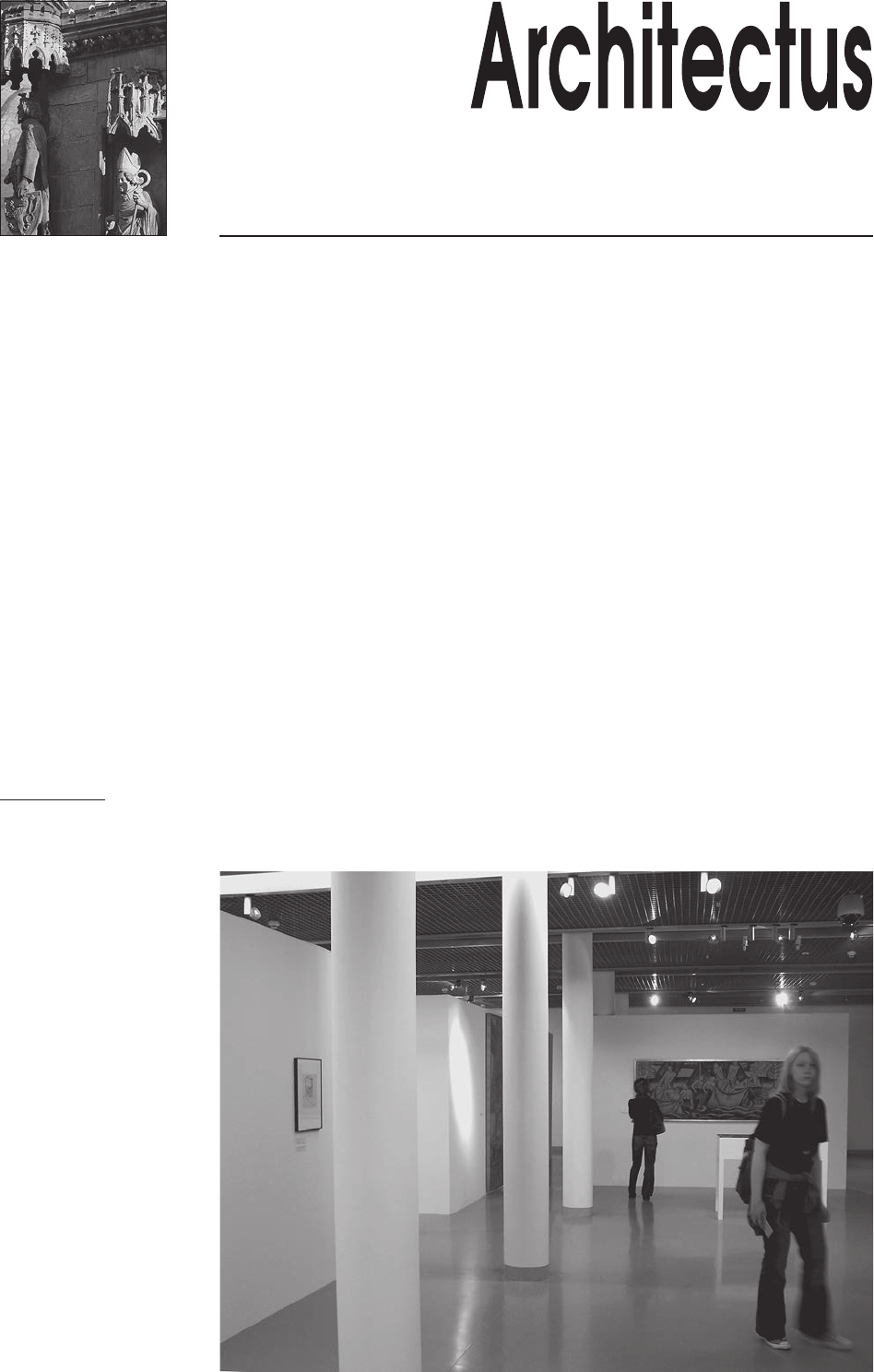
Fig. 1. Neutral interior MS2
of Museum of Modern Art
department at Ogrodowa Street.
Photo by M. Rusnak, 2010
*
Wroclaw University of Technology, Faculty of Architecture.
184 Marta Rusnak
Cultural revitalisation constitutes one of the very
popular models of reviving industrial heritage [1]. Within
the last two decades in Poland, art has become an ele-
ment which supports the processes of degraded terrains
transformations. In the colloquial understanding, the
combination of new buildings or functions with a rough
historical tissue has become very fashionable among dif-
ferent social groups. Among adaptations of old factories,
which were made in Poland for the purpose of perform-
ing culture functions, we can mention ‘Stary Browar’
(Old Brewery) in Poznań, the Museum of Modern Art
– MS2
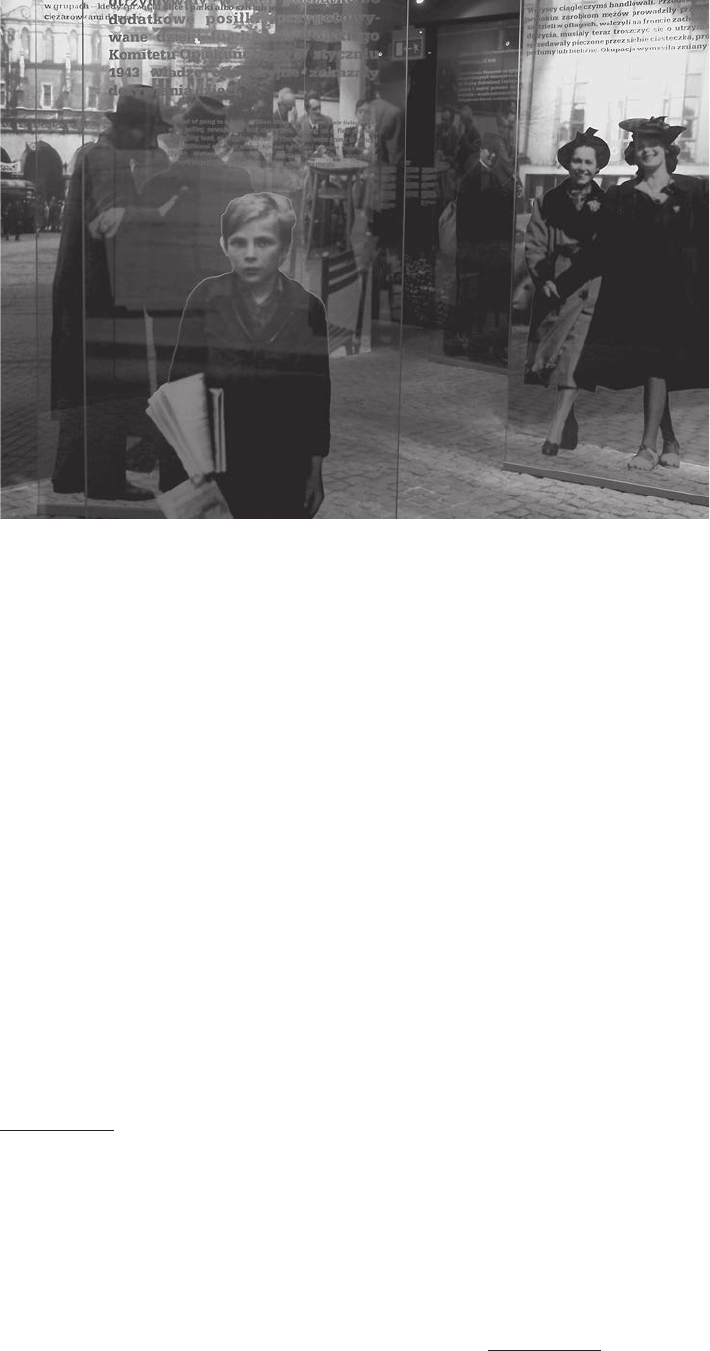
(Fig. 1), revitalisation of Oskar Shindler factory
in Zabłocie district in Cracow (Fig. 2) or rebuilding of
a closed down tram generating station for the need of
the Warsaw Uprising Museum [7]. These are the most
famous and frequently rewarded enterprises
1
and they
are very popular. Recently, they have become widely
known and even recognized by some people as icons of
1
The Warsaw Uprising Museum: ‘The best revitalisation design in
central-east Europe 2008’, a modern icon of Warsaw – a reward in the
plebiscite of Gazeta Wyborcza, 3rd prize in the Competition Museum
Events of the Year ‘Sybilla’ 2006, a special reward SARP 2005, Museum
Event of the year ‘Sybilla 2004’, Grand Prix of the Museum of Modern Art
MS2: Grand Prix 29
th
edition of the Competition ‘Sybilla’ for the Museum
Event of the Year, a reward ‘Seven Miracles of European Funds’, a reward
in the Competition of General Monuments Conservator ‘Well-groomed
Monument’, 1
st
place in 19
th
edition of the Competition “Best Interior of
the Year’ 2008, the City Museum of Cracow, department of Schindler’s
Factory: ‘Best Overseas Tourism Project’ 2010. The author, who refers to
the rewards received by the above mentioned institutions, does not aim
to assess their values. Presenting the rewards is supposed to emphasize
people’s desires, who are connected with these buildings (investors,
politicians and architects), to engage in their wide social promotion.
the Polish culture, architecture and museology develop-
ment
2
.
The introduction of culture function into the build-
ing of a closed down factory may assume an expression
which is different from the commercial one. The above
mentioned publicized enterprises required a lot of nan-
cial investments. Their designs caused a lot of emotions,
particularly in architectural environments. Decisions and
actions taken by decision makers (investors, designers
and ofce workers) during the execution of construction
works of these enterprises made many of the introduced
in this way changes look controversial. It is even more
alarming that there are no steps whatsoever taken in order
to preserve the 19
th
-century industrial heritage.
Taking into account the above mentioned examples, it
is really worth describing the phenomenon of preliminary
adaptation of unknown architectural and building inter-
vention. Lack of spectacular changes in the shape of re-
organized building results in the situation in which these
transformations – in spite of their signicant meaning –
can be easily omitted in the revitalization characteristics
of post-industrial spaces. In the article we presented three
Polish realizations of preliminary adaptations of post-in-
dustrial buildings as follows: Łódź Art Center, Art Gallery
in Bydgoszcz and ‘Artists Colony’ in the territory of the
old Stocznia Gdańska (Gdańsk Shipyard).
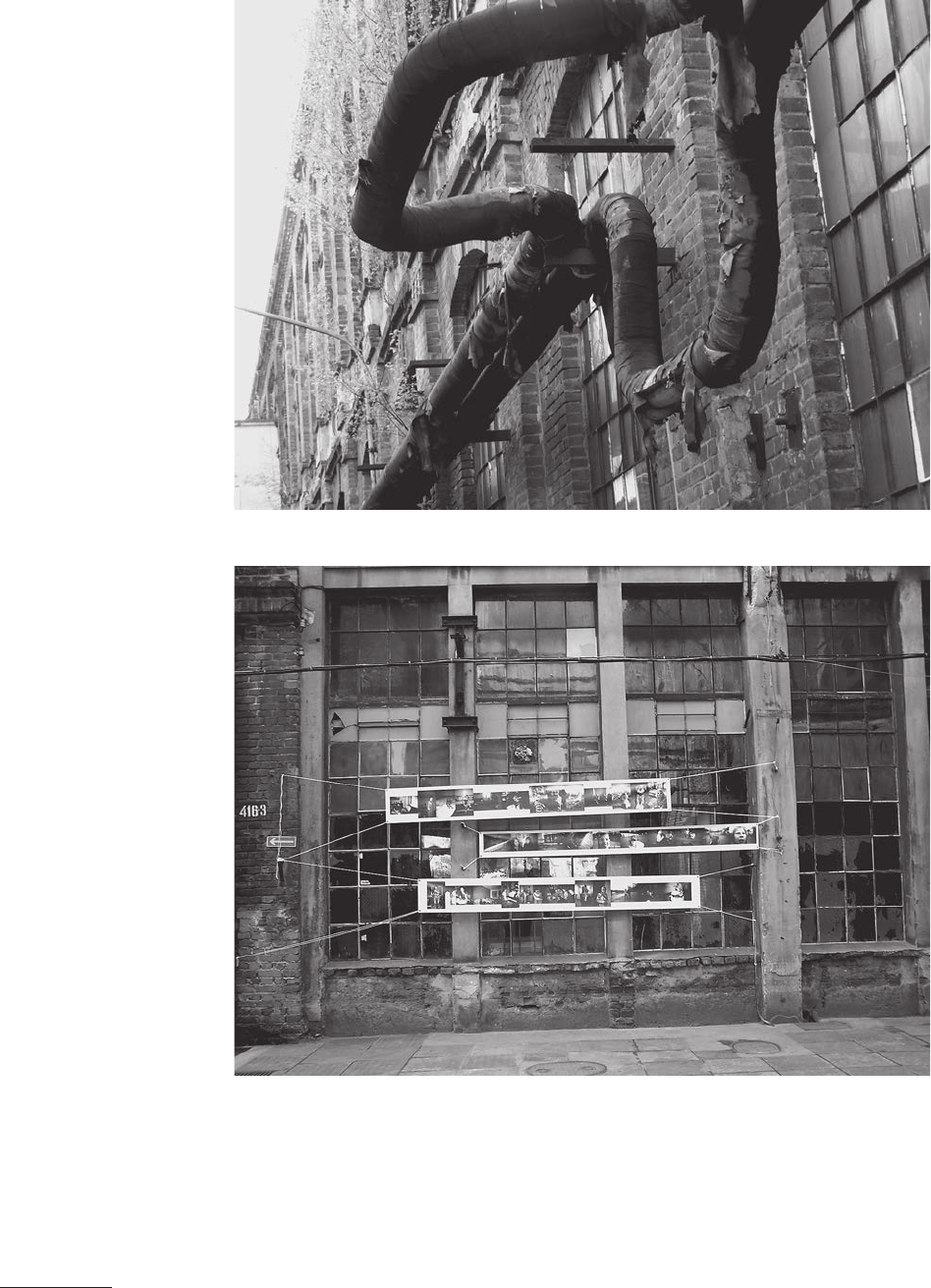
The activities carried out by an informal photographic
gallery are also presented further.
2
Limited nancial resources and differentiated social needs contrib-
ute to the fact that not all the deserted structures can become museums,
galleries or other service or culture institutions. There are still many
buildings which are waiting for a new concept of their use.
Fig. 2. Fragment of exhibition
in Oskar Schindler Factory
in the department of Cracow
Museum of History. Exhibition
scenario is constructed with
the use of the multi-media
presentations and many other
viewer-attracting details.
Photo by M. Rusnak, 2010
Cultural revitalisation
Revitalisation without revolution. Initial adaptation of post-industrial buildings for artistic purposes 185
‘Homeless Gallery’
‘Homeless Gallery’
3
is an ephemeral artistic organisation
which transforms abandoned or not used interiors into tempo-
rary galleries of photography [10]. The main idea of its found-
ers was to present in public their own works of art with an in-
signicant nancial expenditure. The artists nd empty places
and then they try to get a free access to them. The surroundings
in which they decide to exhibit their works are not associated
with a place of contemplating art. Abandoned tenement hous-
es, devastated railway stations, unused warehouses, docks
or terrains of old military bases, similarly to the production
halls
4
used by the artists, do not possess the features which
would describe a typical shape of the museum edice. The
initiators, who organise those short-term events, invite other
photographers. Thanks to the cooperation with them, they are
able to prepare an individualised arrangement for a given in-
terior. The way of presenting an exhibition has a spontaneous
character and depends on the place as well as on the objects
5
3
‘Homeless Gallery’was founded on 25
th
May 2002 by two photog-
raphers Tomasz Sikora and Andrzej Świetlik. This is the date of organizing
the rst exhibition which took place in the tenement house at Złota Street
in Warsaw. The organisation is still developing. During the last eight years
the founders organised 87 temporary exhibitions, including exhibitions
abroad in London, New York, Melbourne, Nantes and San Jose.
4
The above mentioned places have common features. They are
degraded buildings, which due to their superannuated function or sub-
standard character are not used any longer.
5
The artists who work in the ‘Homeless Gallery’ make constructions
from old ladders, boxes, wire mesh fences, branches, wooden pallets, pieces
of materials, strings, cables, road bands on which they can place composi-
tions of their photographs. Equally good places for exhibiting their works
are uneven surfaces of machines, pipes, hooks, chains, broken window
glass, bars, balustrades, and destroyed stairs – simply the whole equipment
to which photographs and other artistic elements can be tted.
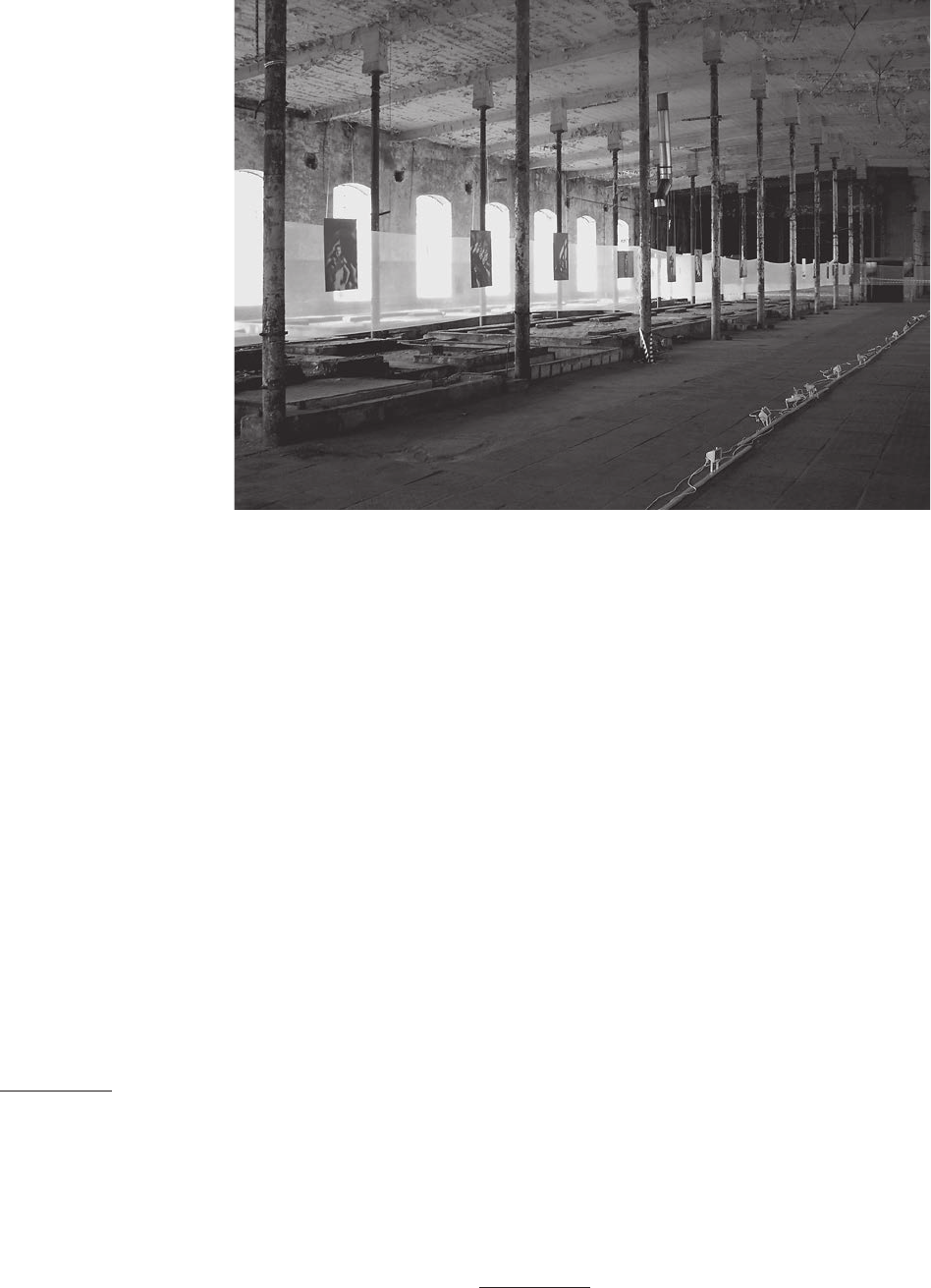
which are in the possession of the artists (Fig. 3). Their exhi-
bitions took place in numerous old factories in the territory of
the whole country such as ‘Diana’ clothes factory in Szczecin
(March 2009), a linen spinning mill converted at present to
the so called Lofts de Girard in Żyrardów (September 2007),
a closed down combed wool spinning mill of ‘Merinotex’
factory in Toruń (April 2003) or in the factory at Piotrkows-
ka Street in Łódź (May 2003) [10]. One of their exhibitions
took place in the interiors of the railway station in Ostrowiec
Świętokrzyski (May 2007)
6
. They also presented their photo-
graphic shows, which were part of the existing interiors, with
the cooperation of other artistic and state institutions
7
.
Art Center and Art Factory in Łódź
Łódź Art Center was established in 2006. Its seat is lo-
cated on the fragment of the terrain of the old Łódź com-
plex of Karol Scheibler at Tymieniecki Street. Art Center
is an organisation which accepted the job of revitalisation
of a specic fragment of space dedicated to them. Aban-
doned buildings of the part of the complex were transferred
to them on the basis of the concluded agreement with the
Łódź City Council. After two years Art Factory was also
established there which cooperated with Art Center.
Within the territory which belongs to Art Center and
Art Factory there are ve buildings (porter’s lodge, of-
ces, three old warehouses of raw and ready materi-
als). The warehouse buildings with big cubature allow
6
The author includes railway stations into the scope of the discussed
post-industrial areas.
7
‘Homeless Gallery’ cooperated with, among other, the following
institutions: Mieszczański Brewery in Wrocław, Gallery „Szyb Wilson” in
Katowice, Alternative Culture Centre Zebra in Tczew, The City Museum
in Śrem or City Ofce in Biała Podlaska.
Initial cultural adaptation of post-industrial spaces
Fig. 3. Production hall interior
at Tymieniecki Street
during preparations
of Katarzyna Czarnecka and
Magdalena Olek photo exhibition.
Photo by M. Rusnak, 2010
186 Marta Rusnak
organising different events there such as theatre spec-
tacles, fashion shows, concerts, lm projections, hap-
penings, as well as photography, sculpture and painting
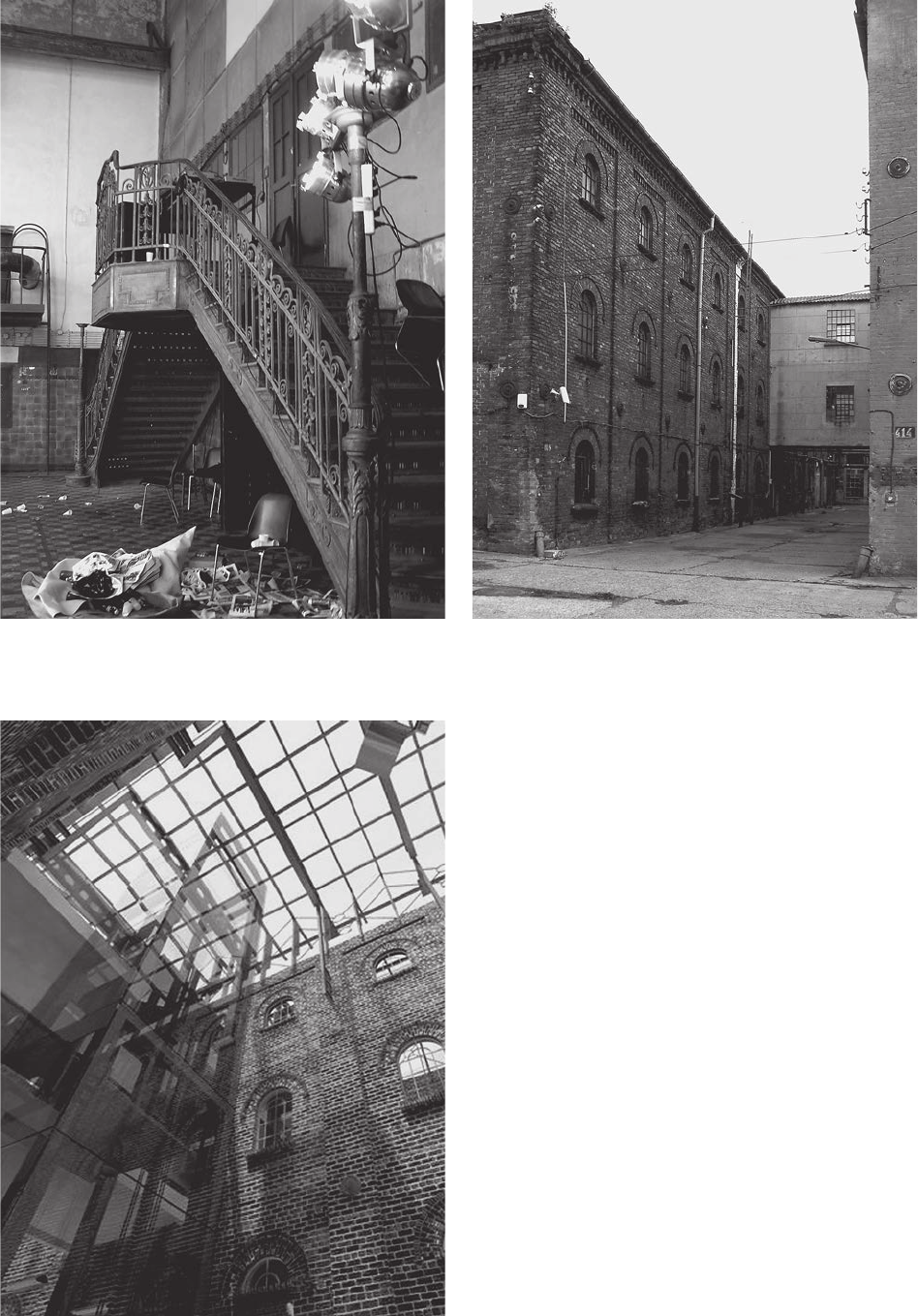
exhibitions. Technical condition of the buildings is bad
and dissatisfactory regarding preservation aspects (Fig.
4). Façades, wooden and reinforced concrete construc-
tions as well as leaking roofs require refurbishment (Fig.
5). A part of construction drawbacks required an im-
mediate intervention. At present, only some emergency
works have been made, which will protect the building
until the target refurbishment are performed. Neverthe-
less, neglected buildings interiors and devastated spaces
between them are ‘tamed’ through exhibited posters, in-
scriptions, pictures and furniture (Fig. 6). The present
arrangements as well as an interesting cultural offer of
both of the described organisations make many visitors
come here during the whole day and particularly in the
evening. The present owners try to make the whole area
safe, in particular they try to protect it from stealing his-
torical remnants of the equipment, which poses a danger
to many buildings of this type that are left without any
care
8
.
Artistic activity of Art Factory, which was put into for-
mal and legal frames, can be regarded as a sort of activity
for creators who want to refer to the context of this type
of place. Such a particular attitude to the exhibition is rep-
resented by some modern artists who level the work with
the exhibition and in this way make the recipient accept
8
In the supervised territory, which is managed by Art Center and Art
Factory, there are not many elements of the original equipment; however,
a valuable remnant is a big number of oors: wooden, parquet, concrete
oor as well as external and internal metal plates with anti-slip geometric
patterns.
the whole exhibition space
9
[3]. It happens not only in the
case of Art Center that neglected buildings become an in-
tegral element of art created in them. The form of activity
undertaken in the territory of the building does not violate
the substance of the structure; there are no conicts of crea-
tive or conservatory activities
10
. In the case of the above
described historical buildings, it is not possible to act in
an artistic way totally independently, however, creating in
such spaces, which still are not renovated, is certainly freer
than accepted activities in the formalised spaces such as
museums and art galleries
11
.
A big advantage of those ‘half-wild’ buildings is their
closer contact with everyday life, which is rarely the case
with the prestige exhibition buildings (Fig. 7). This close-
ness constitutes a sort of propagation of ‘reducing limits
between art and life practice’ [3].
Common functioning of these two Łódź organisations
so far can be dened as ‘a way to survive.’ It is an ac-
tive desire which leads, step by step, to the chosen target.
The number of participants of the next artistic events is
still growing. The result of the conducted educational and
promotional activities can be seen in form of numerous
folders which describe both the past as well as the future
of this terrain. The most formal proof of the organiza-
tion activities are the construction designs which were
9
Some artists desire is to equal the status of the exhibition space
with the presented exhibit in it.
10
Here I refer to street art as an extremely liberal trend which through
its interventions can break the law (Act on Copyright, Act on Monuments
Protection). This problem was widely discussed in the article by Stanisław
Gzell entitled Reurbanisation: conditions which was published in the
Interuniversity Scientic Issue, “Urbanista”, Warszawa 2010.
11
As it was in the case of MS2 or the present form of the Leon
Wyczółkowski District Museum.
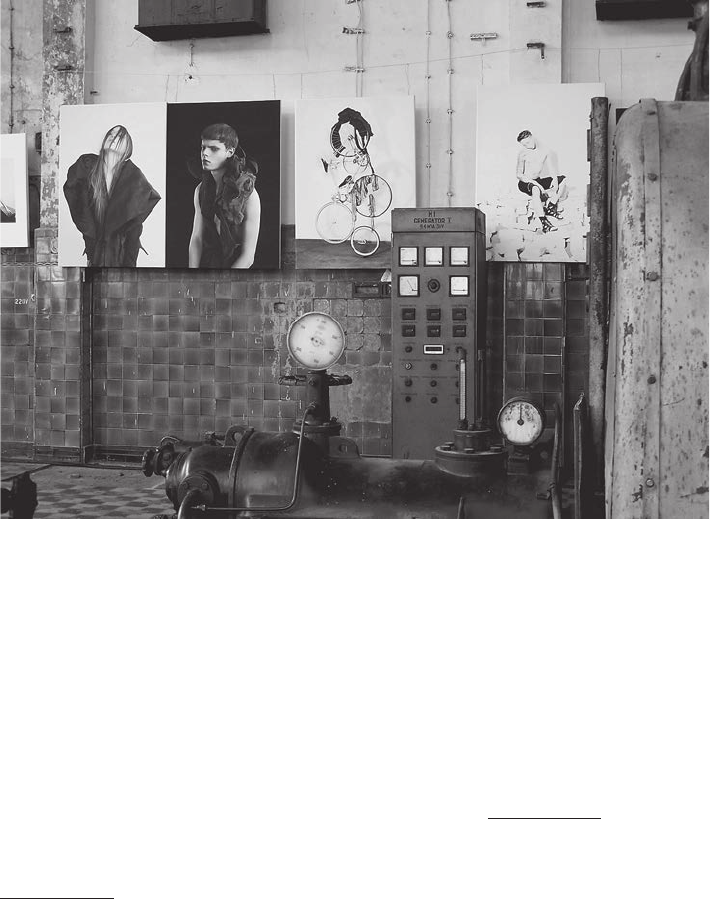
Fig. 4. Old power station
interior near Art Center during
preparations to one
of the photo festival exhibitions.
Photo by M. Rusnak, 2010
Revitalisation without revolution. Initial adaptation of post-industrial buildings for artistic purposes 187
authorized in the middle of 2009 by the District Monu-
ment Restorer in Łódź
12
. The realization of the rst part
of the construction design referring to the development
and changes in the way of usage of three warehouses is
supposed to be started in 2011. The completion of the re-
12
Design materials (construction design and visualizations) were
given to me courtesy of the area administrator, Art Factory. Some of them
are accessible in the archives of District Monument Bureau in Łódź (ref.
No: 212/146, 205/from 53 to 72). The projects’ author (dated 05.11.2009
with regard development and change of usage of buildings B and C and
hall A) is the company AB-Projekt from Tychy.
vitalization process of the whole structure is planned for
the year 2014. The construction design provides a con-
nection between the two warehouses by means of a glass
roof (Fig. 8). A narrow space is to be lled with a high
14-meter hall with an information centre and an elevator
for people (Fig. 9). The authors of the design suggested
lling the wall losses and reconstructing original window
divisions during the replacement of window woodwork.
The design can be described as the one that blends in with
the trend on minimalist intervention and the interior aes-
theticism. The suggested construction solutions are the
results of adapting to the new function and regulations of
Fig. 5. Façade detail showing
the present condition of buildings
in Sheibler complex.
Photo by M. Rusnak, 2010
Fig. 6. Window bars used
as an exhibition element,
building façade of ready
material warehouse
in the territory of Factory of Art.
Photo by M. Rusnak, 2010
188 Marta Rusnak
Fig. 7. Free way of utilisation of the historical power station
in the territory of Art Centre. Photo by M. Rusnak, 2010
Fig. 8. Current condition of warehouse buildings in Sheibler complex
to be revitalized. Photo by M. Rusnak, 2010
Fig. 9. Visualization of the adaptation design for the needs
of Art_Inkubator. The investor Factory of Art made the photo available
to the author in August 2010
the building law. Rebuilt monumental buildings are sup-
posed to become the seat of Art_Incubator organization.
The new entity is to support activities of young artists and
a creative sector of Łódź economy [9].
Gallery of Modern Art of the Leon Wyczółkowski
District Museum in Bydgoszcz
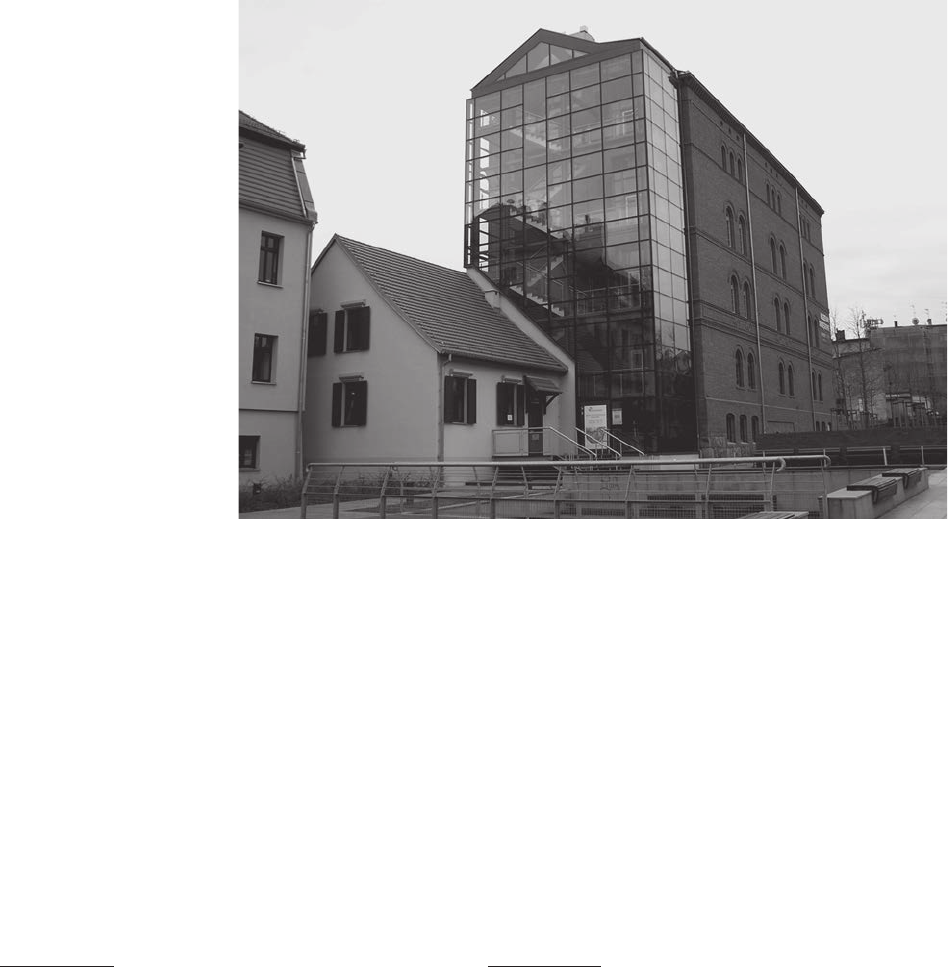
In a similar way as it was in the case of the factory
at Tymieniecki Street in Łódź, a historical steam mill
was converted to the seat of Leon Wyczółkowski District
Museum in Bydgoszcz. In 1997 the museum became the
owner of the building. During the rst ten years, due to
bad technical condition and lack of funds to continue de-
sign and construction activities, only small seasonal exhi-
bitions of modern art were organised. Thanks to this, the
process of destruction was stopped and the residents got
accustomed to the new planned function (Fig. 10). During
the time of initial usage it was possible to create a concept
of the building adaptation as well as to leverage sufcient
sources of funds to continue the investment. Similarly to
the Art_Inkubator designers’ suggestion, an additional
glass transport staircase was built on the main building.
‘Colony of Artists’ in the territory of Stocznia Gdań-
ska (Gdańsk Shipyard)
Describing low-budget programs of post-industrial ter-
rains revitalisation, which initiate further revitalisation, we
should not forget about artistic activity within the area of
Stocznia Gdańska. In 2001 Stocznia Gdańska became the
seat of many small ne arts, theatrical and lm organisa-
tions. The investor – an international company BPTO (Bal-
Revitalisation without revolution. Initial adaptation of post-industrial buildings for artistic purposes 189
tic Property Trust Optima) which now has over 50 hectares
of the post-shipyard terrains – used the artists as a social
group being able to improve and propagate a new usage of
the place. This group activity created the basis for giving
the elaborated design ‘Young City’
13
a fashionable status
of cultural revitalization. The initial purpose of reviving the
old docks was the change of the manner in which this area
was perceived by Tri-city residents. ‘Colony of Artists’ (this
phenomenon was that name) was the rst design in Poland,
which was fully nanced by the independent creative cir-
cles of Gdańsk. The activity of a big group of artists
14
was
so inuential that within only ve years of activities the
shipyard acquired the status of a signicant place of art.
At present, most of the institutions which take part
in this design must look for other seats. At the place of
13
The name of the revitalization design of a part of post-shipyard ter-
rains ‘Young City’ refers to the name of the old Teutonic location (Historia
Gdańska, red. Jan Kucharski, Sopot 1997). More information about the
design we can nd on ofcial websites of Gdańsk City Council as well as
on the information website of the water front revitalization design, http://
youngcity.pl/.
14
Among organisations which acted during the rst ve years of
‘Colony of Artists’ activity were: Theatre Znak (Sign), Discussion Film
Club, Gallery MM, PGRart, Synergia’99, Institute of Art Island, Modeler’s
Room and individual artists studios.
‘Modeler’s Room’ seat a new service and ofce building
will be erected. BPTO Company removed the artists from
the buildings which were to be demolished or rebuilt and
offered some of them temporary supplementary places.
The owner of post-shipyard terrains does not guarantee
that the artists will have a possibility to continue their pre-
vious activities.
It is difcult to criticize strongly the investor because
the lease agreement, which was signed by the artists, was
to be valid for ve years. However, we may get an impres-
sion that thanks to the artists’ own money and enthusiasm,
they were able to create the artistic brand called ‘Stocz-
nia Gdańska’
15
. The process of soft terrains adaptation
16
,
which started in Stocznia Gdańska, is not continued, which
may inuence the nal success of the whole enterprise.
15
Lidia Makowska from the City Culture Association accused Baltic
Property Trust Optima Company of using the prestige created by Colony
of Artists: ‘You as a company took over the potential after Synergia.
There is a notion of social responsibility in business. After ve years you
came here to the territory which is already recognized as a brand’. This
statement was published on the website http://modelator.blogspot.com
in January 2008. In the foreign press we can nd another expression for
establishing a brand, i.e. ‘branding’.
16
The notion of soft design refers to, among other things, low-budget
activities which promote culture, tourism and sport.
Fig. 10. New cubature view
with a staircase and person
elevator added to the old steam
mill on Mill Island in Bydgoszcz.
Photo by M. Rusnak, 2010
Summary
Initial cultural adaptation presents the method of pro-
tecting these buildings which are so important for the
region development and history and using at the same
time their potential. Through the implementation of soft
activities, it is possible to slow down the process of de-
struction – without big sums of money – and prevent these
adaptations which are too hasty and are created without
thorough planning.
A particular value of this non-commercial and slightly
aggressive method of promoting culture – through the ini-
tial recycling of architectural structures – is that it takes
care of the forgotten places, i.e. neglected post-industrial

190 Marta Rusnak
heritage in this case. The organised exhibitions and shows
are also an opportunity to see the place which after the
rebuilding process, in many cases, will become a private
structure inaccessible for the recipients of art. We should
see numerous benets, which have already been appreci-
ated in other countries, of using this ‘initial revitalisation’
model as a prelude
17
for further activities.
Evans and Shawn in their report for DCMS (Depart-
ment of Culture and Sport)
18
from 2004 listed the features
which, according to them, increase chances to achieve
success of cultural revitalisation designs [1]. Among the
characteristic features of successful adaptations which are
suggested by them we can nd a reference to the necessity
of public participation in creating a regeneration program.
17
It is signicant to emphasize the timing of this approach. It would
be reprehensible in consideration of public matters to use a historical
building as a nostalgic staffage which would help only in marketing or
lead to the building’s ruin under the false banner of using it for the needs
of art.
18
Department of Culture and Sport – British Ministry of Culture and
Sport.
According to Evans and Shawn observations, communi-
ties and artistic organisations – which in the case of the
Gdańsk realisation were excluded from the whole project
– constitute a good way to propagate active participation
of local communities in the process of development of the
remodelled part of the city. The abandoned factory can
become a place of identication and development of lo-
cal community as a result of evolving and appropriately
animated process.
Initial adaptation, which is understood by the author
as utilisation ‘without investments’ of the post-industrial
space, in our Polish conditions may contribute to reveal-
ing values of many still not destroyed factories, indus-
trial warehouses, railway stations, military bases territo-
ries, mines and docks. The form of initial annexation of
buildings for the needs of exhibitions and other artistic
activities can show many investors a way how to use
them to a full extent and protect the national heritage of
these places. Those designs which are connected with the
social popularisation of art may bring more long-term
benets than converting these structures into shopping
centres.
References
[1] Evans G., Shawn P., The Contribution of Culture to Regeneration in
the UK: A Report to the DCMS, LondonMet, 2004, p. 60.
[2] Kiciński A., Muzea. Strategie i dylematy rozwoju, Publishing House
of Warsaw University of Technology, Warszawa 2004, p. 76.
[3] Popczyk M., Estetyczne przestrzenie ekspozycji muzealnych, Cracow
2008, pp. 48, 207.
[4] Szylak A., Stiasny G., Instytut Sztuki Wyspa w Gdańsku, Architektura-
-Murator, 2005, No. 4, pp. 39–43.
[5] Gdy bankrutuje fabryka, Architektura-Murator, 1998, No. 1, pp.
68–70.
[6] Fabryka Sztuki, Architektura-Murator, 2005, No. 4, pp. 94–95.
[7] Muzeum Powstania Warszawskiego, Architektura-Murator, 2007,
No. 1, pp. 57–61.
[8] Muzeum Powstania Warszawskiego, Architektura-Murator, 2005,
No. 5, pp. 58–65.
[9] Art._Inkubator, Łódź 2009, informative brochure printed courtesy
of Art Center and Art Factory.
[10] http://www.galeriabezdomna.art.pl/
[11] http://modelator.blogspot.com
[12] http://www.lodz2016.com/articles.php
Rewitalizacja bez rewolucji. Wstępna adaptacja obiektów poprzemysłowych dla działań artystycznych
Jednym z bardzo popularnych modeli ożywiania terenów poprzemy-
słowych jest rewitalizacja kulturowa
19
. Na całym świecie sztuka stała się
elementem wiodącym bądź wspierającym procesy przekształcania tere-
nów zdegradowanych. Nie wszystkie zamknięte zakłady mogą stać się mu-
zeami sztuki czy prestiżowymi galeriami. Ilość obiektów czekających na
nową wizję użytkowania jest duża. Tereny fabryk, pomimo ich znaczącej
19
Określenie cultural revitalisation lub cultural adaptation jest uży-
wane w publikacjach angielskojęzycznych i oznacza tyle co rewitalizacja
na cele bądź przy pomocy kultury [1]. Termin ten określa rewitalizacje
terenów zdegradowanych, w których kultura jest elementem dominującym
pośród pozostałych nowych funkcji.
wartości materialnej i społecznej, w wyniku braku ich użytkowania stają
się miejscami omijanymi, szybko wypieranymi z pamięci ogółu. W arty-
kule zaprezentowano działania kulturalne, wprowadzające współczesne
życie na tereny dawnych fabryk, o niewielkim stopniu ingerencji w ich
materialną strukturę. Są to akcje o charakterze ewoluującego procesu lub
jednorazowego happeningu. Głównym celem tych działań jest zwrócenie
uwagi na zły stan techniczny budynku, utrzymanie pamięci o społeczno-
kulturowym znaczeniu miejsca, odtwarzanie lub wspieranie społeczności
lokalnych oraz zbieranie funduszy na renowację. Organizowane wystawy
i pokazy są również okazją aby po raz ostatni zobaczyć dane miejsce,
które po przebudowie będzie obiektem prywatnym, na przykład loftem
albo budynkiem biurowym.
Key words: cultural adaptation, exhibition, post-industrial terrain Słowa kluczowee: adaptacja kulturowa, ekspozycja, teren poprzemy-
słowy