2010
Nr 2(28)
Throughout centuries, transformations of spatial forms
comprising the architecture of a given place were strictly
connected with the cultural landscape in which they were
located. At the same time, they were subject to the strictly
dened canons that were associated with the surroundings
and time of their creation.
Nowadays, we can observe a decline or even disappear-
ance of any connections between place and time on the one
hand and on the other the form, which process is particu-
larly visible in suburban areas and rural settlement centres,
where the awareness of culture in architecture represented
by the designer must be confronted with the wrongly un-
derstood culture of esthetics represented by the investor.
Perfect examples here are rural areas where the sever-
al centuries long tradition of the place clashes with a new,
sometimes foreign, spatial form.
In this regard, some of the most signicant elements
which betoken the roots and maintain the faint cultural
continuity of the place and at the same time testify the
level of the architect’s cultural awareness are architectural
structures of religious cult. They ought to be perceived in
historical categories and as a link between the past and
the present.
After 1945 in Western Pomerania there were 168
churches. During the war they were partly damaged,
moreover, in the postwar period the state authorities or-
dered to pull down 102 churches. Apart from refurbish-
ments, 128 churches were rebuilt until the present times
and there are 40 more which are still left as ruins
1
.
The most required form of action, which strengthens
the cultural continuity of the place and simultaneously
maintains its tradition along with respecting the centu-
ries long culture of these architectural structures, is the
1
Source: Architektura sakralna Pomorza Zachodniego, http://www.
architektura.pomorze.pl/_index.php?link =_straty.
Wojciech Pawłowski*
Role of architect in creation of ‘culture in architecture’
and new spatial forms in cultural landscape of suburban areas
and rural settlement units on the territory of Western Pomerania
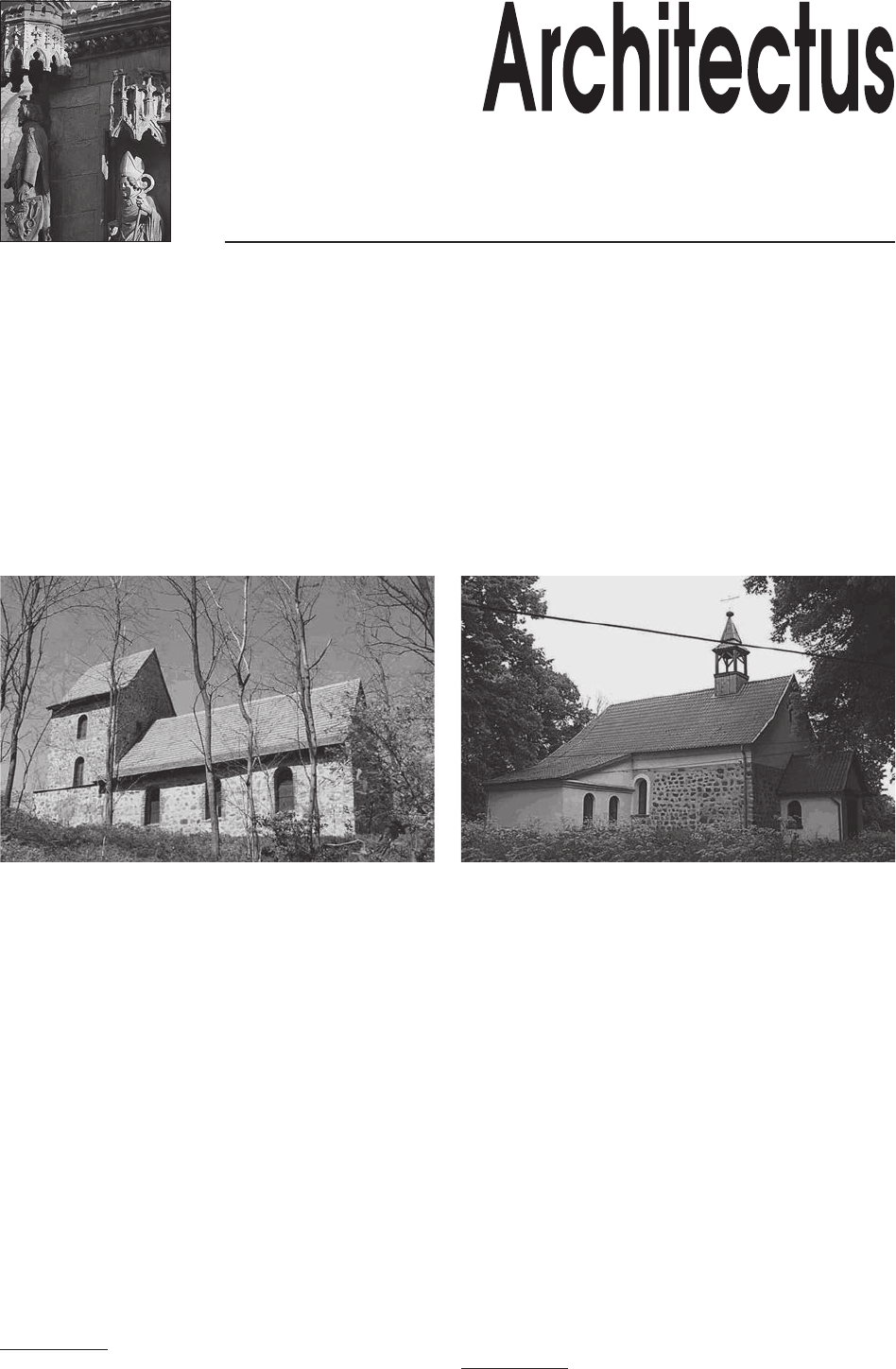
Fig. 1. Church in Binowo – reconstruction. Photo by author Fig. 2. Rebuilt church in Bobolin. Photo by author
*
West Pomeranian University of Technology in Szczecin, Faculty
of Modern Architecture, Theory and Design Methodology, Department
of Building and Architecture.
154 Wojciech Pawłowski
reconstruction of the old form of these buildings and their
original location on the basis of the preserved documenta-
tion. A good example here is St Maximilian Maria Kolbe
Church in Binowo (Fig. 1)
2
.
Similar activities were taken up when rebuilding Our
Mother of Perpetual Help Church in Bobolin (Fig. 2)
3
.
A frequent activity, which was taken up due to the lack
of funds to build a new structure, was to adapt the already
existing buildings to the needs of a place of worship. Un-
fortunately, their form, as their previous functions were
2
Stone and brick church, Gothic, from the 13th century, erected on
the quadrangle plan. In the north part, brick ogival portal; in the east part
ogival window hole; eastern top with blends; in the east part, two butress
pillars – added later on. After 1945 it was demolished, in 1979-1982
rebuilt. [Source: Reverend Roman Kostynowicz, Kościoły Archidiecezji
Szczecińsko-Kamieńskiej, Szczecin 2000, p. 374].
3
Church made of erratic stone, on the rectangle plan, with a separate
presbytery closed by a semicircular apse. The small tower with an ave-bell
grows from the body of the church from the west part. In the years 1945-
1986 the church was in ruins (it was preserved as high as the windows).
In 1986 rebuilding works were started according to the design by Stefan
Kwilecki.
totally different, was far from the canons of sacral build-
ing. Had it not been for the crosses which were placed
on top of the buildings or in their vicinity, nothing would
indicate that this was a place of worship.
A signicant role in the process of adapting such
a building is played by the designer who, while making
decisions as to formal actions and employed materials,
can show his sense of culture in architecture and in this
way, increase the importance of the particular architectural
structure. On the other hand, his incompetent actions can
lead to the total degradation of the cultural landscape.
An excellent example is the village of Kosin. The lo-
cal 13
th
century granite church which was rebuilt in 1891,
by order of the state authorities
4
was demolished in 1945.
On its place a kindergarten was built, which in 1991 was
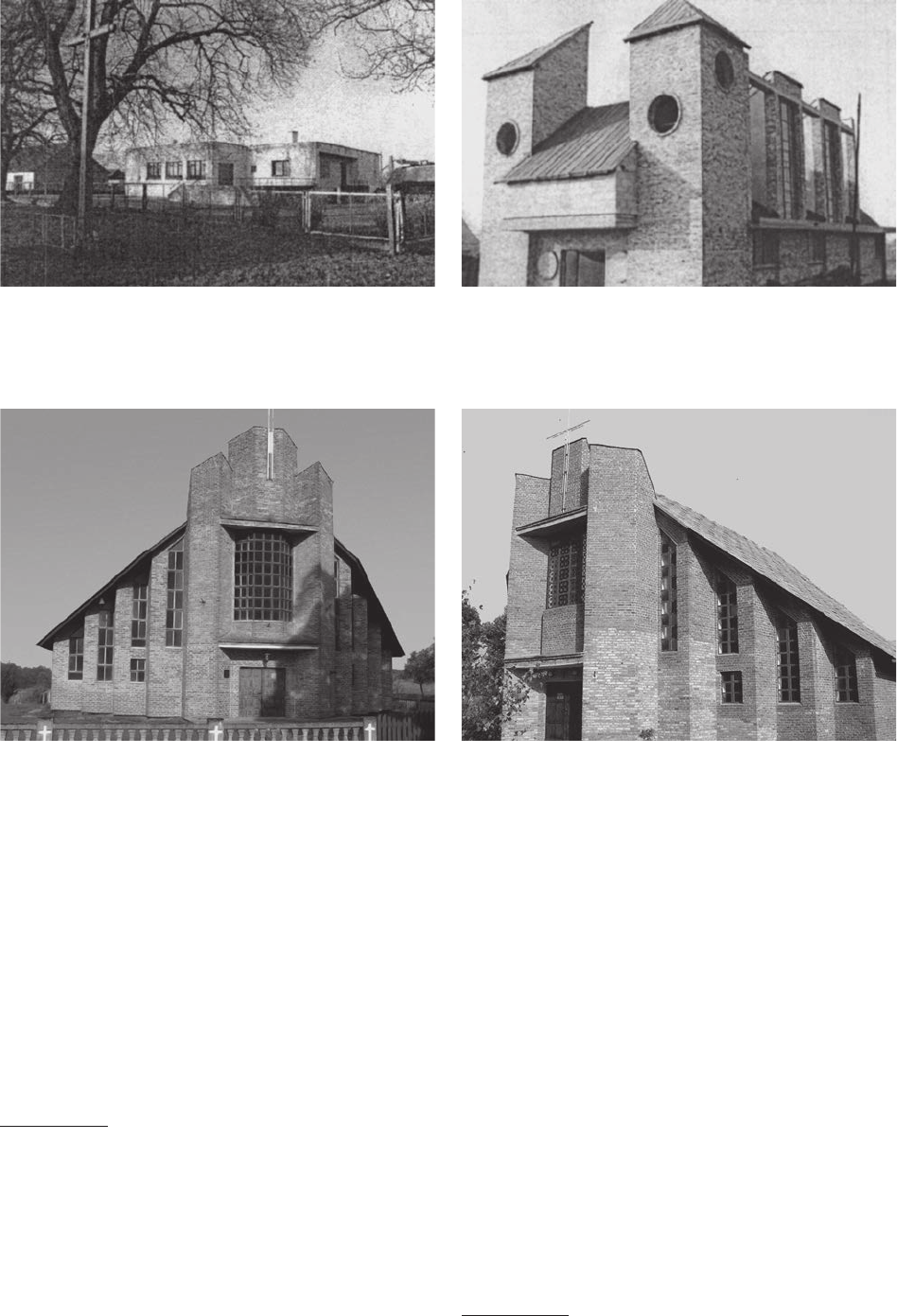
adapted to a church (Fig. 3). In this case, the designer’s
plan is inadequate to the performed function and the form
is far from the typical church structure; as a consequence,
4
Ks. inf. Roman Kostynowicz, Kościoły Archidiecezji…, op. cit.,
p. 70.
Fig. 3. Kindergarten building adapted to the needs
of church in the Kosin village [1]
Fig. 5. Church in Chomętowo village, according to
the design by Jerzy Koniński. Built in 1988–1996.
Photo by author
Fig. 4. Modern church structure on the rectangle plan with a separate
presbytery and two towers, designed by Marek Wołoszyn, in
Komarowo village [1]
Fig. 6. Church in Gębin village, according to
the design by Jerzy Koniński. Built in 1985–1992.
Photo by author
Role of architect in creation of ‘culture in architecture’ and new spatial forms in cultural landscape of suburban areas... 155
it is in no way consistent with the pre-war rural architec-
ture [2].
The most important indicator of the architect’s level of
culture is undoubtedly the fact of designing and building
new structures of sacral architecture.
New sacral buildings on the rural areas were started to
be erected mainly at the beginning of the 1980s.
Unfortunately, in many cases the designers forgot
about consistency of the architectural structure form with
the cultural landscape of the place by creating completely
alienated forms which by no means can be said to blend in
with the existing local architecture (Fig. 4) [1]. By treat-
ing the structure of the church as a typical design of the
repetitive nature (Figs. 3, 5, 6), they contribute to certain
monotony in the landscape which is not a welcome and
positive phenomenon.
The results of the negative designer’s actions neglect-
ing the proper choice of architectural form can often be
observed in the areas which border the great urban ag-
glomerations.
On the territory of Western Pomerania, due to the fac-
tors such as the low potential of agricultural land, low
quality of the soils – 78% of all the arable lands contain
soils which are very poor quality as regards their farmland
value – the existence of numerous small farms (80% of
the farms do not exceed the area of 10 hectares) as well as
unsatisfactory protability of the farms which border the
great urban agglomerations, the level of agricultural ac-
tivity is extensive. This situation leads to transformations
of the existing suburban farmland areas. The adjoining
rural settlements were to be changed into residential areas
which constitute a natural social hinterland for urban cen-
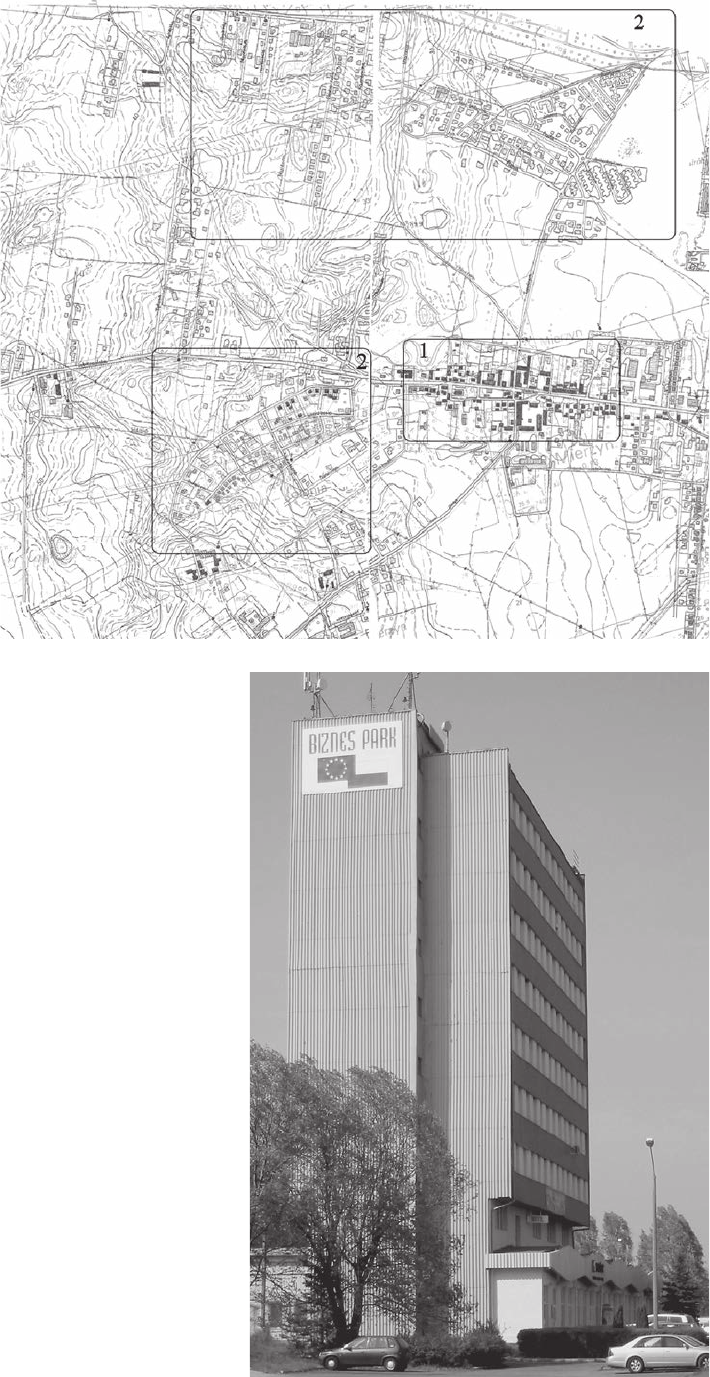
Fig. 8. Ofce building in Przylep village near Szczecin
– condition in 2004. Photo by author
Fig. 7. Mierzyn village;
1 – pre-war village layout;
2 – residential estates which,
administratively, are part
of the village – in black,
the buildings from
before 1939 – own study
156 Wojciech Pawłowski
tres and this change totally distorts the postwar cultural
landscape.
Very often, in the direct vicinity of a great urban ag-
glomeration, next to rural areas which are wastelands,
there are residential areas with one- and multifamily
houses.
Due to intensive urban activities, rural areas after some
time may become absorbed by towns not only functional-
ly but also with regard to administration issues. However,
this process is often conducted chaotically without paying
attention to the harmony in the existing landscape.
We can distinguish two types of such urban activi-
ties: one is orderly and it takes into account the landscape
values of the terrain as well as the existing rural system.
Unfortunately, such situations take place most often only
within the administrative borders of a city. The other type
involves a spontaneous process of land development, both
individual investments which satisfy functional require-
ments of an investor and these requirements are not neces-
sarily in accordance with the idea of the spatial order (Fig.
7) as well as one family housing or small residential units
which are created in between the discussed areas. Those
which are built within a rural unit often create chaotic
structures which have nothing in common with the typical
elements of the village cultural landscape and moreover
are not in accordance with the idea of city residential es-
tates which ought to be harmonized architectonically and
create a logical urban entirety (Fig. 7)
5
. Most often, these
structures are completely beyond a given context, in which
an architect performs the role of a machine that produces
the materials which are necessary for obtaining a building
permit and carrying out the future investment (Fig. 8).
5
In the close vicinity of the prewar buildings, some new multi-family
houses were erected as part of the estate ‘Za wiatrakiem’, which was an
example of typical city buildings as regards their size and form (absorp-
tion of village by city). There are also areas of one-family housing estate,
but still there is no reference whatsoever to the old tradition. Prevailing
here are the structures built on the basis of ‘typical designs’ and pseudo-
residential buildings which are completely not integrated with the existing
buildings.
We must admit that civilization progress rarely goes
hand in hand with the increase of designing awareness or
even more importantly, ethical awareness. This refers to
a designer who creates the esthetical and cultural aware-
ness of architecture.
Another excellent example is the process of building
great residential estates such as Słoneczne, Bukowe and
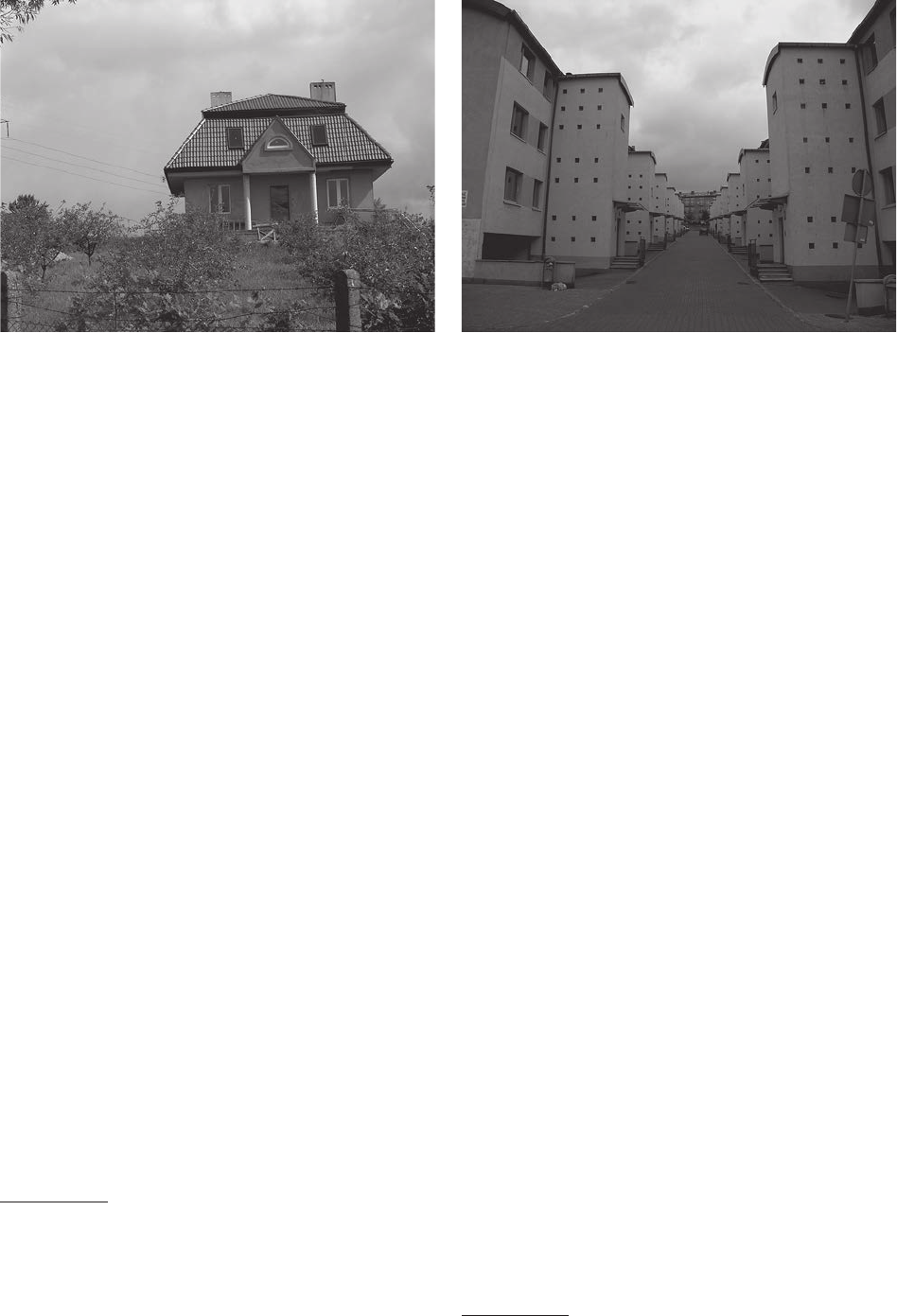
Majowe (Fig. 9) in Szczecin in the 1970s and 1980s. Al-
though these estates, as well as some other similar ones in
city agglomerations of Western Pomerania, employed the
solutions of typical residential structures, we can notice
here a new urban idea which takes into consideration cre-
ating common areas, social facilities as well as securing
the needs connected with education, entertainment and
trade of the future residents. Paradoxically, we must admit
that despite their poor architectonic form, these estates
constituted a well planned urban system with ‘friendly’
space enriched by green areas along with recreation ter-
rains.
Unfortunately, nowadays when designing some resi-
dential complexes the priority is given to the maximum
usage of space in order to achieve the greatest PUM
6
. The
only rules which are adhered to refer to the minimum dis-
tances at which the buildings must be placed, in accord-
ance with the relevant technical specications. As a con-
sequence, we are left with claustrophobic impressions
without the possibility of ‘breathing’ in the created space.
An example of such a solution is the TBS estate situated
at Łucznicza Street in Szczecin, where we can observe
the situation that is contrary to the 1970s and 1980s es-
tates. Attractive spatial form that is created by the particu-
lar buildings is located on a very small area which is the
property of a cooperative (Fig. 10).
In this situation, the designer is faced with the dilem-
ma: he must make a compromise between the two ways
of understanding new space. As a result, we often deal
with the total lack of respecting place and time and dis-
6
PUM – abbreviation: powierzchnia użytkowo-mieszkalna (usable
and residential area).
Fig. 9. One-family building in Siadło Dolne village near Szczecin
– condition in 2008. Photo by author
Fig. 10. Buildings at TBS at Łucznicza Street in Szczecin
– condition in 2010. Photo by author
Role of architect in creation of ‘culture in architecture’ and new spatial forms in cultural landscape of suburban areas... 157
Rola architekta w kreowaniu „kultury w architekturze” a nowe formy przestrzenne
w krajobrazie kulturowym terenów podmiejskich oraz wiejskich jednostek osadniczych
terenu Pomorza Zachodniego
References
[1] Kostynowicz R., Kościoły Archidiecezji Szczecińsko-Kamieńskiej,
Szczecin 2000.
[2] Piskorski J.M., Pomorze Zachodnie przez wieki, Zamek Książąt
Pomorskich w Szczecinie, 1999.
Na przestrzeni wieków przekształcenia form przestrzennych
tworzących architekturę miejsca były ściśle powiązane z krajobrazem
kulturowym, w jakim były lokowane. Jednocześnie były one poddane
ściśle określonym kanonom osadzonym w miejscu i czasie swego po-
wstania.
W obecnej chwili można zaobserwować zanikanie związku
pomiędzy miejscem i czasem a kanonem formy, szczególnie w prze-
strzeniach podmiejskich oraz wiejskich ośrodkach osadniczych, gdzie
świadomość kultury architektury reprezentowana przez projektanta musi
zmierzyć się z błędnie pojętą kulturą estetyki reprezentowaną przez
inwestora.
W tak zastanej sytuacji powstaje moralny dylemat architekta, pole-
gający na stworzeniu kompromisu pomiędzy tymi dwoma stanowiskami
pojmowania nowej przestrzeni, którego efektem niejednokrotnie jest
całkowity brak poszanowania miejsca i czasu, z zaburzeniem krajobrazu
kulturowego, w którym pojawiają się nowe formy przestrzenne niemające
nic wspólnego z „kulturą architektury”.
Mając na uwadze powyższe, powstaje pytanie co do roli architekta
w powiązaniu z niejednokrotnie wypaczonym sposobem pojmowania
nowo projektowanej przestrzeni przez inwestora a możliwością utrzy-
mania odpowiedniego poziomu architektury korespondującego z tak
historycznym, jak i zastanym krajobrazem kulturowym miejsca.
torting the cultural landscape in which some new spatial
forms appear and they have nothing to do with ‘culture of
architecture’.
To sum up, we must ask the following question: what
is the role of an architect in a frequently distorted way of
understanding the newly created space by an investor and
the desire to maintain an appropriate level of architecture
which ought to correspond with the historical as well as
the existing cultural landscape of the particular place? We
must say that the designer’s vision as well as his persever-
ance in defending his own concepts and ability to conduct
talks with the investor are extremely important in shaping
the future landscape which for the future generations shall
be a testimony of our level of culture in architecture.
Key words: cultural landscape, settlement, Western Pomerania Słowa kluczowe: krajobraz kulturowy, osadnictwo, Pomorze Zachodnie