
2026
2(86)
Barbara Widera*, Katarzyna Chojnacka**, Dionysia Kolokotsa***,
Marco Marseglia****, Edoardo Brunelli*****, Tommaso Celli******,
Francesco Cantini*******, Jagoda Mrzygłocka-Chojnacka********,
Kajetan Sadowski*********, Carmelo Carbone**********,
Francesca De Filippi***********, Aikaterini Lilli************
Societal dimension of street furniture
in European neighbourhoods
DOI: 10.37190/arc260207
© by the Author/Authors. Licensee WUST.
Published in open access. CC BY-NC license.
Abstract
Urban infrastructural decline, limited public amenities, and persistent safety concerns continue to aect many older and disadvantaged European
neighbourhoods, with disproportionate impacts on vulnerable population groups. Although street furniture is often treated as a secondary component
of public space, growing evidence indicates that it plays a signicant role in shaping everyday social practices, accessibility, and perceived safety.
This paper examines the societal dimension of street furniture and its contribution to quality of life in European neighbourhoods, with particular
attention to inclusion, thermal comfort, and age‑friendly use of public space. Based on an in‑depth review of academic literature and selected Eu‑
ropean case studies, the analysis explores how contemporary street‑furniture interventions inuence patterns of outdoor use, social interaction, and
perceived security. Shading and cooling elements are discussed in relation to documented surface‑temperature reductions of approximately 2.6
°C,
highlighting their relevance for improved thermal comfort, extended usability of outdoor spaces, and reduced heat‑related risks for older citizens. The
study further examines how accessibility standards, seating ergonomics, and lighting quality interact with these comfort eects to support safer and
more inclusive neighbourhood environments. Participatory co‑design processes are analysed as a key mechanism through which societal benets are
generated and maintained. Evidence shows that sustained engagement of residents and local stakeholders improves contextual t, strengthens place
attachment, and supports shared responsibility for public spaces. Situated within the values and principles of the New European Bauhaus, the paper
frames street furniture as a social interface rather than a passive amenity and outlines directions for more systematic assessment of societal outcomes
across diverse neighbourhood contexts.
Key words: street furniture, accessibility, social cohesion, climate resilience, participatory design, New European Bauhaus
* ORCID: 0000‑0003‑0218‑8038. Faculty of Architec ture,
Wro cław University of Science and Technology, Poland, e‑mail: barbara.
widera@pwr.edu.pl
** ORCID: 0000‑0001‑6897‑9882. Faculty of Chemistry, Wro‑
cław University of Science and Technology, Poland.
***
ORCID: 0000‑0003‑2960‑3772. Chemical and Environmen tal
Engineering School, Technical University of Crete Kounoupidiana, Greece.
**** ORCID: 0000‑0002‑9406‑5969. Department of Architecture,
University of Florence, Italy.
***** ORCID: 0009‑0006‑5412‑9434. Department of Architecture,
University of Florence, Italy.
****** ORCID: 0000‑0002‑7944‑0070. Department of Architecture,
University of Florence, Italy.
*******
ORCID: 0000‑0002‑0017‑1788. Department of Archi‑
tecture, University of Florence, Italy.
********
ORCID: 0000‑0002‑5404‑4696. Faculty of Manage‑
ment, Wrocław University of Science and Technology, Poland.
*********
ORCID: 0000‑0002‑1713‑430X. Faculty of Architec‑
ture, Wrocław University of Science and Technology, Poland.
**********
ORCID: 0009‑0006‑0248‑0804. Department of Archi‑
tecture and Design, Politecnico di Torino, Italy.
***********
ORCID: 0000‑0002‑8236‑3862. Department of Archi‑
tecture and Design, Politecnico di Torino, Italy.
************
ORCID: 0009‑0001‑6843‑3342. Chemical and Envi‑
ronmental Engineering School, Technical University of Crete Kounoupid‑
iana, Greece.
78
Barbara Widera, Katarzyna Chojnacka, Dionysia Kolokotsa et al.
Introduction
Urban public spaces shape quality of life. In the context
of this study, urban infrastructural decline refers to the pro‑
gressive deterioration, obsolescence, or insucient mainte‑
nance of neighbourhood‑scale public‑space infrastructure,
resulting in reduced functionality, accessibility, safety, and
user comfort. Ageing infrastructure denotes physical ele‑
ments that remain in service beyond their intended design
life or no longer meet contemporary technical, accessibili‑
ty, environmental, or social requirements. In European re‑
si dential districts, this condition is frequently manifested
through deteriorated seating, inadequate lighting, inacces‑
sible pathways, outdated bus shelters, degraded playground
equipment, and insucient climate‑adaptation measures.
Together, these decits contribute to unequal access to pub‑
lic space and disproportionately aect older adults, children,
and persons with disabilities (Carmona 2019). Euro pean
neighbourhoods aected by ageing infrastructure and chron‑
ic underinvestment often experience declining public‑space
quality, reduced accessibility, inadequate thermal comfort,
and increased perceptions of insecurity, all of which inu‑
ence everyday patterns of social participation and outdoor
activity (Carra et al. 2023).
Missing or degraded benches, lighting, ramps, signage,
and other street furniture undermine accessibility, usability,
and place identity; insucient seating and lighting create haz‑
ards for vulnerable groups (e.g., poor nighttime visi bi lity for
pe destrians, barriers for persons with disabilities). Care fully
de signed street furniture improves comfort, safety, health,
and inclusivity, while fostering social in ter action, community
co hesion, belonging, and respect for shared spaces (Bouman,
Steg and Johnson Zawadzki 2020). European policy frame‑
works recognise street furniture as a catalyst for inclusive
urban regeneration. The New European Bauhaus (NEB) pro‑
motes design solutions that integrate beauty, sustainabi li ty,
and inclusion in everyday environments (European Com ‑
mi ssion 2025b). Although accessibility and social inclusion
constitute the primary analytical focus of this paper, aesthetic
quality is not treated as a secondary consideration. Following
the NEB framework, beauty is understood as a contributor
to human well‑being, place attachment, cultural identity, and
the overall quality of public space. Accordingly, aesthetic
quality is considered throughout the analysis as a factor that
reinforces social acceptance, community pride, and long‑
term stewardship of street‑furniture interventions.
NEB guidance and Council conclusions emphasise par‑
ticipatory, multi‑level, transdisciplinary processes, engag‑
ing public authorities, civil society, the creative sectors,
and citizens throughout environmental design (European
Commission 2025a). This paper investigates how street fur‑
niture contributes to inclusive neighbourhood regeneration
through three interrelated dimensions: (1) accessibility and
safety, (2) social cohesion and place identity, and (3) cli‑
mate‑responsive comfort supporting everyday public‑space
use. Particular attention is paid to the ways in which partic‑
ipatory design processes generate societal benets consis‑
tent with the principles of the New European Bauhaus. It
synthesises policy and procurement recommendations for
embedding these insights in practice and outlines implica‑
tions for future urban design and governance. The manu‑
script consolidates fragmented evidence concerning the so‑
cietal role of street furniture in European neighbourhoods
linking New European Bauhaus values to observable social
outcomes. The study synthesises evidence from literature,
policy documents, standards, and selected European cases
to identify recurring relationships between design charac‑
teristics, participatory processes, accessibility measures,
cli mate‑responsive features, and reported social benets.
This approach supports a more systematic understanding
of how neighbourhood‑scale public‑space interventions
contribute to inclusive urban regeneration. Its contribution
lies in a structured synthesis that links inclusion‑
oriented
outcomes to design characteristics, participatory processes,
and procurement‑relevant considerations, thereby sup port‑
ing more transparent comparison across diverse neigh ‑
bour hood contexts. By bridging design theory, policy ob‑
jec tives, and measurable eects, the paper advances an
in tegrated framework that responds to growing demands
for evidence‑based, transferable solutions in European ur‑
ban regeneration practice.
State of research
Street furniture and public-space quality
Street furniture constitutes an important component of the
physical environment through which public spaces are expe‑
rienced, used, and socially negotiated. Although often treated
as a secondary design element, contemporary urban studies
increasingly recognize benches, shelters, lighting sys tems,
waynding devices, playground equipment, and other small‑
scale interventions as forms of social infrastruc ture that shape
everyday urban life. According to Jan Gehl (2011), the qual‑
ity of public life in cities depends not only on major urban
structures but also on the provision of comfortable, attractive,
and accessible amenities that encourage people to remain
in public space and engage in social activities. Similarly,
Matthew Carmona (2019) argues that place quality emerges
from the interaction between physical design, functionality,
comfort, safety, and meaning, all of which contribute to so‑
cial, environmental, and public‑health outcomes.
Recent scholarship places street furniture within the
broader concept of social infrastructure. Alan Latham and
Jack Layton (2019) dene social infrastructure as the net‑
work of physical spaces and facilities that enable social in‑
teraction, community formation, and collective life. From
this perspective, street furniture performs functions that ex‑
tend beyond utility, supporting informal encounters, rest, ob‑
servation, and social exchange. Systematic reviews further
demonstrate that well‑designed public spaces create condi‑
tions for everyday interaction among diverse social groups,
thereby strengthening social cohesion and neighbourhood
resilience (Qi, Mazumdar and Vasconcelos 2024).
The importance of neighbourhood‑scale interventions has
become particularly evident in the context of urban regen‑
eration. Small and medium‑sized improvements to every‑
day public spaces are increasingly viewed as cost‑eective
mechanisms for addressing social isolation, enhancing qual‑
ity of life, and supporting equitable access to urban ameni‑
Societal dimension of street furniture in European neighbourhoods 79
ties. Consequently, contemporary public‑space research has
moved beyond purely aesthetic considerations toward inte‑
grated evaluations encompassing social, environmental, be‑
havioural, and governance dimensions.
Accessibility and universal design
Accessibility has become a central principle of contempo‑
rary public‑space design, reecting growing recognition of
the diverse needs of urban populations. The transition from
compliance‑oriented approaches toward universal design has
broadened the understanding of accessibility from barrier re‑
moval to the creation of environments that can be used safe‑
ly, comfortably, and independently by the widest possible
range of people regardless of age, ability, or socioeconom‑
ic condition. Within the European context, EN 17210:2021
represents an important milestone by establishing functional
requirements for accessibility and usability across the built
environment, including outdoor pedestrian and urban spac‑
es. The standard is explicitly grounded in Design for All and
Universal Design principles and promotes equitable access,
independent use, and safety for diverse users CEN 2021
(European Commission 2021). Recent literature emphasiz‑
es that accessibility extends beyond physical mobility and
includes cognitive, sensory, and social dimensions. A sys‑
tematic review by Akshay Gupta, Madhura Yadav and Bibhu
Kalyan Nayak (2025) found that successful inclusive public
spaces combine universal‑design principles with stakeholder
engagement, contextual adaptation, and integrated planning
processes. The authors argue that accessibility should be ad‑
dressed throughout design, implementation, management,
and evaluation rather than treated as a technical add‑on.
For street furniture specically, accessibility considera‑
tions encompass seating ergonomics, wheelchair manoeuvr‑
abi lity, tactile guidance systems, visual contrast, information
accessibility, and age‑friendly design. Research increasing‑
ly highlights the importance of seating availability for older
adults, persons with reduced mobility, caregivers, and indi‑
viduals with temporary impairments. Accessible street fur‑
niture therefore contributes not only to mobility but also to
social participation, autonomy, and inclusion within neigh‑
bourhood life (Younes, Marques and McIntosh 2024).
Social infrastructure
and neighbourhood cohesion
The relationship between public‑space design and so‑
cial cohesion has attracted growing scholarly attention in
recent years. Public spaces function as settings where so‑
cial bonds are formed, maintained, and reinforced through
repeated everyday encounters. According to social‑infra‑
structure theo ry,
neighbourhood facilities facilitate trust,
reciprocity, col lective ecacy, and a sense of belonging, all
of which con tri bute to community resilience and well‑being
(Latham, Layton 2019; 2022). Research demonstrates that
social interaction is strongly inuenced by environmen‑
tal characteristics, including seating arrangements, spatial
conguration, visual connectivity, and opportunities for in‑
formal gathering. Public spaces designed to accommodate
diverse activities tend to support stronger patterns of inter‑
action and social mixing. Jie Qi, Suvodeep Mazumdar and
Ana C. Vasconcelos (2024), in a systematic review of urban
public space and social cohesion, concluded that accessible
and attractive public environments facilitate social encoun‑
ters that contribute to community cohesion and collective
identity. Within this context, street furniture can be under‑
stood as a form of micro‑scale social infrastructure. Benches,
com munal tables, shelters, and multifunctional installations
create opportunities for interaction while supporting passive
forms of public life such as observation and co‑presence.
Evidence from environmental psychology further indicates
that culturally meaningful and aesthetically distinctive el‑
ements strengthen place attachment by fostering emotion‑
al connections between individuals and their surroundings
(Lewicka 2011). Consequently, street furniture contributes
not only to functionality but also to neighbourhood identity,
belonging, and stewardship.
Climate adaptation and thermal comfort
Climate adaptation has emerged as a major challenge for
European cities facing increasing temperatures, more fre‑
quent heat waves, and intensied urban heat‑island eects.
Public spaces are particularly exposed to these pressures
because they directly inuence the comfort, health, and be‑
haviour of urban residents. Consequently, thermal comfort
has become a critical performance criterion in contempo‑
rary public‑space design.
Recent reviews indicate that outdoor thermal comfort
depends on multiple interacting factors, including solar ra‑
diation, shading, vegetation, surface materials, wind condi‑
tions, and water features. Among these variables, shading
and microclimate‑sensitive design interventions are con‑
sistently identied as some of the most eective strategies
for reducing thermal stress and improving outdoor usabili‑
ty (Liu, Li and Xi 2023). The implications are particularly
signicant for vulnerable population groups, including older
adults, children, and individuals with chronic health condi‑
tions. Increasing evidence suggests that thermal comfort in‑
uences not only environmental performance but also social
outcomes by aecting dwell time, activity patterns, and will‑
ingness to use outdoor spaces. Public furniture incorporating
shade structures, vegetation, cooling systems, or reective
materials can therefore contribute simultaneously to climate
adaptation and social inclusion (Han, Jo and Kim 2023).
The growing integration of climate‑responsive elements
into street furniture reects a broader shift toward multifunc‑
tional urban infrastructure capable of delivering environ‑
mental, social, and health benets. This convergence aligns
closely with contemporary European policy agendas pro‑
moting resilient, adaptive, and human‑centred public spaces
(European Commission 2025b; Altrock, Kurth 2024).
Participatory design
and the New European Bauhaus
Participation has become a dening principle of contempo‑
rary urban governance and public‑space design. Rather than
treating residents as passive users, participatory approaches
involve citizens and stakeholders in identifying needs, gen‑
80
Barbara Widera, Katarzyna Chojnacka, Dionysia Kolokotsa et al.
erating ideas, evaluating alternatives, and co‑shaping urban
interventions. Numerous studies indicate that participatory
processes improve contextual t, strengthen community ac‑
ceptance, enhance legitimacy, and increase long‑term stew‑
ardship of public assets (Moore, Evans 2020; Zamenopoulos
et al. 2021). The New European Bauhaus (NEB) represents
one of the most ambitious contemporary frameworks connect‑
ing participation, sustainability, and design quality. Launch ed
by the European Commission in 2021, the initiative promotes
the creation of places that are simultaneously beautiful, sus‑
tainable, and inclusive. Importantly, these values are sup‑
ported by working principles including participation, trans‑
disciplinarity, and multi‑level engagement, thereby linking
physical design outcomes with governance processes and so‑
cietal transformation (European Commission 2025a; 2025b;
Coujard et al. 2023; Woźniczka 2023).
Emerging NEB research emphasizes that participation
should not be limited to consultation but should function as
a continuous process of co‑creation involving citizens, pub‑
lic authorities, designers, researchers, and civil‑society or‑
ganizations. Recent methodological frameworks developed
for urban regeneration projects demonstrate that stakeholder
workshops, local action groups, design charrettes, digital
participation platforms, and living‑lab approaches can eec‑
tively operationalize NEB principles in practice (Danilović
Hristić et al. 2026).
Street furniture oers a particularly suitable domain for
participatory experimentation because interventions can be
implemented at relatively small scales while generating visi‑
ble and tangible impacts. As a result, co‑designed street‑fur‑
niture projects increasingly serve as testing grounds for
broader approaches to inclusive urban transformation. The
literature therefore suggests that the societal value of street
furniture depends not only on its physical characteristics but
also on the participatory processes through which it is con‑
ceived, implemented, and maintained.
Methods
The study is based on a qualitative and analytical re‑
search design combining an in‑depth review of the academ‑
ic and grey literature with a structured analysis of selected
European case studies. The literature review focuses on
recent peer‑reviewed publications, policy documents, and
technical standards addressing street furniture, public space
design, accessibility, safety, sustainability, and participatory
processes. Particular attention is given to sources aligned
with the New European Bauhaus framework and related
European policy initiatives.
Scope of the study and typology
of analysed street furniture
The study focuses on neighbourhood‑scale street furni‑
ture understood as intentionally designed, publicly acces‑
sible physical elements supporting everyday use of public
space. To establish a clear analytical scope, the examined
objects were classied into four functional categories:
– Seating and resting infrastructure (benches, communal
seating, shaded seating systems);
– Mobility‑support infrastructure (bus shelters, bicycle
parking facilities, waynding elements, charging points for
micro‑mobility);
– Environmental and climate‑responsive infrastructure
(shading structures, cooling installations, vegetated furni‑
ture, photobioreactor benches);
– Social and recreational infrastructure (playground el‑
ements, community tables, multifunctional public‑space
installations).
These categories were selected because they represent
the most frequently discussed forms of contemporary street
furniture within European accessibility, public‑space, and
New European Bauhaus literature while also covering the
principal social functions investigated in this research: ac‑
cessibility, comfort, safety, social interaction, and place at‑
tachment.
A purposive case‑study sampling strategy was adopted.
Cases were selected according to four criteria: (1) explicit
relevance to neighbourhood‑scale street‑furniture interven‑
tions; (2) documented participatory or co‑design processes;
(3) reported societal, environmental, economic, or accessi‑
bility‑related outcomes; and (4) alignment with one or more
New European Bauhaus values or principles. The selected
examples were not intended to provide statistical represen‑
tativeness but rather to illustrate diverse approaches through
which street furniture may contribute to social inclusion,
climate adaptation, and neighbourhood regeneration. Recent
projects were prioritised where publicly documented evi‑
dence of impacts was available, including eects on thermal
comfort, environmental performance, social participation, or
community stewardship. Measurable eects reported in re‑
cent cases include surface cooling of approximately 2.6 °C,
carbon dioxide uptake of about 200 g CO
2
per day in algae
photobioreactor benches, and the diversion of roughly 3 t of
plastic waste through local 3D printing initiatives.
To operationalise the New European Bauhaus framework
within the analysis, the study draws on established Euro pean
standards, policy documents, and assessment tools, includ‑
ing EN 17210 and EN 301 549 for accessibility, EU Green
Public Procurement criteria for furniture, and life‑cycle and
circular‑economy approaches. These documents were used
as interpretative references rather than as strict com pliance
criteria and supported the evaluation of accessi bility, inclu‑
sion, environmental performance, and par ti cipatory gover‑
nance across the selected case studies. The methodological
approach reects the interdisciplinary nature of contempo‑
rary street‑furniture research positioned at the intersection
of social inclusion, climate resilience, and sustainable urban
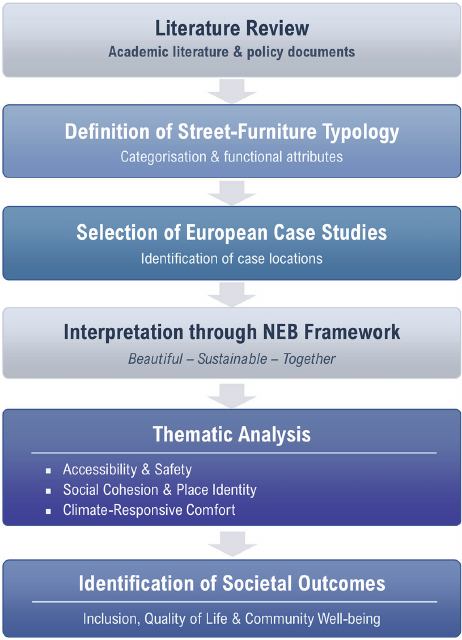
development (Fig. 1).
The analytical synthesis focused on three principal di‑
mensions identied through the literature review and repeat‑
edly reected in the selected case studies: (1) Accessibility
and Safety, (2) Social Cohesion and Place Identity, and (3)
Climate‑Responsive Comfort and Environmental Per for‑
mance. These dimensions were used to organise the analy‑
sis and to interpret the societal implications of dierent
street‑furniture interventions. The study examines how spe ‑
cic design features, participatory processes, and environ‑
men tal characteristics inuence everyday use of public space,
perceived quality of life, and inclusion of diverse user groups.
Societal dimension of street furniture in European neighbourhoods 81
Against this backdrop, the societal dimension of street
furniture emerges as a critical lens for understanding how
everyday urban elements shape accessibility, safety, social
interaction, and a sense of belonging in European neighbour‑
hoods. Addressing these interrelated social, cultural, and
environmental roles requires an integrative perspective that
connects design attributes with lived experience, governance
processes, and broader policy frameworks.
This perspective informs the analytical synthesis that fol‑
lows by situating the societal dimension of street furniture
within the broader conceptual context of the New European
Bauhaus (NEB). The core values and working principles of
the NEB are synthesised in Table 1, which was developed
on the basis of an in‑depth review of academic literature,
policy documents, and selected European examples. The ta‑
ble illustrates how the NEB values of Beautiful, Sustainable,
and Together, together with participatory, multilevel, and
transdisciplinary approaches, can be translated into street
furniture and public space design. Rather than functioning
as assessment criteria, these values and principles provide
the normative and interpretative context for understanding
how neighbourhood interventions may contribute to more
inclusive, environmentally responsible, and socially mean‑
ingful public spaces.
To operationalise these broader principles within the
analysis, an analytical framework was developed and is
presented in Table 2. The framework organises the review
around three principal analytical dimensions identied in the
literature: accessibility and safety, social cohesion and place
identity, and climate responsive comfort and environmental
performance. For each dimension, the framework species
the street furniture attributes examined, the assessment cri‑
teria applied, the principal sources of evidence, and the soci‑
etal outcomes considered. Evidence was extracted from ac‑
ademic publications, policy documents, technical stan dards,
and case‑study reports. Accessibility and safety were exam‑
ined primarily through EN 17210, EN 301 549, and relevant
European accessibility, procurement, and pro duct safety
frameworks. The framework provided a common structure
for reviewing the selected case studies and for comparing
the reported societal implications of dierent street furniture
interventions across neighbourhood contexts.
Accessibility and safety
Street furniture designed with universal‑design princi‑
ples improves accessibility and perceived safety. Barrier‑
free ramps, tactile paving, and ergonomic seating enable
in dependent use by people with disabilities and older
adults. EN 17210 sets accessibility requirements for the
built environment, while the European Accessibility Act
(Di rective (EU) 2019/882) denes essential requirements
for specic public‑facing products and services; for inter‑
active devices, conformity is typically demonstrated via
EN 301 549
covering contrast ratios, reach ranges, and tac ‑
tile/auditory feedback. Embedding these standards in de‑
sign and procurement makes benches, bus shelters, and
playground equipment inclusive for all user groups. Studies
also highlight the role of street furniture in supporting elec‑
tric micro‑mobility (Zaagnini et al. 2022). Guidance from
the European Disability Forum helps public buyers verify
inclusivity claims; checklists conrm armrest geometry,
wheelchair leg clearance, and Braille or audible signage
where needed (European Disability Forum n.d.).
Safety is a core function of street furniture and streets‑
cape design, and it also depends on structural and material
integrity. Adequate lighting, combined with well‑placed,
functional seating, can lower actual and perceived security
risks and extend use of public spaces across seasons and
times of day (Rode et al. 2017). Poor lighting and deterio‑
rated infrastructure correlate with higher petty‑crime rates
and greater fear of victimisation; a Campbell review of 13
evaluations found that improved street lighting reduced
crime by ~20% and supported community cohesion (Welsh,
Farrington 2008). Compliance with the EU Construction
Products Regulation (Regulation (EU) 305/2011) ensures
playground and street‑furniture products meet mechanical,
re, and chemical‑safety requirements (European Com‑
mission 2017). Specications should cap VOCs and form‑
aldehyde in wood‑based components and require ≥5 years
of spare‑parts availability, aligned with EU GPP criteria
(ICLEI 2017). CE‑marked declarations of performance
and relevant EN certicates help pre‑empt structural fail‑
ures and harmful emissions across the lifecycle. Well‑
designed street furniture improves place quality and public
health and strengthens local environmental resilience (Car‑
mo na 2019).
Fig. 1. Research design and analytical workflow
(elaborated by B. Widera)
Il. 1. Projekt badań i schemat analityczny (oprac. B. Widera)

82
Barbara Widera, Katarzyna Chojnacka, Dionysia Kolokotsa et al.
NEB Dimension (pillar) Focus
Key design implications
and illustrative examples
References
Beautiful
(aesthetics and sense
of place)
well‑being through beauty;
cultural meaning;
contextual fit
briefs beyond utility; local heritage cues;
community art/vernacular motifs in seating;
street‑prototyping with local craft (e.g., ceramics)
Melgarejo‑Torralba et al. 2025;
Sádaba et al. 2024
Sustainable
(green and circular)
give back more
than they take; mitigation;
circular flows; biodiversity
EU GPP alignment (recycled steel, FSC timber,
design for disassembly); 3‑D‑printed benches
from post‑consumer plastics (Print Your City);
algae photobioreactor “Liquid Tree” benches
(Skyforest 2023), sequester CO
2
;
provide shading/amenities;
off‑grid dog‑waste biogas lamps,
small‑scale energy recovery
European Commission 2017; 2021;
Print Your City n.d.;
United Nations Development
Programme 2021; George 2023;
Fleming 2018; ISO 20887:2020
Together
(inclusive and affordable)
universal accessibility;
social cohesion;
priority for vulnerable
groups
wheelchair manoeuvring space;
tactile wayfinding; EN 17210 in procurement;
co‑designed lighting + communal tables,
night‑time comfort, neighbourly interaction
(e.g., ToNite); EquiP, addressing power
asymmetries
European Disability Forum, n.d.;
Howard 2025; Çarçani et al. 2023;
Rode et al. 2017;
Welsh, Farrington 2008
Participatory process
active involvement
at every project phase
co‑design charrettes; citizen panels;
on‑street prototyping (e.g., children choose
colours/layouts for SuperBarrio);
digital twins/VR “living labs” for pre‑installation
testing; university–municipality frameworks
for process governance
URBiNAT 2023;
Scerri, Attard 2023;
Dogu et al. 2021;
European Commission 2025a;
Lourenço et al. 2024
Multi‑level engagement
link neighbourhood action
to city/region/EU agendas
pilots inform city adaptation and quality‑of‑life plans;
scaling via Cohesion Policy/Horizon/NEB facilities;
NEB Prizes enable transfer;
rapid street‑prototyping, faster path from test
to implementation
Altrock, Kurth 2024;
European Commission 2025b;
Wacinkiewicz 2023
Transdisciplinary approach
integrate design,
engineering,
social science, art
hybrid teams (architects, materials scientists,
sociologists) co‑create bio‑integrated furniture
(e.g., photobioreactor benches);
STARHAUS modular pavilions, evaluated on
NEB criteria; “quality co‑design”, iterative
learning; shared artefacts mediate collaboration
George 2023; United Nations
Development Programme 2021;
Bratu et al. 2024;
De Smet, Kesdi and Pak 2025;
Moore, Evans 2020;
Zamenopoulos et al. 2021;
Nielsen 2012
Table 1. New European Bauhaus values and working principles relevant to street‑furniture and public‑space design (elaborated by B. Widera)
Tabela 1. Wartości i zasady NEB w projektowaniu mebli miejskich i przestrzeni publicznych (oprac. B. Widera)
Societal benefits of street furniture
Street furniture shapes neighbourhood social life and cul‑
tural character. Interaction venues that reect local identity
strengthen community bonds. The impact has two facets:
(1) furniture fosters social cohesion and cultural identity,
(2) participatory design within the NEB framework empow‑
ers communities.
Social cohesion and cultural identity
Public furniture contributes to the social and cultural fabric
of neighbourhoods. Context‑sensitive design that echoes
local heritage or community values can instil pride and be‑
longing. Mucho Más Mayo urban art festival in Cartagena,
Spain, engaged students and artists to upcycle scrap timber
and shing nets into street furniture with locally resonant
motifs, beautifying the space and celebrating cultural iden‑
tity (Melgarejo‑Torralba et al. 2025). Such interventions
strengthen place attachment and place identity, supporting
long‑term care for the space; evidence reviews link aesthet
‑
ically and culturally anchored small‑scale design with great‑
er belonging and social rootedness (Latham, Layton 2019;
Lewicka 2011). Aesthetic quality can also attract visitors
and stimulate creative tourism, beneting local businesses
and cultural sectors. Street furniture fosters social cohesion
when seating, shade, shelters, and movable elements create
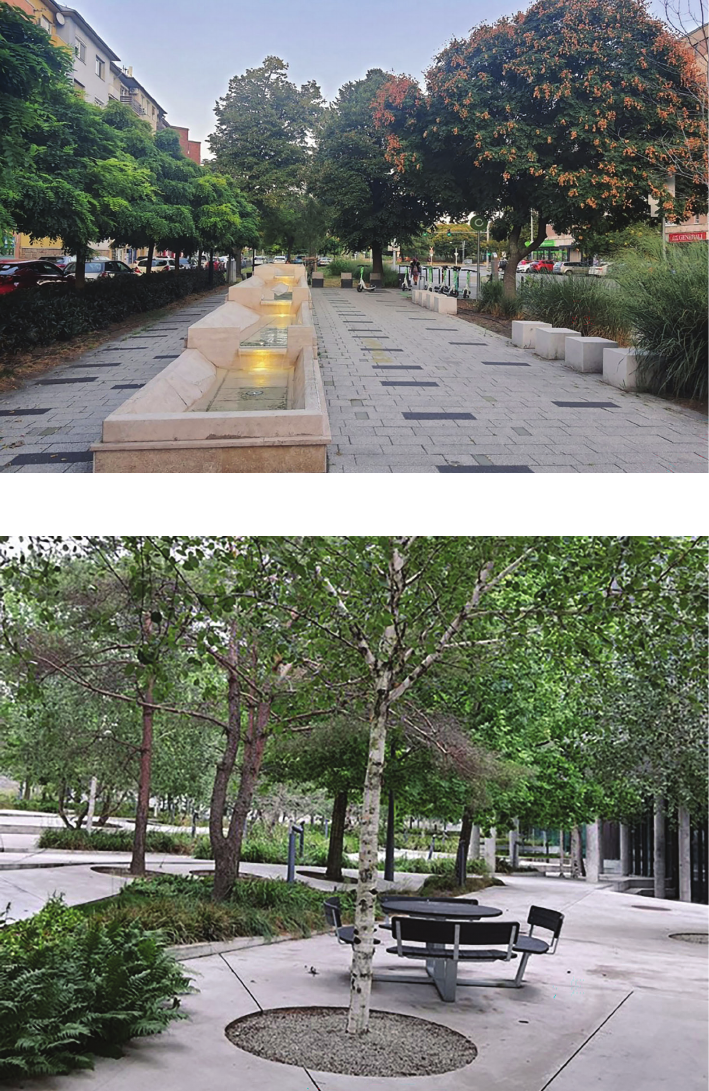
accessible, safe micro‑settings for interaction (Fig. 2).
Field studies locate the densest conversation clusters
along spatial edges and around movable furniture that lets
users co‑produce seating layouts (Loo, Fan 2023; Qi, Ma‑
zum dar and Vasconcelos 2024). Literature on microclimate
shows that shade and material choices lower air/surface
tem peratures by roughly 1–2 °C, increasing dwell time and
social contact during heat periods (Han, Jo and Kim 2023)
(Fig. 3). Projects that pair functional upgrades with cultural
expression, such as murals on seating or story plaques on
xtures, deepen emotional ties to place.

Societal dimension of street furniture in European neighbourhoods 83
Table 2. Analytical framework adopted for the assessment of societal dimensions of street furniture in European neighbourhoods
(elaborated by B. Widera)
Tabela 2. Analityczny model oceny społecznych aspektów mebli miejskich w sąsiedztwach europejskich (oprac. B. Widera)
Analytical
dimension
Street‑furniture aspects
analysed
Assessment criteria Main evidence sources
Societal outcomes
examined
Accessibility
and safety
seating ergonomics;
wheelchair manoeuvrability;
tactile guidance; visual
contrast; lighting quality;
shelter accessibility;
age‑friendly design
compliance with
accessibility requirements;
usability by diverse
user groups;
ease of independent use;
perceived and actual safety;
support for mobility
and orientation
EN 17210:2021; EN 301 549;
European Accessibility Act;
European Disability Forum
guidance; accessibility and
public‑space literature;
documented case studies
inclusion of persons
with disabilities;
independent use of
public space;
age‑friendly environments;
perceived safety;
improved access to
neighbourhood amenities
Social cohesion
and place identity
communal seating;
gathering spaces; culturally
responsive design; public art
elements; multifunctional
installations; neighbourhood
meeting points
potential to support
social interaction;
place attachment;
community ownership;
local identity; opportunities
for informal encounters
public‑space and
social‑infrastructure literature;
participatory‑design
studies; documented
European projects
social interaction;
community cohesion;
place attachment;
neighbourhood identity;
stewardship of public
space
Climate‑responsive
comfort and
environmental
performance
shading structures;
cooling elements;
vegetated furniture;
climate‑adaptive materials;
circular‑design solutions;
nature‑based interventions
contribution to thermal
comfort; support for outdoor
activity; climate adaptation;
resource efficiency;
environmental performance
climate‑comfort studies;
circular‑economy and
procurement guidance;
environmental case studies;
EU GPP criteria;
ISO 20887
reduced heat stress;
increased usability of
public space;
longer dwell time;
environmental awareness;
support for climate
resilience
Participatory and
governance
processes
co‑design workshops;
citizen panels; living labs;
temporary prototyping;
stakeholder collaboration;
community management
arrangements
degree of stakeholder
involvement; continuity of
participation; incorporation
of user knowledge;
long‑term community
engagement
NEB guidance;
co‑design literature;
case‑study documentation;
municipal programmes
greater acceptance
of interventions;
stronger ownership;
improved contextual fit;
long‑term maintenance
and stewardship
Cohesion and stewardship can be tracked with the Neigh‑
borhood Cohesion Index and the Collective Ecacy Scale
(Sampson, Raudenbush and Earls 1997). Place attachment
and sense of community are measurable in environmental
Fig. 2. Street furniture
in Opera Park, Copenhagen,
by Cobe, 2023
(photo by B. Widera)
Il. 2. Meble miejskie
w Opera Park w Kopenhadze,
projektu Cobe, 2023
(fot. B. Widera)
surveys (Francis et al. 2012). Systematic observation proto‑
cols (e.g., SOPARC) quantify interactions and dwell time at
specic furniture types, while CPTED provides a comple‑
mentary frame for safety assessment (Cozens, Love 2015;
84
Barbara Widera, Katarzyna Chojnacka, Dionysia Kolokotsa et al.
Fig. 3. Street furniture
in Budapest contributes to lower
ambient temperature (2025)
(photo by B. Widera)
Il. 3. Meble miejskie
w Budapeszcie obniżają
temperaturę otoczenia (2025)
(fot. B. Widera)
Fig. 4. Co‑designed street furni‑
ture in The City Dune,
Lundgaard Tranberg,
Copenhagen, 2011
(photo by B. Widera)
Il. 4. Współprojektowane meble
miejskie – The City Dune,
Lundgaard Tranberg,
Kopenhaga, 2011
(fot. B. Widera)
McKenzie et al. 2016). Street furniture is cost‑eective so cial
infrastructure that connects communities, expresses iden ‑
tity, and improves place quality (Gehl 2011).
Participatory design
Participatory design is central to the NEB approach. End‑
users and local stakeholders co‑create public‑spaces, im‑
proving alignment with their needs and values. Co‑de sign‑
ed spaces show lower vandalism, reduced maintenance,
and stronger community ownership than top‑down projects
(Sanches, Frankel 2010) (Fig. 4). Examples include the
SuperBarrio playground co‑created with children in Valla‑
do lid and Turin’s ToNite riverfront renewal co‑designed
with youth and migrant groups, both functioning as “liv‑
ing labs” for climate‑resilient, socially cohesive solutions
(URBiNAT 2023). NEB principles are operationalised through
recyclable or bio‑based materials, nature‑ or algaebased sh
ad‑
ing, and seating layouts that promote neighbourly interac‑
tion
(Ghira, Heilemann 2025). These interventions deliv‑
ered multiple benets; in ToNite, improved lighting and
safety coincided with 18 community groups signing long‑
term Pacts of Collaboration to co‑manage the new furniture
(Howard 2025), reinforcing social cohesion.
Societal dimension of street furniture in European neighbourhoods 85
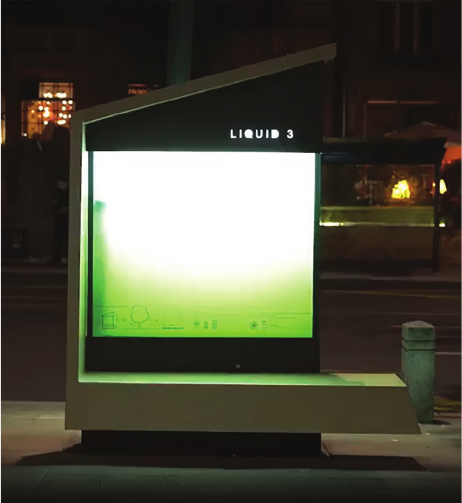
Fig. 5. Algae‑filled “Liquid Tree”, Belgrade, Serbia (photo by B. Widera)
Il. 5. Wypełniony algami „Liquid Tree”, Belgrad, Serbia
(fot. B. Widera)
Participatory design here functions as method, perfor‑
mance metric, and innovation driver. It shapes policy from
the top down: EU green procurement criteria encourage
circular, inclusive solutions informed by participation, and
standards bodies increasingly embed user‑inclusive guid‑
ance (e.g., accessibility standards cite stakeholder input).
Bottom‑up, it catalyses creativity: engaging citizens gener‑
ates novel ideas and builds local acceptance. The European
Commission has institutionalised these practices through
the NEB Self‑Assessment Method and Tool, which requires
projects to document community involvement at each stage
of design and delivery (Lourenço et al. 2024). Education and
capacity‑building promote co‑creation, life‑cycle thinking,
and cross‑disciplinary collaboration in architecture curricula
across Europe (Eckert 2022), aligning with calls for practi‑
tioners to master participatory methods to meet new quality
benchmarks in design governance (Moore, Evans 2020).
Contemporary projects demonstrate the value. The
STARHAUS pavilion prototype in Romania was developed
by a transdisciplinary team of architects, engineers, and
community stakeholders, yielding modular public‑space
structures that scored highly on NEB criteria (Bratu et al.
2024). Hybrid collaborations’
architects with chemists and
sociologists on an algae‑lled “Liquid Tree” (Fig. 5) bench
that doubles as an air purier
,
arose directly from co‑design
processes, producing innovations unlikely in single‑disci‑
pline settings (George 2023). Digital tools widen partici‑
pation’
virtual living labs and digital twins let residents
test furniture in immersive simulations before construction;
in Dublin, stakeholders voted via a QR‑coded interface on
bench congurations, and robotic fabrication adjusted pro‑
totypes overnight
,
while low‑cost urban prototyping kits en‑
able neighbourhood groups to trial temporary installations
and iterate using public feedback (Wacinkiewicz 2023).
These approaches empower communities at the individual
level (voice in design) and the institutional level (partner‑
ships between municipalities, SMEs, and citizens), linking
local action to city‑wide and EU agendas (De Smet, Kesdi
and Pak 2025). Participatory design under the NEB re‑
frames street furniture as something done with people, pro‑
ducing public spaces that are more cherished, more innova‑
tive, and aligned with sustainability and inclusion. Projects
should move beyond utility and create a strong sense of place
by reecting local culture and heritage (Mel garejo‑Torralba
et al. 2025). NEB‑inspired designs aim to give back more
than they take, adopting circular and nature‑based solutions
that improve the environment, for example furniture that ab‑
sorbs CO
2
or generates energy. Participatory, interdisci
plin‑
ary processes are standard. NEB projects engage citizens at
every stage assembling cross‑sector teams (architects
, engi‑
neers, artists, social scientists) to deliver holistic solutions.
This approach echoes earlier calls for co‑design in public
space and elevates empowerment, where users of a space
help design it.
Recent European projects demonstrate how participa‑
tory design translates NEB values into street‑furniture and
public‑space solutions. Table 3 summarises six cases, de‑
tailing their co‑creation processes, materials, technologies,
and measured impacts. Each case was analysed against the
three analytical dimensions identied in the methodologi‑
cal framework (accessibility and safety; social cohesion and
place identity; climate‑responsive comfort and environmen‑
tal performance), while the nal interpretation of outcomes
was structured through the corresponding NEB values and
working principles. In Budapest, the CoolCo’s Cooling Cor-
ners installation, developed with residents, lowered sidewalk
temperatures by 2.6
°C and encouraged local stewardship
(Ghira, Heilemann 2025). In Turin, the ToNite project en‑
gaged youth and migrant groups to improve nighttime public
areas with solar LED lighting and communal seating, leading
to long‑term co‑management agreements and a reduction in
petty crime (Howard 2025). The Print Your City initiative
in Amsterdam and Thessaloniki enabled residents to design
benches from recycled household plastic, diverting approx‑
imately 3t of waste from landlls and illustrating circu‑
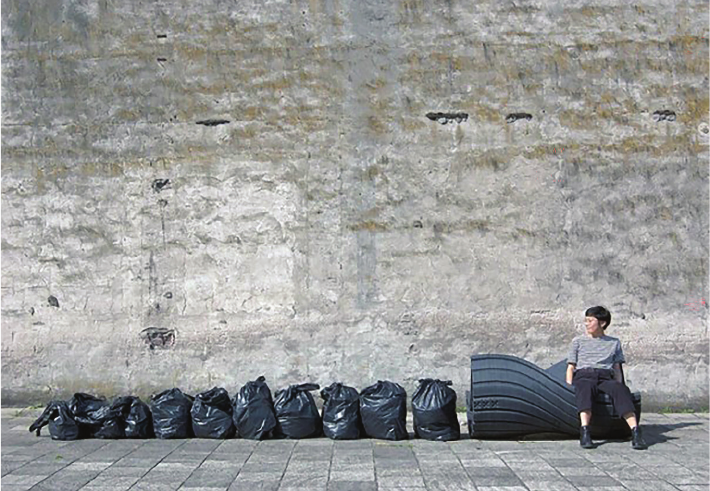
lar‑economy practice (Print Your City n.d.) (Fig. 6). Digital
tools further extend participation. Virtual‑reality “urban liv‑
ing labs” allow residents to test and co‑plan street modica‑
tions in immersive simulations (Scerri, Attard 2023).
Conclusions
This paper demonstrates that street furniture plays a sub‑
stantive role in shaping the societal quality of everyday ur‑
ban environments, particularly in older and disadvantaged
European neighbourhoods where access to amenities, safe‑
ty, and thermal comfort remain uneven. When conceived as
a social interface rather than a passive amenity, street fur‑
niture contributes to inclusion, accessibility, and perceived
security, directly inuencing patterns of outdoor use and
neighbourhood life. The analysed cases show that design
features addressing microclimatic conditions – such as shad‑
ing and cooling elements – support more equitable use of

86
Barbara Widera, Katarzyna Chojnacka, Dionysia Kolokotsa et al.
public space by reducing heat stress and extending the tem‑
poral and seasonal usability of streets and squares. Reported
surface temperature reductions of approximately 2.6
°C are
especially relevant for older adults and other heat‑vulnerable
groups, as they improve walkability, enable longer outdoor
stays, and mitigate health risks during heat events. In this
context, environmental performance functions primarily as
a facilitator of social participation and everyday comfort
rather than as an isolated ecological objective. Accessibility
and safety emerge as closely intertwined with these comfort
eects. Barrier‑free layouts, age‑friendly seating ergonomics,
and appropriate lighting quality reinforce perceptions of safe‑
ty and encourage use by people with reduced mobility, care‑
givers, and older residents. The evidence suggests that when
these elements are coherently combined, street fur niture con‑
tributes to more inclusive patterns of social in ter ac tion and
supports informal surveillance, thereby strength ening neigh‑
bourhood cohesion. Aesthetic quality further amplies these
eects by reinforcing local identity and sig nalling care, per‑
manence, and legitimacy of public space interventions.
A central nding of the study is the critical role of partici‑
patory co‑design in generating and sustaining societal value.
Engagement of residents and local stakeholders throughout
design, implementation, and maintenance phases improves
contextual t, strengthens place attachment, and supports
shared responsibility for public spaces. Co‑designed inter‑
Project
(location and period)
Participatory mechanism
Materials / technology
used
Documented impact and NEB
dimensions
References
“CoolCo’s” Cooling
Corners (Józsefváros,
Budapest; 2023)
five neighbourhood
charrettes;
on‑street mock‑ups;
QR code surveys
modular benches
in thermally modified ash
with recycled‑steel frames;
micro‑fog nozzles;
drought‑tolerant planters
surface temperature 2.6 °C lower
than control pavement;
83% of residents reported
stronger ownership.
NEB: Beautiful Sustainable
Together Participatory
Ghira, Heilemann
2025
ToNite Night‑time
Renewal
(Turin; 2019–2023)
forty‑two co‑design
workshops;
18 Pacts of
Collaboration with local
groups (youth and
migrant associations)
solar‑powered
LED lighting;
recycled‑plastic seating;
movable planters from
municipal fab‑lab
project monitoring reported 24%
fall in night‑time petty crime along
the Dora promenade;
18 groups co‑manage the furniture.
NEB: Together Participatory
Multi‑level
Howard 2025
SuperBarrio digital tool
(Nantes / Porto / Sofia;
2020–2023)
gamified 3‑D
configurator;
online voting linked
to town‑hall meetings
benches CNC‑milled from
cork agglomerate;
play modules in
recycled‑HDPE
bottle caps
1,400+ user sessions;
57% of top‑voted designs
built on site;
NEB Awards 2023 finalist.
NEB: Beautiful Participatory
Transdisciplinary
URBiNAT 2023
Print Your City
(Amsterdam & Thessaloniki;
2018–2019)
web interface for citizen
co‑design and personal
plastic quotas
robotic 3‑D printing
of PET/PP flakes;
NFC tag displaying
kilograms of waste
diverted
single bench reused ~120 kg
household plastic;
total diversion ~3 t;
15 public recycling workshops.
NEB: Sustainable Participatory
Print Your City,
n.d.
LIQUID3
photobioreactor bench
(Belgrade; 2021– )
open call for pilot sites;
citizen‑science sensors
feeding a public
dashboard
~600 L acrylic
photobioreactor
with Chlorella sp.;
PV‑powered circulation;
USB charging
Algae uptake ~200 g CO
2
day⁻¹;
real‑time display used in local
climate‑literacy activities;
communications compare
performance with two young trees
and ~200 m
2
lawn
(context dependent).
NEB: Sustainable Transdisciplinary
Participatory
United Nations
Development
Programme 2021;
George 2023;
Skyforest 2023
Dog‑waste biogas lamp
(Malvern Hills, UK;
2017– )
on‑site demos with
dog‑owners;
suggestion box for lamp
and bag design
small anaerobic digester
producing methane for
a Victorian‑style lamppost;
compostable starch bags
off‑grid lighting generated from
dog‑waste inputs;
single‑use plastic bags replaced by
compostable alternatives;
local authority support reported.
NEB: Sustainable Together
Fleming 2018
Table 3. Participatory street‑furniture case studies illustrating the New European Bauhaus (NEB) approach
(elaborated by K. Chojnacka, B. Widera)
Tabela 3. Partycypacyjne studia przypadków mebli miejskich ilustrujące podejście Nowego Europejskiego Bauhausu (NEB)
(oprac. K. Chojnacka, B. Widera)
Societal dimension of street furniture in European neighbourhoods 87
ventions show higher levels of acceptance, reduced vandal‑
ism, and more consistent everyday use, indicating that social
processes are as decisive as material or technical solutions
in delivering long‑term benets. The synthesis of literature,
policy documents, standards, and selected European case
studies indicates that societal benets are most evident when
street furniture is considered as part of a broader neighbour‑
hood system. Across diverse contexts, the reviewed exam‑
ples demonstrate that seating, lighting, shading, recreational
elements, and small‑scale environmental interventions can
inuence social behaviour, perceptions of public space, and
patterns of neighbourhood use well beyond their imme‑
diate functional purpose. The analysis also highlights the
im portance of considering design quality, governance ar‑
ran gements, and local context together when assessing the
out comes of public‑space interventions. The analysed cases
provide concrete illustrations of how the identied analyt‑
ical dimensions operate in practice. The reviewed projects
demonstrate that climate‑responsive interventions, acces‑
sibility measures, participatory governance arrangements,
and context‑sensitive design can generate complementary
benets extending beyond the immediate functional role
of street furniture. Across the examined cases, societal out‑
comes included stronger community stewardship, improved
perceptions of safety, enhanced opportunities for social in‑
teraction, greater environmental awareness, and increased
accessibility for diverse user groups. Taken together, these
examples indicate that street furniture can simultaneously
support social inclusion, neighbourhood identity, and en‑
vironmental objectives when embedded within appropri‑
ate design and governance processes. Situated within the
values of the New European Bauhaus, the ndings support
a reframing of street furniture as a modest yet powerful in‑
strument of inclusive urban regeneration. Thus, by aligning
aesthetic quality, accessibility, and comfort with participato‑
ry processes, street furniture can address everyday vulnera‑
bilities and enhance quality of life at neighbourhood scale.
The study is subject to several limitations. Its conclusions
are based on qualitative evidence drawn from published re‑
search, policy frameworks, technical standards, and purpo‑
sively selected case studies rather than on primary empiri‑
cal investigation. Consequently, the identied relationships
should be understood as evidence‑based patterns observed
across the reviewed cases rather than as universally appli‑
cable causal eects. Future research should focus on more
systematic assessment of societal outcomes across diverse
contexts, with particular attention to long‑term use patterns,
perceived safety, and distributional eects among vulnerable
groups. Further work is also needed to develop comparable
evaluation approaches that would allow social, environmen‑
tal, and governance‑related outcomes of street‑furniture in‑
terventions to be assessed more consistently across dierent
neighbourhood settings.
Translated by
Barbara Widera
Fig. 6. Print Your City
co‑designed “XXX Bench” from
recycled household plastic
(photo by Print Your City,
source: Products – Print Your City)
Il. 6. Ławka „XXX Bench”
zaprojektowana w ramach
projektu Print Your City,
wykonana z recyklingowanego
plastiku domowego
(fot. Print Your City,
źródło: Products – Print Your City)
Acknowledgements
This article is a part of research undertaken within activities of the Mission
Board of the EU Mission Adaptation to Climate Change.
88
Barbara Widera, Katarzyna Chojnacka, Dionysia Kolokotsa et al.
References
Altrock, Uwe, and Detlef Kurth, eds. Urban regeneration in Europe.
Springer, 2024.
Bouman, Thijs, Linda Steg, and Stephanie Johnson Zawadzki. “The value
of what others value: When perceived biospheric group values in ‑
uence individuals’ pro‑environmental engagement.” Journal of En-
vironmental Psychology 71 (2020): 101470. https://doi.org/10.1016/
j.jenvp.2020.101470.
Bratu, Petruț, Akhilesh Kumar Srivastava, Alex Butean, and Letizia Vacca‑
rella. “The New European Bauhaus: Beautiful‑sustainable‑together
in STARHAUS.” Transylvanian Review of Administrative Sciences,
no. 73 (2024): 36–51. https://doi.org/10.24193/tras.73E.3.
Çarçani, Klaudia, Tone Bratteteig, Harald Holone, and Jo Herstad. “EquiP:
A Method to Co‑design for Cooperation.” Computer Supported Co-
opera tive Work 32, no. 3 (2023): 385–438. https://doi.org/10.1007/
s10606‑023‑09463‑w.
Carmona, Matthew. “Place Value: Place Quality and Its Impact On Health,
Social, Economic And Environmental Outcomes.” Journal of Urban
Design 24, no. 1 (2019): 1–48. https://doi.org/10.1080/13574809.2018.
1472523.
Carra, Martina, Barbara Caselli, Silvia Rossetti, and Michele Zazzi. “Wide‑
spread Urban Regeneration of Existing Residential Areas in European
Medium‑Sized Cities – A Framework to Locate Redevelopment In‑
ter ventions.” Sustainability 15, no. 17 (2023): 13162. https://doi.org/
10.3390/su151713162.
Coujard, Clementine, Larissa De Rosso, Anastasiya Yurchyshyna, et al. New
European Bauhaus: A Handbook. Built4People / NEBULA Project,
2023. Accessed May 25, 2026, at https://built4people.eu/wp‑content/
uploads/2023/10/New‑European‑Bauhaus‑a‑handbook.pdf.
Cozens, Paul, and Terence Love. “A Review and Current Status of Crime
Preven tion through Environmental Design (CPTED).” Journal
of Planning Litera ture 30, no. 4 (2015): 393–412. https://doi.
org/10.1177/0885412215595440.
Danilović Hristić, Nataša, Nataša Čolić Marković, Sanja Simonović Al ‑
rević, Borjan Brankov, and Blaž Barborič. “Recommended Metho‑
dological Steps for Applying New European Bauhaus Principles
in Urban Regeneration: Insights from NONA Project Pilot Sites.”
Sus tainability 18, no. 10 (2026): 4837. https://doi.org/10.3390/
su18104837.
De Smet, Aurelie, Hatice Server Kesdi, and Burak Pak. “Towards Ar‑
chitectural Design Empowerment: An Analysis of the Solidary Mobile
Housing Project’s Development Process through Theory of Action in
Direct Design Empowerment Framework.” CoDesign. International
Journal of CoCreation in Design and the Arts 21, no. 3 (2025): 517–
39. https://doi.org/10.1080/15710882.2025.2468447.
“Directive (EU) 2019/882 of the European Parliament and of the Council
of 17 April 2019 on the accessibility requirements for products and
services (Text with EEA relevance).” Ocial Journal of the European
Union, L 151/70. Accessed May 25, 2026, at http://data.europa.eu/eli/
dir/2019/882/oj.
Dogu, Derya Irkdas, Onur Mengi, Deniz Deniz, and Ozgul Kilincarslan.
“Co‑design Management Framework for Community Empowerment
through Local Government‑Design School Collaboration.” In Pro-
ceedings of the 22
nd
European Conference on Knowledge Management
(ECKM 2021), Coventry, UK, 2–3 September 2021, edited by Alexeis
Garcia‑Perez and Lyndon Simkin. Academic Conferences and Pub li‑
shing International, 2021.
Eckert, Jan. “Extending the New European Bauhaus. An Educational
Initiative that Is Much Needed to Transform Our Society.” In Per-
spectives on Design II, edited by Daniel Raposo, João Neves and José
Silva. Springer, 2022. https://doi.org/10.1007/978‑3‑030‑79879‑6_9.
European Commission. EN 17210:2021. Accessibility and Usability of the
Built Environment – Functional Requirements. European Committee
for Standardization (CEN). Published September 8, 2021. Accessed
May 20, 2026, at https://accessible‑eu‑centre.ec.europa.eu/con‑
tent‑corner/digital‑library/en‑172102021‑accessibility‑and‑usabili‑
ty‑built‑environment‑functional‑requirements_en.
European Commission. Commission Sta Working Document. EU Green
Public Procurement Criteria for Furniture (SWD 283 nal). Published
October 8, 2017. Accessed May 20, 2026, at https://susproc.jrc.ec.eu
‑
ropa.eu/product‑bureau/sites/default/les/contentype/product_group_
documents/1581683289/SWD_furniture_gpp_criteria_only.pdf.
European Commission. New European Bauhaus Checklist: A Self asses-
sment Tool that Helps Evaluate How Built Environment Projects
Align with the NEB Core Values and Working Principles. Publications
Oce of the European Union, 2025a. https://new‑european‑bauhaus.
europa.eu/system/les/2025‑04/NEB%20Checklist_delivery.pdf.
European Commission. Horizon Europe Work Programme 2025: New
European Bauhaus Facility (Work Programme). Publications Oce of
the European Union, 2025b. https://ec.europa.eu/info/funding‑tenders/
opportunities/docs/2021‑2027/horizon/wp‑call/2025/wp‑13‑new‑eu‑
ropean‑bauhaus‑facility_horizon‑2025_en.pdf.
European Disability Forum. Public Procurement. Published n.d. Ac‑
cessed August 2, 2025, at https://www.edf‑feph.org/public‑procure‑
ment‑policy/
Fleming, Nic. “From Stools to Fuels: The Street Lamp That Runs on Dog
do.” The Guardian, January 1, 2018. https://www.theguardian.com/
environment/2018/jan/01/stools‑to‑fuels‑street‑lamp‑runs‑on‑dog‑
poo‑bio‑energy‑waste‑
Francis, Jacinta, Billie Giles‑Corti, Lisa Wood, and Matthew Knuiman.
“Creating sense of community: The role of public space.” Journal
of Environmental Psychology 32, no. 4 (2012): 401–9. https://doi.
org/10.1016/j.jenvp.2012.07.002.
Gehl, Jan. Life Between Buildings: Using Public Space. Translated by Jo
Koch. Island Press, 2011.
George, A. Shaji. “Liquifying Urban Lungs: Assessing the Air Purication
Potential of Photobioreactor ‘Liquid Trees’ in Highly Polluted Cities.”
PUIRP Journal 1, no. 2 (2023): 55–71. https://doi.org/10.5281/zeno‑
do.10111964.
Ghira, Zsóa Anna, and Jasmin Heilemann. “Urban Heat Adaptation
Through Co‑Design of Public Space Using the New European Bau haus
Principles: A Case Study of Józsefváros, Budapest.” Discover Sus tain-
ability 6 (2025): 203. https://doi.org/10.1007/s43621‑025‑00975‑7.
Gupta, Akshay, Madhura Yadav, and Bibhu Kalyan Nayak. “A Systematic
Literature Review on Inclusive Public Open Spaces: Accessibility
Standards and Universal Design Principles.” Urban Science 9, no. 6
(2025): 181. https://doi.org/10.3390/urbansci9060181.
Han, Yuha, Yongjun Jo, and Eujin Julia Kim. “Inuence of Landscape
Inter ventions on Thermal Comfort Under Time‑Varying Building
Shadow; New Gwanghwamun Square Case, Seoul, South Korea.” He
liyon 9, no. 9 (2023): e19436. https://doi.org/10.1016/j.heliyon.
2023.e19436.
Howard, Nick. Turin’s ToNite Project Is Illuminating the Night Through
Community and Care. Eurocities. Published May 22, 2025. Accessed
May 20, 2026, at https://eurocities.eu/stories/turins‑tonite‑project‑is‑
illuminating‑the‑night‑through‑community‑and‑care/.
ICLEI. European Commission Publishes New GPP Criteria for Fur ni
ture. Published August 14, 2017. Accessed May 20, 2026, at https://
sustainable‑procurement.org/news?c=search&uid=f24ce51b.
“ISO 20887:2020, Sustainability in Buildings and Civil Engineering Works
– Design for Disassembly and Adaptability – Principles, Require ments
and Guidance.” International Organization for Standardization, 2020.
https://www.iso.org/standard/69370.html.
Latham, Alan, and Jack Layton. “Social Infrastructure and the Public Life
of Cities: Studying Urban Sociality and Public Spaces.” Geogra phy
Compass 13, no. 7 (2019): e12444. https://doi.org/10.1111/gec3.12444.
Latham, Alan, and Jack Layton. “Social Infrastructure: Why It Matters and
How Urban Geographers Might Study It.” Urban Geography 43, no. 5
(2022): 659–68. https://doi.org/10.1080/02723638.2021.2003609.
Lewicka, Maria. “Place Attachment: How far Have We Come in The Last
40 Years?” Journal of Environmental Psychology 31, no. 3 (2011):
207–30. https://doi.org/10.1016/j.jenvp.2010.10.001.
Liu, Zheming, Jin Li, and Tianyu Xi. “A Review of Thermal Comfort
Evaluation and Improvement in Urban Outdoor Spaces.” Buildings
13, no. 12 (2023): 3050. https://doi.org/10.3390/buildings13123050.
Loo, Becky PY, and Zhuangyuan Fan. “Social interaction in public space:
Spatial edges, moveable furniture, and visual landmarks.” En vi ron ment
Societal dimension of street furniture in European neighbourhoods 89
Streszczenie
Społeczne znaczenie mebli miejskich w dzielnicach miast europejskich
W wielu starszych i defaworyzowanych europejskich jednostkach sąsiedzkich obserwuje się postępującą degradację infrastruktury miejskiej, ogra‑
niczoną dostępność usług publicznych oraz utrzymujące się problemy związane z bezpieczeństwem, które w sposób nieproporcjonalny dotykają grup
szczególnie wrażliwych. Choć meble miejskie są często traktowane jako element drugorzędny, rosnąca liczba badań wskazuje, że odgrywają one istotną
rolę w kształtowaniu codziennych praktyk społecznych, dostępności przestrzeni oraz postrzeganego bezpieczeństwa.
W artykule przeanalizowano społeczny wymiar mebli miejskich oraz ich wpływ na jakość życia w europejskich jednostkach sąsiedzkich, ze szcze‑
gólnym uwzględnieniem inkluzji, komfortu termicznego oraz przyjaznego dla osób starszych korzystania z przestrzeni publicznych. Na podstawie
pogłębionego przeglądu literatury naukowej oraz wybranych studiów przypadków zbadano, w jaki sposób współczesne interwencje w zakresie mebli
miejskich wpływają na wzorce użytkowania przestrzeni zewnętrznych, interakcje społeczne oraz poczucie bezpieczeństwa.
and Planning B: Urban Analytics and City Science 50, no. 9 (2023):
2510–26. https://doi.org/10.1177/23998083231160549.
Lourenço, Paulo B., Thomas Maloutas, Matthaios Santamouris, et al.
A Prac tical Guide to the New European Bauhaus SelfAssessment
Method and Tool. Publications Oce of the European Union, 2024,
https://data.europa.eu/doi/10.2760/9581060.
McKenzie, Thomas L., Deborah A. Cohen, Amber Sehgal, Stephanie
William son, and Daniela Golinelli. “System for Observing Play and
Recreation in Communities (SOPARC): Reliability and Feasibility
Measures.” Journal of Physical Activity and Health 3, no. s1 (2016):
s208–22. https://doi.org/10.1123/jpah.3.s1.s208.
Melgarejo‑Torralba, Mar, Sandra Planes‑Tenza, Dolores Parras‑Burgos,
Da niel G. Fernández‑Pacheco, and Francisco J.F. Cañavate. “Art,
Tech nique and Citizenship: A Space Where the New European Bau‑
haus Converges. Case Study of the Mucho Mas Mayo Art Festival.” In
Ad vances on Mechanics, Design Engineering and Manufacturing V,
edited by Cristina Manchado del Val, Ramón Miralbes Buil, Guil‑
lermo Peris Fajarnés, María Moncho Santonja, Caterina Rizzi and
Lionel Roucoules. Springer, 2025. https://doi.org/10.1007/978‑3‑
031‑72829‑7_56.
Moore, Nicole, and Mark Evans. “It’s All in the Practice: Towards Quality
Co‑Design.” In The Palgrave Handbook of Co-Production of Public
Ser vices and Outcomes, edited by Elke Loeer and Tony Bovaird.
Pal grave Macmillan, 2020. https://doi.org/10.1007/978‑3‑030‑53705‑
0_19.
Nielsen, Brita Fladvad. “Participate! A critical investigation into the re‑
lationship between participation and empowerment in design for
development.” In DS 71: Proceedings of NordDesign 2012 – the
9
th
NordDesign Conference, Aalborg University, Denmark, 22–24
August 2012, edited by Poul Kyvsgaard Hansen, John Rasmussen,
Kaj A. Jørgensen and Christian Tollestrup. Center for Industrial Pro ‑
duction, Aalborg University, The Design Society, 2012. https://www.
designsociety.org/download‑publication/38573/participate_a_criti‑
cal_investigation_into_the_relationship_between_participation_and_
empowerment_in_design_for_development.
Print Your City. Experience Center for Circularity. Retrieved August 2,
2025, from https://www.printyour.city/products
Qi, Jie, Suvodeep Mazumdar, and Ana C. Vasconcelos. “Understanding
the Relationship between Urban Public Space and Social Cohesion:
A Systematic Review.” International Journal of Community Well-
Being 7 (2024): 155–212. https://doi.org/10.1007/s42413‑024‑
00204‑5.
“Regulation (EU) No 305/2011 of the European Parliament and of the
Council of 9 March 2011 laying down harmonised conditions for the
marketing of construction products and repealing Council Directive
89/106/EEC Text with EEA relevance.” Ocial Journal of the
European Union, L 88/5. Accessed May 30, 2026, at http://data.euro‑
pa.eu/eli/reg/2011/305/oj.
Rode, Philipp, Graham Floater, Nikolas Thomopoulos, et al. “Accessibility
in Cities: Transport and Urban Form.” In Disrupting Mobility. Impacts
of Sharing Economy and Innovative Transportation on Cities, edited
by Gereon Meyer and Susan Shaheen. Springer, 2017. https://doi.
org/10.1007/978‑3‑319‑51602‑8_15.
Sádaba, Juan, Ylenia Alonso, Itxaro Latasa, and Arantzazu Luzarraga.
“Towards Resilient and Inclusive Cities: A Framework for Sustainable
Street‑Level Urban Design.” Urban Science 8, no. 4 (2024): 264.
https://doi.org/10.3390/urbansci8040264.
Sampson, Robert J., Stephen W. Raudenbush, and Felton Earls. “Neigh‑
borhoods and Violent Crime: A Multilevel Study of Collective E‑
cacy.” Science 277, no. 5328 (1997): 918–24. https://doi.org/10.1126/
science.277.5328.918.
Sanches, Maria Gabriela, and Lois Frankel. “Co‑design in Public Spaces:
An Interdisciplinary Approach to Street Furniture Development.”
In Design and complexity: Proceedings of the Design Research So-
ciety International Conference 2010, edited by David Durling, Rabah
Bousbaci, Lin‑Lin Chen, Tiiu Poldma, Seymour Roworth‑Stokes and
Erik Stolterman. Design Research Society, 2010. https://dl.design‑
researchsociety.org/drs‑conference‑papers/drs2010/researchpapers/
105/.
Scerri, Karyn, and Maria Attard. “People as Planners: Stakeholder Par ti‑
ci pation in the Street Experimentation Process Using a Virtual Urban
Living Lab.” Journal of Urban Mobility 4 (2023): 100063. https://doi.
org/10.1016/j.urbmob.2023.100063.
Skyforest, Zoe. “The liquid trees of Belgrade: The Facts Behind the
Furore.” Hackaday. Published April 4, 2023. Accessed May 20, 2026,
at https://hackaday.com/2023/04/04/the‑liquid‑trees‑of‑belgrade‑the‑
facts‑behind‑the‑furore/.
United Nations Development Programme. The First Algae Air Purier
in Serbia. Published September 9, 2021. Accessed May 20, 2026, at
https://www.undp.org/serbia/news/rst‑algae‑air‑purier‑serbia.
URBiNAT. SuperBarrio Among the Finalists of the New European Bau-
haus Awards 2023. Published May 17, 2023. Accessed May 20, 2026,
at https://urbinat.ces.uc.pt/articles/superbarrio‑among‑the‑nalists‑ of‑
the‑ new‑european‑bauhaus‑awards‑2023/.
Wacinkiewicz, Daniel. “Urban Prototyping as a Tool to Enhance Pub lic
Participation in Territorial Self‑Government.” Teka Komisji Praw ni-
czej PAN Oddział w Lublinie 16, no. 1 (2023): 315–24. https://doi.
org/10.32084/tkp.5371.
Welsh, Brandon C., and David P. Farrington. “Eects of Improved Street
Lighting on Crime.” Campbell Systematic Reviews: Better Evidence
for a Better World 4, no. 1 (2008): 1–51. https://doi.org/10.4073/
csr.2008.13.
Woźniczka, Agata. “The Impact of Policy Initiatives on the Design of
Pub lic Spaces on the Example of the New European Bauhaus.”
Ar chi tectus,
no.
3
(2023):
95–104.
https://doi.org/10.37190/
arc230308.
Younes, Sadiq R., Bruno Marques, and Jacqueline McIntosh. “Public
Spaces for Older People: A Review of the Relationship between
Public Space to Quality of Life.” Sustainability 16, no. 11 (2024):
4583. https://doi.org/10.3390/su16114583.
Zaagnini, Theo, Gabriele Lelli, Ilaria Fabbri, and Marco Negri. “In no‑
vative Street Furniture Supporting Electric Micro‑mobility for Active
Aging.” In Internet of Things for Human-Centered Design, edited by
Soa Scataglini, Silvia Imbesi and Gonçalo Marques. Springer, 2022.
https://doi.org/10.1007/978‑981‑16‑8488‑3_15.
Zamenopoulos, Theodore, Busayawan Lam, Katerina Alexiou, et al.
“Types, Obstacles and Sources of Empowerment in Co‑Design: The
Role of Shared Material Objects and Processes.” CoDesign. In ter na-
tional Journal of CoCreation in Design and the Arts 17, no. 2 (2021):
139–58. https://doi.org/10.1080/15710882.2019.1605383.
90
Barbara Widera, Katarzyna Chojnacka, Dionysia Kolokotsa et al.
Elementy zacieniające i chłodzące omówiono w kontekście udokumentowanych spadków temperatury powierzchni o mniej więcej 2,6
°C, co pod‑
kreśla ich znaczenie dla poprawy komfortu termicznego, wydłużenia czasu użytkowania przestrzeni zewnętrznych oraz ograniczenia ryzyka przegrzania
u osób starszych. Wykazano również, że standardy dostępności, ergonomia siedzisk oraz jakość oświetlenia wzmacniają te efekty, wspierając tworzenie
bezpieczniejszych i bardziej inkluzywnych środowisk sąsiedzkich.
Procesy partycypacyjnego współprojektowania przeanalizowano jako kluczowy mechanizm generowania i utrzymywania korzyści społecznych.
Dowody wskazują, że trwałe zaangażowanie mieszkańców i lokalnych interesariuszy poprawia dopasowanie rozwiązań do kontekstu, wzmacnia więź
z miejscem oraz sprzyja współodpowiedzialności za przestrzeń publiczną.
Słowa kluczowe: meble miejskie, dostępność, spójność społeczna, odporność na zmiany klimatu, projektowanie partycypacyjne, Nowy Europejski
Bauhaus