
2015
4(44)
DOI: 10.5277/arc150408
Witold Szymański*, Beata Kania**, Maurycy J. Kin***
Przestrzeń w architekturze, przestrzeń architektury
Space in architecture, space of architecture
Architektura jest jednym z najważniejszych, choć
po chodnym od innych, elementem kultury. Wraz z po
zostałymi obiektami danej kultury tworzy jej dy na miczną
strukturę. Zjawiska architektury należy rozpatrywać ze
względu na relacje z innymi elementami przestrzeni kul
turowej w zakresach szeroko pojętych uwarunkowań
społecznych i technicznych. Tworzą one hierarchiczną
strukturę architektury. Niektóre z tych uwarunkowań
mają charakter relacji istniejących w obszarze samej ar
chitektury, pozostałe tworzą związki z innymi obiekta
mi kultury. Całościowe ujęcie problemu wymaga analiz
w obu tych zakresach.
Pojęcie kultury jest niedeniowalne (kłopoty z de ni
cją kultury wynikają stąd, że […] Pojęcie kultury jest co
najmniej tak samo trudne do zdeniowania, jak pojęcie
życia. Skąd się wzięła kultura? Każdy znawca rzeczy
uzna tak postawione pytanie za naiwne. […] Świat jest
wie loskładnikową mieszaniną ładów zdeterminowanych
i statystycznych, czyli przewidywalnych i nieprze wi dy
wal nych w ich stanach przyszłych. Wiele odkryć w róż
nych sferach empirii złożyło się na przyznanie pojęciu
losowości szczególnego znaczenia w tworzeniu przez
naukę obrazu świata. Wiąże się z tym problem losowości
w kulturze. […] Niechętny był od dawien dawna temu
pojęciu umysł ludzki… [1, s. 220]), a sama kultura jest
swoistą przestrzenią zawierającą obiekty, które można
Architecture is one of the most important parts of cul
ture, although derived from other elements. Together with
the other objects of the given culture it creates its dynam
ic structure. The phenomena of architecture can be seen
due to the relationship with other elements of the cultural
space in areas of broad social and technical conditions.
They form a hierarchical structure of architecture. Some
of these conditions feature relations existing in the archi
tecture itself, the others form relationships with other
objects of the culture. Comprehensive coverage of the
problem requires an analysis in both of these areas.
The concept of a culture is undefinable (trouble with
the definition of a culture comes from the fact that […] the
concept of culture is at least as difficult to define as the
concept of life. Where is culture from? Any connoisseur of
the subject finds such a question as being naïve. […] The
world is a multicomponent mixture of determined and
statistical orders, which are predictable and unpredict
able in their future states. Many discoveries in various
spheres of experiences contributed to the concept of ran
domness of particular importance in the creation of the
world image by science. It is linked to the problem of
randomness in the culture. […] The concept has been
rejected for many years by the human mind [1, p. 220]),
and the culture itself is a kind of space that contains
objects that can be considered due to the collection of the
statistical states. These collections can be defined as
events that make up the various trains, for example, cul
tural trains, and depending on the class of the object, they
can take various forms.
Time as a physical element in the cultural sphere also
becomes the cultural object which features nonphysical
dimensions, and the unequal meaning of time in va rious
* Wydział Architektury Politechniki Wrocławskiej/Faculty of
Architecture, Wrocław University of Technology.
** Stypendystka Instytutu Goethego, Wrocław/Scholarship holder
of Goethe Institute, Wrocław.
*** Wydział Elektroniki Politechniki Wrocławskiej/Faculty of
Electronics, Wrocław University of Technology.

84 Witold Szymański, Beata Kania, Maurycy J. Kin
rozpatrywać ze względu na zbiory stanów statystycznych.
Te zbiory można określić jako zdarzenia, które tworzą
rozmaite ciągi, np. ciągi kulturowe, a w zależności od
kla sy obiektu mogą przyjmować różne formy. Czas jako
zy czny element przestrzeni zdarzeń kulturowych staje
się także jednym z obiektów kulturowych o wymiarze
niezycznym, czego przykładem może być niejednakowe
znaczenie czasu w różnych kulturach. Na dwoistą budo
wę elementów kulturowych składają się więc elementy
zycz ne i pojęciowe, jak idee, tradycja itp. Badanie prze
strzeni kulturowej odbywa się poprzez badanie jej obiek
tów, a opis werbalny i doświadczenia pozawerbalne to
narzędzia służące określeniu cech i relacji między nimi,
choćby w zakresie jednej z kategorii poznawczych, ich
deterministycznego lub losowego charakteru. Przytoczmy
kilka przykładów zjawisk istniejących we współczesnej
kulturze.
Jednym z nich jest pojmowanie KULTURY JAKO
DESTRUKCJI KULTURY, czyli upatrywanie wartości
w ich niszczeniu. Przykładem może być to, że jednym
z głów nych trendów obecnej kultury jest obalanie jeszcze
nie obalonych zakazów kulturowych.
Kolejnym zjawiskiem w kulturze jest KULTURA JAKO
UCIECZKA Z KULTURY. A więc za dzieło sztuki podaje
się dziś nie tylko to, co być nim tradycyjnie nie mogło, lecz
i to co jest wyzbyte wszelkiego sensu [1, s. 78].
Jeszcze innym jest KOMERCJALIZM W KULTURZE.
*
Sposób pojmowania świata jest podstawową cechą
każdej kultury i ma olbrzymi wpływ na poszczególne jej
elementy, w tym na architekturę. Odpowiedź na py ta nia
dotyczące swoiście pojmowanej przestrzeni archi tek
tonicznej i jej funkcji oraz to, jakie prawa stoją u podstaw
rozstrzygnięć architektaprojektanta, są nieodzowne
w procesie tworzenia.
Poziom nauki i technologii wyznacza poziom kultury
każdego okresu i epoki.
Współczesna nauka […] proponuje rozwiązania, będą
ce kolejnymi uproszczeniami faktycznego stanu rzeczy,
[…] ujmuje je w zintegrowane bryły, ale zakłada, że […]
zamiast obserwować kolejno pojedyncze obiekty i badać
ich zachowania w zetknięciu (połączeniu) z innymi poje
dynczymi obiektami, dokonuje się jednoczesnej obserwacji
wielu niejednorodnych obiektów naraz i bada ich za cho
wania jako elementów pewnej całości, podlegającej zróż
nicowanym wpływom [2, s. 22–23]. Z powyższego wy
nika, że charakterystyki złożonych całości nie dają się
zredukować do sumy charakterystyk poszczególnych częś
ci, a wzajemne powiązania elementów implikować mo
gą nową jakość w sensie struktury, charakterystyczną
dla da ne go momentu rozwoju kultury i będącą swoistym
„rzu tem” danego rozwiązania użytkowego na przestrzeń
kulturową. Architektura stanowi więc jeden z obrazów
danej kultury, nie tworzy jej praw ani zasad, ale poddaje
się jej rygorom.
Dla starożytnych Greków najbardziej doskonałym pra
wem była statyczna harmonia. W ciągu ostatnich dwustu
lat pojęcie praw przyrody zaczęło oznaczać zbiór reguł
opisujących, jak rzeczy zmieniają się w czasie i przestrzeni
[3, s. 42].
cultures is an example of such a kind of cultural objects.
Thus, the physical and mental elements, such as ideas and
traditions are the cultural elements which build their cha
racter of duality. Research of cultural space is based on
the re search of its objects, and verbal description as well
as experience can be the means which determine their
factors and relations between them in various categories
of knowledge. Below, there are examples of phenomena
existing in contemporary culture.
One of them is comprehanding of CULTURE AS
A DESTRUCTION OF CULTURE, i.e. perceiving its value
in their destruction. An example of this may be that one
of the main trends in the current culture is based on over
throwing of cultural prohibitions not overthrown yet.
Another phenomenon in culture is CULTURE AS AN
ESCAPE FROM CULTURE. So as a work of art today shall
be not only what it traditionally could not be, but what is
completely out of sense [1, p. 78].
Yet another is COMMERCIALISM IN CULTURE.
*
The way of conceiving of the world is a fundamental
feature of each culture and has a huge impact on the indi
vidual elements, including architecture. The answer to
questions about specifically understood architectural
space and its functions, and what canons are at the base of
decisions undertaken by an architectdesigner, are indis
pensable in the process of creating.
The level of science and technology designates the
level of culture of each period and era.
Modern science […] proposes solutions that can be
considered as further simplifications of the actual state
of affairs, […] it embraces them in integrated solids,
but presumes that […] instead of observing indivi
dual objects and exploring their behaviour in contact
with other individual objects, simultaneous observation
of many nonheterogeneous objects occurring at the
same time and also their behaviour as elements of a cer
tain whole being under various influences [2, p. 22–23].
It follows from the above that the complex characteris
tics of the entire system cannot be reduced to the sum
of the chara cteristics of the various components, and
the interaction of elements may implicate a new quali
ty in terms of structure, reflecting a given moment of
the development of a culture and being a kind of “pro
jection” of commer cial solutions for cultural space. Ar
chi tecture is there fore one of the images of culture, it
does not create rights or principles, although it is a sub
ject to its demands.
For the ancient Greeks the most perfect law was static
harmony. Over the past two hundred years the concept of
natural rights began to mean a set of rules that describe
how things may change over time and space [3, p. 42].
A noticeable feature of contemporary architecture is its
inertia. Its evolutionary structures are not as dynamic as
the structures of technological development. The ideas of
the Bauhaus and 1920
s
modernism have not become out
ofdate news and still do not have deserving rivals in
eclectism and turnoil existing in architecture of the last
decades. And though the labels and names of consecutive
and parallel running currents are changing, the condition

Przestrzeń w architekturze, przestrzeń architektury /Space in architecture, space of architecture 85
Zauważalną cechą współczesnej architektury jest jej
bezwładność. Jej ewolucyjne struktury nie są tak dy na
miczne jak struktury rozwoju technologicznego. Idee
Bau hausu i modernizmu lat dwudziestych poprzedniego
wie ku nie straciły na aktualności i nadal nie mają godnych
rywali w eklektyzmie i zgiełku obecnym w architekturze
ostatnich dekad. I choć zmieniają się etykiety oraz nazwy
kolejnych i równolegle biegnących nurtów, stan, w ja kim
znajduje się współczesna myśl architektoniczna, przy
pomina zataczanie tych samych kręgów, podobnie jak
w przypadku innych elementów kulturowych, np. muzyki
czy sztuk audiowizualnych.
Mimo iż współczesna architektura poszukuje inspi ra
cji w teoriach zyki i matematyki, niewiele z tego wy
ni ka. Zastosowania (racjonalne?) w projektowaniu ar
chi tek to nicznym teorii gier (zastosowana w zyce do
ba dania symetrii świata cząstek elementar nych; Tak więc
ślepa wiara w symetrie daje skuteczny przepis, jak bu
do wać teorie pretendujące do poprawnego opisu cząs
tek elementarnych. Nie istnieje natomiast ma szyn ka,
która generowałaby teorie aspirujące do wy ja śnie nia
dzia łania jakichś mniej podstawowych bytów, jak sys
te my ekonomiczne, zachowania społeczne lub po go da.
Twier dzą symetrii jest świat rzeczy najmniejszych i nie
wi dzialnych [4, s. 165]) budzą wątpliwości i zdzi wie
nie. Te same poważne wątpliwości budzą rzeko me za
stosowania (?) teorii chaosu w projektowaniu zarów no
architektonicznym, jak i urbanistycznym.
Jednocześnie jednak trudno dziwić się architektom, że
chcą nazywać i określać swoje dzieła, inaczej widocznie
nieidentykowalne, nawet za cenę banału, a nierzadko
i absurdu. Współczesne nurty architektoniczne stanowią
kom pilację cech typową dla eklektyzmu i manieryzmu,
co przejawia się także w określających je nazwach: post
modernizm, neopostmodernizm, dekonstruktywizm, ar
chi tektura elastyczna, ekologiczna, technologiczna, fu tu
ryzm, strukturalizm, ornamentalizm, hiperrealizm i wie lu
innych. Nurty te nie tworzą spójnej całości sty li stycznej.
Całość jest bowiem czymś więcej niż sumą swych części.
Architektura nierzadko nie potra uwolnić się od eks
trawagancji i przesadnej fascynacji technologią. Zło żo
ność i przypadkowość formy architektonicznej nie wyni
ka często z uwarunkowań funkcjonalnych i tech nicz nych,
a staje się celem samym dla siebie [5].
Obecny w sztuce współczesnej nieograniczony niczym
liberalizm nie musi mieć uzasadnienia dla siebie, ponieważ
nie jest tak niebezpieczny jak w przypadku architektury.
Chcąc wyjaśnić przyczyny powstawania tych zjawisk
w architekturze, musimy sięgnąć do odpowiedzi na py ta
nie, czym jest przestrzeń architektoniczna i co składa się
na przestrzeń architektury, bo przecież nie sama jej prze
strzenna forma.
Architektura jest złożonym zjawiskiem, które rozgrywa
się (istnieje) poprzez zależność układu stosunków prze
strzennych względem form więzi społecznych wa run
kowanych i realizujących się w jej otoczeniu [6].
W celu zdeniowania tej podstawowej relacji po
trzebna jest analiza przestrzeni społecznej, a stąd pły
ną ce wnioski muszą tworzyć zbiór uwarunkowań do
ok reślenia możliwego zakresu rozwiązań funkcjonalno
in which there is a modern architectural thought, recalls
the turning round of the same circles, as in the case with
other cultural elements, for example, music and audiovi
sual arts.
Although contemporary architecture is looking for in
spiration in the theories of physics and mathematics, the
results are not satisfactory. The application (rational?) in
the design of architecture based on the theory of games
(used in physics to the study of the world of elementary
particles. So the blind faith in symmetry gives an effective
recipe, how to build theories pretending to correct the
description of ele mentary particles. How ever, there is no
device, which would generate theories aspiring to explain
the activity of some less basic enti ties, such as economic
systems, social behavior, or the weather. The strong
hold of symmetry is the world of the smallest and un seen
things [4, p. 164]) raising doubts and astonishment. The
same serious doubts evoke the socalled alleged use (?)
of chaos theory in the design of both architectural and
urban domains.
At the same time, however, it’s hard to be surprised
by architects that they want to call and specify their
work, otherwise apparently unidentifiable, even at the
price of banality and often absurdity. Contemporary ar
chi tec tu ral trends are typical characteristics of this compi
lation for eclecticism and mannerism, which manifests
itself in de fining the names of them: postmodernism, neo
post mo dernism, deconstructivism, flexible architecture,
ecological or technological architecture, futurism, struc
tura lism,
or na mentalism, hiperrealism and many others.
These trends
do not form a coherent stylistic whole be
cause the entire system is more complicated than the sum
of its parts.
Architecture is often unable to break free from extra
vagance and inordinate fascination with technology.
Com plexity and randomness of the architectural form is
not often associated with functional and technical con
side rations, and it is becoming a goal in itself [5].
Unlimited liberalism present in contemporary art does
not have to have a justification for itself because it is not
as dangerous as in the case of architecture.
If one wants to explain the reasons for the formation of
these phenomena in architecture, we must regard the
answer to the question, what is the architectural space and
what the architectural space consists of, because it is not
its spatial form?
Architecture is a complex phenomenon that exists
through the system of spatial relations of dependency
with respect to forms of social connections conditioned
and implemented in its environment [6].
In order to define this basic relationship the analysis
of the social space is needed, and hence conclusions fol
lowing from this must create a set of conditions deter
mining the possible range of functional solutions, which
would then decide on a limited range of already possible
technical solutions. As an example (not so obvious) of
con sidering these connections can even be the relation
ship between architecture and music which was stated
a long time ago. Music has always played in life many
functions, and most of its applications included entertain

86 Witold Szymański, Beata Kania, Maurycy J. Kin
przestrzennych, które następnie decydują o ograniczo
nym już zakresie możliwych rozwiązań technicznych.
Przy kła dem (nie tak oczywistym) uwzględniania tych
związków mogą być choćby sięgające odległych czasów
relacje mię dzy architekturą a muzyką. Muzyka zaw sze
peł niła w życiu człowieka wiele funkcji, a do najważ
niejszych jej obszarów zastosowań należą rozrywka i re
ligia. Kompozytorzy od dawien dawna mieli na uwadze
te dwa as pek ty, stąd też różny ładunek emocjonalny
w nich zawar ty. Związek muzyki z architekturą wydaje
się oczy wisty. Każdy utwór był przeznaczony do wyko
nania czy to w sali balowej, czy na dworze możnowładcy
lub w świątyni, dlatego istnieje bardzo silny związek
pomiędzy określo nym ga tunkiem lub stylem a epoką,
w której dany ga tunek pow stawał: kompozytorzy two rzyli
swoje dzieła z my ślą o konkretnych obiektach, ich kształ
tach i ku ba turach, gdyż zjawiska zyczne towarzyszące
roz cho dze niu się dźwięku w pomieszczeniach są ściśle
zde nio wane i mają określony wpływ na wrażenia este
tycz ne odbiorców. Można się zastanawiać, czy muzyka
wymuszała konstrukcje architektoniczne, czy też odgry
wała wobec architektury rolę służebną. Jeśli słuszna jest
druga odpowiedź, to co „napędzało” rozwój form ar
chitektonicznych, a zwłaszcza sakralnych? Z pewnością
były to rozmaite aspekty związane z obrzędowością
i wła śnie ta obrzędowość wymuszała rozwój form i kon
struk cji poprzez uwzględnienie czynników zycznych
(naj mniejsze tło dźwiękowe przenikające do wewnątrz,
a wspo magające odpowiednie nastawienie psychicz ne
czy psy choakustyczne), estetycznych (wrażenia i emo
cje związane z przebywaniem w danym miejscu) [7] oraz
funkcjonalnych (wzrost liczby wiernych). Do no wych
i wciąż rozwijających się warunków architek tonicz nych
musieli dostosowywać się kompozytorzy, aby wspól nie
z konstruktorami i projektantami bu dowli w odpowiedni
sposób oddziaływać na emocje ludzi uczestniczących
w konkretnych, świeckich bądź sakralnych, wydarzeniach.
*
Poznanie świata i praw przyrody przeszło długą drogę
od mitu do naukowych wyjaśnień.
Prymitywna wiara w porządek i ciąg przyczyn i skutków,
którą odzwierciedlają mity, idzie w parze z przekonaniem,
że istnienie każdej rzeczy wymaga jakiejś racji [3, s. 196].
W kulturach starożytnych powszechna była wiara,
że u podstaw wszystkich rzeczy leży porządek i bos ka
harmonia. Efekty tej wiary przejawiały się w upodo baniu
symetrii. Odzwierciedlało się to w lozoi, w nau ce,
sztuce i architekturze, strukturach społecznych i pań
stwo wości. Zjawiska nieregularne, przypadkowość,
ko ja rzono z chaosem i ciemnością, niepewnością i nie
prze wi dywalnością. Obydwie te cechy (tzn. uporząd ko
wa nie i przypadkowość) wykształciły coś na wzór pa ra
dygmatów, typowych dla danego otoczenia społecznego
i danej dziedziny przestrzeni zdarzeń kompozycyjnych.
Jednak gdyby prawa natury i prawa ewolucji cywili
zacyjnej pozbawione były zjawisk chaotycznych, a ich
efekty były w pełni przewidywalne, obraz świata i cy
wilizacji byłby zasadniczo inny, o ile w ogóle ist niał by
świat i kultura. Świat ożywiony nie jest jednak mar mu
ro wym pałacem. Jest chaotycznym wytworem pro cesów
ment and religion. Composers had regard for these two
aspects for a long time, and therefore a different emo
tional charge existing in them. The relationship of music
with architecture seems obvious. Each piece was intend
ed to be performed either in the ballroom or in the manor
of a magnate, or in the temple, so there is a very strong
relationship between a specific genre or style and the
epoch in which the piece was written. Composers created
their works for specific objects, their shapes and dimen
sions, since the physical phenomena accompanying the
propagation of sound in rooms are strictly defined and
have a definite impact on the aesthetic experience. We
may wonder whether the music enforced architectural
constructions or whether it was ancillary in relation to
architecture. If the second answer is true, then what
incited the development of architectural forms, and par
ticularly religious ones. Certainly there were different
aspects connected to religious ceremonies and this cere
mony enforced the development of forms and structures
by taking into account the physical aspects (the smallest
background sound penetrating into the interior, and assi
sting the appropriate mental or psychoacoustical atti
tude), aesthetic (impressions and emotions associated
with being in a particular location) [7] and functionality
(an in crease in the number of believers). To the new and
de ve loping architectural conditions constructors together
with the builders and designers have to adapt in a proper
way to affect the emotions of the people involved in spe
cific, secular or religious, events.
*
Getting to know the world and laws of nature has
passed a long way from the myth to scientific explana
tions.
Primitive belief in order and a train of causes and
consequences, which is reflected by myths, goes hand in
hand with the belief that the existence of each thing
requires some kind of reason [3, p. 196].
In ancient cultures, the common belief was that at the
root of all things lies the order and divine harmony. The
effects of this faith have been reflected in the attraction
of symmetry. This was also reflected in the philosophy,
science, art and architecture, social structures and state
hood. Irregular phenomena, randomness, was associated
with chaos and darkness, uncertainty and unpredictabi lity.
Both of these features (i.e. order and randomness) formed
something along the lines of the paradigms, typical for
the given social environment and the given range of space
of composite events.
However, if the laws of nature and the laws of civiliza
tion evolution were deprived of chaotic phenomena and
their effects were fully predictable, the picture of the
world and civilization, would be fundamentally different,
if there would be a world and a culture. However, the
animate world is not a marble palace. It is a chaotic pro
duct of a natural selection, process formed as a result of
competition of many factors operating on [1, p. 32].
There is a quality, we call it beauty that we associate
with the perception of harmony and unity in an appar
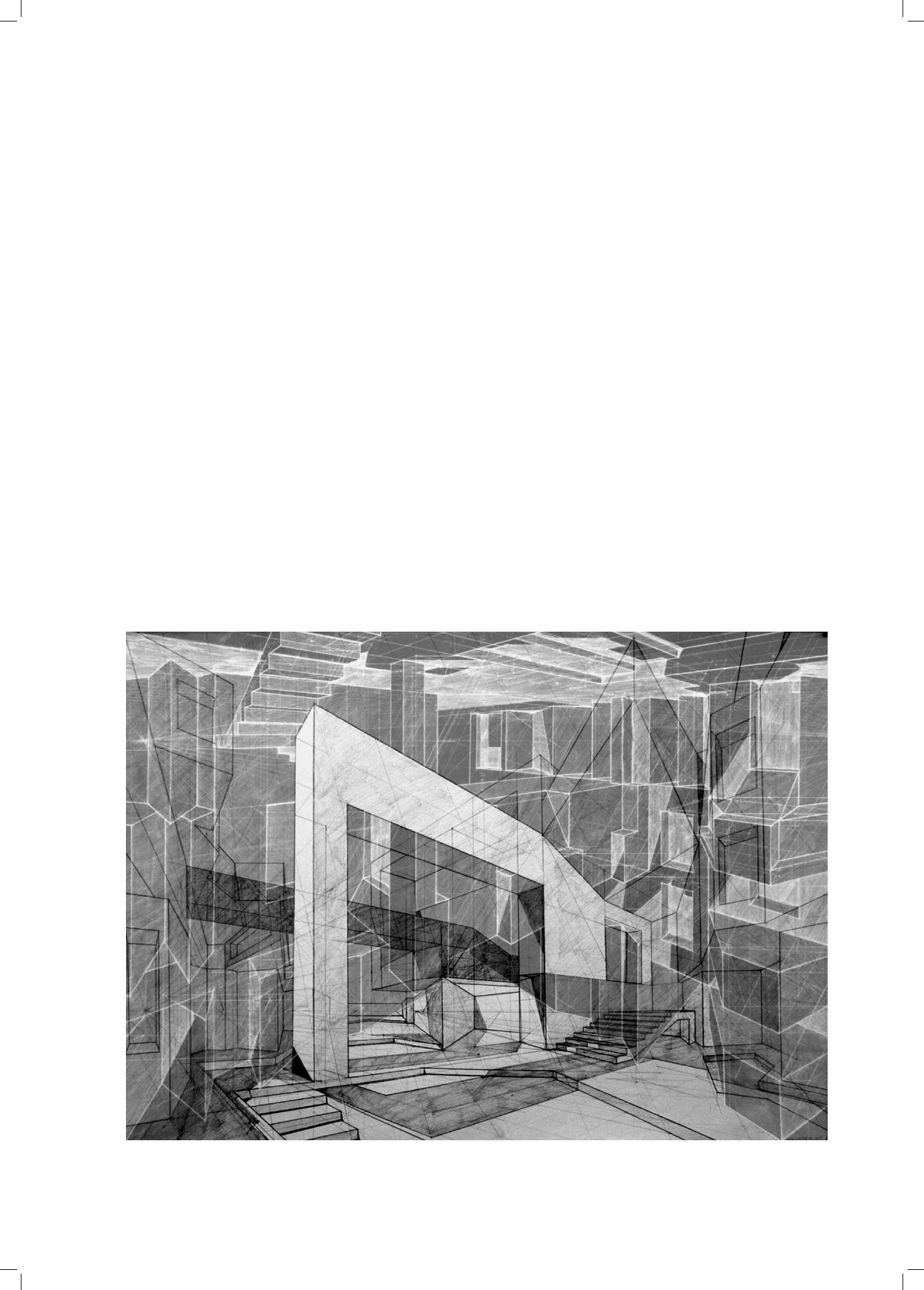
ently inhomogeneous structure [8, p. 87]. Figure 1 illus
trates this idea.
Przestrzeń w architekturze, przestrzeń architektury /Space in architecture, space of architecture 87
doboru naturalnego, który powstał w efekcie konkurencji
wielu działających na siebie czynników [1, s. 32].
Jest taka jakość, nazywamy ją pięknem, która kojarzy
nam się z zauważeniem harmonii i jedności w pozornie
różnorodnej strukturze [8, s. 87]. Myśl tę obrazuje ilu
stracja 1.
Znaczenie stałości. Stałe architektury
Gdy czytam, jak architekci rozumieją problemy
stojące u podstaw architektury, to często zastanawiam
się, czy podobnie czułaby się architektura, gdyby czytała
podręcznik do projektowania architektonicznego [8, s. 133]
– parafraza stwierdzenia Jamesa Trela
W trwałości jest coś pociągającego. Instynktownie
czujemy, że rzeczy, które przetrwały przez wieki bez zmian,
muszą posiadać jakąś istotnie dobrą cechę. Przeszły test
czasu. Czujemy, że mimo ciągłego przepływu zmiennych
zdarzeń, świat ma jakieś niezmienne podłoże, którego
ogólne cechy pozostają takie same [4, s. 124].
Czy w odniesieniu do architektury możemy mówić
o jakichś stałych, pierwotnych cechach, które na zwa li
byśmy jej niezmiennikami? Odpowiedź na to pytanie
jest twierdząca. Architektura nie jest bowiem tylko formą
The importance of stability.
Immutable facts in architecture
When I read how architects understand the problems
which are basics of architecture, I often wonder
whether architecture would feel similarly, if it read a guide
to architectural design [8, p. 133]
– a paraphrase of the statements of James Trefil
In constancy there is something attractive. Instinctively
we feel that things which have survived for centuries with
out change, must possess a significantly good feature.
They have passed the test of time. We feel that, despite the
continuous flow of variable events, the world has a cer
tain unchanging basis, whose general characteristics re
main the same [4, p. 124].
Can we, in relation to architecture, talk about some
immutable, original features, which we would call its con
stant features? The answer to this question is: yes. Archi
tecture is not only a spatial form assigned to a particular
function which it has to perform, but this function has to
result from, something, which the architect does not in
vent, but discovers, that something is a determined culture
and a dynamic structure of social connections by the users
of architecture [9]. The architect should reach, even when
Il. 1. „W przestrzeni kultury” (rys. W. Szymańskiego inspirowany pracami jego studentów)
Fig. 1. “In the space of culture” (W. Szymanski’s work inspired by his students)

88 Witold Szymański, Beata Kania, Maurycy J. Kin
przestrzenną przyporządkowaną funkcji, jaką ma spełniać,
ale funkcja ta wynikać musi z czegoś, czego architekt nie
wymyśla, a odkrywa, tym czymś jest określona kul tura
i dynamiczna struktura więzi spo łecznych, jaką two rzą
użytkownicy architektury [9]. Ar chitekt powinien się
gać, nawet gdy to nie jest nie zbędne, do biologicznych
uwarunkowań zachowań osobniczych i społecznych.
Obraz a rzeczywistość
Bliska zgodność pomiędzy obrazem rzeczywistości,
jaki tworzymy, a tymi jej aspektami, które były ważne dla
przetrwania, zdecydowała o sukcesie ewolucyjnym na
szego gatunku [10].
Architektura jest obrazem rzeczywistości społecznej
i technologicznej danej kultury. Jej sukces zależy od stop
nia, w jakim odwzorowuje wspomnianą rzeczywistość,
na co bezpośredni wpływ mają przyjęte metodologie
projektowania układów architektonicznych (będących
czymś więcej niż tylko prostym zagospodarowaniem
prze strzeni zycznej).
Kultura oczywiście nie jest tylko sumą jej zjawisk,
ale funkcjonalną całością stanowiącą układ chaotyczny.
Nieregularność zjawisk w kulturze powoduje, że do ich
rozumienia potrzebna jest pełna znajomość całości, a także
społecznohistorycznych uwarunkowań odpowiednich
do świadczeń kulturowych ludzkości [11]. Z chaosem
kul tury wiąże się przypadek. Jego rola, jak tego dowodzi
historia, jest olbrzymia. Jak w tę rzeczywistość wpisuje
się architektura?
Aby odpowiedzieć na to pytanie, pominiemy metody
służące kolejnym kompilacjom porównawczych opisów
obiektów architektury na rzecz podjęcia pewnego prostego
wnioskowania dotyczącego pierwotnych uwarunkowań,
do których można zaliczyć uwarunkowania społeczne,
funkcjonalne i techniczne. Pierwsze z nich tworzą gru
pę zagadnień związaną z daną kulturą, formami wię zi
społecznych określonych grup użytkowników, insty tu
cjami ogniskującymi życie społeczne. Całokształtem
tych zagadnień zajmuje się antropologia kultury, so cjo
lo gia i psychologia społeczna. I tutaj już powstają pew
ne ograniczenia wynikające z natury przedmiotu ba
dań, albowiem Generalizacje z zakresu humanistyki,
hi sto riozoczne czy antropologiczne, mają to do sie bie,
że – niestety! – się sprawdzają zawsze. Każe to przy
pusz czać, że humanistyka chętnie podaje za uogól nie nie
empirycznego materiału pewne myśli, które w rze czy
wistości są tylko regułami interpretacji tego ma teria
łu. Jest to zwyczajny los tych gałęzi wiedzy, któ re jak
lozoa i humanistyczne generalizacje mają w swym
rozwoju ciągłość, ale nie dokonują kumulacji wy ni ków.
Wydaje się to niekwestionowalne z takim oto za strze
żeniem: generalizacje humanistyczne, jako reguły in
ter pretacji sensów, pewnym zbiorom zjawisk kulturowo
na danych, muszą być wprawdzie jeśli nie wywrotne
w eks perymencie, to wzajemnie równoważne, tj. każda
jest tyle warta (co się jej prawdziwości tyczy), ile każda
inna (odnosząca się, naturalnie, do tych samych spraw).
Status ich jest poznawczo podobny zatem do statusu
wielu różnych gramatyk tego samego języka, które go
it is not necessary, to the biological state of individual and
social behavior.
Image and reality
Good compatibility between the image of reality,
which we create, and those of its aspects which were im
portant for survival, have decided the success of our
evolutionary species [10].
Architecture is the image of social and technological
reality of a given culture. Its success depends on the
extent to which it imitates the reality an on which a direct
impact have the adopted design methodologies of archi
tectural systems (which are much more than just a simple
physical space management).
Culture, of course, is not just the sum of its phenome
na, but a functional whole determining the arrangement of
chaos. Irregular phenomena in culture cause that to their
understanding a complete knowledge of the whole is
needed, as well as socialhistorical circumstances relevant
to cultural experiences of humanity [11]. Culture chaos is
linked to chance. Its role, as evidenced by history, is enor
mous. How into this reality is architecture enroled?
To answer this question, we will skip descriptions of
methods which compare architectural objects for a simple
request relevant to the original conditions that can include
social, functional and technical determinants. The first of
these is formed by a group of issues related to the given
culture, forms of social connections of specific groups of
users and institutions focusing on social life. These issues
are the subjects which cultural anthropology, sociology,
and social psychology deal with. And here are some limi
tations arising from the nature of the subject to be
researched, because generalizations of the scope of the
humanities, anthropology or the philosophy of history
feature the fact that, alas!, they are always true. This
makes us assume that humanities will gladly present cer
tain thoughts as a ge ne ralization of the empirical mate
rial which in fact are the only rules for the interpretation
of this material. This is the usual fate of those branches of
know ledge such as philosophy and generalizations of hu
manities have in their development continuity, but do not
make an accumulation of results. It seems unquestionable
but with the following condition: generalizations of hu
manities, as rules for interpretation of meanings, must be,
however, if not unsteady in the experiment than mu tually
equivalent, i.e. each one is as important worth (as related
to its truth), as much as many other one as (re ferring to
the same cases, naturally). Their status is therefore simi
lar to that of the status of many different grammars of the
same language, which describe it with the same success:
as we have seen, we cannot talk sensibly
about these
grammars, i.e. that anyone of them could “how
ever” be
true. Conventionalism so unpleasantly brought to light, is
how ever not ultimate [1, p. 220].
The essential knowledge of social ecology and its
rights (segregation, succession, communication, with its
para meters, such as fluidity, mobility, isochrony – which
ar ticulates spatial objectives availability at a specific
time, etc.) is necessary, especially for spatial and urban

Przestrzeń w architekturze, przestrzeń architektury /Space in architecture, space of architecture 89
z analogicznym sukcesem opisują: jak zauważyliśmy,
w podobnej sytuacji nie można mówić sensownie o tym,
aby którakolwiek z owych gramatyk „jednak” była praw
dziwa. Konwencjonalizm tak niemile odkryty nie jest jed
nak ostateczny [1, s. 220].
Zwłaszcza dla planisty przestrzennego, urbanisty i ar
chitekta niezbędna jest wiedza z zakresu ekologii spo
łecz nej i jej praw (segregacji, sukcesji, komunikacji, z jej
parametrami, jak choćby oudity, mobility, izochroną –
wyra żającą dostępność celów przestrzennych w ok reś lo
nym czasie itd.). Na kolejnym etapie potrzebna jest tak
że wiedza szczegółowa dotycząca określonych funkcji
danego obiektu architektury. I tak np. w przypadku ar
chi tektury związanej z muzyką należałoby uwzględnić
aspekty odbioru dzieł wykonywanych w odpowiednich
przestrzeniach, gdyż – jak już wspomniano – z najlepszą
sytuacją z punktu widzenia percepcji dzieła mamy do
czynienia wtedy, gdy określone dzieło muzyczne jest wy
konywane w odpowiednim pomieszczeniu, z od po wied
nimi warunkami akustycznymi. W przeciwnym wypadku
elementy „aury dźwiękowej” nie będą zawierały istotnych
informacji o sposobie narastania i zanikania dźwięku
w po mieszczeniu, więc niemożliwe będzie prze kazanie
wszyst kich aspektów związanych z estetyką i emo tyw
noś cią wykonywanego dzieła.
Dla architekta i urbanisty ustalającego program funk
cjonalny obiektu architektury lub zespołu urba nistycz ne
go istotne będą wnioski wynikające z analiz za gad nień
przestrzeni społecznej. Nawet gdy nie są oni bez po
średnio zaangażowani w ich wykonanie, muszą po
siąść wiedzę o komunikowaniu się w zakresie tej pro
blematyki. Czy architekci są przygotowani do tego? Czy
szkoły architektoniczne realizują odpowiadający tym
po trzebom plan kształcenia? Czy kursy kształcenia archi
tektonicznego stanowią procesy, czy raczej sumę pewnych
faktów, nazwijmy je, dydaktycznych? Nie są to pytania
re toryczne. Uzyskamy pewne wnioski z tym związane
w wy niku prowadzonych spekulacji. Ciekawe są też,
w tym kontekście, relacje późniejszych projektantów, jed
nak nie będziemy ich przytaczać.
Przejdźmy do rzeczywistości praktyki projektowej.
W sytuacji braku bądź niekompletnych analiz architekt,
zazwyczaj kierując się intuicją, życzeniowym, a czasem
nawet magicznym myśleniem, przyjmuje wnioski o nie
dedukcyjnym, postulatywnym charakterze. Jest to błąd
w zakresie metodologii projektowania i stanowi za gro
że nie dla racjonalnego przebiegu procesu twórczego. Na
tym etapie, dla określonego programu użytkowego, archi
tekt tworzy formę przestrzenną i jej realizację poprzez
wybraną technikę i technologię. Można się domyślać, że
w wielu przypadkach rozwiązanie nie odpowiada w pełni
– nie zawsze jasno określonym – potrzebom inwestorów.
Niektóre z błędów procesu projektowania ujawniają się
natychmiast, inne po dłuższym okresie. Rzeczywistość do
starcza wielu przykładów na niedostosowanie przestrzeni
architektonicznej do potrzeb społecznych i wymagań jej
użytkowników.
W takiej sytuacji powstaje pytanie o miarę stopnia zgod
ności, która decyduje o efektywności rozwiązania wzglę
dem potencjalnych i obiektywnych potrzeb, ja kich lista,
planners and architects. At the next stage of knowledge it
is needed to know specific functions of the architectu
ral object. And so, for example, in the case of architec
ture related to music the aspects of reception of the com
positions created in suitable spaces because – as it has
been mentioned – the best situation from the point of view
of perception we achieve when a defined musical work is
carried out in an appropriate space, with appriopriate
acoustical requirements. Otherwise, the elements of am
bience, or soundsphere will not contain important in
formation about the rise and decrease of the sound in the
room, so it will not be possible to transfer all aspects
connected to aesthetics and impressions of music per
formed.
For the architect and urban planner determining the
functional program of the architectural object or urban
complex the conclusions of the analysis of issues of social
space will be im portant. Even when they are not directly
involved in their implementation, they must possess
knowledge of communicating in this issue. Are architects
prepared for this? Do architectural schools realize an
appropriate to the needs training plan? Do architectural
education courses represent processes, or ra ther the sum
of certain facts, let us call them didac tic? The se are not
rhetorical questions. We will obtain some conclusions
from this as a result of ongoing speculation. The reports
stated by later designers are also interesting in this con
text, however, we will not quote them.
Let us proceed to the reality of design practice. In the
absence or incomplete analyses, the architect, usually
guided by intuition, wishful and sometimes even magical
thinking, accepts conclusions which are of a nondeduc
tive, postulative character. This is a mistake in the design
methodology and poses a threat to the rational course of
the creative process. At this stage, for a specific utility
pro gram, the architect creates a spatial form and its im ple
men tation through a selected technique and techno lo gy.
One can guess that, in many cases, the solution does not
match the needs of investors, not always clearly defined.
Some of the errors of the design process will be revealed
immediately, the others – after a longer period of time.
The reality provides many examples of not adapting the
ar chi tec tural space to social needs and requirements of
its users.
In such case, there arises the question about the degree
of conformity, which determines the effectiveness of a so
lution relating to the potential and objective re qui re
ments, whose list of unquestionable needs, must be de ter
mined through rational analysis, of designing conditions.
One of the possible answers to this question are the
opinions of the architects about works. This forces us to
draw our attention to the important fact that makes these
reviews not fully reliable. Architects as an occupational
group make up more or less hermetic societies, from the
re gional through national and transnational ones. In these
groups there are strictly defined behavior patterns which
discipline the members. The paradigms existing inside the
group determine its hierarchy and ways of behavior
among its members. This obviously applies in the terms
of understanding architecture and as a result of this speci

90 Witold Szymański, Beata Kania, Maurycy J. Kin
czego nie można zakwestionować, musi być ustalona na
drodze racjonalnej analizy uwarunkowań projektowych.
Jedną z możliwych odpowiedzi na to pytanie są opi nie
samych architektów o swoich dziełach. Każe to zwró
cić
naszą uwagę na pewną ważną okoliczność, która czyni
te opinie nie w pełni wiarygodnymi. Archi tekci jako
grupa zawodowa tworzą mniej lub bardziej hermetyczne
środowiska, od regionalnych poprzez na rodowe i po nad
narodowe. W zakresie takich grup istnieją ściśle zde
niowane dyscyplinujące wzorce zachowań. Pa radygmaty
obowiązujące w obszarze danej grupy określa ją jej hie
rarchię, sposoby zachowań pomiędzy jej człon ka mi. Do
tyczy to w oczywisty sposób zachowań w zakresie poj
mo wania architektury i w wyniku tego rodzi określone
postawy i zachowania projektowe. Ci spośród członków
grupy, którzy wychodzą poza obowiązujący paradygmat,
są z niej wykluczeni. I odwrotnie, przynależność do grupy
warunkowana jest podporządkowaniem się obowią zu ją
cemu w jej obszarze wzorcowi zachowania.
Zakres możliwych środków stosowanych przez grupę
jest szeroki. Grupy organizują się w stowarzyszenia.
Sto warzyszenia podejmują różne formy promocji jej
człon ków, od organizacji konferencji i innych forów dy
sku syjnych, poprzez konkursy architektoniczne do wy
dawnictw typu „100 najwybitniejszych architektów”,
„100 najwybitniejszych dzieł architektury”. Brakuje jed
nak publikacji takich jak „100 największych błędów archi
tektury
” (na marginesie należy dodać, że nie ma wy daw
nictw o charakterze krytycznym analizujących przy czyny
porażek w architekturze pojmowanej jako zja wis ko spo
łeczne i kulturowe). Miałyby one za pew ne nie ocenioną
wartość poznawczą, dydaktyczną i prak tyczną, zwłaszcza
w kształtowaniu wyobraźni, wraż li woś ci estetycznej
oraz nauczaniu kompozycji, gdzie ważne jest wy waże nie
relacji przestrzennych, właściwe wy korzystanie wskaź
ników percepcyjnych i form prze strzen nych.
Naszym celem nie jest jednak rozstrzyganie praw, jakie
ustala grupa względem swoich członków, ale stwierdzenie,
że wspomniana sytuacja bez wątpienia ma olbrzymi
wpływ na obraz architektury, kulturę architektoniczną
i miejsce architektury w przestrzeni kultury.
Architektura zawiera też najbardziej wymierny aspekt.
Poza „zagospodarowaniem” przestrzeni jest nim określone
rozwiązanie techniczne. Z jednej strony składa się na
nie zastosowana technika wykonania. Jest ona jednym
z możliwych wyborów w zakresie technologii i użytych
materiałów, a to decyduje o trwałości realizacji. Para met
ry określające przyjęte rozwiązanie są w pełni mie rzal
ne i we rykowalne. Jednocześnie to zastosowany system
i us trój konstrukcyjny stanowią rozwiązanie techniczne.
Ale o tym aspekcie obiektu architektonicznego w naj
mniejszym stopniu decyduje architekt, jest on bowiem
przestrzenią działania inżyniera konstrukcji.
Należy zwrócić tu uwagę na interesującą okoliczność.
O ile architektowi często trudno dowieść nowatorstwa
w zakresie tworzonej przez niego formy architektury
(spełniającej określone funkcje użytkowe), o tyle piękno
i nowatorstwo konstrukcyjne dostrzega się niemalże na
tychmiast. Doskonałość rozwiązania architektonicznego
odnosi się bowiem w dużym stopniu do kompozycji
fied attitudes of design and behaviors appear. Those me
m bers who are beyond the current paradigm, are ex cluded
from the group. Conversely, belonging to a group involves
strict adherence to the laws and regulations in the area of
model behavior.
The range of possible means applied by the group is
wide. Groups are organized in associations. The associa
tions take various forms of promotion of its members,
from conferences and other forums, through architectural
competitions to publications like “100 greatest ar chitects”,
“100 greatest works of architecture”. How ever, there is
lack of such publications as “100 biggest mistakes of ar
chitecture” (as a side note it should be added that there are
no publications of a critical analysis of the causes of fail
ures in architecture considered as a social and cultural
phenomenon). They would probably be of inestimable
value in teaching, cognitive and practical areas, especially
in the development of the imagination, aesthetic sensitiv
ity and the teaching of composition. In the fields men
tioned above, it is important to achieve a pro per balance
between spatial relationships, use of per ceptual indicators
and spatial forms.
Our goal, however, is not to arbitrate the laws, which
the group established in relation to its members, but to
pre sent the statement that the situation has a huge impact
on the image of architecture, architectural culture and the
place of architecture in the field of culture.
Architecture also includes the most measurable aspect.
In addition to “management” of the space it is the particu
lar technical solution. On the one hand, it consists of the
applied technique. It is one of the possible choices in
terms of technology and materials, and this determines
the durability of the object. The adopted parameters de
fining the solution are fully measurable and verifiable. At
the same time it is the applied system and construction of
the design that determine the technical solution. Al
though this aspect of the architectural object is not de
cided by the architect but it is suggested by the engineer.
Attention should be paid to an interesting cir cum
stance. The architect often has difficulties proving inno
vation, created by the forms of his architecture (satis fying
the specific utilities), the beauty and innovation of con
struction emerge almost immediately. Perfection of archi
tectural solutions refers in fact to the composition and
common issues of all the arts, and applied here evaluation
categories of aesthetic values, do not be long to categories
strictly measurable.
It is often possible to be a witness to undeserved
applause for something that fits into the current fashion
preferences. Not always valuable works had an unques
tionable appreciation, as evidenced by the history of art
and architecture. Whereas the solution of design must be
assed the laws of physics, and they are so autonomous
that they do not yield to any influence, political, social or
cultural. Thus, it is possible to make a highly objective
assessment. Of course, it is the engineer who decides on
the style in which he has constructional success. The his
tory of achievements of the innovators and inventors
proves that success in this area is extremely difficult to
reach and often requires the highest price, but in the end

Przestrzeń w architekturze, przestrzeń architektury /Space in architecture, space of architecture 91
the beauty of the work is undisputed. If for the construc
tion the basic verification criterion are the laws of physics
and to a large economy, than in the case of architecture
success is designated mainly by attributes of architectural
culture in whose domain the work is created.
Architectural culture, which is part of a wider domain,
governs itself, often by chance, in a random manner,
which is difficult to explain by reasonable speculation.
However, culture along with his hidden senses, is much
more benevolent than the laws of nature. With mo therly
love it embraces all of its children: those timeless and
brilliant, owing to which continuity in the scale between
generations (this is also true of the architecture of our
times) is achieved, but what should be sadly ascertained,
including those unwanted: kitsch and often the absurd.
Cultural margin of choices is wider today than it has ever
been. We are surroundered more and more by monuments
of stupidity in various spheres of culture. There are so
many of them that they largely determine its nature by
their universality. Un fortunately, the average participant
is often not fully aware of this, he becomes an involuntary
victim, mostly innocent. Tadeusz Kotarbiński warned: Let
us praise the actual importance of stupidity [12, p. 57].
Translated by
Maurycy J. Kin
i zagadnień typowych dla sztuki, a stosowane tu kategorie
wartościowania, kategorie wartości estetycznej nie należą
do kategorii ściśle mierzalnych.
Często można być świadkiem niezasłużonego poklas
ku dla czegoś, co wpisuje się w nurt modnych preferencji.
Nie zawsze, jak tego dowodzi historia sztuki i architek
tury, wartościowe dzieła znajdowały niekwestionowane
uz nanie. Natomiast rozwiązania konstrukcji muszą ocenić
pra wa zyki, a są one tak dalece autonomiczne, że nie
pod dają się żadnym wpływom politycznym, społecznym
czy kulturowym. Dzięki nim możliwa jest wysoce obiek
tywna ocena. Oczywiście to sam inżynier decyduje jed nak
o stylu, w jakim odnosi konstrukcyjny sukces. Hi sto ria
osiągnięć nowatorów i wynalazców konstrukcji dowo dzi,
że o powodzenie w tej materii jest niezwykle trudno i często
wymaga ono najwyższej ceny, ale w nale piękno dzieła
jest bezdyskusyjne. O ile dla konstrukcji zasadniczym
kry terium werykacji są kategorie bezwzględne, prawa
zyki i w dużej mierze ekonomii, o tyle w przypadku
ar chi tektu ry sukces określają w zdecydowanym stopniu
cechy kul tu ry architektonicznej, w której obszarze pow
staje dzieło.
Kultura architektoniczna, będąca częścią szerszej ca
łości, rządzi się jak ona, często przypadkiem, wyborem
losowym, trudnym do ogarnięcia racjonalną spekulacją.
Kultura wraz ze swymi ukrytymi sensami jest jednak
dużo bardziej łaskawa niż prawa przyrody. Z matczyną
mi łością przygarnia wszystkie swoje dzieci: te ponad
czasowe i genialne, dzięki którym zachowana jest jej
ciąg łość w skali międzypokoleniowej (tyczy to także ar
chi tektury naszych czasów), ale – co należy stwierdzić
z zasmuceniem – także te niechciane: kicz, a nierzadko
absurd. Skrajnia kulturowych wyborów jest współcześnie
szersza niż kiedykolwiek. Otaczani jesteśmy coraz częściej
pomnikami głupoty w różnych sferach kultury. Jest ich
tak wiele, że przez swoją powszechność wyznaczają
w dużej mierze jej charakter. Niestety, przeciętny uczest
nik nierzadko nie jest w pełni tego świadomy, staje się
jej mimowolną oarą, najczęściej niewinną. Tadeusz Ko
tarbiński ostrzegał: Doceńmy rzeczywistą doniosłość głu
poty [12, s. 57].
Bibliografia /References
[1] Lem S., Filozoa przypadku – literatura w świetle empirii, t. 2,
Wy
dawnictwo Literackie, Kraków 1988.
[2] Laszlo E., Systemowy obraz świata, Państwowy Instytut Wydaw
ni
czy, Warszawa 1978.
[3] Russo L., Zapomniana rewolucja – grecka myśl naukowa a nauka
nowoczesna, Universitas, Kraków 2005.
[4] Feynman R.P., Przyjemność poznawania, Prószyński i Ska, War
szawa 2006.
[5] Kaufmann A., Fustier M., Drevet A., Inwentyka – metody poszu
kiwania twórczych rozwiązań, WNT, Warszawa 1975.
[6] Ossowski S., U podstaw estetyki, [w:] S. Ossowski, Wybór pism
estetycznych, Universitas, Kraków 2004, 121–124.
[7] Ingarden R., Ze studiów nad zagadnieniem formy i treści dzieła
sztuki, [w:] R. Ingarden, Wybór pism estetycznych, Universitas,
Kraków 2005, 153–157.
[8] Barrow J.D., Teorie wszystkiego – w poszukiwaniu ostatecznego
wyjaśnienia, Wydawnictwo Znak, Kraków 1995.
[9] Read H., O pochodzeniu formy w sztuce, Państwowy Instytut
Wydawniczy, Warszawa 1973.
[10] Kuhn Th.S., Dwa bieguny, Państwowy Instytut Wydawniczy, War
szawa 1985.
[11] Morawski S., Studia estetyczne, [w:] S. Morawski, Wybór pism
estetycznych, Universitas, Kraków 2007, 166.
[12] Kotarbiński T., Doceńmy rzeczywistą doniosłość głupoty, „Odra.
Miesięcznik społecznokulturalny” 1987, Nr 4, 39.

92 Witold Szymański, Beata Kania, Maurycy J. Kin
Streszczenie
W pracy omówiono relacje architektury, pojmowanej jako jeden z elementów kultury, z innymi obiektami przestrzeni społecznej. Podano przy
kłady zjawisk istniejących we współczesnej kulturze i ich związków z architekturą, którą rozpatrywano jako obraz rzeczywistości społecznej
i technologicznej. Przedstawiając wiele wybranych zagadnień, wskazano zakresy rozważań, w których można i należałoby niezmiennie prowadzić
procesy poznawania dotyczące tego, co określa przestrzeń architektury. Procesowi poznawczemu musi towarzyszyć wątpliwość. Jest ona warunkiem
niezbędnym do stawiania pytań. A tylko wtedy, gdy zadajemy pytania, możemy uzyskiwać odpowiedzi. Są to niezbędne warunki każdego postępu.
Polemiczny charakter artykułu, zdaniem autorów, spełnia ten postulat.
Słowa kluczowe: kultura, architektura, uwarunkowania
Abstract
The paper presents the relations between architecture as one of the elements of culture and various objects in the social sphere. Examples of
contemporary existing phenomena and their connections with architecture considered as a reflection of social and technical realities are described.
Presenting many selected problems the range of considerations has been shown, in which it is possible and obligatory to carry out cognitive
processes referring to what determines architectural space. In the cognitive process the existence of doubts is a necessary condition. It is a necessary
requirement for asking questions. And only when we ask questions we may obtain answers. These are necessary conditions of every development.
The polemical character of this paper, according to the authors, fulfills this demand.
Key words: culture, architecture, backgrounds for art