2026
2(86)
Cecilia Luschi*, Marta Zerbini**, Alessandra Vezzi***,
Novella Lecci****
The ancient practice of reuse.
From the Roman viridarium
to the medieval church in the old Ashkelon (Israel)
DOI: 10.37190/arc260201
© by the Author/Authors. Licensee WUST.
Published in open access. CC BY-NC license.
Abstract
This study focuses on the architectural and functional analysis of the structure known as Santa Maria in Viridis, located at the highest point of
the ancient city of Ascalona (Ashkelon, Israel), directly against the city walls and near the medieval Main Gate (Jerusalem Gate). Traditionally inter-
preted as a Byzantine church with a baptistery and subjected to modications up to the medieval period, the building presents several architectural
inconsistencies related to liturgical use.
The AskGate Mission (Italian Archaeological Mission – MAECI) conducted research and in-depth investigations employing an integrated, mul-
tiscalar methodology to address the compositional issues that made the denition of the church space anomalous.
The architectural and compositional investigations revealed that the church was built over a pre-existing Roman viridarium featuring a complex
water system and a nymphaeum, organised on at least two terraced levels resting upon a podium. The viridarium included an exedra equipped with
a marble-lined basin that collected water and channelled it through a conduit into a basin at the centre of the courtyard.
What emerges from the architectural analysis and the examination of the decorative elements, such as the frescoes, is the substantial medieval
phase during which the structure was reshaped as a church. This phase may correspond to the transformation of the site from a space dened by
a pagan architectural language, characterised by an exedra, into one expressing a Christian language, marked by the presence of an apse.
Key words: Ashkelon, viridarium, mystagogy, historical architecture, cultural heritage
Introduction
The concept of architectural reuse became a widely
prac
ticed approach during the transition from a pagan to
a Christian architectural language, particularly between the
5
th
and 7
th
centuries. The issue becomes especially delicate
when dealing with cult buildings, which must meet spe-
cic requirements related to the rituals performed within
them. The eorts made to convert pagan structures into the
Christian language invite us to reect on the principles that
guided these transformations.
In the pagan world, architecture had for centuries repre-
sented the divine powers that governed human life. The gods
were considered unreachable beings, inhabiting a world sep-
arate from that of humans, upon whom human existence
depended. Consequently, within a hierarchical order, they
dwelled in elevated places, and their distant, inaccessible na-
ture was expressed architecturally: altars raised on mounds,
temples standing on high crepidoma, dark cellae such as in
the oikoi, or colonnaded enclosures surrounding sacred pre-
cincts.
The otherness of the divine in relation to the human con-
dition was conveyed through mechanisms of disproportion,
*
ORCID: 0000-0002-7777-5360.
Department of Architecture.
DIDA, University of Florence, Italy, e-mail: cecilia.luschi@uni.it
** ORCID:
0000-0003-4936-6735. Department of Architecture.
DIDA, University of Florence, Italy.
***
ORCID:
0000-0001-9334-3982. Department of Architecture.
DIDA, University of Florence, Italy.
****
ORCID:
0000-0002-4614-788X. Department of Architectu-
re. DIDA, University of Florence, Italy.

4 Cecilia Luschi, Marta Zerbini, Alessandra Vezzi, Novella Lecci
verticality, and darkness, features common to celebratory
architectures across all major ancient civilizations, though
articulated dierently according to local technologies and
decorative traditions. Decoration, always inspired by nat-
ural forms, could be rendered guratively or through geo-
metric patterns, bestowing dignity upon the architectural
apparatus. If the ancient world relied for centuries on this
idea of sacred architecture as an inaccessible place, it fol-
lows that the concept of architectural reuse was not com-
monly practiced. Materials (spolia) from older buildings
were reused to construct new ones according to renewed
principles. Structures were rebuilt to give them a new con-
guration: for example, a temple transformed into an oikos
might become a distyle or tetrastyle structure, introducing
signicant variation. More often, however, materials were
salvaged to enlarge an existing complex, an operation that
typically required the demolition of the earlier temple. Im-
portantly, architectural reuse did not aect the architectural
language itself, which remained rmly xed over time. The
symbolic lexicon of architecture thus remained unchanged
for centuries, reiterating the same formal patterns.
Considering that the ancient world, up to the Roman pe-
riod, developed the celebratory architectural tradition using
recurring compositional devices, we can turn our attention
to the true emergence of architectural reuse within cultic
contexts, and to how the nature of religious architecture
changed in ways that made unexpected forms of reuse possi-
ble. The Christian architectural language transformed what
we today might call the immaterial dimension, and more
precisely, the mystagogical dimension, of cult buildings,
making architecture a support for the liturgy and a means of
emphasizing its ritual dynamics.
Although explaining the full process behind this transfor-
mation of meaning is complex, the overall trajectory, from
the earliest decades of Christianity through the 7
th
cen tu ry,
can be summarized succinctly. Architecture underwent a re-
semanticization, acquiring a new ontological reality with-
out requiring changes to the existing structure. During early
Christianity, therefore, sacred monuments were not convert-
ed; instead, buildings such as houses, domus, or imperial pa-
laces were reinterpreted. In the Roman context, the domus,
originally the household dwelling, took on the meaning of
domus Dei, the “house of God”, becoming a gathering place
for the religious community.
A clear example of the resemanticization of architectur-
al space is the viridarium of a villa (Canopus–Serapeion,
Hadrian’s Villa, Rome, Italy): a place designed for host-
ing guests, characterized by water as a dominant element
and by an exedra symbolizing hospitality. Conceptually,
the exedra of the Roman villa gained a new meaning when
transformed into the apse of a church, while the garden in
front of it came to represent the paradisiacal realm of the
Heavenly Jerusalem.
To better illustrate the most signicant steps of this ex-
perimental architectural process, we present the study of
the ancient site of Ascalona, modern Ashkelon, in Israel.
Here, Roman remains emerging from the ancient sands of
the eastern Mediterranean coast enable us to describe the
functional transformation of a large structure known also
as the church of Santa Maria in Viridis.
AskGate Mission: the research
The Italian International Archaeological Mission, known
as AskGate and recognized by the Italian Ministry of For-
eign Aairs (MAECI), has been conducting research since
2020 on the case study of the so-called church of Santa
Maria in Viridis (Luschi 2021; Luschi et al. 2023). The
research team is composed of the mission director (Prof.
Cecilia Maria Roberta Luschi), architects
1
, archaeologists
2
,
physicists specialized in microarchaeology
3
, and geolo-
gists
4
, who together have made it possible to interpret this
enigmatic architecture within the ancient city of Ascalona
or Scalona, located south of modern Ashkelon, which re-
tains the historical name (Ricci, Lecci 2024).
Ascalona was one of the Philistine biblical cities that, to-
gether with Gaza, Ashdod, Ekron, and Gath, formed a pen-
tapolis independent of any hegemonic control. Egyptians,
Syrians, Canaanites, Phoenicians, and the so-called Sea
Peoples all left their traces in the site of Ascalona. The city
occupied a strategic geographical position along a route
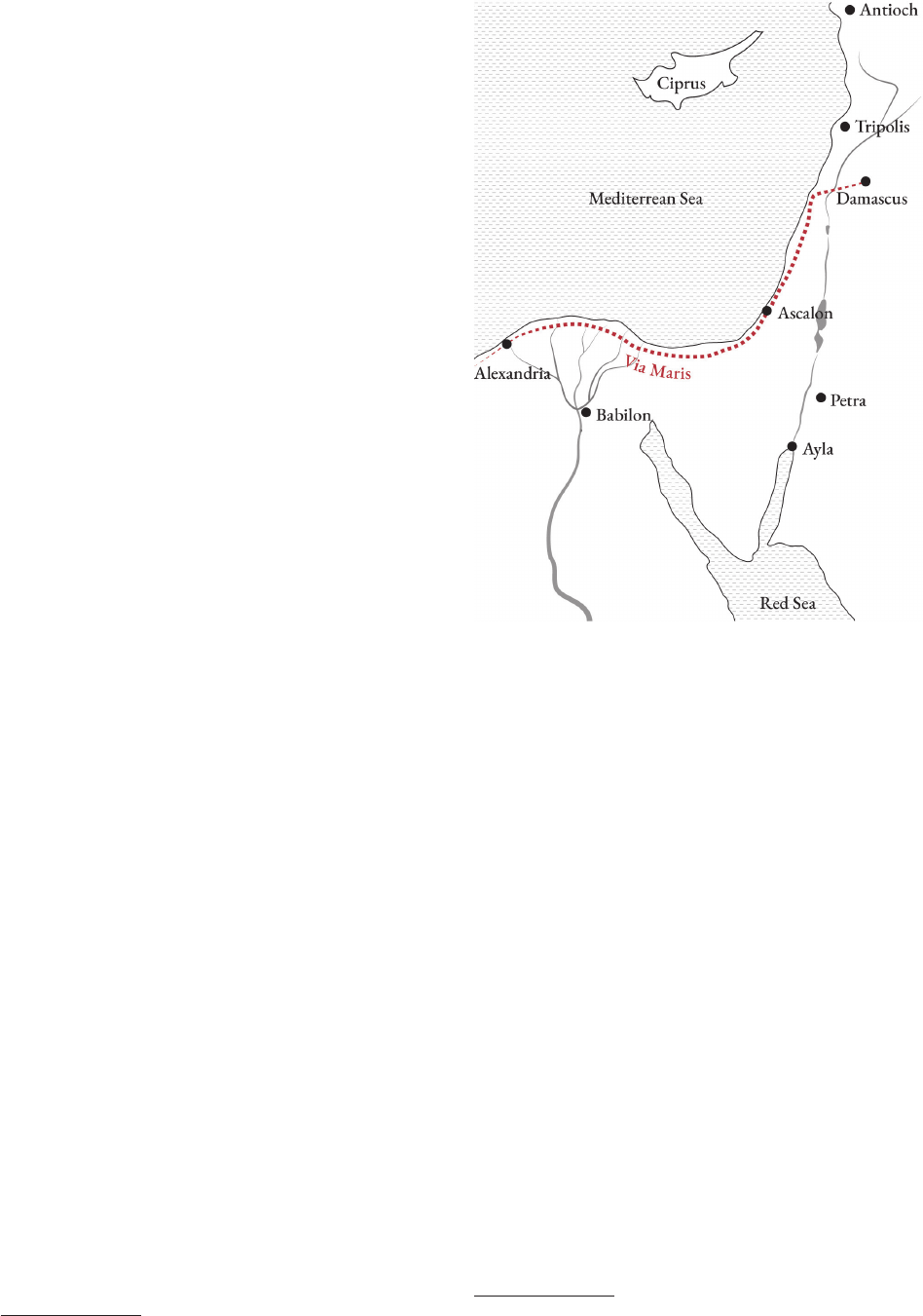
parallel to the Mediterranean coast connecting Damascus
and Alexandria (Fig. 1). Archival documents are broadly
divided into two main strands: Arabic and Latin sources.
These form the basis for reconstructing the city’s long his-
tory. Ascalona was destroyed in 1270 and largely faded into
oblivion. It remained obscure until the rise of travel and pil-
grimage in the 18
th
and 19
th
centuries, followed by formal
archaeological excavations in the 20
th
century
5
.
Today, the ancient city of Ascalona is preserved as an
Archaeological Park and National Nature Reserve (Isra-
el Nature and Parks Authority), its boundaries following
the course of the reconstructed city walls. The walls form
a semicircular layout, with the maximum chord coinciding
with the seafront, making the site analogous to Caesarea
Maritima (Luschi, Stefanini and Vezzi 2021). Recognizing
the historical depth of occupation, the morphology of As-
calona becomes clearly dened from the Roman-Byzantine
period onward.
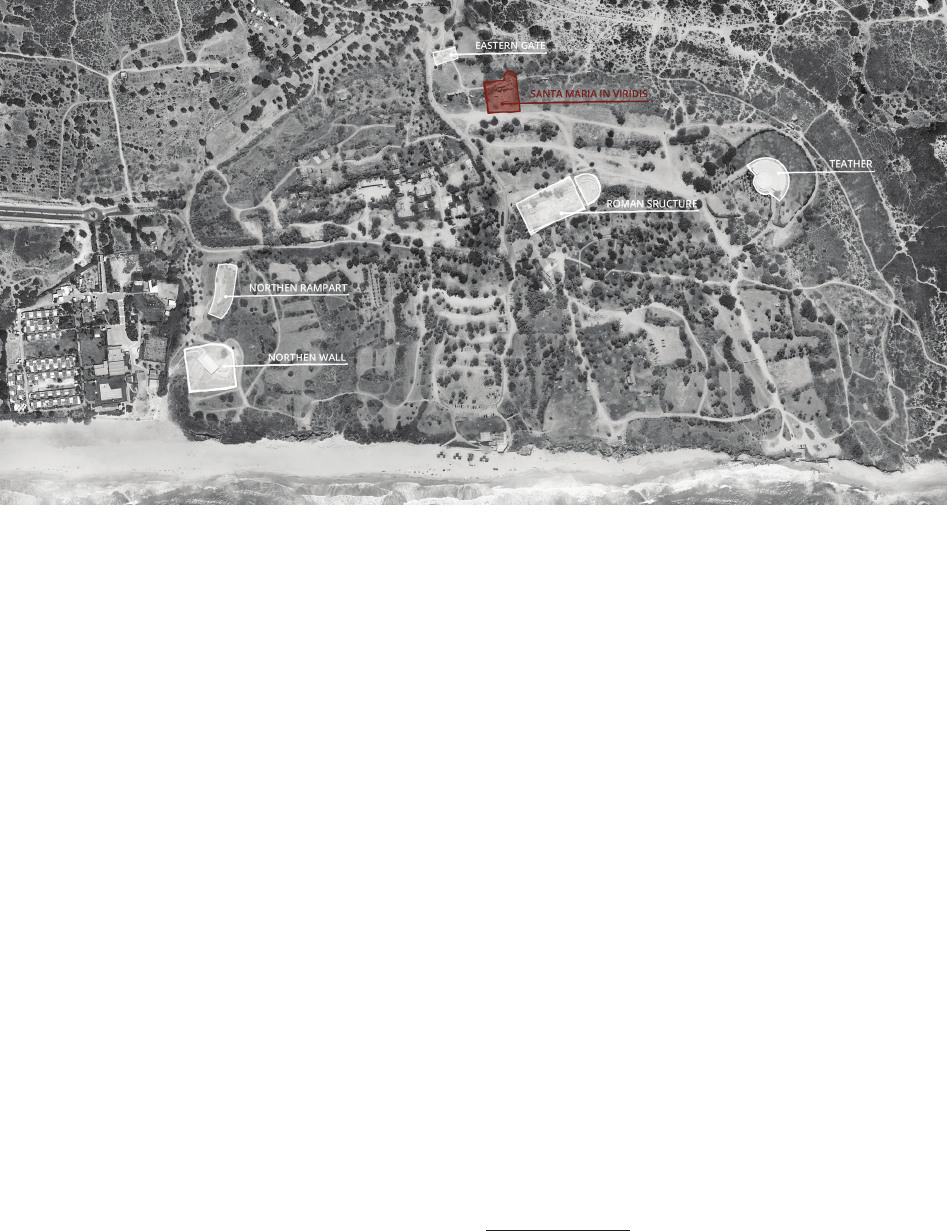
Ottoman period, including signicant Roman elements,
among which the most famous and studied is the colonnad-
ed structure known as the Basilica, located between the tell
and the Eastern Gate (Bar-Nathan, Ganor 2021; Boehm,
Master and Le Blanc 2016) (Fig. 2).
Archaeological studies have identied the rst Bronze
Age settlement on the two tells, attributing the construction
of the massive earthen ramparts to this same period. These
ramparts were subsequently reused as the foundation for the
city’s fortications in later centuries. The walls currently vis-
ible are instead attributed to Byzantine construction phases,
with further modications during the medieval period. Along
the circuit of these walls, still partially preserved today (Lec-
1
Researchers from the University of Florence, members of the Ask-
Gate project team (https://www.dida.uni.it/vp-784-askgate.html).
2
Professor Rafael Y. Lewis, archaeologist, Department of Land of
Israel Studies and Archaeology, Bar Ilan University.
3
Professor Elisabetta Boaretto, Scientic Archaeology Unit, Weiz -
mann Institute of Science.
4
Dr. Emma Cantisani, CNR Florence.
5
For a concise historical overview of the site, reference may be
made to Stager and Schloen (2008) and Phythian-Adams (1921).
The ancient practice of reuse. From the Roman viridarium to the medieval church in the old Ashkelon (Israel) 5
Fig. 1. The ancient city of Ascalona, Ascalon, or Scalona (now Ashkelon)
has been located on the route connecting Damascus and Alexandria
since ancient times (elaborated by @AskGate)
Il. 1. Starożytne miasto Ascalona, Ascalon lub Scalona (obecnie Aszkelon)
od czasów starożytnych znajdowało się na szlaku łączącym Damaszek
z Aleksandrią (oprac. @AskGate)
ci, Aiello and Luschi 2023), just south of the Eastern Gate,
known in the medieval period as the Main Gate or Jerusalem
Gate
6
, the case study of the church of Santa Maria in Viri-
dis has been identied. The structure is organized on three
terraces: the rst, forming the highest part of the system, is
characterized by massive double walls and the only semicir-
cular tower projecting from the line of the walls; the second,
the middle terrace, consists of a large structure whose spatial
conguration has been interpreted by scholars as a church;
the third and lowest terrace is composed of traces of walls
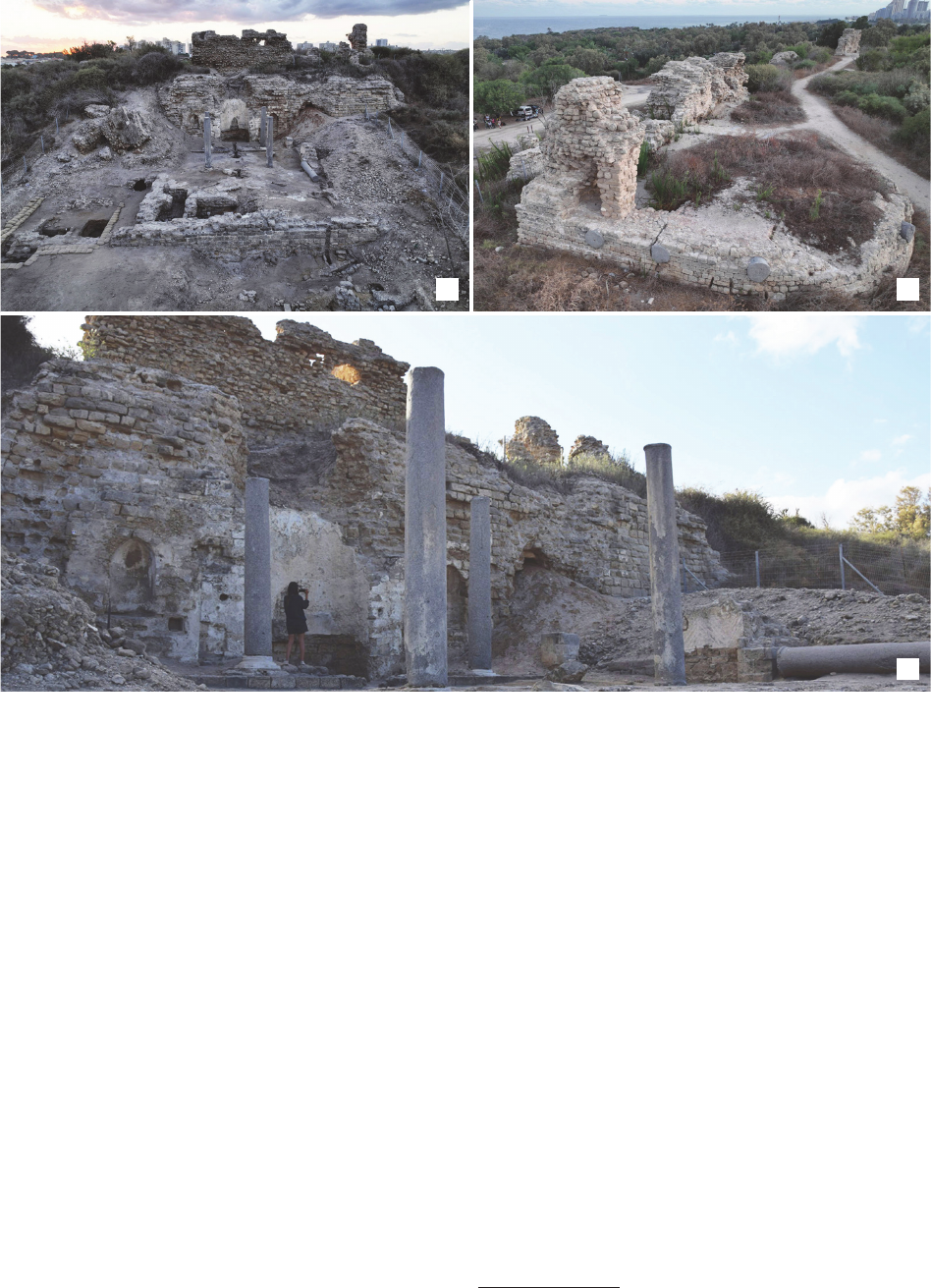
indicating a further articulation of the building (Fig. 3).
The rst construction phase identied in previous studies
was a Byzantine church, but the placement and congura-
tion of the baptismal font deviate from the established con-
ventions of the Christian ritual. The baptismal font, whether
of spring or still water, cannot be positioned in front of the
celebration altar, as baptism is the initiation rite of Christi-
anity and is to be performed outside the church.
Starting from this inconsistency, the research conduct-
ed by AskGate, which adopts a multiscalar and interdisci-
plinary approach, has pursued investigations from multiple
specialist perspectives aimed at interpreting and deeply un-
derstanding the architecture and its evolution. To this end,
during eld missions, in addition to excavation activities,
detailed architectural and integrated surveys were con-
ducted. These enabled the creation of a three-dimensional
digital model of the site, metrically accurate and reliable,
allowing both the production of orthogonal graphic repre-
sentations (plans, sections, elevations) and an in-depth geo-
metric analysis of the architectural space.
This article presents some results from the 2022–2023
excavation activities of the AskGate project. An integrat-
ed, multi-scale survey methodology combining topographic
mea surements with drone-based and ground-based photo-
grammetric techniques was employed to document these ac -
tivities. The topographic survey was designed and imple-
mented using a closed, nearly equilateral triangular tra-
verse. Control and verication points were recorded from
the main stations and used to process and manage the
photogrammetric surveys. This established a well-work-
ing methodology across various archaeological campaigns
(Luschi et al. 2023). In addition to the topographic survey,
photogrammetric projects were carried out daily to obtain
3D models of the individual excavation areas. This made
the various daily excavation activities accessible and de-
veloped a methodology for the virtual reversibility of the
excavation (Luschi, Lecci 2023). The drone photogram-
metry project created a 3D model of the site, from which
two-dimensional images (orthophotos) were extracted to
support the site plans, sections and elevations required for
the description of the excavation and architectural structure.
Operational decisions made during the dierent stages of
the survey resulted in the creation of a 3D model of the site
and all its excavation areas, ensuring accurate and reliable
documentation (Luschi et al. 2025b).
6
Guglielmo of Tyre, a 12
th
-century chronicler, describes Ascalona
as a fortied city with four gates: the Jaa Gate to the north, the Gaza
Gate to the south, the Maris Gate to the west, and the Great Gate or Jeru-
salem Gate to the east (Zaganelli 2012, 982–988).
The viridarium and the church
As mentioned above, the church structure, located south
of the Jerusalem Gate, has been described in previous exca-
vation reports as a “Byzantine church with a baptistery”
(Tza feris, Stager 2008; Homan 2019, 33–38), modied se -
veral times up to the medieval period. This period also corre-
sponds to the now-lost fresco cycle, depicting four gu res
that scholars have identied
7
, from right to left, as St. John
Chry so stom, Basil the Great, and Gregory the Theo logian,
while the last gure has been proposed as either St. Atha na-
sius or St. Cyril (Peers 2009).
Examining the frescoes, which show similarities in sub-
ject matter and style, Peers considers it plausible to date
their execution to the Crusader renewal phase of the church,
between 1153 and 1187. It is notable that the characteristics
of the saints’ garments and the presence of a cartouche with
Greek inscriptions nd parallels in the depiction of St. John
Chrysostom
8
in the medieval Cattolica of Stilo in Calabria
7
Fresco of the apse and a detail still visible at the time of the Leon
Levy mission. Today it has completely disappeared.
8
Fresco inside the Cattolica of Stilo in Calabria, dated 1190. It
depicts St. John Chrysostom, with garments and a cartouche similar to
those found at Santa Maria in Viridis.
6 Cecilia Luschi, Marta Zerbini, Alessandra Vezzi, Novella Lecci
which is reproduced with the same iconography. Based on
this evidence, the possible dating of the frescoes can be
extended to the 11
th
and 12
th
centuries, revealing in this
phase a strong inuence of the Byzantine culture.
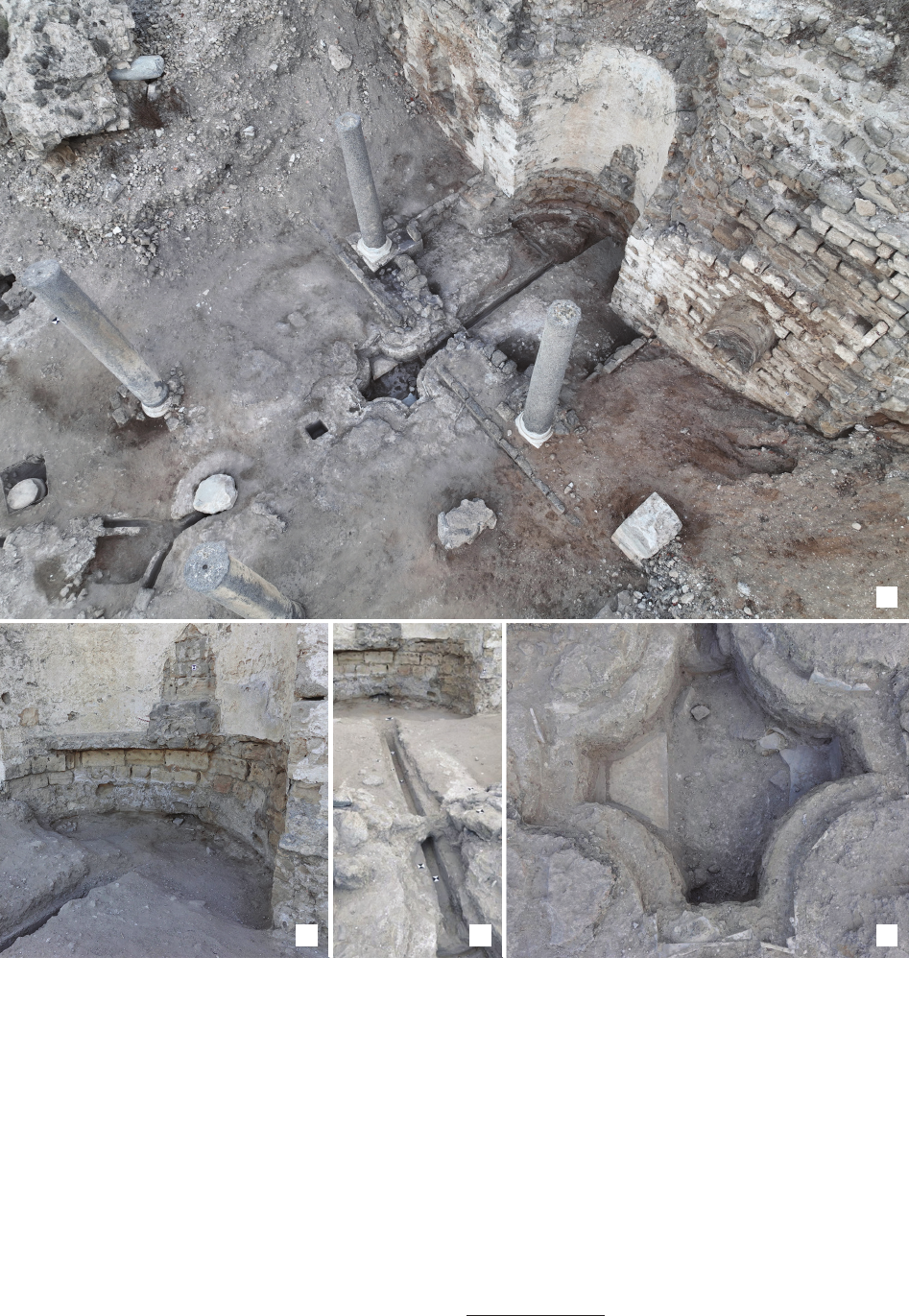
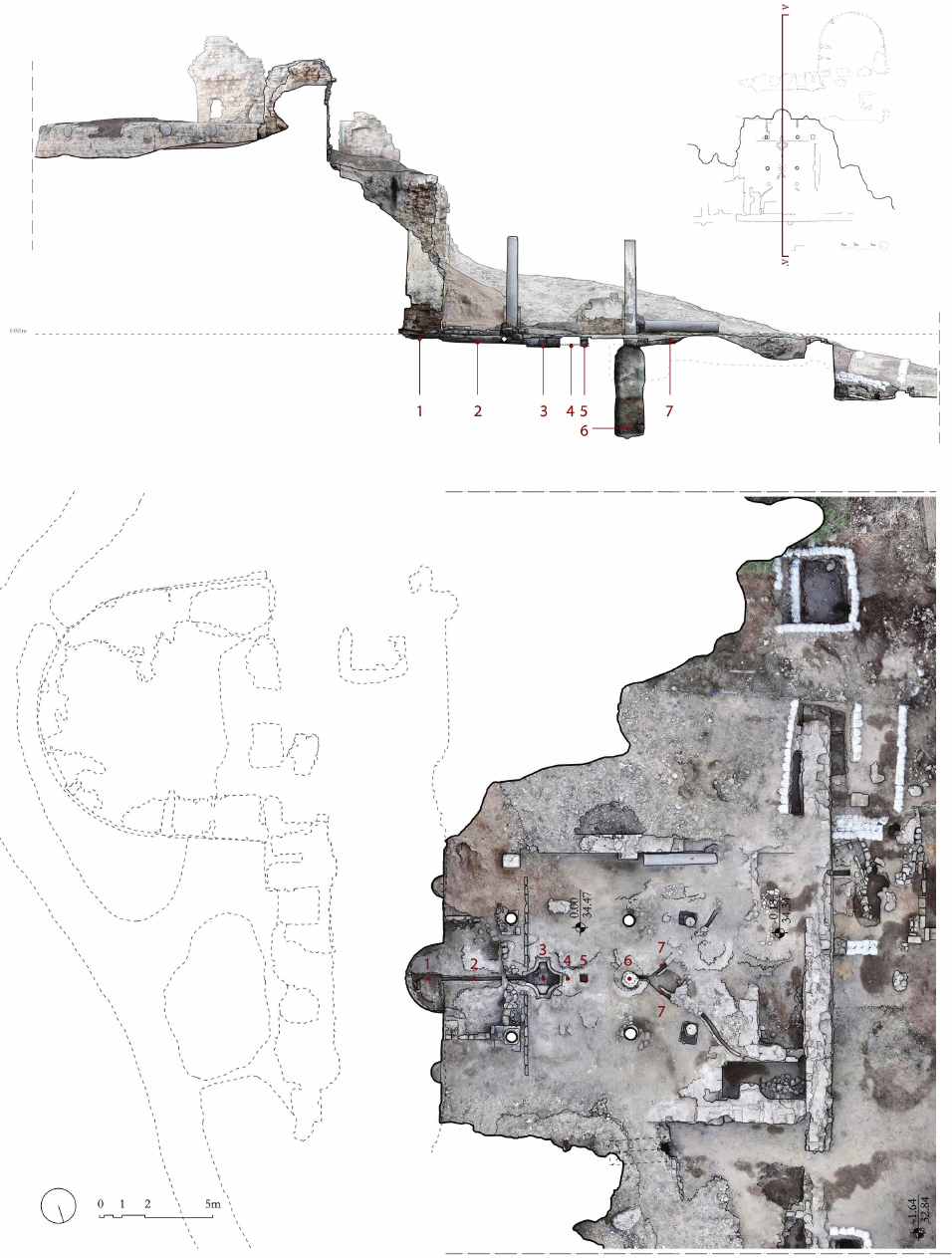
Santa Maria in Viridis is also dened as a church with
a baptistery due to the presence of a water system located
on the central plateau (second terrace), which is particularly
complex. The water ow, whose source remains unknown,
started from the apse, where a basin clad with white mar-
ble slabs was placed. From there, through a small channel,
it reached a possibly fountain-like basin, before entering
a cistern and nally passing through a lead pipe and a small
cistern (Figs. 4, 5).
Cleaning, excavation and survey work carried out in this
section of the Santa Maria in Viridis architectural complex
(identied as “Area 1”) has enabled the water system to be
reconstructed and interpreted as a whole, and a functional
interpretation proposed. The discovered water system leads
to the identication of the surrounding area as a viridarium:
a classic ornamental garden used in ancient Rome and typ-
ically located within the courtyard of a villa (Luschi et al.
2025a).
In Santa Maria in Viridis’ site, the exedra from which the
water emerged, clad in white marble, collected the water at
its base and, by gravity, through the central slightly slop-
ing channel, fed the basin, also entirely nished in white
marble.
The centre of the podium therefore functions as a court-
yard that can be dated back to the Roman period, which
lasted approximately four centuries in the history of the
city. The site is attested as an oppidum liberum under Ro-
man authority from 104 BC (Phythian-Adams 1921), and
historical sources conrm an urban prole with public,
commercial, and productive structures
9
.
According to the AskGate hypothesis, there are clear
parallels between the viridarium and its water system and
Herod’s building projects, as reported by Flavius Josephus
regarding the construction of fountains and porticoes in As-
calona (Josephus Flavius 1974, I, 422).
To verify this hypothesis and provide more specic de-
tails about the structure, investigations were carried out in to
construction techniques alongside archaeological analy ses
of the excavation stratigraphy and material characteri-
zation. During the excavations, mortar samples were taken
from within the water system and are currently being anal-
ysed through petrographic, mineralogical and microarchae-
ological studies
10
.
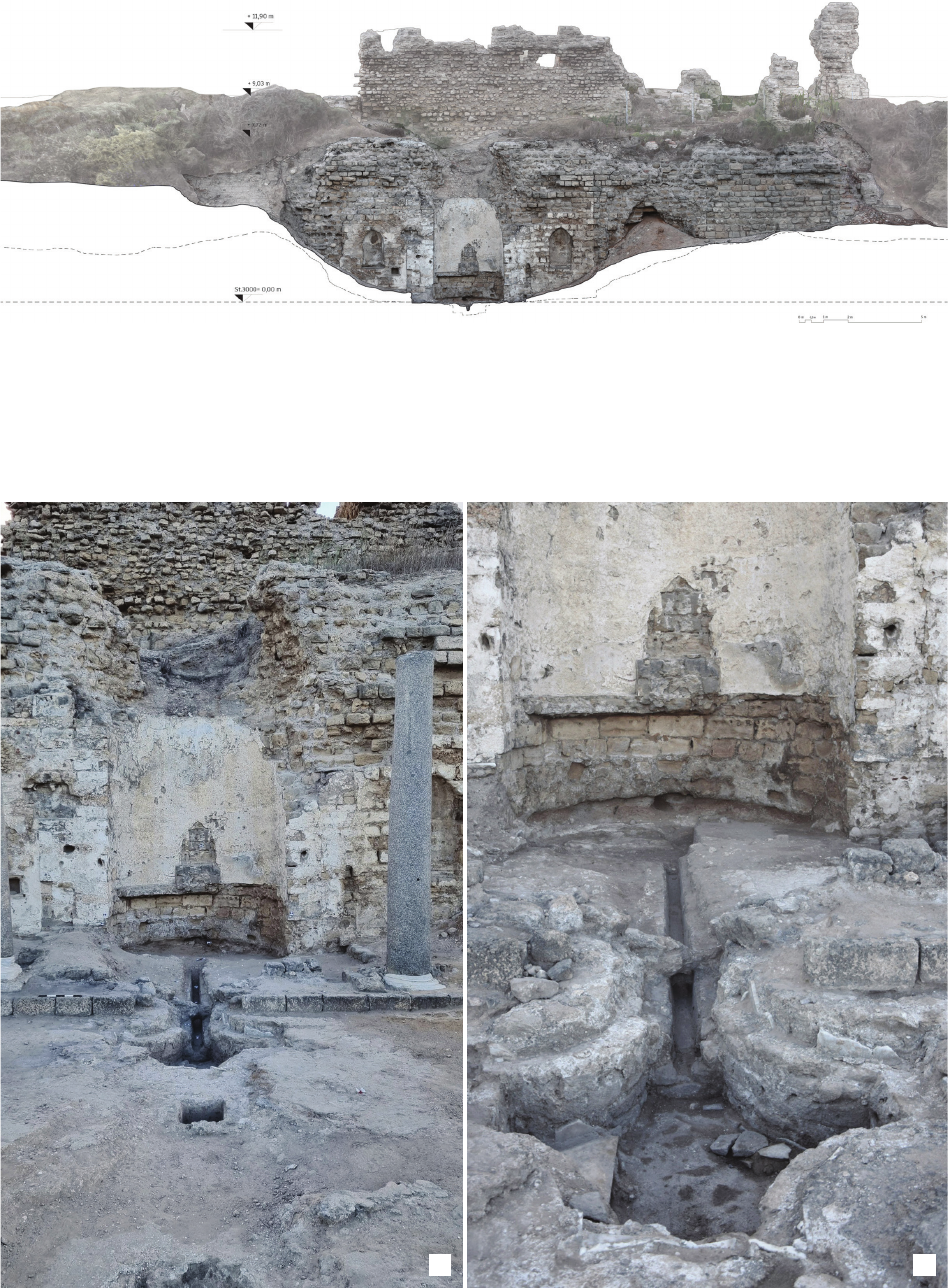
The recongured presbytery oor is located above the
level of the channel and the exedra basin, representing
a complete obliteration of the previous water system and
basin. It includes the area of the basin within the exedra,
occupied by a throne placed at the centre of the apse and
raised approximately 80 cm above the level of the altar,
which itself is elevated by at least three steps from the rest of
9
Documents and ndings indicate that, during the Roman period,
the city was a maritime center with a signicant port, renowned for trade
(Di Segni, Tsafrir and Green 2015, 1021), but also a hub of manufac-
turing and agricultural activities (Di Segni, Tsafrir and Green 2015,
1029–1031).
10
The mineralogical and petrographic analyses were carried out by
the team supervised by Emma Cantisani of the CNR in Firenze. The mi-
croarchaeological analyses (FTIR and C14) were conducted at the Scien-
tic Archaeology Unit laboratory of the Weizmann Institute of Science
(Israel) by the team supervised by Elisabetta Boaretto.
Fig. 2. Within the Ascalona (Ashkelon, IL) ancient city, historical architectures can be identified based on historical documents
and archaeological studies (elaborated by @AskGate)
Il. 2. W starożytnym mieście Ascalona (Aszkelon, IL) zabytkową architekturę można zidentyfikować na podstawie dokumentów historycznych
i badań archeologicznych (oprac. @AskGate)
The ancient practice of reuse. From the Roman viridarium to the medieval church in the old Ashkelon (Israel) 7
the nave. Two granite columns with white marble bases and
single scotia mouldings frame the front. Interestingly, clay
material was used to ll the basin in the exedra, likely in-
tended to seal it and prevent the possible emergence of water.
If the oor reveals a classical building while the paint-
ings refer to a medieval church, it is necessary to continue
analysing the composition of the main front to obtain a more
complete understanding. The exedra–apse is anked by two
niches, the pastophoria, which in their current conguration
feature pointed arches at the top and traces of marble clad-
ding at the bottom.
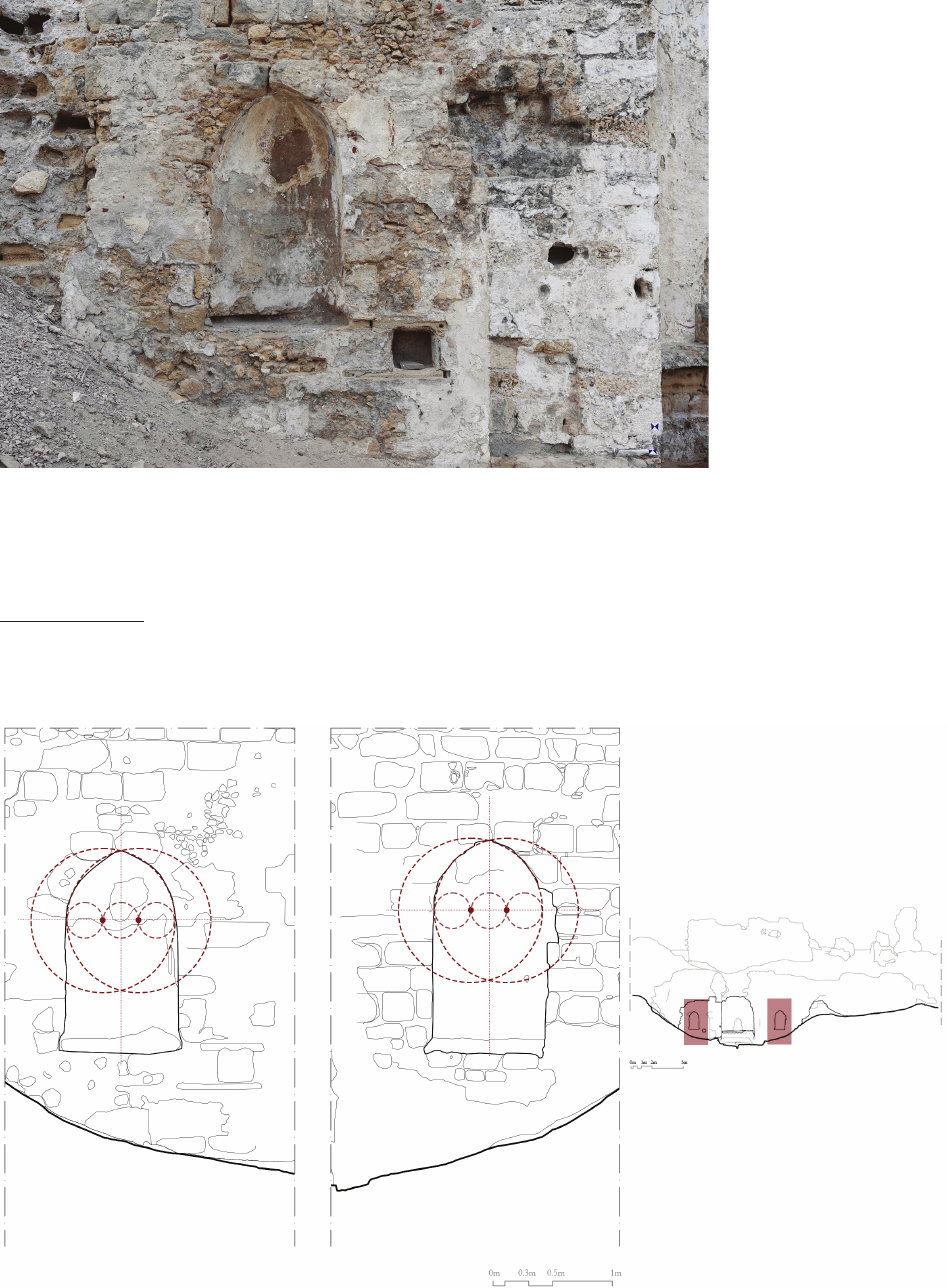
Analysis of their construction clearly shows that the point-
ed upper part of the niches was cut into the preexisting wall,
while the lower portion was partially lled in (Figs. 6–8). The
reconguration of these two niches reects an original clas-
sical structure, with a straight upper prole and positioned
nearly at oor level. To convert the structure into a church,
these two architectural elements of strong aesthetic value,
were enlarged in height and capped with a pointed arch
form, cutting through the courses of the wall blocks. The
pointed geometry of the two pastophoria, the protiron to the
north and the diaconicon to the south of the apse, indicates
a medi
eval rather than Byzantine period
11
, consistent with
the likely
later dating of the frescoes (Lecci 2025, 192–194).
This
conguration became widespread particularly between
the
12
th
and 13
th
centuries, and in the Holy Land similar
pointed-arch features are found in architectural elements, for
example in the openings of Montfort Castle (Luschi, Aiello
2012; 2017; Aiello 2010, 42, 43). These observations have
led to a reassessment of the original function of the site and to
the understanding that it was converted into a Latin Christian
cultic structure during the medieval period.
Conclusions
The architectural reading of the site, and the composi-
tional and functional analyses, have led to an interpretation
11
In line with the prevailing historiographical periodization, the text
denes the “Byzantine period” as the time span up to the 7
th
century, which
concludes with the Muslim conquest of the rst half of the 7
th
century (Phy-
thian-Adams 1921; Stager, Schloen 2008). However, the Christian-Byzanti-
ne heritage in Ascalona demonstrates a longer persistence, as documented by
the presence of bishops in the city at less than the 10
th
century (Bagatti 1974).
Fig. 3. Photographs of the church called Santa Maria in Viridis, located along the city walls near the main gate, also known as the Jerusalem Gate,
in Ascalona (Ashkelon, IL). The site is organized across three terraces: a) the entire site occupied by the architectural complex, b) the rounded
tower of the city walls behind the church, c) the level of the church and the four standing granite columns (elaborated by @AskGate, mission 2023)
Il. 3. Zdjęcia kościoła zwanego Santa Maria in Viridis, położonego wzdłuż murów miejskich w pobliżu bramy głównej, znanej również jako
Brama Jerozolimska, w Ascalonie (Aszkelon, IL). Teren jest podzielony na trzy tarasy: a) cały teren zajmowany przez kompleks architektoniczny,
b) zaokrąglona wieża murów miejskich za kościołem, c) poziom kościoła i cztery granitowe kolumny (oprac. @AskGate, misja 2023)
a b
c
8 Cecilia Luschi, Marta Zerbini, Alessandra Vezzi, Novella Lecci
of the structure that identies a phase predating its cong-
uration as a medieval church, which can instead be traced
back to a classical-period building. The considerations
dis cussed above allow for the formulation of new re con-
struc tion hypotheses, according to which the space and its
architectural elements were converted using new design
languages, adapting the space to its new use.
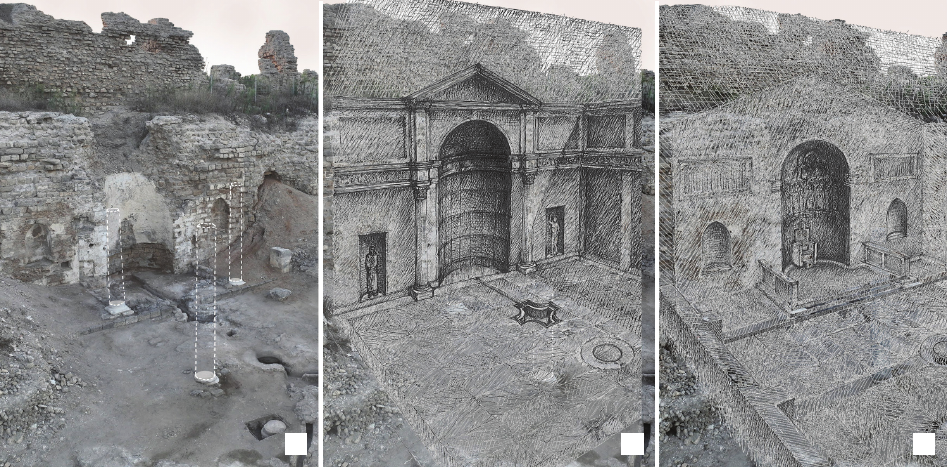
In the hypothesis that sees the previous conguration of
the medieval church as a structure of Roman period, it is
possible to recognize: an exedra, later transformed into an
apse; a system of basins and channels, whose structure re
-
calls that of nymphaea, a term used with various nuances
over time (Settis 1973), also indicating monumental foun-
tains
12
(Figs. 9, 10).
12
In order to support and disseminate the research ndings via
a mobile application, graphic reconstructions of the three historical func-
tions served by the architectural structure were developed; these images
Fig. 4. Photographs of the church called Santa Maria in Viridis, in Ascalona (Ashkelon, IL), and details from the water system: a) the water system
located on the structure of the plateau (second terrace) [The water system is lined with white marble, fragments of which have been found.
It includes basin, channel, fountain, inspection basin and cistern.], b) the basin in the apse, c) the connection channel, d) the basin
(photos by @AskGate)
Il. 4. Fotografie kościoła zwanego Santa Maria in Viridis w Ascalonie (Aszkelon, IL) oraz detale systemu wodnego: a) system wodny znajdujący
się na konstrukcji plateau (drugi taras) [System wodny wyłożony jest białym marmurem, którego fragmenty zostały znalezione. Obejmuje on
basen, kanał, fontannę, basen inspekcyjny i cysternę], b) basen w absydzie, c) kanał łączący, d) basen (fot. @AskGate)
a
d
c
b
The ancient practice of reuse. From the Roman viridarium to the medieval church in the old Ashkelon (Israel) 9
Fig. 5. Plan and section of the site in Ascalona (Ashkelon, IL) following the 2023 excavations carried out by the AskGate project.
The elements of the water system are indicated: 1 – basin located in the exedra, 2 – channel connecting the exedra to the basin,
3 – basin, 4 – lead pipe connecting the basin to the small pit, 5 – small pit, 6 – reservoir, 7 – small channels converging into
the reservoir (elaborated by @AskGate)
Il. 5. Plan i przekrój terenu w Ascalonie (Aszkelon, IL) po wykopaliskach w 2023 r. przeprowadzonych w ramach projektu AskGate.
Wskazano elementy systemu wodnego: 1 – zbiornik zlokalizowany w eksedrze, 2 – kanał łączący eksedrę z basenem, 3 – basen,
4 – ołowiana rura łącząca basen z małym wykopem, 5 – mały wykop, 6 – zbiornik, 7 – małe kanały zbiegające się do zbiornika (oprac. @AskGate)
10 Cecilia Luschi, Marta Zerbini, Alessandra Vezzi, Novella Lecci
Fig. 7. Geometric study of the shape of the niches, the pastophoria of the medieval church near the Jerusalem Gate in Ascalona (Ashkelon, IL).
The arch
delimiting them at the top is a pointed arch. The radius of curvature of the arches forming the figure is equal to two-thirds of the span of the niche
(elaborated by @AskGate)
Il. 7. Geometryczne studium kształtu nisz, pastoforiów średniowiecznego kościoła w pobliżu Bramy Jerozolimskiej
w Ascalonie (Aszkelon, IL). Łuk ograniczający je od góry jest ostrołukowy. Promień okręgu tworzącego krzywiznę łuku jest równy
dwóm trzecim rozpiętości niszy (oprac. @AskGate)
Fig. 6. The northern pastophorion
of the medieval church near
the Jerusalem Gate in Ascalona
(Ashkelon, IL). They were
evidently remodelled by cutting
through the entire wall facing.
Afterwards, they were plastered
and painted with Christian-themed
verses in the Arabic language
(photo by @AskGate)
Il. 6. Północne pastoforium
średniowiecznego kościoła
w pobliżu Bramy Jerozolimskiej
w Ascalonie (Aszkelon, IL).
Zostały one najwyraźniej
przebudowane poprzez przebicie
całej ściany elewacyjnej.
Następnie otynkowano je
i pomalowano pokrywając
wersetami w języku arabskim
(fot. @AskGate)
The exedra and the nymphaeum are, moreover, closely
related elements, since originally the term indicated a sacred
place dedicated to nymphs, characterized by above ground
were created by overlaying drawings by Prof. Andrea Ricci onto the 3D
model representation (Luschi, Vezzi 2025; Vezzi 2024).
or subterranean spaces with water features, where the exedra
becomes a metaphor for a grotto and is often adorned with
decorations evoking a natural environment. This relation-
ship is also reected in the analysis of the Ascalona remains.
The space, which may have been marble-clad, as suggested
by the stone fragments found in the niches, the exedra, and
The ancient practice of reuse. From the Roman viridarium to the medieval church in the old Ashkelon (Israel) 11
Fig. 9. Photographs of the site in Ascalona (Ashkelon, IL): a) the apse with the partially exposed presbytery floor, supporting the columns,
which reveals the channel running underneath, connecting the apse to the basin, b) detail of the basin, where fragments
of the marble cladding are still visible (photos by @AskGate)
Il. 9. Zdjęcia stanowiska w Ascalonie (Aszkelon, IL): a) absyda z częściowo odsłonietą posadzką prezbiterium, na której spoczywają kolumny,
widoczny kanał łączący absydę z basenem, b) fragment basenu, gdzie nadal widoczne są fragmenty
marmurowej okładziny (fot. @AskGate)
a b
Fig. 8. Façade of the church near the Jerusalem Gate in Ascalona (Ashkelon, IL). The section passes through the channel. The second terrace,
on which the church is built, and the third terrace, corresponding to the city walls at the top of the embankment, are visible
(elaborated by @AskGate based on 2023 survey)
Il. 8. Fasada kościoła w pobliżu Bramy Jerozolimskiej w Ascalonie (Aszkelon, IL). Przekrój przechodzi przez kanał. Widoczny jest drugi taras,
na którym stoi kościół, oraz trzeci taras, odpowiadający murom miejskim u góry nabrzeża (oprac. @AskGate na podstawie badań z 2023)
12 Cecilia Luschi, Marta Zerbini, Alessandra Vezzi, Novella Lecci
Fig. 10. The church near the Jerusalem Gate in Ascalona (Ashkelon, IL) and reconstruction hypotheses: a) the 3D model visualization
of the site with the columns removed, b) a perspective view of a reconstruction hypothesis of the Roman viridarium,
c) a perspective view of a reconstruction hypothesis of the medieval church (elaborated by @AskGate)
Il. 10. Kościół w pobliżu Bramy Jerozolimskiej w Ascalonie (Aszkelon, IL) i hipotezy rekonstrukcji: a) wizualizacja 3D stanowiska
z usuniętymi kolumnami, b) perspektywiczny widok hipotezy rekonstrukcji rzymskiego wirydarza, c) perspektywiczny widok hipotezy rekonstrukcji
średniowiecznego kościoła (oprac. @AskGate)
a b c
the basin, seems to recall known models such as the Nym-
phaeum of the Erotes in Ostia: an open space entirely clad in
marble, with a semicircular niche on one of the walls, other
niches arranged along the perimeter, and a central fountain.
A similar conguration can be found in the nymphaeum of
the Villa of the Mosaic Columns in Pompeii, where the space
is dened by an exedra built against a wall, with a fountain
arranged along the same axis of symmetry. Nymphaea and
viridaria are architectural types that are widespread through-
out the Mediterranean basin, including the southeastern pro-
vinces. In these regions, however, such structures tend to be
limited to contexts of marked monumentality, as document-
ed by the current state of research (Lamare 2019).
This hypothesis is further supported by the presence of
a lead pipe connecting the basin to the small square basin,
a technology widely used in the Roman world.
Considering these comparisons, the structure in Asca lo-
na was originally likely an open space: an atrium, or a Ro-
man type viridarium, characterized by the presence of wa-
ter. The reuse of the architectural structure as a church can
instead be associated with the raising of the pres byterial
area and the consequent obliteration of the water system.
Thus, it was not a baptistery with a font, but an echo of
the classical structure that reorganizes a garden into a con-
ceptual garden, that is, the church, which inhabits the exedra
space through the composition of the apse and appropriates
the niches of aesthetic and decorative value, transforming
them into storage for liturgical objects. The eminence of the
place is ensured by the elevation of the presbyterial oor,
both for the seating and the altar, thus allowing the water
system, whose presence would have hindered the perfor-
mance of the ritual, to be removed.
We are therefore faced with the reuse and resemantici-
zation of a pagan civil space into a religious architecture,
translating its mystagogical reading. We propose, therefore,
the representation of what has survived over two thousand
years of history. In this site, it is possible to observe both
the original characteristics and the reuse implemented by
the Christian domain, which, following its prescriptions,
was able to make the pagan architecture express a new
function. True reuse is thus the meaning of that immateri-
al dimension that architecture can express when properly
congured.
Acknowledgements
The authors would like to thank the Ministry of Foreign Aairs and In
ter national Cooperation (MAECI) for both its nancial funding and con-
tinued support. We also express our gratitude to archaeologist Rafael
Lewis and all the participants of the AskGate missions for their contri-
bution to the research.
The ancient practice of reuse. From the Roman viridarium to the medieval church in the old Ashkelon (Israel) 13
Streszczenie
Starożytna praktyka adaptacji budynku. Od rzymskiego viridarium po średniowieczny kościół w starożytnym Aszkelonie (Izrael)
Przedstawione w artykule badania skoncentrowane były na analizie architektonicznej i funkcjonalnej budowli znanej jako kościół Santa Maria in
Viridis, położonej w najwyższym punkcie starożytnego miasta Askalona (Ashkelon, Izrael), bezpośrednio przy murach miejskich i w pobliżu średnio-
wiecznej Bramy Głównej (Brama Jerozolimska). Tradycyjnie interpretowana jako kościół bizantyński z baptysterium i poddawana przekształceniom aż
do okresu średniowiecznego budowla ta wykazuje liczne niespójności architektoniczne związane z użytkowaniem liturgicznym.
Misja AskGate (Włoska Misja Archeologiczna – MAECI) przeprowadziła badania i szczegółowe analizy, stosując zintegrowaną, wieloskalową
metodologię, aby rozwiązać problemy kompozycyjne, które utrudniały jednoznaczne określenie przestrzeni kościoła. Badania architektoniczne i kom-
pozycyjne ujawniły, że kościół został wzniesiony na wcześniejszym rzymskim viridarium, wyposażonym w złożony system wodny i nimfeum, zorgani-
zowanym na co najmniej dwóch poziomach tarasowych opartych na podium. Viridarium obejmowało eksedrę z marmurową misą zbierającą wodę i kie-
rującą ją kanałem do basenu położonego w centrum dziedzińca. Na podstawie analizy architektonicznej oraz badań elementów dekoracyjnych, takich
jak freski, można wnosić, że znacząca była faza średniowieczna, podczas której budowla została przekształcona w kościół. Faza ta może odpowiadać
przemianie miejsca z przestrzeni deniowanej przez pogański język architektoniczny, charakteryzujący się obecnością eksedry, w przestrzeń wyrażającą
język chrześcijański, podkreślony obecnością absydy.
Słowa kluczowe: Aszkelon, viridarium, mistagogia, architektura historyczna, dziedzictwo kulturowe
References
Aiello, Laura. “Il ‘Castellum Novum’ di Montfort. Fonti e rilievi critici
a confronto.” PhD diss., Università degli Studi di Firenze, 2010.
Bagatti, Bellarmino. “Ascalon e Maiuma di Ascalon nel VI secolo.” Liber
Annuus, no. 24 (1974): 227–64.
Bar-Nathan, Rachel, and Saar Ganor. “The Basilica of Ashkelon between
Herod and the Severan Dynasty.” In The Basilica in Roman Palestine:
Adoption and Adaption Processes, in Light of Comparanda in Italy
and North Africa, edited by Antonio Dell’Acqua and Orit Peleg-Bar-
kat. Quasar, 2021.
Boehm, Ryan, Daniel M. Master, and Robyn Le Blanc. “The Basilica,
Bouleuterion, and Civic Center of Ashkelon.” American Journal of
Archaeology 120, no. 2 (2016): 271–324. https://doi.org/10.3764/
aja.120.2.0271.
Di Segni, Leah, Yoram Tsafrir, and Judith Green. The Onomasticon of Iu-
daea-Palaestina and Arabia in the Greek and Latin Sources. Vol. 2.
Part 2. The Israel Academy of Sciences and Humanities, 2015.
Homan, Tracy. Ashkelon 8: The Islamic and Crusader Periods. Vol. 8. Final
Reports of the Leon Levy Expedition to Ashkelon. Eisenbrauns, 2019.
Josephus, Flavius. La Guerra Giudaica (Bellum Iudaicum). Translated
and edited by Giovanni Vitucci. Vol. 1. Mondadori, 1974.
Lamare, Nicolas. Les Fontaines monumentales en Afrique romaine. Pub-
lications de l’École française de Rome, 2019. https://doi.org/10.4000/
books.efr.39132.
Lecci, Novella. “La chiesa della Porta Maggiore rivela l’antica città di
Ascalona. Analisi di un’architettura in contesto archeologico.” PhD
diss., Università degli Studi di Firenze, 2025.
Lecci, Novella, Laura Aiello, and Cecilia Luschi. “Tracce di ricerca per
lo studio delle mura storiche della città antica di Ashkelon / Research
traces for the study of the historical walls of the ancient city of Ash-
kelon.” In Città e guerra: Difese, distruzioni, permanenze delle mem-
orie e dell’immagine urbana. Vol. 1. Fonti e testimonianze, edited by
Francesca Capano, Emma Maglio and Massimo Visone. Federico II
University Press, 2023.
Luschi, Cecilia. “Il disegno che supera linguaggi e distanze – la missione
archeologica italiana di AskGate.” In 42
th
International Conference
of Representation Disciplines Teachers. Congress of Unione Italiana
per il Disegno. Proceedings 2020. Linguaggi, Distanze, Tecnologie,
edited by Adriana Arena, Marinella Arena, Domenico Mediati, Paola
Raa. FrancoAngeli srl, 2021. https://doi.org/10.3280/oa-693.96.
Luschi, Cecilia, and Laura Aiello. Monsfortis alias mons feret: il castello
dei Teutonici in TerraSanta / The Teutonic castle in the Holy Land.
Alinea editrice, 2012.
Luschi, Cecilia, and Laura Aiello. “The Building Below the Castle.” In
Montfort: History, Early Research and Recent Studies of the Princi-
pal Fortress of the Teutonic Order, edited by Adrian Boas and Rabei
G. Khamisy. BRILL, 2017. https://doi.org/10.1163/9789004307766.
Luschi, Cecilia, and Novella Lecci. “Virtual Reversibility of the Archaeo -
logical Excavation: Santa Maria in Viridis in the Old Ashkelon.”
Disegnare Con 16, no. 30 (2023): 7.1–7.16. https://doi.org/10.20365/
disegnarecon.30.2023.7.
Luschi, Cecilia, and Alessandra Vezzi. “La ricerca della giusta imperfezi-
one. App AskGate.” In Linguaggi Graci. Informazione, edited by
Enrico Cicalò, Valeria Menchetelli, Ilaria Trizio. Publica, 2025.
Luschi, Cecilia, Novella Lecci, Alessandra Vezzi, and Marta Zerbini.
“The Logic of Form: The Viridarium of Ascalona.” TRIBELON
Journal of Drawing and Representation of Architecture, Landscape
and Environment 2, no. 4 (2025a): 112–4. https://doi.org/10.36253/
tribelon-3878.
Luschi, Cecilia, Marta Zerbini, Novella Lecci, and Alessandra Vezzi. “Ver-
so uno scavo archeologico transdisciplinare, digitale e reversibile: dal
rilievo alla valorizzazione del modello virtuale / Towards a Trans-
disciplinary Digital Workow for Reversible Archaeological Excava-
tions: from surveying to enhancing the virtual model.” Dienne. Build-
ing Information Modeling, Data and Semantics 17 (2025b): 44–58.
Luschi, Cecilia, Rafael Y. Lewis, Andrea Ricci, et al. “AskGate – Studi
e ricerche sull’antica città di Ashkelon 2020-23.” Annuario della Scu-
ola Archeologica di Atene e delle Missioni Italiane in Oriente 101
(2023): 407–29.
Luschi, Cecilia, Beatrice Stefanini, and Alessandra Vezzi. “Forma e cultu-
ra architettonica dell’antica città di Ashkelon.” Evolution – Journal of
Life Sciences and Society 1, no. 2 (2021): 74–83.
Peers, Glenn. “The Church at the Jerusalem Gate in Crusader Ascalon:
A Rough Tolerance of Byzantine Culture?” Eastern Christian Art 6
(2009): 67–86. https://doi.org/10.2143/ECA.6.0.2052729.
Phythian-Adams, W.J. “History of Askalon.” Palestine Exploration Quar-
terly 53, no. 2 (1921): 76–90. https://doi.org/10.1179/peq.1921.53.2.76.
Ricci, Andrea, and Novella Lecci. “Ascalon/Ashkelon. La memoria
della città e la città senza memoria.” U+D Urbanform and Design
21 (2024): 170–75.
Settis, Salvatore. “‘Esedra’ e ‘ninfeo’ nella terminologia architettoni-
ca del mondo romano. Dall’età repubblicana alla tarda antichità.”
In Philosophie und Wissenschaften, Künste, edited by Hildegard
Tem porini and Wolfgang Haase. De Gruyter, 1973. https://doi.org/
10.1515/9783110833126-018.
Stager, Lawrence, and J. David Schloen. “Introduction: Ashkelon and Its
Inhabitants.” In Ashkelon 1. Introduction and Overview (1985–2006),
edited by Lawrence E. Stager, Daniel M. Master and J. David Schlo-
en. Final Reports of the Leon Levy Expedition to Ashkelon 1. Eisen-
brauns, 2008.
Tzaferis, Vassilios, and Lawrence E. Stager. “The Church by the Jerusalem
Gate.” In Ashkelon 1. Introduction and Overview (1985–2006), edited
by Lawrence E. Stager, Daniel M. Master and J. David Schloen. Final
Reports of the Leon Levy Expedition to Ashkelon 1. Eisenbrauns, 2008.
Vezzi, Alessandra. “La santa Maria in Viridis di Ashkelon. I linguaggi del-
la Ricerca.” PhD diss., Università degli Studi di Firenze, 2024.
Zaganelli, Gioia, ed. Crociate: testi storici e poetici. A. Mondadori, 2012.