
2015
3(43)
DOI: 10.5277/arc150309
Barbara Misztal*
Ocena przydatności różnych gatunków drewna do budowy konstrukcji
The assessment of usability of various types of wood in construction
Wprowadzenie
Trwałość konstrukcji drewnianych w prestiżowych obiek-
tach
uzależniona jest m.in. od racjonalnego wyboru i właś-
ciwości drewna zastosowanego do ich wykonania. Na ilu -
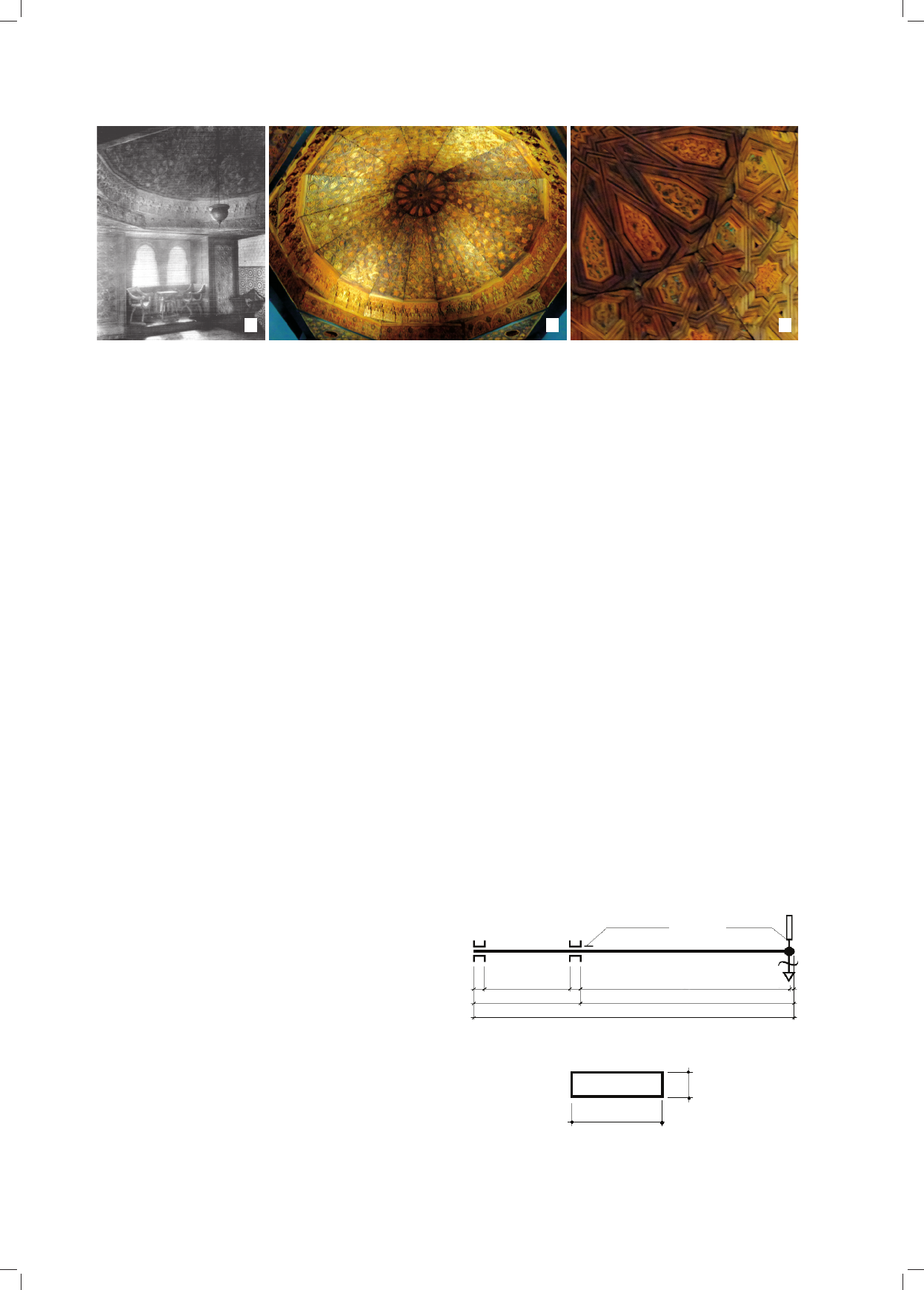
stra cji 1
przedstawiono drewnianą kopułę wybu do wa ną
w 1320 r. jako zadaszenie jednej z wież wido ko wych pa -
łacu Alhambra w Grenadzie. Kopuła ma wy sokość 1,90 m
i wymiary w rzucie: 3,55 × 3,55 m. Wykonano ją z drewna
cedrowego i topoli. Dzięki umiejętnościom jej twórców
kopuła przetrwała 700 lat i można ją podziwiać w pawi-
lonie Muzeum Sztuki Islamskiej w
Muzeum Pergamoń-
skim na Wyspie Muzeów w Berlinie.
Wybór drewna do budowy konstrukcji w obiektach
prestiżowych jest zadaniem trudnym. Metodą powszech-
nie obecnie stosowaną jest metoda selekcji drewna pole-
gająca na oględzinach elementów z drewna potrzebnego
do budowy. Obiektywnych kryteriów wyboru dotychczas
nie opracowano. W pracy [2] zwrócono uwagę na możli-
wość selekcji drewna do budowy konstrukcji na podsta-
wie badań dynamicznych.
Celem artykułu jest pokazanie, jak na podstawie badań
dynamicznych oszacować właściwości modeli z różnych
gatunków drewna oraz określić ich przydatność do budo-
wy trwałych konstrukcji. Jako kryterium przyjęto zmiany
sztywności i modułu sprężystości tych modeli na skutek
zawilgocenia. Opisano badania drgań swobodnych mo -
deli z następujących gatunków drewna: sosny, świerku,
mo drzewia i dębu po 24-godzinnym moczeniu w wodzie.
Introduction
The durability of wood constructions in prestigious
stru ctures depends, e.g. on the rational selection of ele-
ments and properties of wood used for their construction.
Figure 1 shows the wood dome built in 1320 as the roof
of one of the viewing towers in the Alhambra palace in
Grenada. The height of the dome is 1.90 m and its dimen-
sions are 3.55 × 3.55 m. It was made of cedar and poplar
wood. Due to the skills of its builders the 700 years old
original dome is on display and can be admired in the Is -
lamic Art Museum in the Pergamon Museum on the Mu -
seum Island in Berlin.
The selection of wood for construction of prestigious
structures is a difficult task. The universally applied wood
selection method involves the inspection of elements made
of wood needed for the construction. The objective se -
lection criteria have not been determined yet. It is noted
in
[2] that there is a possibility of selection of wood for the
construction of structures on the basis of dynamic tests.
The objective of the paper is to demonstrate how to
estimate the properties of models built of different types
of wood on the basis of dynamic tests and how to assess
their usability for construction of durable structures. The
changes in the stiffness and the elasticity of these models
as a result of moisture have been assumed as the criterion
for the selection. This paper describes the tests of free
vibrations in the models made of the following types of
wood: pine, spruce, larch and oak after submergence in
water for 24 hours. It demonstrates which model is the
least susceptible to degradation caused by moisture. The
most moisture resistant types of wood are recommended
for use in the construction.
* Wydział Architektury Politechniki Wrocławskiej/Faculty of
Architecture, Wrocław University of Technology.
106 Barbara Misztal
Pokazano, który z modeli ulega najmniejszej degradacji
spowodowanej wilgocią. Gatunki drewna najbardziej od -
porne na wpływ wilgoci rekomenduje się do stosowania
w konstrukcji.
Metody badań
Do badań przygotowano modele z desek o przekroju
10 × 40 mm, długości 1200 mm po 24-godzinnym mocze-
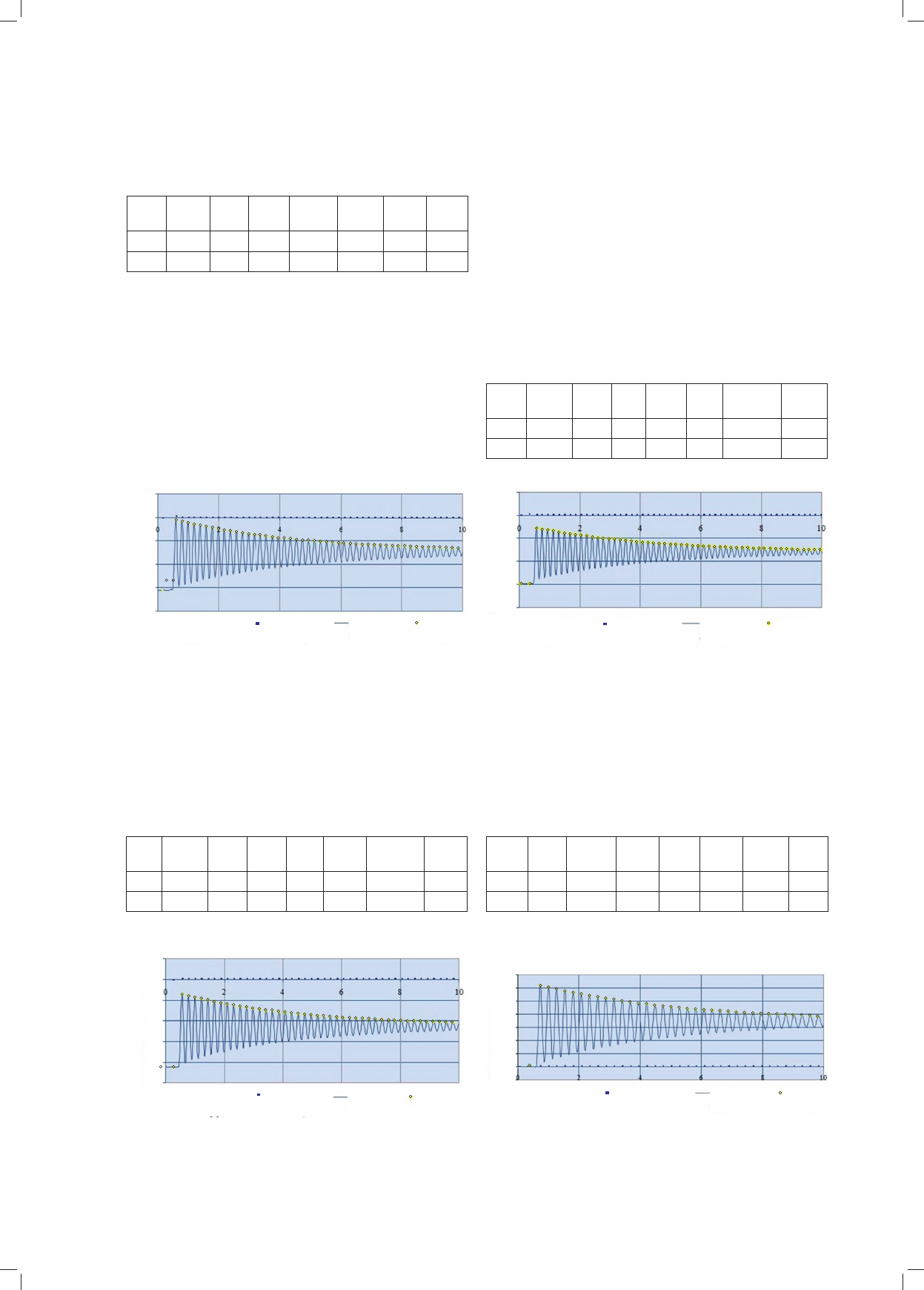
niu w wodzie. W ruch drgający wprowadzano modele
ob ciążone wspornikowo jak na ilustracji 2.
Przed doświadczeniem deski zważono w stanie po -
wietrznosuchym. Po badaniach dynamicznych desek su -
chych moczono je w wodzie przez 24 godziny. Po tym
czasie deski ważono ponownie, obliczając ich wilgotność
wagową. Obciążenie wymuszające przykładano na końcu
wspornika prostopadle do płaszczyzny mniejszej sztyw-
ności belki. W celu ograniczenia wpływu drgań drugiego
rzędu umieszczono masę skupioną m = 250,0 g na końcu
wspornika.
Badano częstość n i tłumienie ρ drgań swobodnych
wymuszonych impulsem za pośrednictwem obciążenia
P = 250,0 g zawieszonego na końcu wspornika. Drgania
wzbudzano poprzez przecięcie zawiesia utrzymującego
ob ciążenie. Przeprowadzono badania wpływu zawilgoce-
nia belek drewnianych na częstość n i tłumienie ρ drgań
swo bodnych. Parametry ruchu drgającego T, ρ, ω,
∆
, po -
kazane w tabelach: 1–4, wyznaczono na podstawie nu -
merycznych wyników pomiarów za pomocą arkuszy kal-
kulacyjnych EXCEL.
Wyniki
W tabeli 1 przedstawiono wyniki badań modelu z des-
ki sosnowej po 24-godzinnym moczeniu w wodzie. Na
wykresie (il. 3) pokazano przebieg drgań w czasie pierw-
szych 10 s badania. W tabelach (2–4) i na wykresach
przedstawiono wyniki badań i drgania dla modeli z desek:
świerkowej (tab. 2, il. 4), modrzewiowej (tab. 3, il. 5)
i dę bo wej (tab. 4, il. 6), badanych po 24-godzinnym mo -
cze niu w wodzie.
Research methods
The tests were conducted on models made of dry wood
beams, 10 × 40 mm in cross section and 1200 mm long,
after being submerged in water for 24 hours. The vibra-
tions were induced to the cantilever beams fi xed as shown
in Figure 2.
The boards were weighed before the tests in dry air.
After the dynamic tests of the dry boards, they were sub-
merged in water for 24 hours. After that period, the boards
were weighed again, calculating their weight moisture.
The load was applied at the end of the beam perpendicu-
larly to the plane of lower stiffness of the beam. A concen-
trated mass of m = 250.0 g was placed at the end of the
beam to limit the infl uence of secondary vibrations.
The test included the measurement of frequency n and
absorption ρ of free vibrations induced by impulse from
load P = 250.0 g suspended at the end of the beam. The
vibrations were induced by cutting the suspension of the
load. The influence of moisture of wood beams on fre-
quency n and absorption ρ of free vibrations was tested.
The parameters of the vibratory movement T, ρ, ω,
∆
,
shown in Tables: 1–4, were calculated on the basis of
Il. 1. Kopuła jednej z wież widokowych pałacu Alhambra w Grenadzie:
a) widok wnętrza zadaszonego kopułą [1], b) podniebienie kopuły (fot. B. Misztal), c) detale w zbliżeniu (fot. B. Misztal)
Fig. 1. The dome of one of the viewing towers in the Alhambra palace in Grenada:
a) view of the interior with a dome roof [1], b) interior of the dome (photo by B. Misztal), c) closer view of details (photo by B. Misztal)
Il. 2. Model badawczy testowanych belek
Fig. 2. Model of beams being tested
a) Schemat belki do badań dynamicznych / Schematic diagram of
a beam for dynamic testing
b) przekrój
/ section
strefa sztywnego
zamocowania belki
area of rigid beam
fixing
40
10
10
40
40
785
785
15
P = 250,0 g
M = 250,0 g
400
800
1200
tensometr
elektrooporowy
czujnik
indukcyjny
inductive sensor
electroresistant
extensometer
320
40
a c
b
Ocena przydatności różnych gatunków drewna /
The assessment of usability of various types of wood
107
numerical results of the measurements with the use of
Excel spread sheets.
Results
Table 1 presents the test results of the model made of
pinewood boards after submergence in water for 24
hours. The graph in Fig. 3 shows the course of vibrations
over the first 10 s of the test. Tables (2–4) and the graphs
T
m
t
0
y
0
ρ
m
n
m
=
1/T
ω
m
φ
∆
m
[s] [s] [mm] [1/s] [1/s] [°] [°]
0,197 0,506 15,57 0,241 5,076 31,8 3,21 0,047
Tabela 1. Parametry ruchu drgającego modelu z sosny
o wilgotności 56,62% (il. 3)
Table 1. The parameters of the vibratory movement
of the model made of pinewood with moisture of 56.62% (Fig. 3)
Legenda do tabel 1–4 / Legend to Tables 1–4:
T
m
– okres drgań/period of vibrations, t
0
– czas początkowy/initial
time, y
0
– maksymalne wychylenie/maximum deflection,
ρ
m
– tłumienie drgań/damping of vibrations, n
m
– częstość drgań modelu
/
vibration frequency of the model, ω
m
– prędkość kołowa drgań
tłumionych/circular speed of damped vibration,
φ
– przesunięcie fazowe/phase displacement,
∆
m
– logarytmiczny
dekrement tłumienia/logarithmic damping dekrement.
Indeks m oznacza stan mokry modelu/Index m means wet model of wood.
T
m
t
0
y
0
ρ
m
n
m
=
1/T
ω
m
φ
∆
m
[s] [s] [mm] [1/s] [1/s] [1/s] [°]
0,187 0,4667 14,85 0,26 5,348 33,6 –3,51436 0,048
Tabela 2. Parametry ruchu drgającego modelu ze świerku
o wilgotności 34,92% (il. 4)
Table 2. The parameters of the vibratory movement
of the model made of spruce with moisture of 34.92% (Fig. 4)
T
m
t
0
y
0
ρ
m
n
m
=
1/T
ω
m
φ
∆
m
[s] [s] [mm] [1/s] [1/s] [1/s] [°]
0,22 0,4533 21,16 0,256 4,54 28,56 9,524647 0,056
Tabela 3. Parametry ruchu drgającego modelu z modrzewia
o wilgotności 25,93% (il. 5)
Table 3. The parameters of the vibratory movement
of the model made of larch with moisture of 25.93% (Fig. 5)
Il. 6. Zapis ruchu drgającego modelu z dębu
o wilgotności 23,00% w czasie pierwszych 10 s badań
Fig. 6. The vibratory movement of the model made of oak
with moisture of 23.00% over the first 10 s of the test
T
m
t
0
y
0
ρ
m
n
m
=
1/T
ω
m
φ
∆
m
[s] [s] [mm] [1/s] [1/s] [1/s] [°]
0,267 0,6 30,118 0,236 3,745 23,53 15,876 0,063
Tabela 4. Parametry ruchu drgającego modelu z dębu
o wilgotności 23,00% (il. 6)
Table 4. The parameters of the vibratory movement
of the model made of oak with moisture of 23.00% (Fig. 6)
wychylenie [mm] /
deflection
deflection
35
35
30
30
25
25
20
20
15
15
10
10
5
5
0
0
-5
-5
czas [s]
czas [s]
time [s]
time [s]
okres drgań
okres drgań
vibrations’ period
vibrations’ period
wychylenie
wychylenie
deflection
deflection
maxima
maxima
wychylenie [mm] /
deflection
deflection
5
5
0
0
-5
-5
-10
-10
-15
-15
-20
-20
czas [s]
czas [s]
time [s]
time [s]
okres drgań
okres drgań
vibrations’ period
vibrations’ period
wychylenie
wychylenie
deflection
deflection
maxima
maxima
Il. 4. Zapis ruchu drgającego modelu ze świerku
o wilgotności 34,92% w czasie pierwszych 10 s badań
Fig. 4. The vibratory movement of the model made of spruce
with moisture of 34.92% over the first 10 s of the test
Il. 3. Zapis ruchu drgającego modelu z sosny
o wilgotności 56,62% w czasie pierwszych 10 s badań
Fig. 3. The vibratory movement of the model made of pinewood
with moisture of 56.62% over the first 10 s of the test
wychylenie [mm] /
deflection
deflection
5
5
0
0
-5
-5
-
-
10
10
-15
-15
-20
-20
czas [s]
czas [s]
time [s]
time [s]
okres drgań
okres drgań
vibrations’ period
vibrations’ period
wychylenie
wychylenie
deflection
deflection
maxima
maxima
Il. 5. Zapis ruchu drgającego modelu z modrzewia
o wilgotności 25,93% w czasie pierwszych 10 s badań
Fig. 5. The vibratory movement of the model made of larch
with moisture of 25.93% over the first 10 s of the test
wychylenie [mm] /
deflection
deflection
5
5
0
0
-5
-5
-10
-10
-15
-15
-20
-20
-25
-25
czas [s]
czas [s]
time [s]
time [s]
wychylenie
wychylenie
deflection
deflection
maxima
maxima
okres drgań
okres drgań
vibrations’ period
vibrations’ period

108 Barbara Misztal
Analiza wyników badań dynamicznych
We wszystkich przypadkach tłumione drgania swo-
bodne, niezależnie od gatunku drewna, dobrze opisywała
funkcja (1) według [3]:
y
t
= y
0
e
–ρt
cos(√α
2
– ρ
2
t + φ), (1)
gdzie:
α – częstość drgań własnych,
ρ – wymiarowe tłumienie drgań,
φ – przesunięcie fazowe.
Prędkość kołowa drgań tłumionych:
ω = √α
2
– ρ
2
(2)
Prędkość kołową drgań swobodnych ω [°] i tłumienie
ρ [1/s] wykorzystano do obliczenia sztywności rzeczywi-
stej i modułu sprężystości podłużnej badanych belek.
Wyniki zestawiono w tabelach: 5 i 6.
W pracy [3] podano związki między sztywnością K,
masą m, prędkością drgań ω i tłumieniem ρ. Pomijając
lepkość η, można oszacować lokalną sztywność efektyw-
ną K
ef
pręta z wzoru:
K
ef
= m
z
α
2
(3)
Zastępczą masę skupioną m
z
obliczono z wzoru (4)
według [4]:
m
z
= 0,243ql + 250, (4)
gdzie: q – pomierzony ciężar na 1 mb wspornika.
Z porównania przemieszczeń y = Pl
3
/3E
m
J i y = P/K
ef
otrzymano równanie (5):
(5)
Moduł sprężystości podłużnej E otrzymano z równa -
nia (6):
(6)
Wnioski
Procedurę wyboru najlepszego gatunku drewna do
budowy konstrukcji na podstawie stosowanych do tej
pory oględzin lub badań długotrwałych warto uzupełnić
o obiektywne parametry uzyskane na podstawie badań
drgań swobodnych elementów z drewna.
Z przeprowadzonej analizy drgań swobodnych modeli
drewnianych wynika, że gatunki o większej przydatności do
konstrukcji wykazywały w badaniach dynamicznych mniej-
sze okresy drgań, wyższe częstości, mniejsze tłumienie
wy miarowe i mniejszy logarytmiczny dekrement tłumienia.
Jako kryterium przydatności drewna do długotrwałej
pracy w konstrukcji można przyjąć spadek wartości mo -
dułu sprężystości na skutek zawilgocenia. W opisanych
badaniach najmniejszy spadek wartości modułu E wyka-
zuje drewno sosny.
Na podstawie pomiarów drgań swobodnych można ja -
kościowo uszeregować gatunki drewna badanych modeli
do długotrwałego zastosowania w konstrukcji według przy-
datności: sosna, modrzew, dąb, świerk.
show the test results and vibrations for the models made
of spruce, larch, and oak boards tested after being sub-
merged in water for 24 hours.
Analysis of dynamic tests
In all cases the absorbed free vibrations, regardless of
the variety of wood, were well described by the following
function (1) according to [3]:
y
t
= y
0
e
–ρt
cos(√α
2
– ρ
2
t + φ), (1)
where:
α – own vibration frequency,
ρ – dimensional vibration damping
φ – phase displacement.
Circular speed of absorbed vibrations:
ω = √α
2
– ρ
2
(2)
The circular speed of free vibrations
ω
[°] and the dam-
ping ρ [1/s] were used to calculate the actual stiffness and
the modulus of direct elasticity of the beams under test-
ing. The results are listed in Tables 5 and 6.
[3] presents the relationship between stiffness K, mass
m, speed of vibrations ω, and absorption ρ. If viscosity η
is ignored, the local effective stiffness K
ef
of the rod can
be calculated with the following formula:
K
ef
= m
z
α
2
(3)
The equivalent concentrated mass m
z
was calculated
from formula (4) according to [4]:
m
z
= 0.243ql + 250, (4)
where: q – measured weight per 1 linear meter of beam
The comparison of movements y = Pl
3
/3E
m
J and y =
P/K
ef
gave the following equation (5):
(5)
The longitudinal elasticity modulus E was calculated
from equation (6):
(6)
Conclusions
The procedure of the selection of the best type of wood
for construction on the basis of the inspections or long-
lasting tests applied so far should be extended to include
the objective parameters established on the basis of the
tests of free vibrations of the elements made of wood.
The analysis of free vibrations conducted on the mo -
dels made of wood indicates that the types of wood with
a greater usability for construction demonstrated in the
dynamic tests smaller periods of vibrations, higher fre-
quencies, smaller dimension absorption and smaller loga-
rithmic decrement of absorption.
The reduction in the value of the elasticity modulus as
a result of moisture could be assumed as the criterion of
usability of wood for long-term application in construc-
tion. The smallest reduction in the value of modulus E in
the described tests was demonstrated by pinewood.
Pl
3
P
=
3E
m
J K
ef
Pl
3
P
=
3E
m
J K
ef
K
ef
l
3
=
3J
E
m
K
ef
l
3
=
3J
E
m

Ocena przydatności różnych gatunków drewna /
The assessment of usability of various types of wood
109
Parametry dynamiczne modeli w stanie powietrznosuchym badanych według il. 2
Dynamic parameters of dry models tested according to Fig. 2
m
z
K
= m
z
α
s
2
E
s
modeli w stanie
powietrzno-
suchym
E
s
of dry models
E
wg normy
E
per standard
materiał
material
masa
modelu
model
weight
masa rów.
rozłożona
uniformly
distributed
weight
ρ
s
ω
s
drgania
własne
free vibrations
ρ
s
2
ω
s
2
α
s
2
= ρ
s
2
+ ω
s
2
[g] [g/s
2
] [GPa] [GPa]
[g] [g/m] [1/s] [1/s] [1/s
2
]
12345 6 78 9 10
Sosna
Pine wood
260,70 178,15
0,14 33,80
285,498 326170,1 17,98
11÷14
0,0196 1142,44 1142,46
Świerk
Spruce wood
224,58 153,46
0,1724 36,3168
280,578 370065,5 20,40
0,0297 1318,91 1318,94
Modrzew
Larch wood
267,60 182,86
0,1485 30,01375
286,437 258035,6 14,23
0,0220 900,825 900,847
Dąb
Oak wood
314,42 214,85
0,1673 24,835
292,811 180607,3 9,96
brak danych
w normie
no data
within norm
0,028 616,777 616,805
Parametry dynamiczne modeli mokrych badanych według il. 2
The dynamic parameters of wet models tested per Fig. 2
m
z
K
= m
z
α
s
2
wilgotność
moisture
E
m
modeli mo krych
E
m
of wet mo dels
Zmniejszenie E
Decrease E
materiał
material
masa
modelu
model
weight
masa rów.
rozłożona
uniformly
distributed
weight
ρ
m
ω
m
α
m
2
=
ρ
m
2
+ ω
m
2
ρ
m
2
ω
s
2
[g] [g/s
2
] [%] [GPa] [%]
[g] [g/m] [1/s] [1/s] [1/s
2
]
123456789 10 11
Sosna
Pine wood
408,30 279,00
0,2411 31,811
305,594 309260,05 56,6 17,05 5,0
0,0581 1011,94 1011,998
Świerk
Spruce wood
308,52 210,82
0,2636 33,6
292,008 329685,65 34,9 18,18 10,9
0,0695 1128,96 1129,0295
Modrzew
Larch wood
337,00 230,28
0,2562 28,5664
295,886 241474,01 25,9 13,31 6,5
0,06565 816,04 816,106
Dąb
Oak wood
386,70 264,23
0,236 23,5325
302,650 167618,73 23,0 9,24 7,2
0,0557 553,78 553,836
Tabela 5. Porównawcze zestawienie sztywności i modułów sprężystości podłużnej E
s
modeli badanych w stanie powietrznosuchym z pracy [5]
Table 5. The comparison of stiffness and longitudinal elasticity modulus E
s
of dry tested models [5]
Tabela 6. Porównawcze zestawienie sztywności i modułów sprężystości podłużnej E
m
modeli badanych po 24-godzinnym moczeniu w wodzie
Table 6. The comparison of stiffness and longitudinal elasticity modulus E
m
of the models tested after being submerged in water for 24 hours
Krótkie testy dynamiczne warto polecić do selekcji
drewna potrzebnego do budowy konstrukcji, a także do
wy
krywania elementów zawilgoconych lub uszkodzo-
nych w już wybudowanych obiektach.
On the basis of the measurements of free vibrations,
the types of wood used in the tested models can be quali-
tatively ranked for long-term application in construction
according to their usability: pine, larch, oak, spruce.
The short dynamic tests are worth recommending for the
se lection of wood needed for the construction and also for
de tecting wet or damaged elements in already built structures.
Translated by
Tadeusz Szałamacha

110 Barbara Misztal
Bibliografia /References
[1] Brisch K., Kuppeldach aus dem Aussichtsturm des Torre de las
Damas (Damenturm), Foto: Bundesarchiv, Staatliche Museen zu
Berlin.
[2] Misztal B., Kształtowanie kopuł z drewna jednolitego, Oficyna Wy -
dawnicza PWr, Wrocław 2012.
[3] Kowal Z., Dynamika nieważkiej belki na podporach lepkospręży-
stych, „Archiwum Inżynierii Lądowej” 1966, Nr 1(12), 29–42.
[4] Banasiak M. (red.), Ćwiczenia laboratoryjne z wytrzymałości ma -
teriałów, PWN, Warszawa 1985.
[5] Misztal B., Oszacowanie efektywnej sztywności i modułu sprężysto-
ści różnych gatunków drewna na podstawie pomiarów drgań swo-
bodnych, „Architectus” 2014, Nr 1(37), 81–87.
Streszczenie
W artykule opisano badania dynamiczne modeli z drewna sosnowego, świerkowego, modrzewiowego i dębowego. Przeprowadzono je w celu
poznania właściwości modeli z różnych gatunków drewna na podstawie danych uzyskanych z badań drgań swobodnych elementów. Zbadano
modele powietrznosuche i po 24-godzinnym moczeniu w wodzie. Przebieg drgań każdego z modeli zilustrowano na wykresie. Pokazano metodę
szacowania efektywnej sztywności i modułu sprężystości podłużnej E różnych gatunków drewna. Celem badań było określenie, jak zmienia się
efektywny moduł sprężystości drewna na skutek zawilgocenia.
Słowa kluczowe: moduł sprężystości podłużnej, drgania swobodne, tłumienie drgań swobodnych
Abstract
The paper describes the dynamic testing of models made of pine, spruce, larch and oak wood. The testing was conducted in order to learn the
properties of planks on the basis of data obtained from the testing of free elements’ vibration. Planks dried in air and after a 24 hours’ soaking in
water were tested. The course of the vibration of each of the models was illustrated on a graph. The calculations of the determination of elements’
stiffness, and of the modulus of direct elasticity E for various wood species were shown. The aim of the testing was to determine how the modulus
of elasticity varies due to wetting.
Key words: modulus of longitudinal elasticity, free vibration, damping of free vibration