
2010
Nr 2(28)
It is common belief nowadays that the development
of contemporary architecture was smooth and it origi-
nated naturally from the continuity of the development
of civilization of societies. That is why industrialization
of building which intensied especially after the Second
World War and its architectural consequences are errone-
ously believed to be obvious. However, this would not
have been possible without such favorable circumstances
as deviations from diligence, designing talent and work-
manship in favor of semi-courage and grandeur.
The creative capabilities of the pioneers of interna-
tional modernism reached their pinnacle at the moment
when new materials and engineering solutions enabled
the development of totally new architecture. The destruc-
tions in the south of France, degradation of industrial
regions in Germany after the First World War and espe-
cially dramatically growing residential needs of the peo-
ple required building to become a mass industry. It was
a problem which nobody could effectively solve at that
time.
Modernists grew up when the decor of a typical burgh-
er’s house included heavy decorated furniture, plush up-
holstery and ubiquitous knick-knacks. It can be said that
that kind of aesthetics achieved its highest level of devel-
opment. However, its another form, instead of being an
antidote against it, became the extreme opposite of that
exaggeration. The authors of modern architecture claimed
that it should be universal in respect of aesthetics and
functionality because the only right way of building in-
deed can exist. They excluded all exceptions: Oslo, Mos-
cow, Berlin, Paris, Algiers, Port Said, Rio de Janeiro or
Buenos Aires; it doesn’t matter, the solution is always the
same as it satises the same needs (Le Corbusier) [1].
The most famous ideological dispute in modern archi-
tecture took place still during the development of Britz
residential estate near Berlin (1925–1927). Howard’s city-
garden was divided into two parts “traditional” and “mod-
ern”. This, however, did not mean at all that the advo-
cates of international modernism came out of the conict
victorious. On the contrary, an assumption bordering on
certainty can be made that only huge destruction suffered
during the Second World War paved the road for a new,
not necessarily better, perception of developed space and
different methods of design. What was noticed in ugly ar-
chitectural experiments by L. Hilberseimer, Ch.-E. Jean-
neret (Le Corbusier), A. Loss, M. van der Rohe and others
was primarily utilitarian necessity and not beauty and that
is why they were universally ostracized even before they
died.
The difference between residential needs and condi-
tions before and a little after the Second World War re-
garded the damaged and lost resources. They were, how-
ever, so severe and extensive that they resulted in a dra-
matic change in social awareness and application of even
radical solutions. That in turn resulted in a transformation
of architectural thought, basing it on universalism and
aesthetic purism as well as special material – concrete.
It became possible then to carry out undertakings which
earlier had been considered totally impossible. They were
often carried out by untrained persons and amateurs
1
.
1
From among the representatives of international modernism listed
here only L. Hilberseimer was profoundly educated in the scope of archi-
tecture; he completed ve-year-long studies at University of Technology in
Karlsruhe, whereas Le Corbusier at rst studied engraving and chiseling
at the art school in La Chaux-de-Fonds (1900–1904). He took his rst
architecture study trip when he was twenty (Austria-Hungary, Italy).
M. van der Rohe took his training in a construction and decoration com-
pany (1899–1904) and at the age of eighteen he started his internship in
an architecture ofce. At the age of twenty, A. Loos began three-year-long
studies in architecture at Dresden Technical University (1890–1893).
Grzegorz Wojtkun*
The culture of architectural design
– the ideological basis of modern architecture
*
West Pomeranian University of Technology in Szczecin, Faculty of
Building and Architecture, Institute of Architecture and Urban Planning,
Department of Architectural Design.

230 Grzegorz Wojtkun
This was the origin of ideas which enabled the natural
process of evolution in architecture and urban planning
which lasted for centuries to stop.
The aesthetics of concrete extremely quickly became
a showcase of the soulless movement in architecture called
modernism
2
. It seems that it was supposed to terrify and
confuse. Le Corbusier was one of those who especially
adamantly gloried his destructive ideas as courage and
unrestricted imagination: Le Corbusier was to architec-
ture what Pol Pot was to social reforms. He felt fullled
in destruction [1]. The comments of the representatives
of international modern movement were ominous for the
post-war development of cities in Europe and around the
world. That is why it was difcult to be proud of it.
The aesthetic coherence of works of architecture was
based primarily on the apotheosis of functionalism, and
the design process as well as its culture was developed
into an intellectual revolutionism. There was no escape
from the dictates of the representatives of modern archi-
tecture: Enthusiasm is the only way, the source of energy
in human machine (Le Corbusier). It can be said that
this is when the rst symptoms appeared of distortion of
a uid state in architecture – total philosophy, workshop
minimalism, aesthetics of multi-motifs connected even
with turpism. However, the canon of “out of the box” ar-
chitecture which remains in total opposition to the values
of civilization, humanity and natural environment, proved
extremely catchy. This was happening despite many nega-
tive experiences connected with the mono-cultural designs
of multi-family developments from the 1930s. Paradoxi-
cally, such slogans as ornament and crime (A. Loos), less
means more and God is in the details (M. van der Rohe)
instead of provoking protest were gloried as expression
of creative genius of their authors.
Contrary to the declarations of the advocates of modern
architecture, it was dehumanized. Human elements prac-
tically disappeared from drawings to prevent impeccably
pure, almost platonic built environment. Everything had
to be assigned a specic function to suppress any spon-
taneous interpersonal relations. Chandigarh in India (Le
Corbusier) and Brasilia in Brazil (L. Costa, O. Niemeyer)
testify to the grim visions and insufferable arrogance.
In communist countries, the contempt for humanity
dramatically exceeded words. This was evident in treating
history as tyranny which should be rejected, as if nobody
knew or created anything valuable earlier. The at con-
crete surfaces, bare and abstract shapes perfectly suited
the system difculties. High-rise blocks dominated the
structure of urban space in the cities very quickly, aspir-
ing to become everlasting progress, whereas not so long
earlier – during the interwar period – such architects as
H. Kilus, P. Schmitthenner and H. Rimpl could design in-
novatively and harmoniously the same time. They did not,
however, try to obsessively impose their own will on the
2
The term “modern” in fact proved euphemistic as at least one of
the main advocates of vernacular architecture in Germany before the First
World War – P. Schmitthenner in Staaken Residential Estate (1914–1917)
limited the number of apartment types to as few as ve and intended to
obtain the same living conditions for everybody.
society but they did try to contribute to the civilization
legacy of previous generations.
The totally unintentional and therefore the most sin-
cere “homage” that has been paid to date to modernists and
their continuators has been paid by mural artists. Unedu-
cated and pauperized dwellers of big-city slums intuitively
noticed what a lot of architecture designers tried not to see:
namely that they often acted against ordinary people. It
was most accurately described by the French philosopher
J.-F. Revel: it is a sign of the abiding strength of the totali-
tarian temptation that Le Corbusier [and the like] is still
revered in architectural schools and elsewhere [1].
The problem with creative activities of the architect is
that they often represent ambiguous aesthetic value and
moral aspect. Many historical gures can be undoubtedly
considered the most prominent gures in specic histori-
cal periods. However, the thing is about their inuence
on the course of events and not merits. A similar attitude
can be noticed among architects today too. As if the es-
sence was not solving inherited problems but considering,
with few exceptions, the past an error. That is why many
modern projects and designs show that architecture can be
both enchanting, sophisticated and soulless. This is best
demonstrated by the ideas promoted by the advocates of
the New Bauhaus school in Chicago, practical experienc-
es connected with Marseille L’Unité D’Habitation as well
as arcological visions of human habitat (Soleri).
However, it was only in post-modern societies that it
was possible to improve the culture of design based on
perfection, talent and reliable knowledge. It seems to have
great signicance in the situation of constant attempt at
shortening the time needed to execute investments, pri-
marily in respect of applying optimal design solutions,
constant pressure of economic factors and low awareness
of investors.
Today it is the developers who are more and more
often the actual city architects. Consequently, buildings
must be constructed quickly and inexpensively. Combin-
ing those two features can be dangerous [4].
Such a defective interaction can cause a decrease in
motivation of a designer of architecture. This is not far
from banality and repetitiveness of solutions designed for
anonymous and “standard” users even if the solutions re-
ect the architect’s anthropocentric and holistic point of
view. That can cause serious consequences which can be
demonstrated by numerous examples of architecture with
completely dehumanized graphic message, which at the
same time is in compliance with the latest stylistic trends
– minimalism or more catchy conceptual formalism
3
.
However, a lot indicates that the present development
of architecture again began to smoothly result from the
natural cycles of the development of societies. Fortunate-
ly, again it began to assume elements from other realms
and more importantly it became exceptionally diverse. It
3
Formal conceptualism as an antithesis of minimalism was based
on graphic constellations and multiplication of ornaments. These two
styles in architecture were advocated by Swiss designers J. Herzog and
P. de Meuron who were considered world class at the end of the 20
th
century.
The culture of architectural design – the ideological basis of modern architecture 231
began more evidently to succumb to fashion, naturally
more easily during economic prosperity than during cri-
ses. At the same time creative activities of architects, un-
like in the 19
th
century (J. Ruskin), demonstrate that it can
be both pure art (I think that artistic expression is the juice
which drives our collective soul– F.O. Gehry) [2, p. 60],
‘engineering’ (each new design is a series of construction
problems that need to be solved – P. Andreu) [2, p. 60],
as well as virtual (building was designed as a dynamic
system with constant computer interaction between users,
environment and the building – L. Spuybroek) [2, p. 134].
This means that it does not have to serve exclusively util-
ity purposes. Furthermore, since constructivism works of
art have been created at the point where engineering meets
art, and their scale as well as technology is not worse than
the scale and technology of architecture structures, for in-
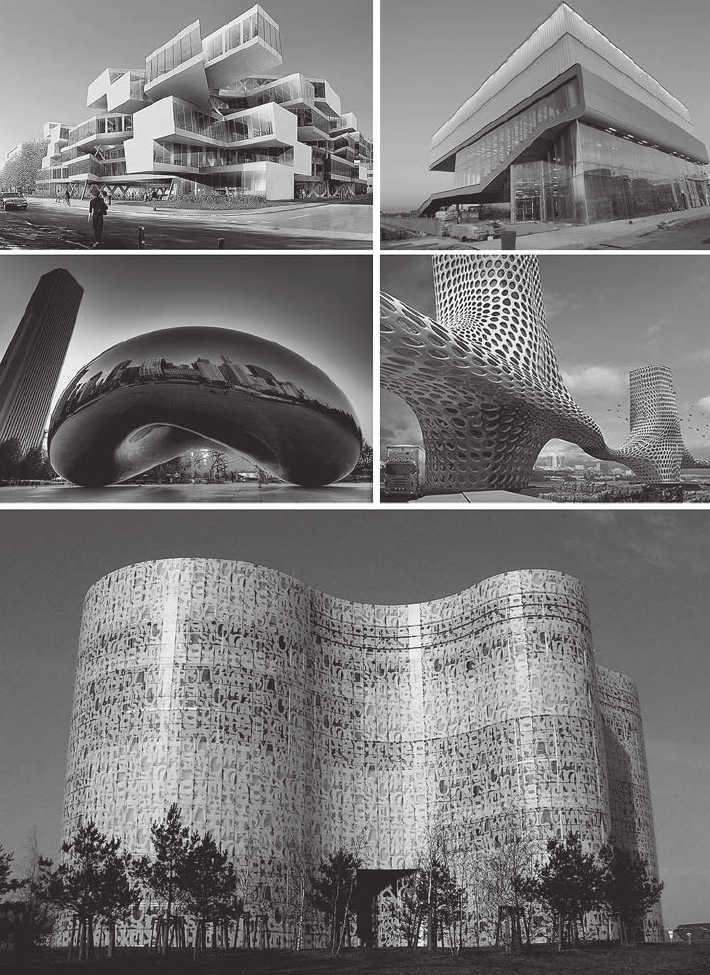
stance famous Cloud Gate in Chicago (A. Kapoor).
Nowadays a great majority of architects present their
own style, apply different materials and draw inspiration
from other regional factors. Buildings are erected from
concrete (T. Ando) or even paper (S. Ban) in gurative
(B. Coates), futuristic (Z. Hadid), minimalistic (W. Arets)
or sculptural style (F. Gehry). Apart from solving tasks
given by the clients, architects try to impart to their works
their own identity. The generation of neo-modernists only
complements other international designers (T. Ando,
T. Ito).
On the basis of that diversity the following conclusion
can be naturally drawn: one cannot talk today about an
international style; there is no one way to look at pres-
ence. (…) A lot of buildings testify to a great accelera-
tion of changes which take place in architecture. Today’s
architecture is driven by computers or the will to improve
ideas that go back to modernism... [2, pp. 7–8].
Fig. 1. Actelion Business Center
in Allschwill (J. Herzog,
P. de Meuron, Switzerland)
– top left; source:
www.elpais.com (02/02/2010).
Renfo Institute of Contemporary
Art in Boston (Diller+Scodio
Architect, 2006) – top right;
source: www.archidialog.com.
Cloud Gate in Chicago
(A. Kapoor) – left;
source: www.ickr.com.
Residential buildings
“The three graces”
in Dubai (NOX) – right;
source: www.designboom.com.
University Library in Cottbus
– bottom. Source:
www.pl wikipedia org
232 Grzegorz Wojtkun
Designing architecture has always been an individual
process of creation where the rational assumptions and skills
of the architect should play the key role. These exact quali-
ties determine the signicance of the design culture among
so many manifestations of activities of the architect.
Architecture should be given back to people. It is con-
nected with a specic place but it also leaves its imprint in
the psyche. We like buildings that are noble, sensual, in-
spiring: those which we keep in our memory (…), as well
as cheap architecture, custom made and precise [4].
References
[1] Dalrymple T., The Architect as Totalitarian. Le Corbusier’s baleful
inuence, City Journal Autumn, 2009, Vol. 4., www.city-journal.org.
[2] Jodidio P., Architektura dzisiaj, Taschen/TMC Art Gmbh, Köln
2003.
[3] Reiter C., Minimal style, Taschen Gmbh, Köln 2006.
[4] Zabalbeascoa A., Entrevista: Planeta Urban – Entrevista Jacques
Herzog. No nos interesan las burbujas. Queremos seguir dudando,
El Pais, www.elpais.com (02/02/2010).
O kulturze projektowania architektonicznego. Podstawy ideowe współczesnej architektury
Zagadnienie kultury projektowania w architekturze współczesnej
w dużej mierze odnosi się do nośnych niegdyś prądów modernizmu. Na
początku XX stulecia doszło do gwałtownego przyspieszenia rozwoju
ekonomicznego wielu państw europejskich. Pociągnęło to za sobą zmiany
na polu kulturowym, a w dalszej kolejności w warsztacie architektów.
Aby móc odpowiedzieć na nurtujące nas dziś pytania o kierunki rozwo-
ju architektury współczesnej należy poddać analizie przesłanki, które
legły u podstaw powstania i ugruntowania się międzynarodowego stylu
modernistycznego.
Key words: culture, modern architecture Słowa kluczowe: kultura, współczesna architektura