
2010
Nr 2(28)
Monika Bogdanowska*
The drawn landscape – a permanent record
of the historic cultural landscape on the impermanent carrier
– the Sketchbooks by Janusz Bogdanowski
How durable can a pencil sketch often made in a hur-
ry be? As it was only a note on the sheet of paper from
a sketchbook which was kept in a rucksack, hidden un-
der the raincoat during the rain and nally, it was put
on the shelf between other papers where beams of light
destroyed the poor material in the process of irreversible
changes. How important can a drawing documentation
of a non-existing mechanism of the mill, a cottage plan
or the view of a wooden shepherd shelter be? Can such
a drawing be compared with a good photography, ana-
lytic thesis or precise inventory? A sketch often has some
content as well: a description of the road in the elds,
which leads to the wayside shrine; a story told by an old
man met near the wayside shrine. Isn’t it the most real
record of the society history, which emanates with cul-
tural landscape? The landscape irreversibly lost, which
disappeared in silence with indulgent acceptance of pass-
ing of time. Nowadays, sketchbooks are becoming the
shocking evidence of hecatomb which swept away from
our planet and blotted out the memory of something
which generations had built for hundreds of years creat-
ing in this way a new cultural identity. Let us take several
sketches by Janusz Bogdanowski. As the life’s work of one
man – it is a giant job but as regards destruction – hard-
ly a readable after-image of something that has already
gone by.
The need of recording phenomena of the surround-
ing world is very strong for many architects. It results
from the ability to observe, which is often exercised in
the process of drawing because this is the drawing that
teaches not only manual uency but rst of all empathy
towards the encountered world, which in turn releases the
impulse to record this world. Therefore, there appears the
need to record everything that is seen in form of photogra-
phy, sketch or painting. And like an architect develops his
passion, similarly the passion inuences the development
of his technique and design experiences.
Janusz Bogdanowski, Professor of architecture, had
a drawing passion which accompanied him for the whole
life. The need to create the rst sketchbook appeared dur-
ing the studies at the Department of Architecture of Cra-
cow University of Technology in 1952. Soon it turned out
that the sheets had to be placed in the next sketchbook and
it was continued until the year 2001 when the last – 68
th
sketchbook was made. Every year, for almost fty years,
at least one sketchbook was created in which, apart from
pencil sketches and sketches made with a thin marker in
the next years, notes were taken as well. All sketchbooks
were made by the author and they consist of sheets in A5
format, which are connected by means of a metal clip.
Almost three thousand sheets were collected during these
years. It would be difcult to assess the total number of
sketches because on many sheets there are more sketches
than only one. Thanks to unusual sensitivity and a good
theoretical preparation in the scope of architecture and
construction the author easily ‘snatched’ objects which
were worth recording. Thus, we can observe cottages
with the equipment of everyday use, complicated machin-
ery, sketches of villages and farms, panoramas, parks and
palaces, churches and fortresses, paintings discovered in
wayside shrines – the index comprises over 600 places
from different regions of Poland (in the later period, they
were rst of all the records of foreign expeditions). The
sketchbooks constitute a rich source of the material for
varied analyses [2–11], [14].
The review of sketches, which were created within
such a long period, allows following the changes in the
author’s interests starting from fascinations with regional
architecture and the process of inventory, analyses of gar-
den constructions and ending in military architecture. The
*
Cracow University of Technology, Department of Architecture,
Faculty of Drawing, Painting and Sculpture.
12 Monika Bogdanowska
review also makes it possible to observe the scientist’s
work and the appearance of concepts which later deter-
mined new directions and research methods (for example,
JARK WAK method). In the sketchbooks, it is also pos-
sible to follow the development of the author’s drawing
skills: from the rst awkward attempts through technical
inventories, landscape studies which were drawn with one
line, axonometric drawings of architectural complexes –
because a ‘normal’ view was not inspiring enough – and
nally several-second sketches of the gothic cathedrals.
Janusz Bogdanowski put his drawing skills into practice
by illustrating, among others, his own publications. The
drawing documentation, contained in the sketchbooks
made in the 1950s, is the most precious in assessing the
changes of cultural landscape. It was also the period of
the greatest activity of the author because from 1952 till
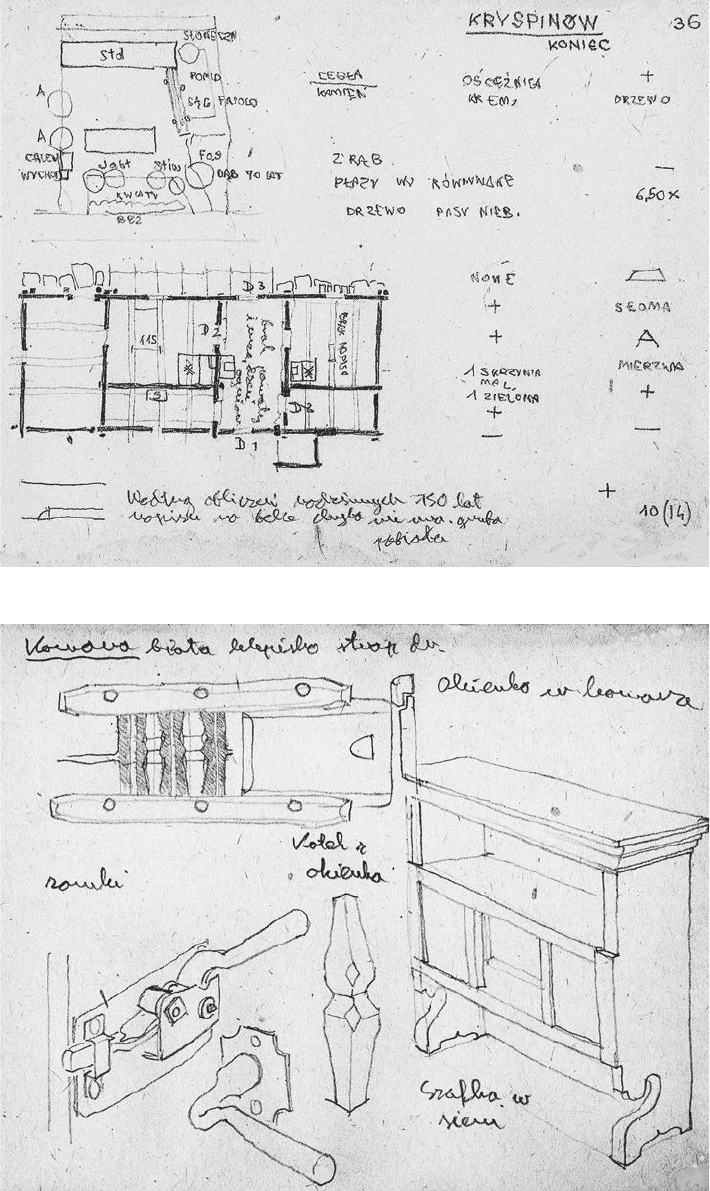
Fig. 1. Kryspinów-Koniec.
Inventory drawing, hut No. 36.
J. Bogdanowski, 1955
Fig. 2. Domestic equipment of the
Kryspinów hut: widow wooden
grating, cupboard, door handle.
J. Bogdanowski, 1955
The drawn landscape – a permanent record of the historic cultural landscape on the impermanent carrier... 13
the end of 1959, 27 sketchbooks were created and many
of them contain more than 200 pages. It is worth noticing
that the world recorded in the sketchbooks was not the
world which was described in guidebooks or catalogues
of monuments in a simple way. These were rather places
off the beaten track and lost somewhere in the elds and
whose discovering required great perseverance. Let us
analyse several sketches. The can be an inspiration for
considering the changes of the Polish cultural landscape
of the last 50 years.
In the sketchbooks there are inventories of several vil-
lages. In order to accelerate work, the author invented the
following system: in the thin cardboard of the sketchbook
sheet’s size he cut out several openings and then described
each of them. When the cardboard was put on the sheet, it
was possible to write appropriate data in the openings and
in this way to ll in the table (Fig. 1). Thanks to this meth-
od, all the building elements of the described structure
were recorded quickly and the author had time to draw
some other interesting pieces: a wooden door leading to
the little barn, inherited-from-grandmother baby cradle or
a staple designed in a clever way.
Thanks to the drawings and descriptions it is easy to
observe ‘yesterday and today’ of these villages. In 1955
an inventory of Kryspinów, situated near Cracow, was
made. In the past, it was a destination point of bicycle
trips along the road at the feet of Srebrna Góra – with
a white gure of the Congregation of Monk Hermits of
Camaldoli Church – in the direction of pine wood coppice
on sand slopes/scarps. The number of thatched cottages
with colourful walls allowed Janusz Bogdanowski to try
to dene the forms typical of villages situated near Cra-
cow [3]. However, already at that time the author saw an
architectural structure in its landscape context, which can
be proved beautiful, painted with watercolours panoramas
of villages, which open the sketchbook; then the analy-
sis of the urban system, description of plant types, list of
plants grown in gardens adjoining to the houses. As we
can see in the sketches, Kryspinów-like farmsteads were
full of clever carpenter’s elements as well as the equip-
ment – in more or less decorative forms – painted with
different colours (Fig. 2), while wooden ceiling beams of
houses were decorated with inscriptions and dates which
proved their 19
th
century origin.
A very interesting is also a written down history of
the chapel, which is hidden in the forest growing on the
hill and brings to mind pagan rituals, thus a proof of sa-
credness of the place: At Easter, pretzels were put in front
of the chapel and children came to collect them (…) The
chapel is already on the cadastre, therefore it certainly is
over 120 years old, perhaps from the 18
th
century situated
on the place of the old castle (…); thus, is the village re-
ally the old borough?
1
A choleric cemetery was also situ-
ated at the feet of the hill separated with a quadrilateral
stone wall and the Immaculate Mother of Jesus gure on
the stone column.
The sketchbook, which is devoted to the small ham-
let Juszczyna, i.e. Oleksowa Rola (suski district), looks
slightly different – this is a place where the author of
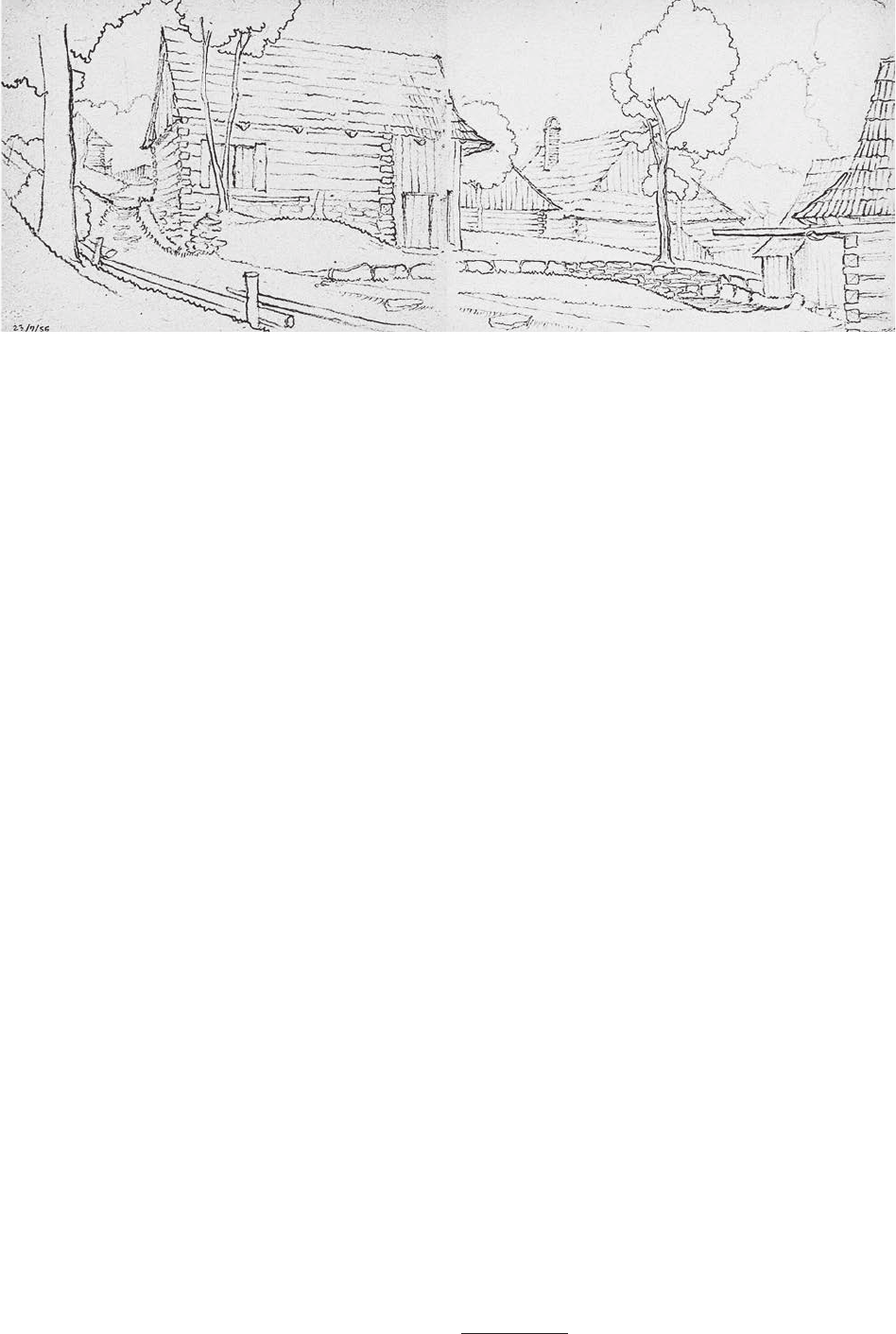
sketchbooks spent the summer of 1956. Thanks to the
plan of the village with marked directions of the drawn
views, it is possible so stand exactly in the same places
and compare ‘yesterday and tomorrow’ of the hamlet. It
also one of the best sketchbooks – the joy of the author
resulting from the discovery of his own style can be seen
in his mastership of the line (Fig. 3).
The places described in the sketchbook, which are
so familiar, appear to be fabulous. Here is the excerpt of
the description from a trip to Zdów (Silesian voivodship,
Zawiercie district), which led along the Biała River bank
in 1959: the road still at the feet of the mountain, one more
brook and then the exit to a small meadow from where you
can see a beautiful view of Kroczyckie Rocks – rst from
among the trees and then from the small meadow. Far-
ther, the Biała River forks near the willows and ows to
Jędruszek mill – a settlement consisting of two houses, the
mill, basement and several barns, which are all situated
near the beech-trees and rocks. From the northern side
– only empty and huge meadows (…) Suddenly, the path
1
All quotations contain the original spelling.
Fig. 3. Oleksowa Rola, view of the hamlet. J. Bogdanowski, 1956
14 Monika Bogdanowska
changes into a sand road along the river and then a thin
forest – to the right, while to the left – a green valley, the
river ows in its full width and the weir towards Piła. The
settlement Piła, which is situated on the island in the fork
of the river Biała, is one of the most unusual places im-
mortalised in the sketchbooks. It only consisted of three
houses and the mill plus several barns and gardens adjoin-
ing to the houses.
Another unusual place was situated in the region of
Mstowa (Silesian voivodship, Częstochowa district). Ja-
nusz Bogdanowski arrived at this place in 1958 during
the journey to the Mstowa cloister. In the nearby, on top
of Kamionka hill surrounded by elds, the author found
a complex of a few dozen barns. The ordinary farm hous-
es, which are presented in the drawing, stand next to each
other along slightly curved streets and form a picturesque
complex which – blended in with the silhouette of the
hill – creates the view complement of the surroundings
with a dominating gure of the cloister and the baroque
cupolas of the church towers. ‘Barns Mountain’ is an
extraordinary landmark in the landscape of Mstowa sur-
roundings.
The acquaintance with devices of the old technol-
ogy presented in the sketchbook is also fascinating. In
the past, those devices determined the economic exist-
ence of the village community and constituted a germ of
the local industry. A lot of such buildings were drawn in
the sketchbook from 1955, for instance, the ones in Jusz-
czyna (suski district) where the following buildings were
situated along the river: a small farm mill, a picturesque
big sawmill, a grinder, a shingle house, a bit bigger mill,
a smokehouse. According to the tradition, the above men-
tioned shingle house was built by a self-taught cartwright
who calculated everything on his own and built it without
any special purpose but he was afraid of making any mis-
take; if he did, people would laugh at him. On the next
pages of the sketchbook we can nd an excellent mill from
Lachowice (suski district). The inventory of this building
is opened by a view of a wooden structure with a huge
roof, and then a mechanism and numerous woodcarving
details were described precisely, for example, the ending
of the our chute in form of a goat head which probably
moved during the work.
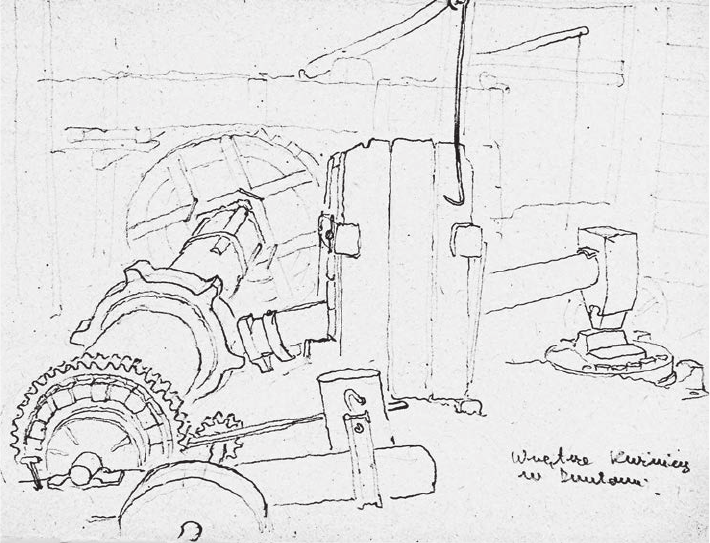
Drutarnia – another village in konecki district (świę-
tokrzyskie voivodship). In the sketchbook from 1956,
we can nd views of the blacksmith’s shop interior
with a precisely drawn mechanism of the forging ham-
mer. This is probably the only existing record of this
‘industrial’ interior appearance: gloomy and blackened
with smoke, which is full of huge items of equipment.
What a noise must have been there when massive tur-
bines started the work of the huge forging hammer
(Fig. 4).
The novel written down next to the drawing present-
ing the interior of Fugiel oil mill in Dąbrowa Szlachecka
(Cracow district) shows how important for the village
residents was building of a new structure of technology:
A special ‘huge oak’ was brought to the building site (eve-
rybody remembers that). This cut oak gave poles to the
piston of the oil mill, which were sunk into the ground
at the same height as they stood out above the ground. It
was a great sensation – all the time the people (especially
children) were coming and staring. (…) Here, the oil was
pressed, often nights and days. People stood in a queue
like at the mill.
The analysis of the sketchbooks is really moving be-
cause the following question inevitably appears: how
many of those places, buildings and equipment survived?
The answer is also shocking and obvious: nearly none of
them did! The hand-made wooden elements of houses
Fig. 4. Drutarnia, interior of the
smithy. J. Bogdanowski, 1956
The drawn landscape – a permanent record of the historic cultural landscape on the impermanent carrier... 15
were most probably burnt just before the move to a new
brick house where new furniture in form of wall units
made of veneered ax board and PVC elements were
waiting for new residents. Huge hinges, door handles,
door locks, which were forged in the local blacksmith’s
shop, were replaced by mass produced trash. Unfortu-
nately, the memory of the people who lived and the sense
of cultural identity disappeared along with the houses and
their equipment.
When we look at the forms of the drawn objects, it be-
comes clear that they were made on the basis of patterns
which were handed down from one generation to another.
Therefore, we can see carpenter’s daps in the donkey’s
back, simplicity and functionality, balanced ornaments
and strong colours, whose prototypes we can already nd
in… the Gothic style.
This also makes us think about the process in which
generations of home craftsmen participated working in
carpenter’s and blacksmith’s shops; about potters, wicker
workers, stove tters, woodcarvers, women embroiderers,
workers of fullers and oil mills.
Thus, within a short period of fty years only, man –
an inventive creator of his own surroundings – became
a passive recipient of the mass production. He does not
need either the knowledge of the place where clay is the
best to make the threshing oor or the knowledge of how
to dry wood to make a robust table. He does not observe
the older carpenter in order to learn how to cut lintels;
he does not learn how to mix lime in order to paint the
house. Our knowledge in the range of creation of our own
place of living is limited to the shop location and a prod-
uct price, which in fact does not differ from the one that
is sold thousands kilometres away from our place and the
boundaries of creativity are determined by the choice of
patterns from colourful magazines. Thus, what kind of
cultural landscape does Poland of modern times create?
Or in a simpler way: what cultural landscape do we cre-
ate? What does this creation say about us and our attitude
to the surrounding world? Because: Observing the way in
which we transform our natural environment, it is easy to
conclude that we use our senses in completely different
ways [15].
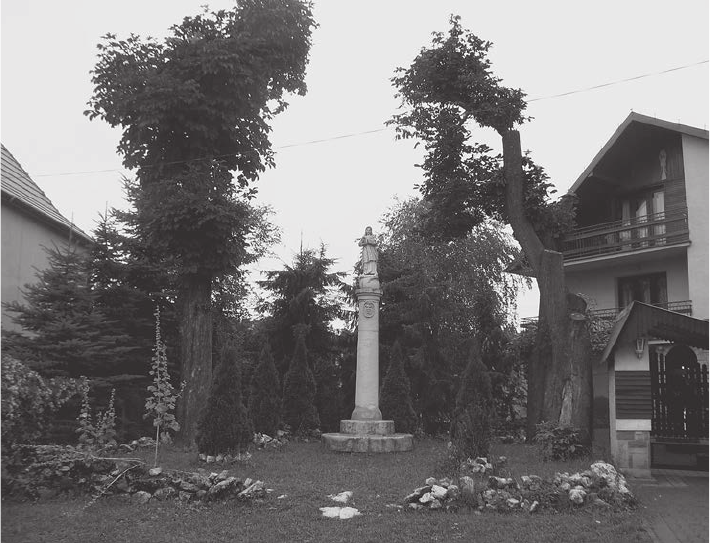
Nowadays, there are no longer cottages in Kryspinów,
however, the chapels survived. Perhaps, nobody remem-
bers the story about the hill where there is an old recon-
structed chapel decorated with colourful reproductions in
plastic frames. Today, Kryspinów represents the so called
unidentied area [4], suburbs of the city in which repre-
sentative detached houses and catalogue houses are built.
A present, the gure on the column, which took care of
peace of the dead people during the period of plague, con-
stitutes the artefact of the gardens adjoining to the houses
(Fig. 5).
The example of Oleksowa Rola perfectly illustrates
the changes of the Polish village. Wooden cottages dis-
appeared gradually and were replaced by brick houses
which were built at the same locations. Instead of trees
which give the shade and shelter for birds, instead of gar-
dens full of owers, these new houses are surrounded by
smoothly mowed lawns decorated with sad conifers. Nev-
ertheless, the residents remember the village from the past
very well and they recognise the interiors of their houses
even with the equipment, which were preserved in the
drawings. They look at them with some kind of nostalgia
and seem to miss something which determined the iden-
tity of this small hamlet: they miss a small mill behind the
creek, a wicker hedge, a wooden stool or an old apple tree
in the garden.
The everyday life of the Polish village disappeared –
the repository of the national identity which was created
Fig. 5. Kryspinów, column with
the gure of Our Lady on the
former choleric cemetery.
Photo by M. Bogdanowska, 2010

16 Monika Bogdanowska
through centuries and considered to be the essence of our
culture by many people. The objects stored in the museum
storerooms lost their context and in this way their reliabil-
ity. Hundreds of mills were replaced by concrete berths of
regulated rivers and the useless devices of the old technol-
ogy fell into ruin.
The drawings and descriptions contained in the sketch-
books take us for short but sensually intensive walks to
the old Polish landscape which is not only seen but takes
us to the so called sound landscape [17]; apart from eye
impressions, every walk delivers other additional sensual
stimuli: we can feel the temperature, smells and we can
hear sounds [1].
This wandering in hot summer becomes unusually fa-
miliar; hiking along the road shaded with the mountain
massif and accompanied by the brook humming and the
warmth of sand, a cool breath of the wind from green
meadows and a distant noise of the river. And what about
Mstowa barns? There must have been great commotion
during the harvest time when hayracks and running peo-
ple appeared on the maidan. Their calls and laughter must
have been heard far away along with ringing of the bells
coming from the cloister direction.
Fifty years ago man recognized his own place on earth
not only due to landscapes but also due to sounds and
smells. It had to be different from other places because it
was shaped individually and the basis of its shape was the
original landscape and things offered by nature: a river
giving a drive to the water-wheel, the rise with farmlands
and natural resources of the forest. Today, the landscape
values undergo gradual unication and sensor experi-
ences become simplied in the world dominated by the
highway hum, the smell of fumes and ‘twittering’ of cell
phones. It is obvious that cultural globalization caused
the change of man-creator into man-recipient also called
a consumer. Potentially, each of us has become a precious
market target for the ‘tourist product’ – the name used for
the landscape in some programs [16]. The landscape val-
ue becomes the trade value and the reason for its existence
becomes dangerously dependent on economy. But when
we browse through the sketchbooks, we can see that new
fashionable denitions, for example 4H, are not in fact so
contemporary at all
2
. Fifty years ago, it was quite obvi-
ous that a cottage in the landscape was not only the car-
penter’s structure but people’s will to settle in a specic
place as well as the record of somebody’s life, thinking
and practised values.
This is another proof of the fact that the author of
sketchbooks created things which are ahead of his time. In
the 1960s a chimneyless hut was nothing else but a sym-
bol of Polish backwardness, brick bastions built by occu-
pants – a symbol of the decline of Polish statehood, while
the defence against demolition of them in order to obtain
bricks for the reconstruction the capital city – simply an
attack on the Polish raison d’état. Fifty years ago, almost
nobody sentimentalised about old objects, products of
folk craftsmanship or devices of country technology. On
the contrary – all this was just the echo of the times about
which the supporters of modernity would like to forget
once and forever.
These are only some of the considerations which ap-
pear while reviewing sketches drawn many years ago. The
sketches were created out of pure love, passion of cogni-
tion and recording. And what is really interesting: here,
not only sketches on yellowed pages but also their author
became the element of the Polish cultural landscape his-
tory in some strange process. The landscape of the past,
but recorded – perhaps on the poor carrier, however, still
vital.
2
The essence of the countryside tourism is based on 4H rule: habi-
tat, heritage, history and handcraft. J. Środulska-Wielgus, Z. Błachut,
K. Wielgus, Eksploracja przestrzeni historycznej Gorców dla potrzeb
turystyki kulturowej, [in:] Polskie krajobrazy dawne i współczesne,
Prace Komisji Krajobrazu Kulturowego, No. 12, Komisja Krajobrazu
Kulturowego PTG, Sosnowiec 2009, p. 243.
References
[1] Bernat S., Krajobraz dźwiękowy doliny Bugu, Annales Universitatis
Mariae Curie-Skłodowska, T. LIV, 15 Sectio B, Lublin 1999,
pp. 297–309.
[2] Bogdanowska M., Szkicowniki Janusza Bogdanowskiego, „Aura”,
2007, No. 10, p. 13.
[3] Bogdanowska M., Kryspinów, sierpień 1955, „Aura” 2007, No. 10,
pp. 14–15.
[4] Bogdanowska M., Juszczyn, lipiec 1956, „Aura” 2007, No. 11,
pp. 32–33.
[5] Bogdanowska M., Szkicownik XVI Pomorze Zachodnie, wrzesień
1956, „Aura”, 2007, No. 12, pp. 22–23.
[6] Bogdanowska M., Miasteczka polskie w latach 50. XX wieku, „Aura”,
2008 No. 1, pp. 22–24.
[7] Bogdanowska M., Urządzenia dawnej techniki – młyny, tartaki,
olejarnie, „Aura”, 2008, No. 2, pp. 26–29.
[8] Bogdanowska M., Szkicowniki: IX 1955, XVI 1958, II 1959 Świat
utracony, „Aura”, 2008, No. 3, pp. 20–23.
[9] Bogdanowska M., Parki i ogrody, „Aura”, 2008, No. 4, pp. 29–32.
[10] Bogdanowska M., Militaria, „Aura”, 2008, No. 5, pp. 24–27.
[11] Bogdanowska M., Rysunek, „Aura” 2008, No. 6, pp. 26–29.
[12] Bogdanowski J., Malowane chałupy w architekturze krajobrazu
podkrakowskich wsi. Ich formy i postępujący zanik, [in:] Teka
Komisji Urbanistyki i Architektury, T. IV, PAN, Kraków 1970,
pp. 103–115.
[13] Gonda-Soroczyńska E., Czy to jeszcze wieś?, [in:] Polskie krajobrazy
dawne i współczesne, Prace Komisji Krajobrazu Kulturowego,
No. 12, Komisja Krajobrazu Kulturowego PTG, Sosnowiec 2009,
pp. 178–190.
[14] Góra Zborów i okolice, Czylok A., Ślusarczyk M., Tyc A., Waga J.M.
(eds.), Towarzystwo Miłośników Ziemi Zawierciańskiej, Wydział
Nauk o Ziemi Uniwersytetu Śląskiego, Zawiercie 2008.
[15] Hall, E.T., Ukryty wymiar, Warszawskie Wydawnictwo Literackie
MUZA SA, Warszawa 2003, p. 11.
[16] Latocha A., Zmiany krajobrazu wiejskiego w Sudetach w okresie
powojennym, [in:] Polskie krajobrazy dawne i współczesne, Prace
Komisji Krajobrazu Kulturowego, No. 12, Komisja Krajobrazu
Kulturowego PTG, Sosnowiec 2009, pp. 130–139.
[17] Schafer R.M., The New Soundscape, Toronto 1969.
[18] Środulska-Wielgus J., Błachut Z., Wielgus K., Eksploracja
przestrzeni historycznej Gorców dla potrzeb turystyki kulturowej,
[in:] Polskie krajobrazy dawne i współczesne, Prace Komisji Kra-
jobrazu Kulturowego, No. 12, Komisja Krajobrazu Kulturowego
PTG, Sosnowiec 2009, pp. 233–247.
The drawn landscape – a permanent record of the historic cultural landscape on the impermanent carrier... 17
Kultura z architekturą bodaj najpełniej łączą się w krajobrazie kultu-
rowym, który to stanowi widoczną emanację życia społeczeństwa, jego
przekonań, sposobu funkcjonowania i wyznawanych wartości. Stąd też
jego granice zaczynają się tam, gdzie następuje przekształcanie krajobrazu
naturalnego, a kończą się na drobnostkach, takich jak formy małej archi-
tektury, detali, czy elementy domowego wyposażenia. Gdy zmienia się
styl życia społeczeństwa zmienia się i wygląd krajobrazu kulturowego.
Tworzone przez ponad pięćdziesiąt lat szkicowniki architekta – Janusza
Bogdanowskiego są znakomitym źródłem danych na temat tych przemian.
Dzięki szczegółowym opisom, przekraczającym granice suchej inwen-
taryzacji, pozwalają odtworzyć nieodwracalnie utracone dziedzictwo
polskiego krajobrazu kulturowego, więcej, pozwalają na porównywanie
przemian, jakim był on poddawany. Świetny warsztat rysunkowy i wiedza
autora, które pozwoliły na stworzenie tak wyjątkowego rejestru, sprawiły,
że i same szkicowniki stały się już dobrem kulturowym.
Krajobraz narysowany czyli trwały zapis historycznego krajobrazu kulturowego
na nietrwałym nośniku – szkicowniki Janusza Bogdanowskiego
Key words: historic landscape, sketchbook Słowa kluczowe: krajobraz historyczny, szkicownik