The conservators of artworks who studied their profes-
sion half a century ago did not find it difficult to define
authenticity. Neither did their masters, I think. Authentic
paintings or sculptures were simply made by specific
ar tists, at specific times, from then available materials and
with the use of known techniques and technologies [1,
p. 32]. This is why the relevant claim that authenticity is
unclear makes a conservator, who knows very well what
is authentic what is not, first smile and then become inter-
ested. I hope, as you read, the smiling will eventually
disappear and the interest will grow.
At the beginning of the last century, art historians were
fooled by van Meegeren’s forgeries and some other less
famous painting forgers, although they already had reli-
able testing tools, including chemical and physical tests.
The formal analyses developed at the end of the 19
th
cen-
tury were still greatly valued. In time, more and more
critical studies by scholars of old treaties written by paint-
ers themselves emerged. The publications specifying the
dates when new, synthetic pigments and materials were
first produced were also popular, which resulted in almost
automatic provision of expert opinions of all antiques.
Knowing exactly when the chemical inventions were
applied finally resulted in precise dating the moment of
origin of paintings and polychrome sculptures. Famous
museums with their own laboratories took pride in study-
ing artworks and confirming their authenticity. Because
some expert opinions were more credible than others it
was also possible to manipulate the market of antiques.
The improvement of testing techniques and the develop-
ment of more and more precise analytical methods
seemed to have no limits and the answers to the questions
asked by art historians and conservators were longer and
2014
1(37)
DOI: 10.5277/arc140105
Ewa Święcka*
Pojęcie autentyzmu i malarstwo ścienne
The notion of authenticity and wall painting
Konserwatorzy dzieł sztuki, którzy rozpoczynali stu-
dia przed pół wiekiem, nie mieli problemów z defi nicją
autentyzmu. Myślę, że ich mistrzowie także. Autentyczny
obraz czy rzeźba były po prostu wykonane przez okreś-
lonego artystę, w danej epoce, z dostępnych wtedy ma-
teriałów i przy użyciu znanych wówczas technik i tech-
nologii [1, s. 32]. Dlatego celne stwierdzenie, że pojęcie
autentyzmu jest nieostre, budzi u konserwatora – który
przecież dobrze wie, co jest autentyczne, a co nie – naj-
pierw uśmiech, a potem zaciekawienie. Mam nadzieję, że
w miarę lektury ten uśmiech będzie zanikał, a zaciekawie-
nie wzroś nie.
Historycy sztuki w początkach ubiegłego wieku dali
się zwieść oszustwom van Meegerena i paru mniej sław-
nych fałszerzy malarstwa, chociaż mieli już wówczas nie-
zawodną broń w postaci badań chemicznych i fi zycznych.
Nadal przykładano też ogromną wagę do analiz formal-
nych, wypracowanych w końcu XIX w. Z czasem poja-
wiały się coraz liczniejsze opracowania krytyczne bada-
czy dawnych traktatów pisanych przez samych malarzy.
Rozpowszechniano też publikacje podające lata otrzyma-
nia po raz pierwszy nowych, syntetycznych pigmentów
i materiałów, co nieomal zautomatyzowało eks perty zy
wszelkich antyków. Dokładnie znane momenty zastoso-
wania chemicznych wynalazków pozwalały wreszcie na
precyzyjne datowanie czasu powstania obrazów i poli-
chromowanych rzeźb. Przebadanie dzieł i potwier dzenie
ich autentyzmu stało się dumą wielkich muzeów, które
tworzyły własne laboratoria. Mniej i bardziej wiarygodne
* Konserwator dzieł sztuki, Warszawa/Restorer of works of art, Warsaw.

42 Ewa Święcka
longer and more and more exhaustive. The market of
forgers, however, grew equally fast along with scholarly
expertise. The modern research tools can as well be used
to make forgeries. Special machines can provide a spe-
cific climate to speed up aging processes of the materials
used nowadays to produce changes in new paintings
which in natural conditions emerge over centuries. At pre-
sent traditional painting materials can be made at home
from simple ingredients – just like old masters used to do.
This is why at present you can still come across forgeries
in art trading.
It seems that the situation of wall painting is rather not
that bad when compared with movable artworks. There
are no forged wall paintings on the market of antiques as
they are inextricably connected with architecture and they
usually remain in their original place. It is different with
movable artworks – as long as paintings were not taken
down from the walls and transferred – their place of ori-
gin is always known. A lot more information about their
authors have survived along with the memory of the his-
tory of the buildings whose walls they decorate. It is
rather difficult to separate them from the walls or ceilings
and steal, and it is even more difficult to carry them away,
so they can’t be swapped, which has happened in the case
of easel paintings. It is true, however, that being used
simply as decorations, wall paintings were often repaint-
ed. But even if we finally manage to get to the oldest paint
layer, can we automatically call it authentic? This is after
all what we usually call a painting decoration which was
made at the same time as the piece of architecture which
it decorates. A Romanesque church with Romanesque
polychrome, a Baroque church with Baroque polychrome.
However, are those the only cases when it is possible to
claim that the authenticity of the paintings is obvious?
What about Baroque polychrome in a Gothic church? Not
to mention added layers of decorations. The oldest paint-
ings discovered from underneath later repaintings aren’t
necessarily the most valuable or artistically the best. And
how should we address their authenticity? Is it possible to
precisely define it in the context of authenticity of the
whole building? These are not rhetorical questions
because the answer to them determines both the program
of conservation works conducted on wall paintings and it
affects the way its exhibition is arranged. Can then the
notion of authenticity regard only more movable artworks
which are displayed in galleries, museums, and auction
houses?
Anyway, does the issue of authenticity regard exclu-
sively the consistent use of materials and establishing the
authorship? Probably not. The same as it happens in ana-
lytical processes which more and more accurately specify
the chemical composition of a work of art, new nuances
of its philosophical aspect and social perception are dis-
covered all the time too. Authenticity [2, pp. 27–32], [3,
pp. 40–46], [4, p. 88] of a wall painting is a much more
com plex notion than it seems to be for researchers of
tech nologies. The following elements testify to the au -
thenticity of this kind of artwork:
– authenticity of matter,
– authenticity of idea,
ekspertyzy pozwoliły też na manipulowanie rynkiem anty-
kwarycznym. Doskonalenie warsztatu badawczego i wy-
najdowanie coraz dokładniejszych metod analitycznych
wydawało się nie mieć końca, a odpowiedzi na pytania
zadawane przez historyków sztuki i konserwatorów były
coraz dłuższe i bardziej wyczerpujące. Ale rynek fałsze-
rzy rozwijał się równie sprawnie, jak rosła bieg łość uczo-
nych. Nowoczesne narzędzia badawcze można przecież
wykorzystywać także do tworzenia falsyfi katów. Specja-
listyczne szafy klimatyczne przyspieszające procesy sta-
rzenia współcześnie stosowanych materiałów mogą być
z powodzeniem używane do prowoko wania w nowych
obrazach zmian, które w warunkach natu ralnych powsta-
ją z upływem wieków. A tradycyjne materiały malarskie
można i dziś uzyskać w domowych warunkach z pros tych
składników – podobnie przecież czynili to dawni mistrzo-
wie. Dlatego też w handlu sztuką stale pojawiają się nowe
fałszerstwa.
Wydaje się, że w porównaniu z ruchomymi dziełami
sztuki malarstwo na murach jest w szczególnie dob rym
położeniu. Nie ma na rynku antykwarycznym fałszy -
wych malowideł ściennych. Jako integralnie związa -
ne z architekturą pozostają zazwyczaj do końca swo-
ich dni w miejs cu, w którym je stworzono. Inaczej niż
w przypad ku rucho mych dzieł sztuki – o ile malowideł
nie zdjęto up rzednio ze ścian w postaci transferów – za-
wsze wiadomo, skąd pochodzą. Razem z pamięcią o his -
torii budowli, których ściany zdobią, zachowało się też
znacznie więcej informacji o ich autorach. Dość trud-
no je oddzielić od podłoża i ukraść, jeszcze trudniej wy-
nieść, nie istnieje więc też zagrożenie „podmienienia”,
co zdarzało się przypadku obrazów sztalugowych. Praw-
da, że jako dekoracje użytkowe były wielokrotnie prze-
malowywane. Ale czy warstwę najstarszą
– o ile do niej
dotrzemy – możemy machinalnie nazwać autentyczną?
Tak zaz wyczaj mówi się o dekoracji malarskiej, która po-
wstała w tej samej epoce, co ozdobiony nią zabytek ar-
chitektury. Romański kościół z romańską polichromią,
barokowy – z ba rokową. Czy jednak tylko wtedy moż-
na stwierdzić, że autentyzm malowideł jest sprawą oczy-
wistą? A barokowa poli
chromia w gotyckim kościele?
Nie mówiąc już o dekora cjach nawarstwionych. Malowi-
dła najstarsze wydobyte spod późniejszych przemalowań
wcale nie muszą być automatycznie najcenniejsze ani też
najlepsze artystycznie. I w jaki sposób należy odnieść się
do ich autentyzmu? Czy możliwa jest jego precyzyjna de-
fi nicja w kontekście autentyczności całej budowli? Nie
są to pytania retoryczne, bo odpo wiedź na nie warunku-
je zarówno programy prac konser watorskich prowadzo-
nych przy malarstwie ściennym, jak też wpływa na spo-
sób aranżowania jego ekspozycji. Czyżby więc pojęcie
autentyzmu odnieść można było jedynie do bardziej ru-
chomych dzieł, które znajdują się w galeriach, muzeach
i domach aukcyjnych?
Ale czy problem autentyzmu polega wyłącznie na
zgodności materiałów i ustaleniu ręki mistrza? Chyba
nie. Podobnie jak to się dzieje w procesach analitycznych,
coraz dokładniej precyzujących skład chemiczny dzie-
ła sztuki, także w jego warstwie fi lozofi cznej i odbiorze
społecznym odkrywane są stale nowe niuanse. Autentyzm

Pojęcie autentyzmu i malarstwo ścienne /The notion of authenticity and wall painting 43
– authenticity of context,
– authenticity of emotion.
The authenticity of matter is the mentioned earlier –
characteristic of the time and place – features of technol-
ogy in which it was made. This quality is diminished by
the materials added later, that is repaintings or even con-
servation works as well as changes in architecture itself:
secondary divisions of rooms, remodeling of walls and
vaults. The highest quality will be demonstrated by
specimens which have survived in their ideal condition,
untouched by any later intervention, and even original
remains which no longer demonstrate artistic value, those
which have survived only partially whose authenticity
can be compared to that of relics. There are fewer and
fewer of such specimens. Usually they have survived
under several layers of plaster – their original surface is,
however, changed. Archeologists sometimes come across
those really original ones, for instance paintings hidden
behind built-in furniture, such as church stalls, organs or
old decorations forgotten in the attics when the ceilings
and vaults were remodeled.
The authenticity of idea, that is the maintenance of
the original architectural design assumptions as well as
the objective of the decorations. These conditions shall be
maintained if the interiors continue to serve their original
function. This kind of buildings include temples: church-
es, monasteries, synagogues, mosques as well as decora-
tions in active town halls and even interiors of residential
buildings, such as castles and palaces which have had
private owners for centuries, which is, however, rare in
our region.
The authenticity of context is about paintings which
are on the walls inside or outside of the buildings where
they were painted and where the local conditions were not
changed that is the natural light was not changed (location
of windows remained original), they have proper perspec-
tive, layout of the rooms and passages remained original,
unchanged ceilings or vaults, floor level remained origi-
nal. Such an ideal situation is rare nowadays in the build-
ings which have been used for centuries. More often
original specimens have been preserved in abandoned
buildings or in archeological finds. Changes in the con-
text can be caused by the transformations in the nearest
surroundings, including aggressive development or ex -
pansive green areas. The absolute opposite of authenticity
of context includes paintings transferred to substitute
substrates, that is transfers of painting decorations which
are used as movable objects, exhibited like paintings – in
galleries. They do not render the scale, tectonics, and
perspective of architecture in which they were created,
and most often they also contradict it when for instance
a painting, after being moved from a vault to canvas, is
exhibited on a flat wall. Then the foreshortenings deliber-
ately applied by the master, such as crooked columns,
awkward gestures or deformed faces, are usually inter-
preted by the viewers as the painter’s ineptitude.
(Everybody has seen some of those in galleries ).
The best example of authenticity of emotion is the
often referred to far-eastern tradition where a temple
which is systematically rebuilt – as a result of tradition or
[2, s. 27–32], [3, s. 40–46], [4, s. 88] malowidła ścienne-
go jest pojęciem o wiele bardziej złożonym, niż to się wy-
daje badaczom technologii. O prawdziwości tego rodzaju
dzieła świadczą następujące elementy:
– autentyzm materii,
– autentyzm idei,
– autentyzm kontekstu,
– autentyzm emocji.
Autentyzm materii to wspomniane wcześniej – cha-
rakterystyczne dla epoki i miejsca – cechy technologii
wykonania. Wartość tę pomniejszają materiały doda-
ne w póź niejszym czasie, a więc przemalowania, a na-
wet konserwacje malowideł, ale też zmiany w samej ar-
chitekturze: wtórne podziały pomieszczeń, przebudowa
ścian i sklepień. Najwyższy walor będą miały świadec-
twa ideal nie zachowane, nietknięte żadną późniejszą in-
gerencją, a nawet pozbawione już walorów artystycznych
pierwotne relikty, zachowane szczątkowo, których auten-
tyzm porównywalny jest z autentyzmem relikwii. Przy-
kładów takich jest coraz mniej. Zwykle przetrwały pod
warstwami wtórnych tynków – ich oryginalna powierzch-
nia jest już jednak naruszona. Na te naprawdę oryginal-
ne trafi ają czasami archeolodzy, zdarzają się malowidła
przechowane za wbudowanymi we wnętrzu meblami, jak
na przykład koś cielne stalle czy organy albo dawne de-
koracje zapomniane na strychach przy przebudowie stro-
pów i sklepień.
Autentyzm idei, czyli trwanie programowych zało-
żeń architektonicznego obiektu, a także kontynuacja ce-
lów, którym dekoracje te miały służyć. Warunki te zostaną
zachowane, jeśli wnętrza nadal pełnią pierwotne funkcje.
Do tego rodzaju budowli zaliczyć można obiekty kultu:
kościoły, klasztory, synagogi, meczety, jak również de-
koracje w czynnych ratuszach, a nawet – bardzo rzadko
w naszym obszarze – we wnętrzach mieszkalnych, czyli
zamkach i pałacach należących przez wieki do prywat-
nych właścicieli.
Z autentyzmem kontekstu mamy do czynienia, gdy
malowidła znajduj
ą się na wewnętrznej lub zewnętrz nej
ścianie budynku, gdzie je namalowano z uwzględnie-
niem lokalnych warunków, a więc: nie zmieniono natu ral-
nego oświetlenia (rozmieszczenie okien), mają odpo wied -
nią perspektywę, zachowany został układ pomiesz czeń
i przejść, przetrwały oryginalne stropy czy skle pienia,
utrzymano pierwotny poziom posadzki. Taką idealną sy-
tuację rzadko można zastać w obiektach stale użytko-
wanych przez wieki. Częściej stan pierwotny przetrwał
w budowlach opuszczonych albo w znaleziskach archeo-
logicznych. O zmianach kontekstu decydować mogą też
przekształcenia najbliższego otoczenia, w tym agresyw-
na zabudowa czy ekspansywna zieleń. Absolutnym za-
przeczeniem autentyczności kontekstu są malowidła prze-
niesione na podłoża zastępcze, czyli transfery dekoracji
malars kich, które funkcjonują jako obiekty ruchome, eks-
ponowane podobnie jak obrazy – w galeriach. Nie tylko
nie oddają one skali, tektoniki i perspektywy architektury,
w której je stworzono, ale też najczęściej jej zaprzeczają,
gdy na przykład malowidło po przeniesieniu ze skle pienia
na płótno eksponowane jest na płaskiej ścianie. Wówczas
zastosowane przez mistrza celowe skróty perspektywicz-
44 Ewa Święcka
some natural disaster – still remains a thousand-year-old
temple. (Obviously this does not satisfy our fundamental
Western dogma of authenticity of material). Today this is
a well-known mechanism. We do not need to look far. The
Old Town in Warsaw with its churches or the rebuilt
Royal Castle (together with the reconstructed paintings of
rather uneven artistic value) is emotionally genuine in
spite of a “gap in its life”. The inscription of the Old Town
in Warsaw on the World Heritage List doctrinally resolved
the reservations of the Venice document for the benefit of
Poles tragically afflicted with war losses who suffered
injustice and spontaneously rebuilt destroyed historical
monuments. Today there are more and more advocates of
monumental reconstructions all over Europe. Churches
which were destroyed in the aftermath of Second World
War re-emerge from oblivion which lasted fifty years, or
even whole districts of medieval houses and nobody cares
about the fact that two generations of city dwellers disap-
peared from the life of the historical buildings.
Let us try to track the authenticity of wall paintings on
the basis of two examples. They both come from Africa,
from places geographically located not so far from each
other, considering the size of that continent – about 800
kilometers. However, the dates of their origin are much
further apart – more than a thousand years. Their story,
character, and function are totally different. Let us try to
compare the degree of their authenticity.
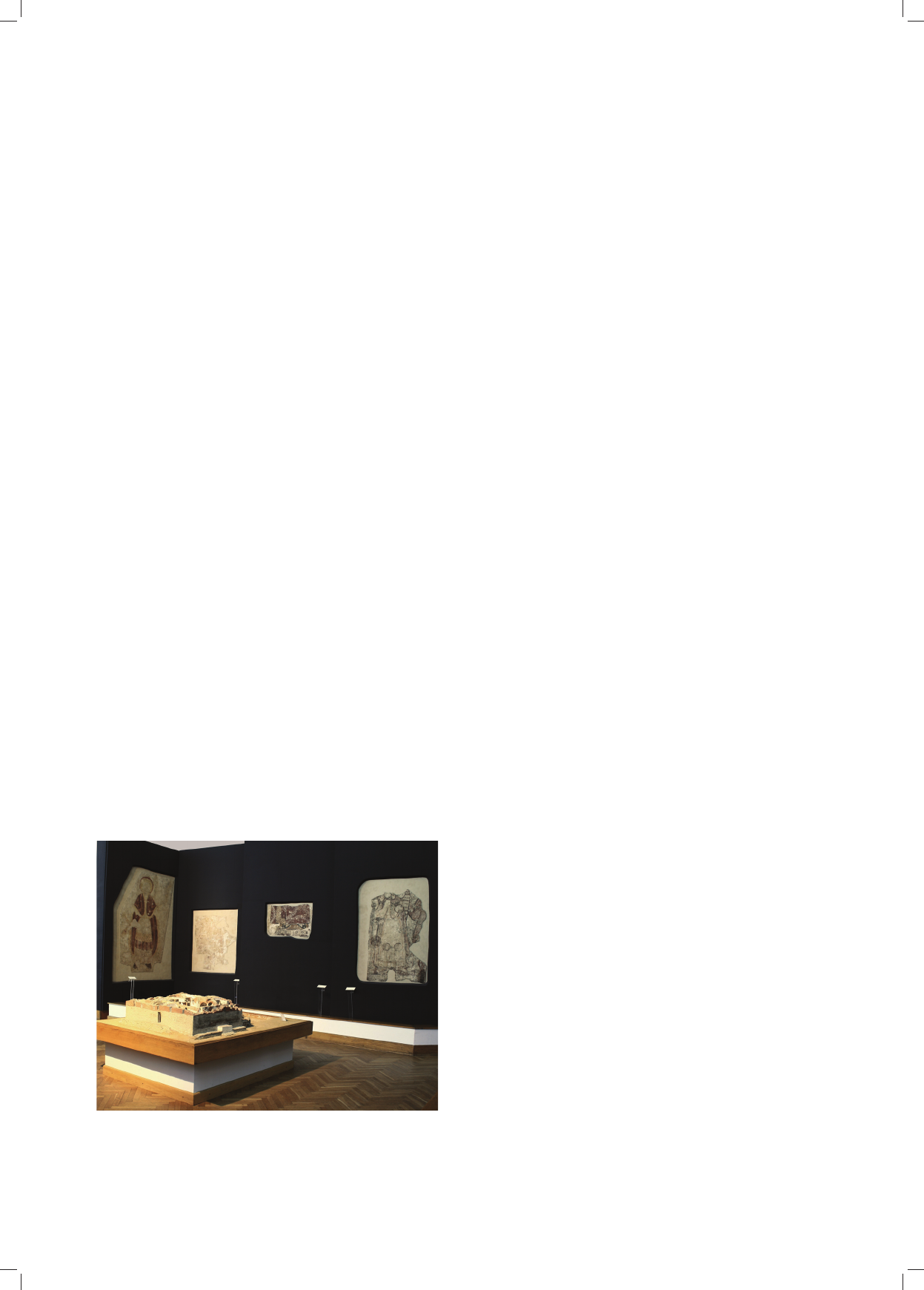
First example (Fig. 1) is the unique collection of early
Christian frescoes from the temple of Nubia in Faras
exhibited at the National Museum in Warsaw. What
should be noticed right at the beginning is the difference
in the distance between the location of the exhibition and
the place of its origin: the paintings left Africa with the
Polish archeological mission in the 1960
s
and they ended
up in Europe.
Authenticity of matter – as regards the presentation
aspect, that is the layer of paint itself and thin remains of
the original substrate, we can see the fully preserved
original substance. What lies deeper, however, is not yel-
lowish rocks, not architecture, but artificially developed
construction which has nothing to do with a stone wall of
the church – what is more, it has nothing to do with the
landscape.
Authenticity of idea? The decorations were designed
for the interior of a sacred place; they were supposed to
provide a setting for religious ceremonies over centuries.
Neither the present interiors nor the way in which they are
used have anything to do with church.
Authenticity of context? This is even worse. The paint-
ings are exhibited thousands of kilometers away from the
place of their origin. They are displayed in spacious gal-
leries, placed in artificial frames whose sizes are deter-
mined by the size of the cut-out fragments in compliance
with the exhibition aesthetics from around half a century
ago. Being displayed in front of the walls or in the middle
of large rooms, they do not resemble tight interiors of the
temple where they come from. What they lack is the scale
of an authentic building and the natural light [5, pp. 120–
122]. The color of their frames and backgrounds is
a source of even more reservations. The color of some
ne: krzywe kolumny, pokraczne gesty, zdeformowane
twarze, zazwyczaj wywołują u odbiorcy wrażenie nie-
udolności malarza. (Każdy widział kiedyś takie żałosne
szmatki w galeriach).
Najlepszy przykład autentyzmu emocji stanowi częs-
to przywoływana tradycja dalekowschodnia, gdzie świą-
tynia odbudowywana systematycznie – w wyniku tradycji
czy po zniszczeniu wskutek kataklizmu – nadal pozosta-
je świątynią tysiącletnią. (Oczywiście nie mamy tu speł -
nienia naszego fundamentalnego zachodniego dogma-
tu auten tyzmu materiału). Jest to już dziś dobrze znany
mecha nizm. Ale nie musimy sięgać tak daleko. Stare Mias-
to w Warszawie z jego kościołami, a nawet odbudowany
Zamek Królewski (razem ze zrekonstruowany mi malowi-
dłami o dość nierównym poziomie artys tycz nym) są emo-
cjonalnie prawdziwe, pomimo „przerwy w ży ciorysie”.
Wpisując warszawską Starówkę na Lis tę Świa towego
Dziedzictwa, rozstrzygnięto doktrynalne zastrzeż
enia we-
neckiego dokumentu na rzecz tragicznie doświad czonych
stratami wojennymi Polaków, którzy w po czu ciu krzyw-
dy spontanicznie odbudowali utracone zabyt ki. Dziś mo-
numentalne rekonstrukcje znajdują coraz liczniejszych
naśladowców w całej Europie. Powstają z półwieczne-
go niebytu kościoły zburzone w wyniku działań II wojny
światowej, ba, całe dzielnice średniowiecznych domków
i nikomu nie przeszkadza, że z życiorysu zabytku wyle-
ciały dwa pokolenia mieszkańców miasta.
Spróbujmy zatem prześledzić autentyzm malowideł
ścien nych na dwóch przykładach. Pochodzą z Afryki,
z miejsc geografi cznie nieodległych w skali tego konty-
nentu – dzieli je jakieś 800 kilometrów. Bardziej odległe
są daty ich powstania – to dystans ponadtysiącletni. Zu-
pełnie inne są ich losy, charakter, funkcja. Postarajmy się
porównać stopień ich autentyzmu.
Pierwszy przykład (il. 1) to unikatowa kolekcja
wczes nochrześcijańskich nubijskich fresków ze świątyni
w Faras, eksponowana w Muzeum Narodowym w War-
szawie. Już na począ
tku należy zwrócić uwagę na różni-
Il. 1. Galeria Faras, Muzeum Narodowe w Warszawie
(fot. A. Lewandowska, 2007)
Fig. 1. Faras Gallery, the National Museum in Warsaw
(photo by A. Lewandowska, 2007)
Pojęcie autentyzmu i malarstwo ścienne /The notion of authenticity and wall painting 45
monumental frames resembles sandstone, whereas others
are painted black; they look like huge Dutch paintings in
huge black frames. The paintings seem to be stuck to the
piano lid and they have nothing to do with a house of
prayer built in the middle of a hot desert. (This exhibition
layout will be soon changed).
The authenticity of emotion has been lost forever. No
matter how genuinely excited the “cultured viewers”
would be with the old frescoes, admiring those paintings
in a museum gallery, their feelings will have nothing to do
with the emotions of Christians for whom they were
originally painted.
However, in spite of so many reservations, could any-
one accept the opinion that the frescoes from Faras are not
authentic?
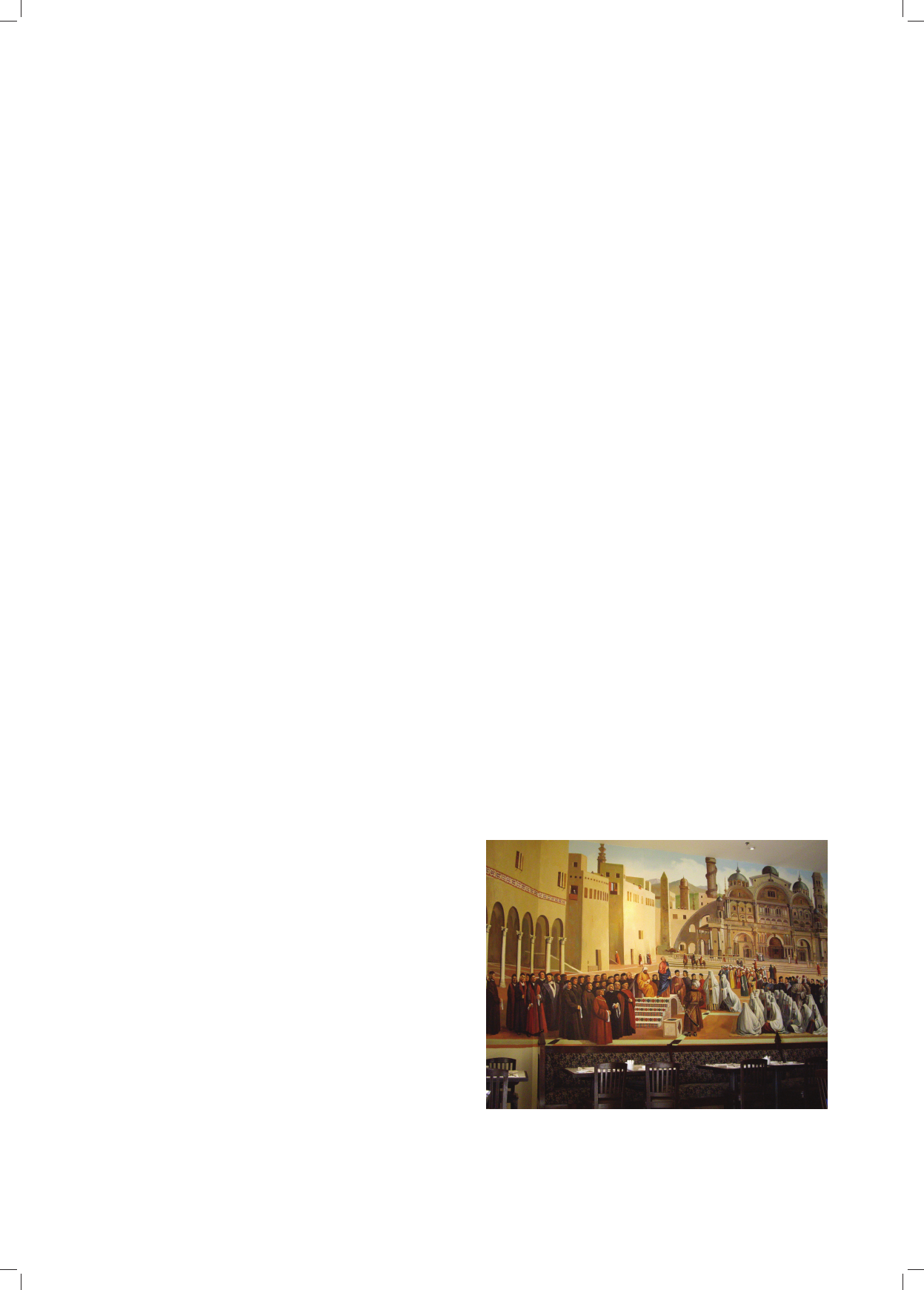
Second example (Fig. 2) – the paintings in an Egyptian
hotel near Hurghada which were made only a few years ago.
They are painted exclusively with the use of modern
materials, that is technique and technology in which they
are made is fully consistent with the present knowledge,
so it is authentic.
As regards the idea – the decorative art, the presenta-
tions formally and in respect of their meaning fit the hotel
rooms, its reception, and the restaurant; they glorify the
historical heritage of the country chosen by tourists for
their vacation. So we are dealing here with a complete
compliance with the origin of the idea.
Authenticity of context – in the sense of decorative
painting it does not cause any doubts. Some elements can
be considered to be a clear allusion to the frescoes of
Florentine Renaissance, others render the landscape typi-
cal of that geographic region and culture.
Emotionally – they bring some life to the monotonous
views of the desert around the hotel. They are admired
and recognized, and at the same time they confirm the
conviction of the hotel guests that in spite of being far
away from the original pyramids they are in the country
where they used to be built centuries ago.
cę odległości miejsca ekspozycji od miejsca powstania:
malowidła opuściły Afrykę z polską misją archeologiczną
w latach 60. XX w. Znalazły się w Europie.
Autentyzm materii – w warstwie przedstawieniowej,
a więc w samej powłoce malarskiej i cieniutkich reszt-
kach zachowanego podłoża mamy w pełni zachowaną
substancję oryginalną. Ale głębiej to już nie żółtawe gła-
zy, nie architektura, lecz sztucznie stworzona konstrukcja,
niemająca z kamiennym murem kościoła – więcej: z bry-
łą w krajobrazie – nic wspólnego.
Autentyzm idei? Dekoracje przeznaczone były do wnę-
trza sakralnego, stanowiły przez wieki oprawę ceremonii
religijnych. Ani obecne wnętrza, ani charakter ich użyt-
kowania nie mają z kościołem żadnych cech zbie
żnych.
Autentyzm kontekstu? Tu jest jeszcze gorzej. Malowi-
dła eksponowane są tysiące kilometrów od miejsca po-
wstania. Zostały ustawione w przestronnych galeriach,
umieszczone w sztucznych oprawach, których forma-
ty uwarunkowane są wielkością powycinanych fragmen-
tów, zgodnie z wystawienniczą estetyką sprzed przeszło
pół wieku. Stojąc pod ścianami lub pośrodku obszernych
sal, nie przypominają ciasnych wnętrz świątyni, z której
pochodzą. Brak im skali autentycznego obiektu i natural-
nego oświetlenia [5, s. 120–122]. Jeszcze więcej wątpli-
wości budzi kolorystyka opraw i teł. Niektóre monumen-
talne obramienia przypominają kolorem piaskowiec, inne
pomalowane są na czarno; wyglądają jak monstrualne ho-
lenderskie obrazy oprawione w szerokie, czarne ramy.
Malowidła sprawiają wrażenie, jakby były nalepione na
klapę fortepianu, nie mają nic z klimatu domu modlitwy
stojącego pośród gorących piasków pustyni. (Ekspozycja
ta będzie wkrótce zmieniana).
Autentyzm emocji bezpowrotnie przepadł. Choćby nie
wiem jak żarliwie zachwycali się dawnymi freskami „kul-
turalni odbiorcy” podziwiający te malowidła w muzealnej
galerii, ich odczucia nie będą miały nic wspólnego z emo-
cjami chrześcijan, dla których je pierwotnie namalowano.
A jednak, pomimo tak licznych zastrzeżeń, czy ktokol-
wiek zaakceptowałby opinię, że „freski z Faras” są nieau-
tentyczne?
Przykład drugi (il. 2) – malowidła w egipskim ho-
telu niedaleko Hurghady. Wykonane zaledwie przed kil-
ku laty.
Są namalowane wyłącznie z użyciem nowoczesnych
materiałów, czyli technika i technologia ich wykonania
jest w pełni zgodna z wiedzą epoki, a więc autentyczna.
Ideowo – to sztuka dekoracyjna, przedstawienia formal-
nie i treściowo dostosowane są do wnętrz hotelowych re-
cepcji i restauracji, sławią historyczne dziedzictwo kraju,
który turyści wybrali na miejsce wypoczynku. Mamy więc
do czynienia z pełną zgodnością założeń programowych.
Autentyzm kontekstu – w sensie malarstwa dekoratyw-
nego nie budzi wątpliwości. Gdy jedne elementy możemy
potraktować jako cytat z fresków fl orenckiego renesansu,
inne stanowią odwzorowanie krajobrazu właściwego dla
tego obszaru geografi cznego i kulturowego.
Emocjonalnie – ożywiają monotonne widoki pustyni
otaczającej hotel. Mogą budzić jedynie podziw i uznanie,
a jednocześnie utwierdzają hotelowych gości w przekona-
niu, że pomimo znacznej odległości od prawdziwych pi-
Il. 2. Dekoracje hotelu
„Le Meridien”, Makadi Bay, Egipt
(fot. E. Święcka, 2008)
Fig. 2. Decorations in “Le Meridien”
hotel, Makadi Bay, Egypt
(photo by E. Święcka, 2008)
46 Ewa Święcka
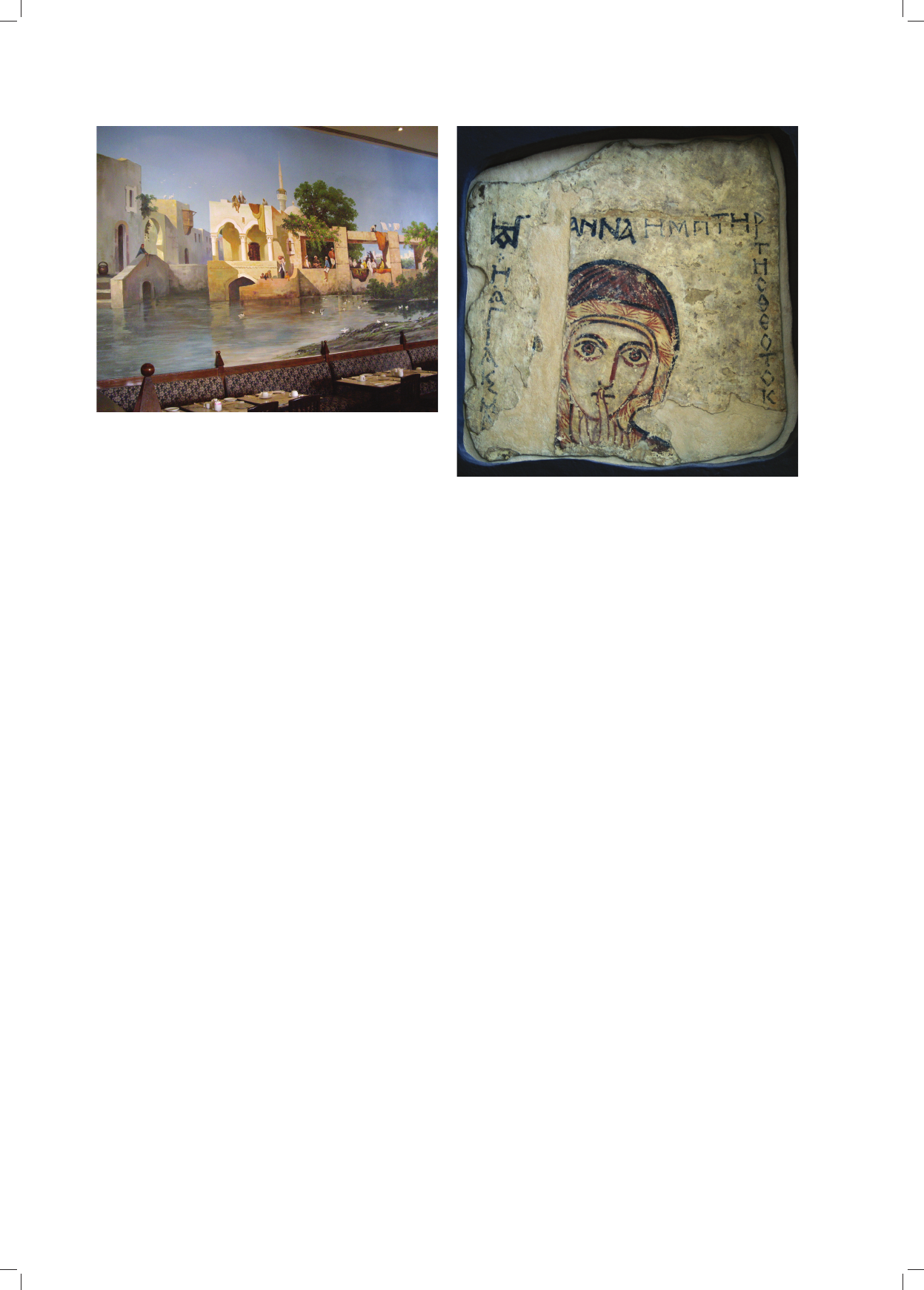
Can we then dare to claim that a completely new and
slightly kitschy hotel paintings (Fig. 2 and 3) are more au -
thentic than the famous “frescoes from Faras” (Fig. 1
and 4)? If so, then maybe authenticity is not one of the basic
features/qua lities of the painting, the features which de ter-
mine their significance and level of acceptance [6, p.
216].
Anyway, most people interested in wall painting would
select with no hesitation less authentic “frescoes from
Faras”. Why? Only because they are older? No. This is
a matter of their VALUE. But this is a totally different issue.
The article by Alois Riegl which is often referred to on
the cult of historical monuments does not mention authen-
ticity when describing values; this notion appeared only
in the context of historical research [7, p. 199]. Authenticity
of a historical monument is a sine qua non for any serious
discussions or research of art and architecture. A hundred
years ago times were different. Vows and covenants made
for life were much more often kept; banks were held
responsible for the deposits they kept, and producers
cared for the opinion about whatever they made to be as
good as possible, and their products possibly perfect and
most durable. I am not going to describe the world today
– we all know things are what they are – but the informa-
tion which we hear, see, and read every day about fakes,
forgeries, frauds and falsifications greatly inspire delib-
erations about authenticity. That is why this notion is so
frequently the main topic of many seminars and confer-
ences and it continues to fascinate researchers all over the
world. This is also our responsibility to constantly define
its meaning.
Translated by
Tadeusz Szałamacha
ramid znaleźli się w kraju, gdzie je przed wiekami wzno-
szono.
Czy więc możemy ważyć się na stwierdzenie, że zupeł-
nie nowe i nieco kiczowate malowidła hotelowe (il. 2 i 3)
są bardziej autentyczne od słynnych „fresków z Faras” (il.
1 i 4)? Jeśli tak, to może autentyzm nie należy do podsta-
wowych walorów malowideł, cech, które decydują o ich
randze i poziomie akceptacji [6, s. 216]. A przecież więk-
szość osób zainteresowanych malarstwem ściennym wy-
bierze bez wahania mniej autentyczne „freski z Faras”.
Dlaczego? Tylko dlatego, że są starsze? Nie. To sprawa
ich WARTOŚCI. Ale to już zupełnie inna historia.
W często przywoływanym artykule Aloisa Riegla
o kul cie zabytków, wśród omawianych przez niego war-
toś ci autentyzmu nie było; pojęcie to pojawiło się jedynie
w kontekście badań historycznych [7, s. 199]. Autentyzm
zabytku stanowił warunek sine qua non jakichkolwiek po-
ważnych rozważań i badań sztuki oraz architektury. Sto
lat temu były inne czasy. Śluby i przysięgi składane na
całe życie były znacznie częściej dotrzymywane, banki
z całą odpowiedzialnością stały na straży powierzonych
walorów, a ci, którzy cokolwiek wytwarzali, starali się,
aby opinia o ich pracach była możliwie najlepsza, dzie-
ło zaś czy wyrób jak najdoskonalszy i najtrwalszy. Nie
będę opisywać dzisiejszego świata, który „jaki jest, każdy
widzi”, ale docierające do nas codzienne wiadomości
o podróbkach, fałszerstwach, oszustwach i nadużyciach
bardzo inspirują do rozważań o autentyzmie. Dlatego po-
jęcie to tak często powraca jako temat przewodni roz mai -
tych seminariów i konferencji, fascynuje nieustannie ba-
daczy na całym świecie. Także i na nas spoczywa zadanie
stałego defi niowania jego istoty.
Il. 3. Fragment dekoracji w hotelu „Le Meridien”, Makadi Bay, Egipt
(fot. E. Święcka, 2008)
Fig. 3. Fragment of decorations in “Le Meridien” hotel, Makadi Bay,
Egypt (photo by E. Święcka, 2008)
Il. 4. Św. Anna w Galerii Faras (fot. A. Lewandowska, 2007)
Fig. 4. St. Anne in Faras Gallery (photo by A. Lewandowska, 2007)

Pojęcie autentyzmu i malarstwo ścienne /The notion of authenticity and wall painting 47
Bibliografia /References
[1] Tomaszewski A., Konserwatorstwo między twórczością a nauko-
wością, [w:] E. Małachowicz (red.), Materiały z sesji Komitetu
Architektury i Urbanistyki PAN w Nieborowie 22–23 września
1995, „Krajobrazy” 1996, nr 15 (27), 31–34.
[2] Jokilehto J., Authenticity: A General Framework for the Concept,
[w:] K.E. Larsen (ed.), Nara Conference of Authenticity in Rela-
tion to the World Heritage Convention, Nara, Japan 1–6 November
1994, UNESCO, Paris 1995, 17–34.
[3] Lowenthal D., Criteria of Authenticity, [w:] K.E. Larsen (red.),
Conference on Authenticity in Relation to the World heritage
Convention. Workshop in Bergen, Riksantikvaren (Directorate for
Cultural Heritage), Tapir, 1994, 35–64.
[4] Petzet M., „In the full richness of their authenticity” – The Test
of Authenticity and the New Cult of Monuments, [w:] K.E. Larsen
(ed.), Nara Conference of Authenticity in Relation to the World
Heritage Convention, Nara, Japan 1–6 November 1994, UNESCO,
Paris 1995, 85–99.
[5] Tomaszewski A., Konserwacja pomiędzy „estetyką” a autenty-
zmem, [w:] E. Święcka (wybór i oprac.), Ku nowej fi lozofi i dziedzic-
twa, Międzynarodowe Centrum Kultury, Kraków 2012, 116–122.
[6] Święcka E., To, co przetrwało – to, co pozostanie. Kryteria tro-
ski o malarstwo ścienne, [w:] B. Szmygin (red.), Wartościowanie
w ochronie i konserwacji zabytków, Politechnika Lubelska, War-
szawa–Lublin 2012, 209–218.
[7] Riegl A., Nowoczesny kult zabytków. Jego istota i powstanie, [w:]
J. Krawczyk (red.), Zabytek i historia. Wokół problemów konser-
wacji i ochrony zabytków w XIX w. Antologia, Ofi cyna Wydawni-
cza „Mówią wieki”, Warszawa 2002, 191–202.
Streszczenie
Malowidła ścienne tworzą swoisty pomost pomiędzy architekturą a ruchomymi dziełami sztuki. W odniesieniu do każdego z tych trzech typów
obiektów wypracowana została odrębna metodyka ochrony i konserwacji. I choć istnieje na tym polu wiele punktów stycznych, to jednak odmienny
charakter poszczególnych grup wymaga szczególnego podejścia i interpretacji. Dotyczy to także zagadnienia autentyzmu. Kluczowy problem stano-
wią tu transfery malarstwa ściennego eksponowane w galeriach jak obrazy sztalugowe.
Słowa kluczowe: autentyzm, malarstwo ścienne, konserwacja, transfery
Abstract
Wall paintings provide a special bridge between architecture and movable artworks. In reference to these three types of structures a separate method
of protection and conservation has been developed. Although there are many common points, the different character of the individual groups requires
a special approach and interpretation. This also regards the issue of authenticity. The key problem in this respect includes transfers of wall paintings
displayed in galleries as easel paintings.
Key words: authenticity, wall painting, conservation, transfers
Rys. Karol Milczarek
Drawn by Karol Milczarek