2010
Nr 2(28)
Introduction
Renata Gubańska*
Towers – the element of Jutrosin’s spatial composition
(Greater Poland Province)
Dwelling and farm buildings along with greenery are
the elements that for centuries to a large extent have formed
and arranged space. The tallest or the biggest of them domi-
nate the whole composition. These include primarily town
halls and churches with their spacious interiors and distinc-
tive functions as well as high towers which are the main ar-
chitectural landmarks. These buildings also often have ex-
quisitely rich architectural forms as well as sculptural and
painting decorations which greatly affect the perception of
landscapes or skylines of selected settlements. The town
halls and temples create specic architectural landmarks of
the cities and thus diversify their spatial composition.
It is worth emphasizing that it was the buildings and spa-
tial composition that signicantly inuenced the diversity
and architectural design of a town; those factors determined
the harmonious adjustment to the neighboring landscape. As
a rule the closer to the center (market square), the buildings
are higher and higher. The architectural landmarks, which
would be vertical elements, located over a larger area signi-
cantly inuence the architectural diversity of a town. The fun-
damental element in the process of architectural development
of settlements and their landscape was their geographical lo-
cation. Making the most of the landscape features enhances
and facilitates the artistic perception of town skylines [8].
The issues indicated above will be exemplied by
Jutrosin – a town in Greater Poland. Although it is not
a huge and popular center, its historical and urban growth
is as interesting and fascinating as that of its selected his-
torical buildings.
Jutrosin
1
is a small town located in Greater Poland
Lowland whose characteristic features include signicant-
ly undulating landscape, absence of lakes, gravel and sand
hills as well as two wide-bottomed valleys of small rivers:
Orla and Radęca. This is because of dangerous and regular
overows of Orla river and its tributaries that Jutrosin was
located on a little hill, which makes its skyline clearly vis-
ible from anywhere around it [4].
1
The town is located 25 km in a straight line to the east of the main
national road between Wrocław and Poznań; from an administrative point
of view it belongs to Greater Poland Province. It is located in the center
of district (gmina) that in the south borders on Lower Silesia Province.
History of Jutrosin
The rst mention of Jutrosin comes from 1281, how-
ever, it is believed that the town was founded much earlier.
At that time Poland was divided into regions. The town
certainly belonged to Greater Poland and it was part of
Dubin Castellany [10]. The rst written mention of the
town comes from 1395 and the church in Jutrosin was rst
mentioned in 1420 [6].
It is known that in the 16
th
century Jutrosin had the
privilege of organizing general assemblies
2
and it is re-
peated in written accounts that there was a castle whose
2
This privilege was granted to such cities as Warsaw, Malbork or
Bydgoszcz.
*
Wrocław University of Environmental and Life Sciences, Institute
of Landscape Architecture.
30 Renata Gubańska
location has not been determined so far (it is believed
that so called „Górzysko” it the place where it that castle
stood) [4].
In 1532, one of the biggest res broke out in the town
and it destroyed the oldest documents, including those re-
garding its incorporation
3
and providing the obligations
as well as privileges of the townsmen. Already in 1533,
the town’s owners issued a new document with the rights
and obligations granted to the inhabitants of Jutrosin. The
rst mention of the Holy Cross Church comes from 1557
and of the Evangelical school from 1573. The settlement
grew dynamically in the 16
th
century as it was located
on the trade route leading from Poland to Silesia and to
Saxony [2].
3
Presumably, Jutrosin was granted a charter before 1281 (after:
[10]).
In 1642, the then owner of Jutrosin – Prokop Stanisław
Kołaczkowski granted a privilege to the immigrants from
Silesia which guaranteed the newcomers their own au-
thorities and freedom to practice religion. It is known that
in the rst half of the 17
th
century, apart from Polish and
German religious communities there was also a Jewish
community in Jutrosin. Crafts developed more and more
in the town too. Already in the second half of the 17
th
century, selected guilds were granted charters. During that
period there was a growing unrest between individual re-
ligious groups (and consequently – national). In the 18
th
century, these relations grew much worse. In the second
half of the 18
th
century, the political situation improved
and crafts as well as trade continued to ourish and that
contributed to further benecial changes in the develop-
ment of the town [4].
Over the centuries Jutrosin has had numerous own-
ers until 1841 when Duke Adam Czartoryski purchased
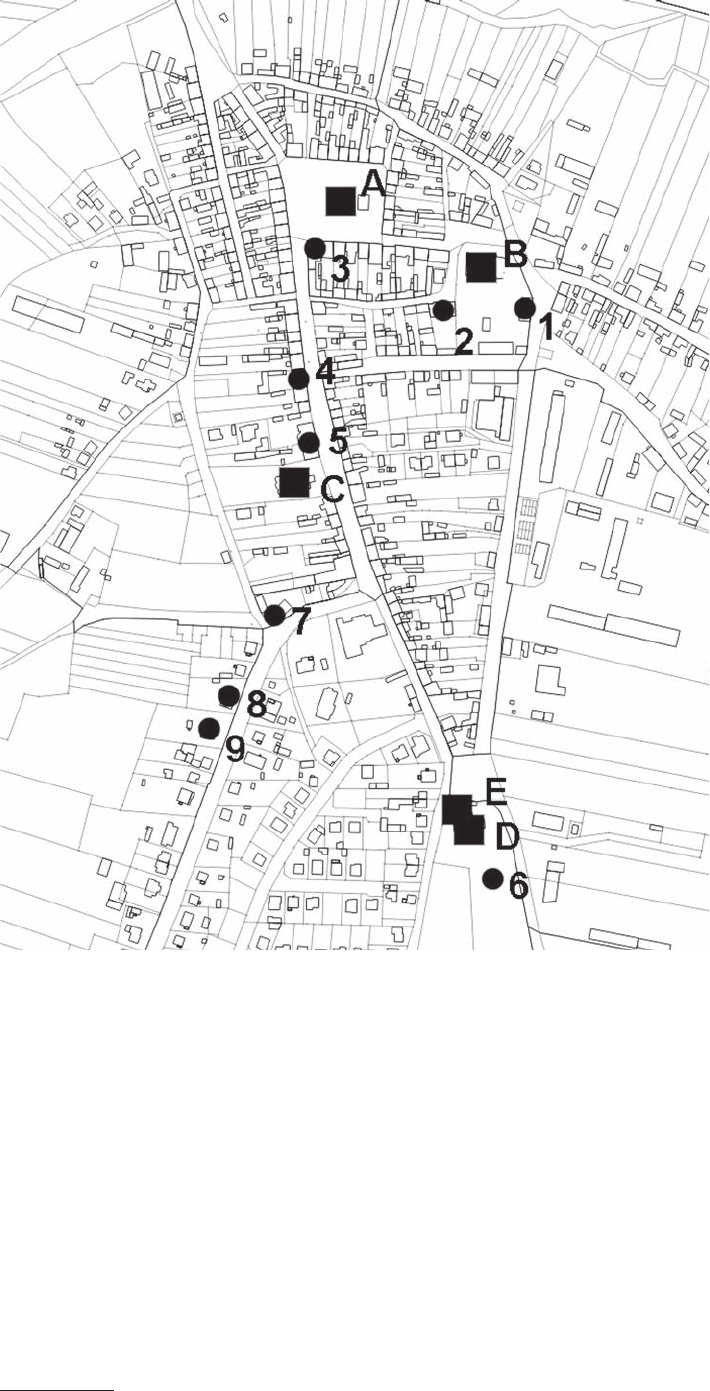
Fig. 1. The layout of Jutrosin
(by Janusz Gubański):
A – town hall, B – St. Elizabeth’s
Church, C – former Evangelical
Church, D – Holy Cross Church,
E – belfry; 1 – rectory, 2 – former
Catholic school, 3 – restaurant,
4 – post ofce, 5 – former pastor’s
house and Evangelical school,
6 – cemetery, 7 – Sacred Heart
Statue, 8 – kindergarten,
9 – St. Hedwig nuns’ house

Towers – the element of Jutrosin’s spatial composition (Greater Poland Province) 31
the holdings from Count Potulicki from Wielki Bór [10].
The Czartoryski family managed the holdings until World
War II.
After liberation of Jutrosin in 1945, the German origin
population left the town. During the years immediately af-
ter the war there was a slight revival of trade and culture.
When in June 1945 Leszno Province was established, the
town and district (gmina) belonged to that province [4].
In general it can be said that until the 1990s the town
declined and its economic, social as well as cultural life
fell into stagnation. Only after 1990, after implementation
of some necessary organizational and nancial changes
in local authorities, did the town grow. It was evident in
the area of construction (a new district of single-family
houses), necessary investments (e.g. water supply or
sewer systems), and rst of all improvement of the town
general beauty (new sidewalks, repair or in some cases
even conversion of public utility buildings to serve new
functions, renovation of elevations of most residential
buildings). Due to efforts of both local authorities and
the residents themselves the image of this Greater Poland
town improved considerably over the last few years.
Spatial development
4
At present it is very difcult to unambiguously de-
termine the course of history of the oldest settlement in
Jutrosin because so far no source materials have been
found. It is believed that Jutrosin developed from an old
early medieval settlement. July 15, 1281 is the ofcially
recognized date of the town location. For centuries the
town was always owned by private people and it was
a knight’s town.
The plan of Jutrosin (Fig. 1) indicates that Dworcowa
Street is the oldest street in town as its location diago-
nally disturbs its regular medieval layout. One can risk
a statement that it dates from before the town location and
the market square of the original settlement was probably
within the boundaries of the present Market.
The medieval layout of the town is relatively well vis-
ible in the development of its spatial composition
5
. The
trapezoid market is in its center. Its irregular line, with
the main road (Wrocław – Krotoszyn) going along it, is
from the west. Perpendicular streets go from each of the
corners of the square (with the exception of the corner
from which Dworcowa Street goes
6
). Around the market
there are residential quarters with rather irregular shape.
At the end of the street going off the south-east corner
of the square there is a Catholic parish church. The Holy
Cross Church was built for the immigrants from Silesia
by the road going in the direction of Wrocław. The loca-
tion of this small church on the axis of that street indi-
cates the rst deliberate attempts at urban planning. The
life of the settlement intensied after 1642 when the then
squire of Jutrosin granted privileges to the immigrants
from Silesia. Those newcomers settled along present
Wrocławska Street (so called Silesian Route). The present
Garncarska Street is the old 17
th
century potters’ out-
skirts.
One of the characteristic features of the town was so
called trade roads located on the elds’ side along which
the townsmen–farmers built numerous barns. The build-
4
The spatial development of Jutrosin was described on the basis of
the following publications: [3], [4], [5], [10].
5
It is important that the town in question has never had defensive
walls or any other kind of fortications.
6
As the name suggests the street led to the railroad station about
2 km away (to the north) from the town buildings.
ings were constructed as timber-framed structures which
gave the town a special character and appearance.
In 1859, after the most disastrous re in the history
of Jutrosin the rebuilding of the town began. Among
others two new schools were built: Evangelical one at
Wrocławska Street and Catholic one at Szkolna Street.
In the rst half of the 19
th
century, a new town hall was
built on the market. In the years 1862–1863, on one of
the parcels at Wrocławska Street, in the place of earlier
Evangelical church, a new Evangelical church was built
in the immediate neighborhood of the school of the same
denomination.
For dozens of years, Jutrosin was a multinational town.
The abandoned cemeteries: Evangelical one at Ogrodowa
Street and Jewish one by the road leading to the village of
Nadstawem are the remains of that religious diversity
7
.
The contemporary plan of Jutrosin Market resembles
a square (150×150m), although ve streets still go off of
it
8
. The Market is a location of a bank and ofces as well
as numerous stores; there is a restaurant at the corner of
the Market and Wrocławska Street. In the very center of
the square there is the town hall building from the middle
of the 19
th
century. At present most buildings around the
Market as well as beyond it are historical buildings. The
houses around the Market are mainly two-storied build-
ings, whereas those beyond it are usually single-storied
buildings with their roof ridges parallel to the street.
Near the Market, close to its south-east corner, there
is a great Neo-Romanesque St. Elizabeth’s Church with
a rectory and elementary school
9
.
The main and at the same time most representative
street of the town is the old Silesian Road – at present
Wrocławska Street. The most important buildings such as
former Evangelical church with adjacent pastor’s house
and former Evangelical school
10
, post ofce, culture cent-
7
Almost impossible to nd in the contemporary spatial structure of
the town.
8
They include: Wrocławska, Dworcowa, Chłodna, Dolna and
Kościuszki Streets.
9
The building of former Catholic school; over the last few years
extended and modernized.
10
At present these buildings belong to the Elementary School in
Jutrosin.
32 Renata Gubańska
er, Holy Cross Church, belfry and parish cemetery are lo-
cated by that street. The buildings of vocational and sec-
ondary schools are located at the corner of Wrocławska
and Mickiewicza Streets. The kindergarten, St. Hedwig
nuns’ house, Sacred Heart Statue, outpatient clinic as
well as police station are located at Mickiewicza Street
which is an exit road from the town in the direction of
Wrocław. At the end of that street, in the place where once
there was an impressive wooden trestle type windmill,
there is a relatively new development of single-family
houses. The main industrial facilities in the town are lo-
cated along Polna Street, parallel to Wrocławska Street
(on the opposite side of the cemetery)
11
. The old dairy
and the butcher’s shop are located by the town’s north
border.
To the south of the town, beyond its borders, there are
areas for mining natural aggregate. As a result there are
numerous post-mining gravel pits there. One of them was
lled with water and developed as a recreational area to
accommodate summer holidaymakers.
11
For instance sawmill, concrete products manufacturer, Christmas
decorations factory, power facility.
Towers in Jutrosin
One does need to be an observant visitor to notice,
when approaching Jutrosin, from far away four prominent
towers: one – of the town hall and three others – of the
churches. These vertical elements of the town absolutely
dominate the skyline of both residential and farm build-
ings as well as the green belt. The town is well visible due
to its exceptional location – on a small hill.
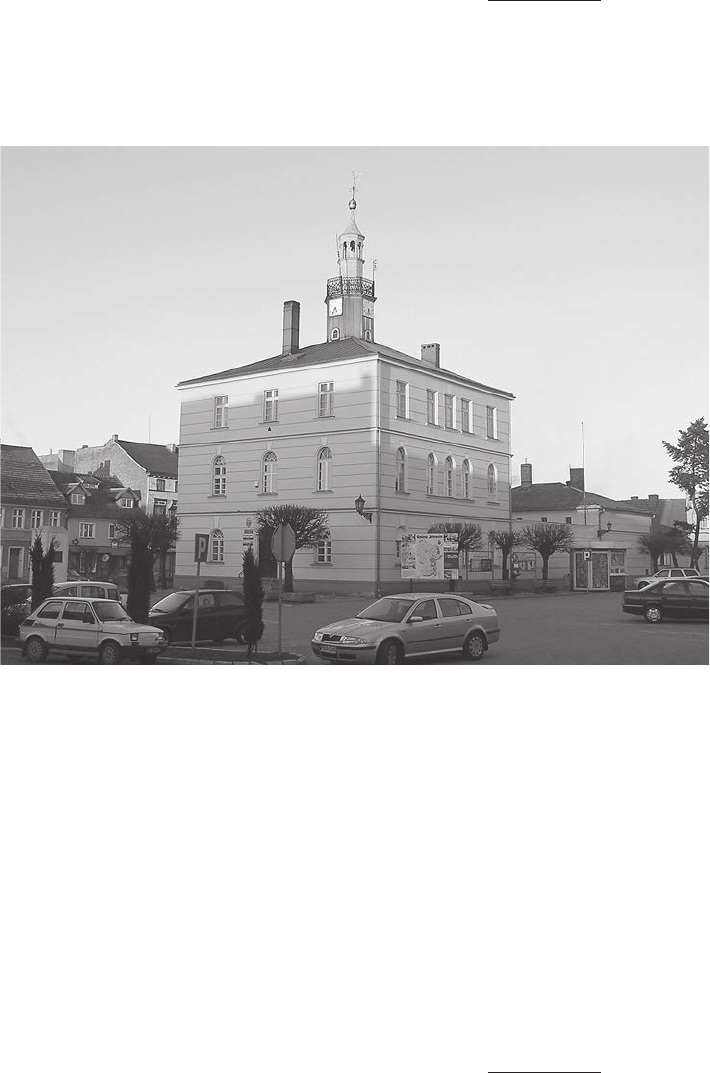
One of the four main landmarks is the tower of the
town hall in Jutrosin (Fig. 2). The town hall dates back
to the middle of the 19
th
century and it is located in the
center of the Market, which is in compliance with the
town composition principles applied in the Middle Ages
[1, 9]. The building was built on a square plan. Its three-
storied, cubic building is covered by a pyramid hip roof.
Two extensions and a facilities building were annexed to
the town hall main building from the east. The main en-
trance to the building is on the opposite side – from the
west. A kind of gravity and grandeur of the building was
emphasized by the rhytmicality of its elevations and ex-
cellent application of architectural details.
It should be emphasized that the octagonal tower with
a clock on top of the town hall is especially worth not-
ing
12
. There is a beautiful balustrade above the clock. The
proper tower is covered by a lantern with a spire. That
tower with a metal rooster weathervane
13
[4] is one of the
major landmarks of that town.
As mentioned earlier, at the end of the scenic axis of
the street going off the south-east corner of the Market,
a quarter was assigned for building of a Catholic church.
Probably the rst church was built of wood; later it was
replaced by a masonry structure which burned down at
the beginning of the 19
th
century. This way the town did
not have a parish church for almost 100 years
14
. Only in
12
The date 1882 is visible on the clock as well as the words:
A. Winkler Breslau (name of the company, after: [4]).
13
The rooster is the only preserved element of former town hall
(after: [4]).
14
During that time the small Holy Cross Church located at the
outskirts of the town served as a parish church (after: [4]).
Fig. 2. Town Hall.
Photo by R. Gubańska, 2005
Towers – the element of Jutrosin’s spatial composition (Greater Poland Province) 33
the years 1900–1902, on the initiative of Duke Zdzisław
Czartoryski, was the present church built. Its main archi-
tect was Tomasz Pajzderski whose architectural design of
the building referred directly to the Romanesque cathe-
drals in Speyer and Mainz [4].
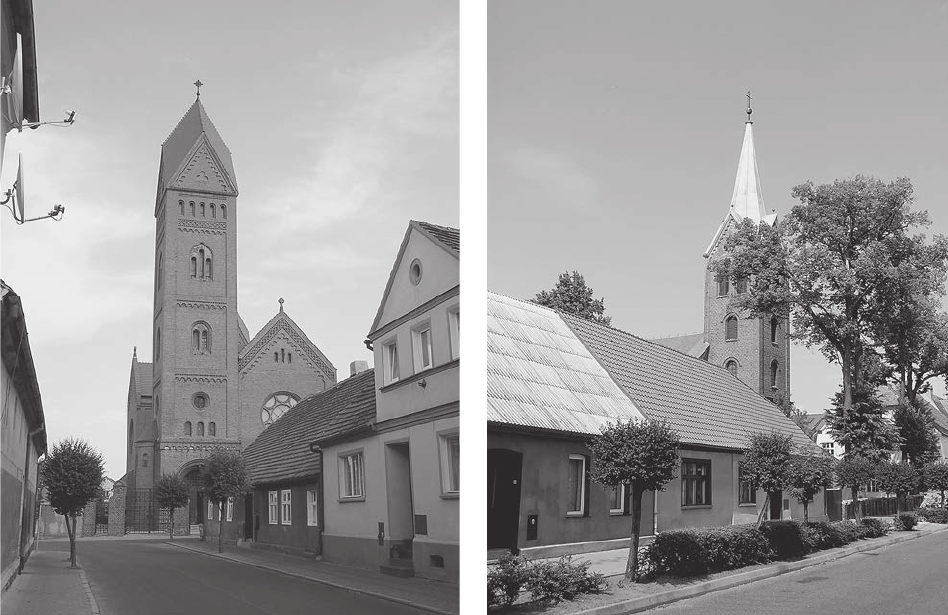
St. Elizabeth’s Church (Fig. 3), as a free-standing build-
ing, was built on the assigned square which was surrounded
by a decorative brick wall. The church combines simplicity
and moderation and it has a high gable roof. Its facades,
which are made of ceramic bricks, are covered with plaster
from the outside. The architectural brick details have ex-
quisite forms and proportions. The 47 m tall tower which is
also a belfry adds to the building’s austerity and grandeur.
The bell tower, which is a component element of the west
elevation of the parish church, utterly dominates the whole
structure. Just like in the case of the main body of the build-
ing, the tower’s decorative details are moderate and simple.
Its brick elevations are not covered with plaster. The only
exception is a group of windows with brick frames locat-
ed in a relatively ‘shallow recess’ which is covered with
plaster. In the corners of upper section – lesenes connected
by an arcade frieze at each stage. The elevation walls are
crowned with triangular gables decorated with a staircase
frieze, eaves-cornice and centrally located small blank win-
dow in the form of a clover leaf. The whole helm is cov-
ered with picturesque rhomboid roof planes. It should be
remembered that the tower of Jutrosin church is not only
a great architectural landmark but also, or maybe rst of all,
an interesting scenic closure of both streets located on the
extension of the main axis of the church.
From the east, there are two small towers with a semi-
circular altar apse between them. In the immediate neigh-
borhood, from the south, there is a rectory and the former
Catholic school. At present the rectory buildings are sur-
rounded by a beautiful garden with select plants which is
cared for with utter meticulousness.
It should be stressed that the church building with
a dominating tower creates an interesting closure not only
of the street but also a scenic axis of both Kościuszki
Street (going directly from the Market) and Garncarska
Street (former potters’ outskirts).
The building of the former Evangelical church dating
from the years 1862–1863, that was built in the place of an
earlier church, which had burned down [4, 10], is equally
interesting. The free-standing building is located in some
distance from the Market (about 200 m) at Wrocławska
Street (old Silesian Road). It was built on a square plan
which from the side of the main road is separated by a his-
torical brick wall; from the north it adjoins the buildings of
former pastor’s house and the Evangelical school (Fig. 4).
The former Evangelical church is designed on the
plan of an elongated rectangular. The single-storied main
body of the building has no basement. On the west side
there are three polygonal apses. The whole structure is
covered with a tall gable roof. The base walls look like
rough rubble walls, whereas the upper sections were built
from solid ceramic bricks and they were not covered with
plaster on the outside.
The ve-stage tower, which is an interesting landmark
of the street as well as of the town, clearly stands out
Fig. 3. St. Elizabeth’s Church – view from Kościuszki Street.
Photo by R. Gubańska, 2005
Fig. 4. Former Evangelical Church, Wrocławska Street.
Photo by R. Gubańska, 2005
34 Renata Gubańska
against the east elevation of the church. The three-axis
elevation of that tower can be divided into three stages:
ground level with the front door with a semicircular lin-
tel; upper levels with rectangular semicircular-headed
windows and the third level which is the fourth stage
with paired windows. The brick walls of the tower have
triangular gables with varied architectural details: orna-
mented staircase frieze, eaves-cornice, centrally located
round blank window. The tower is covered with a brick
helm roof. On the sides of the main elevation there are
pinnacles. The architecture of the church is a combination
of styles with references to the Middle Ages that is Neo-
Romanesque and Neo-Gothic [4].
After World War II, due to political and economic situ-
ation, nobody needed the Evangelical church so the build-
ing was neglected. For dozens of years it was abandoned
and unused which resulted in its gradual fall into ruin.
A few years ago the conversion and repair works were
completed. The interior of the former Evangelical church
was converted into a hall for sports and other events main-
ly for children and youth. Although the decision to change
the function of the building from a church to a gym was
and still is a little controversial, it seems rational and
above all benecial for the building itself as well as for
the whole town because that church building – which is
one of the town’s architectural landmarks – maintained
its position in the spatial layout of the town. Its ve-stage
tower with a high helm roof built in the form of a pyra-
mid dominates not only the main body of the building but
it also stands out against the skyline of the town and it
is one of four characteristic architectural features of the
town which is being renovated.
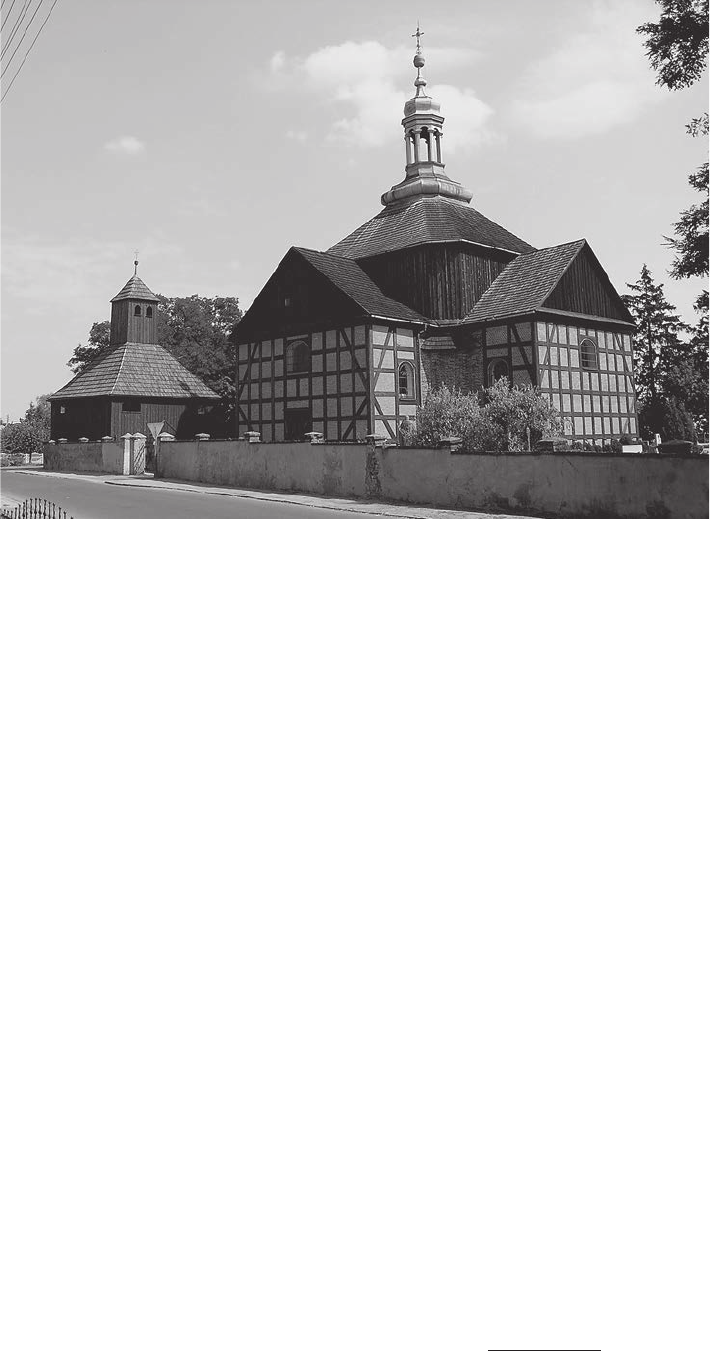
The last tower which dominates the town’s skyline is
a small cupola of the Holy Cross church (Fig. 5). That
church is located about 500 m to the south of the Market
(at the end of Wrocławska Street) on the cemetery. The
lot of the cemetery, which is trapezoid, is surrounded by
a plastered brick wall with prominent posts. Originally the
building had a beautiful timber-framed construction
15
on
the Greek cruciform plan. Its central part is covered with
a pyramid hip roof crowned with a lantern and an onion
dome and each arm of the cross with a gable roof. The
roof planes are covered with wood shingles. The cupola
which is located on top in the middle section of the roof
is made of wood and it is covered with zinc sheets. On
the very top of the picturesque late Baroque onion dome
there is a metal ball and a cross [4, 10]. This interesting
structure is a great closure of the scenic axis of the main
street of the town. The beauty of that small architectural
landmark is especially well visible on sunny days when
the sunrays reecting in the surface of the cupola emerg-
ing from the green belt can be seen from as far away as
a dozen or so kilometers.
From the north, in the direct neighborhood of the
church cemetery, there is a wooden belfry with two bells.
Its pyramid hip roof, which is also covered with wood
shingles, is crowned with a simple tower covered with
a small pyramid hip roof with a metal ball and a cross.
That belfry is not only a picturesque structure beautifully
integrated into the town skyline but at present also one of
the most interesting examples of wooden architecture in
Greater Poland.
The four towers described above – which are char-
acteristic architectural landmarks of Jutrosin landscape
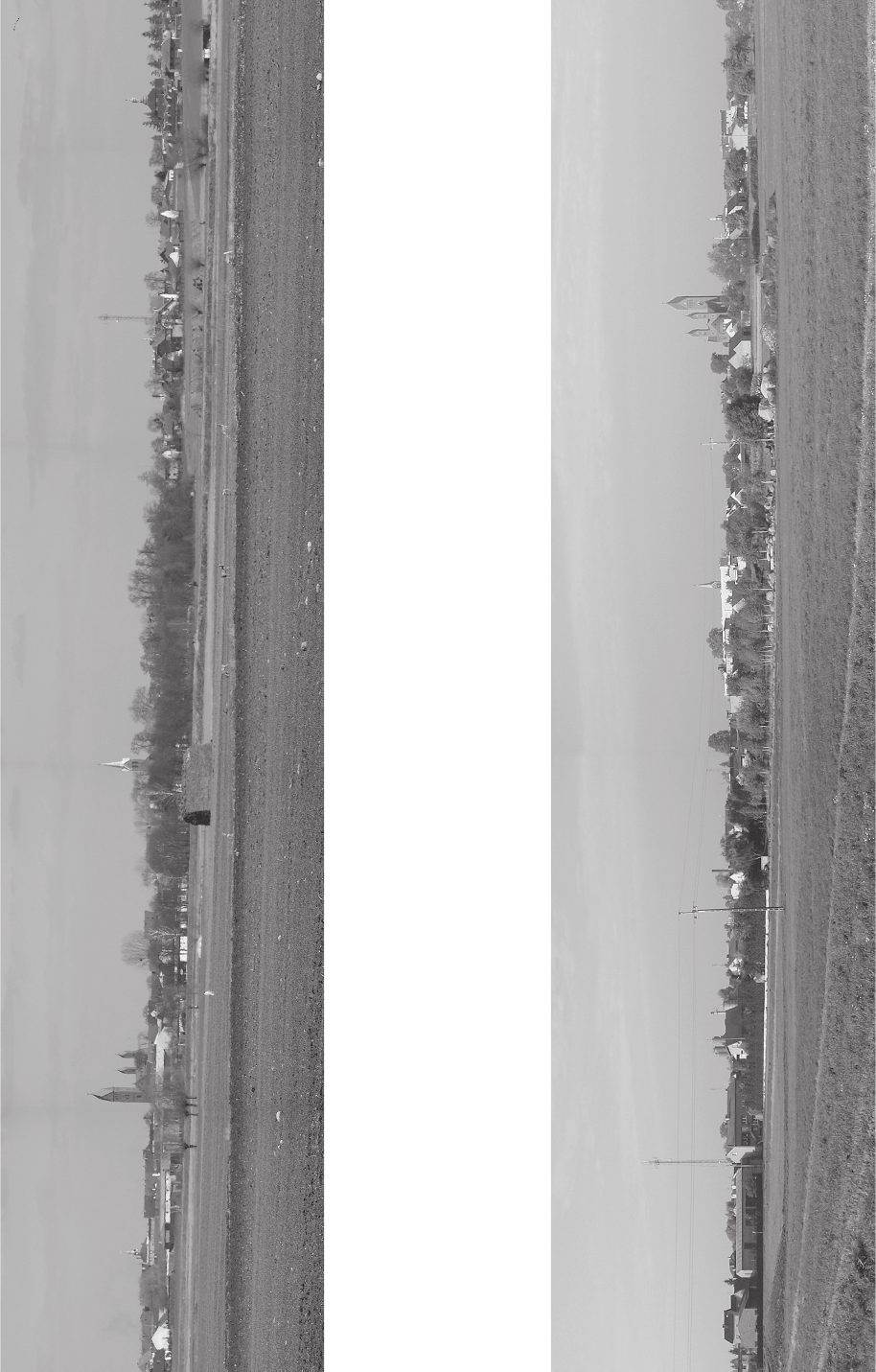
– undoubtedly affect its dynamics and attractiveness. Fig-
ure 6 shows a typical view of Jutrosin (regardless of geo-
graphical direction, in this case from direction of Sielec
15
A dozen or so years ago some repair works were conducted in
the building during which the historical timber-framed construction was
replaced by brick walls with wooden boards nailed to them only imitating
the timbers on elevations.
Fig. 5. Holy Cross Church
and belfry. Photo by R. Gubańska,
2005
Towers – the element of Jutrosin’s spatial composition (Greater Poland Province) 35
Fig. 6. Panorama of the town viewed from Sielec Stary. Photo by J. Gubański, 2005
Fig. 7. Panorama of the town viewed from Pawłowo. Photo by R. Gubańska, 2010
36 Renata Gubańska
Stary). In the foreground there are arable elds and the
shimmering surface of the river. Only in some distance
can one notice the residential and farm buildings with out-
standing towers: on the left – the one a little shorter of the
town hall and on the right – the other three ones of the
local churches: from the left – the parish St. Elizabeth’s
church, in the middle – former Evangelical church, and
a little further to the right – the Holy Cross church. The
blue sky is the landscape’s closure and at the same time its
background. It is a perfect example of towers being both
architectural and urban landmarks.
Figure 7 shows the totally opposite sequence of the
towers set in the urban design of the town, namely from
the left there is the former Evangelical church or actually
its tower, then the tower of the parish church and nally
the tower of the town hall. Unfortunately, the view of the
Holy Cross church – both its building and its tower – is to-
tally blocked by the trees surrounding it. The other build-
ings in the town create a consistent kind of background of
Jutrosin skyline because the foreground is still lled with
arable elds which surround the town from all sides.
It should be remembered that it is the very towers be-
ing vertical elements that in fact dene landscape, which
is indeed one of the most fundamental elements of the
environment around us. Landscape is a material asset
inherited from our ancestors. Due to the respect for past
generations and events we should preserve the cultural
heritage left for us [7].
Conclusions
The above indicates that there are some relations
between buildings which are determined by their form,
shapes and spatial composition. They are especially evi-
dent when we are dealing directly with buildings domi-
nating by their height and size as well as function. Tow-
ers, which are the vertical elements shaping landscape,
not only serve as architectural landmarks because of their
height; often they are integral parts of buildings which are
functional landmarks, obviously due to the way in which
they are used, for instance churches, squares, town halls.
It should be remembered that towers were rst noticed
and deliberately used to shape landscape already in the
16
th
century [8, 9]. This type of landmarks became the
foundation for landscape composition, a kind of urban fac-
tor which is perfectly exemplied by Jutrosin. The towers
in Jutrosin not only form a very interesting skyline, which
makes the town much more attractive, but they also are
perfect streets’ closures (or more specically – their sce-
nic axes). Those vertical elements are clearly visible from
far away and virtually from anywhere around the town,
which is the result of its location on a hill.
There is one more function of the tower that needs to be
mentioned – the symbolic one – that of a sign-post. When
approaching a place one can correctly guess from far away
that it is a town; the emerging shapes of the towers per-
fectly specify the buildings’ character of a small town.
References
[1] Böhm A., Planowanie przestrzenne dla architektów krajobrazu.
O czynniku kompozycji, Cracow University of Technology Publishing
House, Cracow 2006.
[2] Callier E., Powiat pyzdrski w XVI stuleciu. Szkic geograczno-
-historyczny, Poznań 1888.
[3] Dzieje Wielkopolski edited by J. Topolski, Poznań Publishing House,
Poznań 1969.
[4] Jędraś St., Miasto i Gmina Jutrosin, Leszno 1999.
[5] Krygowski B., Krajobraz Wielkopolski i jego dzieje, Polish Scientic
Publishers PWN, Poznań 1958.
[6] Łukaszewicz J., Krótki opis historyczny kościołów parochialnych,
kościółków, kaplic, klasztorów, szkółek parochialnych, szpitali i in-
nych zakładów dobroczynnych w dawnej dyecezji poznańskiej,
Vol. 2, Poznań 1859.
[7] Małachowicz E., Konserwacja i rewaloryzacja architektury
w środowisku kulturowym, Oficyna Wydawnicza Politechniki
Wrocławskiej, Wrocław 2007.
[8] Przyłęcki M., Zarys dziejów budowy miast i wsi, Wroclaw University
of Environmental and Life Sciences Publishing House, Wrocław
2004, p. 1.
[9] Rylke J., Kompozycja krajobrazu kulturowego, Architektura Krajo-
brazu, 1–2, 2006, pp. 24–31.
[10] Sobisiak W., Dzieje Ziemi Rawickiej, Polish Scientic Publishers
PWN, Poznań 1967.
Wieże elementem kompozycji przestrzennej Jutrosina (woj. wielkopolskie)
Od wieków elementami kształtującymi i porządkującymi przestrzeń
były i są nadal zabudowania mieszkalne, gospodarcze oraz towarzysząca
im zieleń. Bardzo często jednak pojawiają się akcenty wertykalne, które
nie tylko wpływają na zróżnicowanie kompozycji przestrzennej, ale także
tworzą malownicze zespoły widokowe. To przede wszystkim kościoły
wraz z wysokimi wieżami stanowiły główne dominanty architektoniczne.
Podobnie wyróżniającymi się elementami były ratusze, nierzadko konku-
rujące z kościołami. Należy podkreślić, że na różnorodność i interesujący
kształt sylwety miasta duży wpływ miała kompozycja przestrzenna oraz
układ zabudowy.
Zasygnalizowane zagadnienia zostaną przedstawione na przykładzie
Jutrosina, miasteczka zlokalizowanego na Nizinie Wielkopolskiej. Jutro-
sińskie wieże nie tylko w interesujący sposób kształtują panoramę miasta,
czyniąc tym samym jego sylwetę znacznie ciekawszą, stanowią również
wspaniałe zamknięcia ulic, a uściślając – ich osi widokowych.
Na podkreślenie zasługuje jeszcze jedna funkcja wieży – symbolicz-
na, a mianowicie drogowskazu. Zbliżając się do wybranej miejscowości,
już z daleka możemy określić, czy mamy do czynienia ze wsią czy
miastem. Zarysowujące się sylwety występujących tam wież doskonale
określały i określają nadal charakter zabudowy.
Key words: Jutrosin, towers, spatial composition Słowa kluczowe: Jutrosin, wieże, kompozycja przestrzenna