2010
Nr 2(28)
If we agree with the assumption that an architect and
urban planner are the professions which enjoy public
trust, then we cannot in our work resort to cultural pat-
terns, social needs or ecological conditions. If, however,
we egoistically assume that the most important thing is
individual artistic experience of the author, realizing their
unrestrained vision of architecture or urban development,
and its future users do not participate at all in this process,
then we only build a monument of the author which is
useless for local community.
There are a lot of examples of such egoistic activities
in architecture and urban development. For instance the
design of Brazylia in the second half of the 20
th
century,
Robert Masztalski*, Paweł Pach*
Transformations of urban and architectural space
of the market square in Leszno
at the turn of the 20
th
and 21
st
centuries
Introduction
*
Wrocław University of Technology, Faculty of Architecture.
Fig. 1. View of Town Hall
in Leszno located
on the Market Square
120 Robert Masztalski, Paweł Pach
which is admired by architects and rejected by the com-
munity and has been challenged by demographic prob-
lems or development of a Le Corbusier unit where few
people want to live.
Assuming that at present in architecture and urban
development we operate in a transition period from in-
dustrial to information civilization, then the subject of
transforming market square spaces is especially inter-
esting from the point of view of urban changes which
have been taking place over the last twenty years in out
country.
In this context the opinion voiced by Krzysztof Do-
maradzki [2] is especially pertinent; he dened the
problem like that: The rebellion against scenic axes,
traditional squares and developments cannot mean that
designing cities in the 21
st
century should contemptu-
ously reject the whole classical art of space develop-
ment. Knowledge should not be replaced with igno-
rance, and the skills developed over the centuries should
not be replaced with their lack. Conservatism in space
development of the city, (…) usually means proven so-
lutions which have been veried by history as well as
by users who feel good in them and which they simply
like.
The post-war activities in Polish architecture and ur-
ban development seem to be searching for a new direction
which would lead out of that dead-end street created at
the beginning of the 20
th
century by CIAM’s modernism.
They include efforts at restoring the signicance of space
with clearly dened boundaries. This does not exclude in
any way the search for new means of expression in archi-
tecture and urban development. This includes the search
for a new expression of public spaces which change
in accelerated motion the needs of Polish cites. This
search could be exemplied by the plan of moderniza-
tion activities in the area of the old town market square in
Leszno
1
.
1
Koncepcja urbanistyczno-architektoniczna dla terenu rynku
w Lesznie – development plan commissioned in 2009 by the City Ofce
in Leszno from a team of designers: Wrocław University of Technology,
Professor Robert Masztalski, D. Eng., Arch, Ewa Masztalska, M. Eng.,
Arch., Paweł Pach, M. Eng., Iwona Olanin, M. Eng. and Łukasz Truchal-
ski, M. Eng., Arch. [4].
History of the market square in Leszno
Leszno was designed in the middle of the 16th century
on a plan of a slightly irregular grid with two streets going
off each of the corners
2
. Its four-sided market square, with
the dimensions of the sides 81 m × 91 m × 65 m × 90 m, was
created at the crossroads of the major streets from Rydzyn
2
This type of design refers to much earlier, medieval locations based
on German law to the north and east of the upper and middle Elbe river
basin [1, 5].
to Kościan and from Głogów to Poznań [5]. 6.5–8.5 m
wide plots were marked around the market square [6]. The
dominant and original function of the market square was
connected with commercial trading. Apart from common
Monday and Friday trade fairs held on the market square
in Leszno on specically designated days in the year there
were also fairs which attracted merchants from Greater
Poland as well as from more distant regions. The commer-
cial function determined the market square development
Fig. 2. Elements of development
of the market square in Leszno
installed along its sides
Transformations of urban and architectural space of the market square in Leszno at the turn of the 20
th
and 21
st
centuries 121
full of sheds, stands and benches where goods were traded.
From the very beginning the market square in Leszno also
served representative functions. The houses around the
market square owned by the wealthiest townsmen were
usually the tallest and most decorated. The town’s most
important secular administration and commerce building,
the town hall, was located in the middle of the market
square. The rst masonry town hall was built in the mid-
dle of the market square in Leszno in 1639. Over the next
years it was remodeled many times. The present town
hall, which was built in 1707–1709, is one of the most
valuable Baroque and classicistic buildings in Poland
(Fig. 1). In the late 1670s, the population of the city was
about 5 thousand and over the next one hundred years it
at least doubled [5].
Although most of the original buildings around the
market square were gradually replaced, the function and
the main elements of the market square development
for centuries actually remained unchanged. The market
square served its functions as the main place for commer-
cial trading. The prestige of the city, and consequently of
its market square, has grown signicantly since the mo-
ment when in 1975 Leszno became capital of newly es-
tablished Leszno Province.
Fig. 3. One of the market square
sides separated from the market
square space by “beer gardens”
Fig. 4. One of the structures
enclosed in the “beer gardens”
122 Robert Masztalski, Paweł Pach
In 1977, the Polish Central Harvest Festival was held
in the city. The preparation to that festival greatly im-
proved the appearance of Leszno. That improvement in-
cluded for instance the cleaning of the facades of the town
hall and of the houses around the market square. However,
the most important modernization for the functioning of
the city center was banning vehicular trafc from the mar-
ket square. Another important modernization of the center
was conducted in the middle of the 1990s. Wolności, Lesz-
czyńskich and Zielona Streets were converted into pedes-
trian streets, which was caused by the need to facilitate fur-
ther development of shopping facilities along those streets.
In the middle of the 1990s, the town hall was extensively
modernized and renovated.
The market square in Leszno today
The area of the market square today is the main public
space in Leszno. In the representative building of the Town
Hall, there are exhibition and conference rooms and a cafe.
Most of the historic houses around the market square which
were built in the last quarter of the 19th century and in the
rst quarter of the 20th century demonstrate high architec-
tural qualities
3
. Most of their facilities on the ground oor
are used for services mainly commercial. Over the last few
years the services have been provided also on upper oors,
replacing their residential use. The market square space
is occupied by rows of trees growing along its sides as
well as small architecture structures and technical infra-
3
As many as 21 of them are on listed in the register of historic monu-
ments, whereas the rest are on the list of protected historic monuments.
structure. These elements have been located there over the
last fty years, generating a sense disorder of the market
square space. Their location is often random and their style
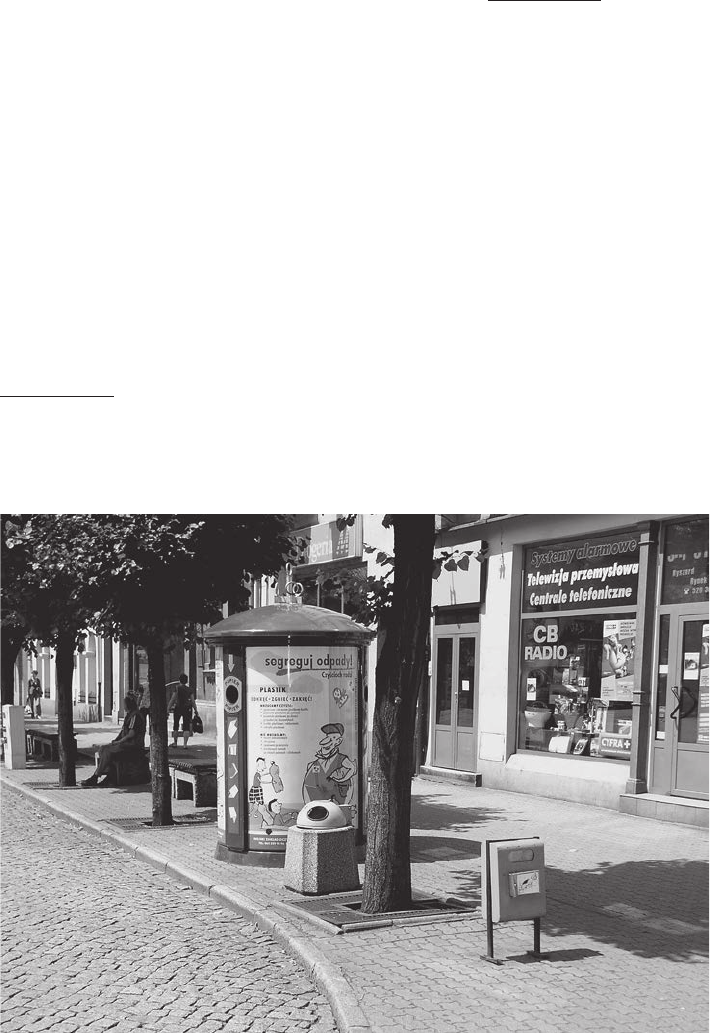
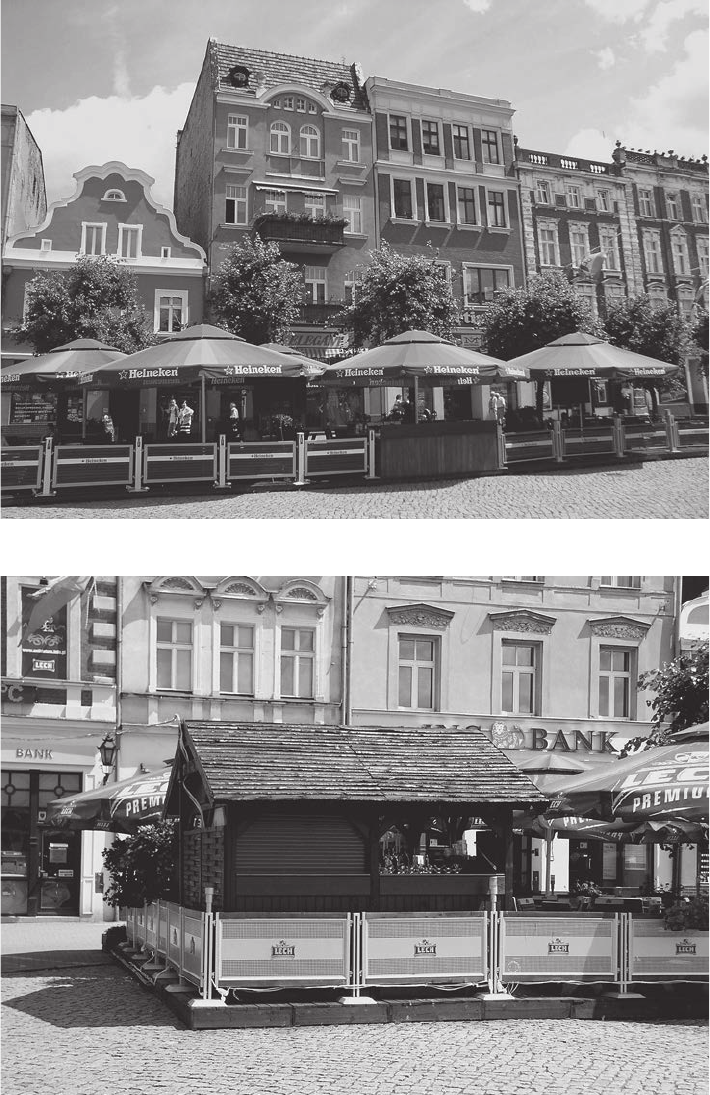
incoherent (Fig. 2). Their number and the size of some of
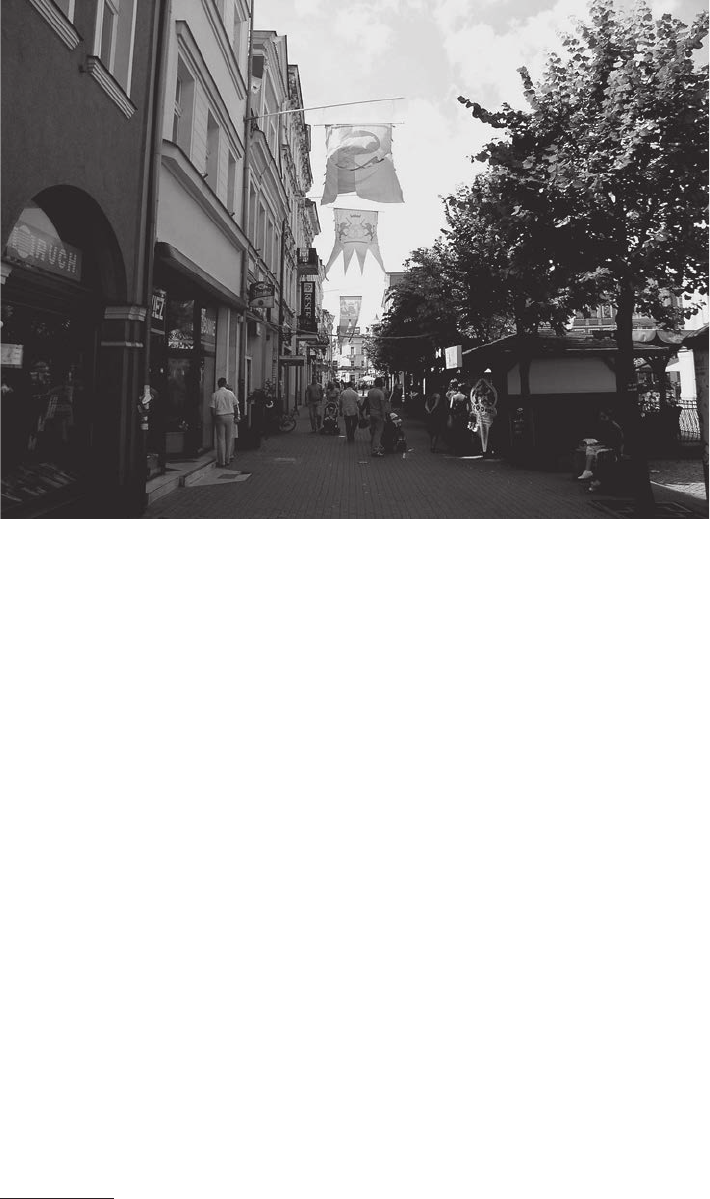
them e.g. “beer gardens” make the space along the sides
of the market square seem overloaded and overwhelmed
(Figs. 3, 4). Unfortunately, the market square surface does
not seem representative enough to reect the ‘city salon’
either. Paved with gray granite blocks, the market square
which was earlier used by cars now is surrounded by side-
walks whose surface covered with typical concrete blocks,
going around the market square. The rows of trees and
beer gardens going along the sides of the market square
divide functionally and visually the space of the market
square into a pedestrian street mall along the sides and the
market square (Fig. 5).
Fig. 5. Pedestrian street mall
between houses and a row of trees
New vision of the ‘Old’ market square
In 2009, the authorities of Leszno commissioned an
urban and architecture development plan of the market
square in Leszno from a team of Wrocław designers.
While conducting the plan the present state of the market
square development was diagnosed and the following de-
sign objectives were formulated:
Transformations of urban and architectural space of the market square in Leszno at the turn of the 20
th
and 21
st
centuries 123
– elimination of structures disturbing spatial order and
diminishing the prestige of the place
4
;
– design of an attractive public space, emphasizing the
valuable elements of the development;
– creation of places and attractions attracting citizens
and tourists and emphasizing the prestige of the market
square.
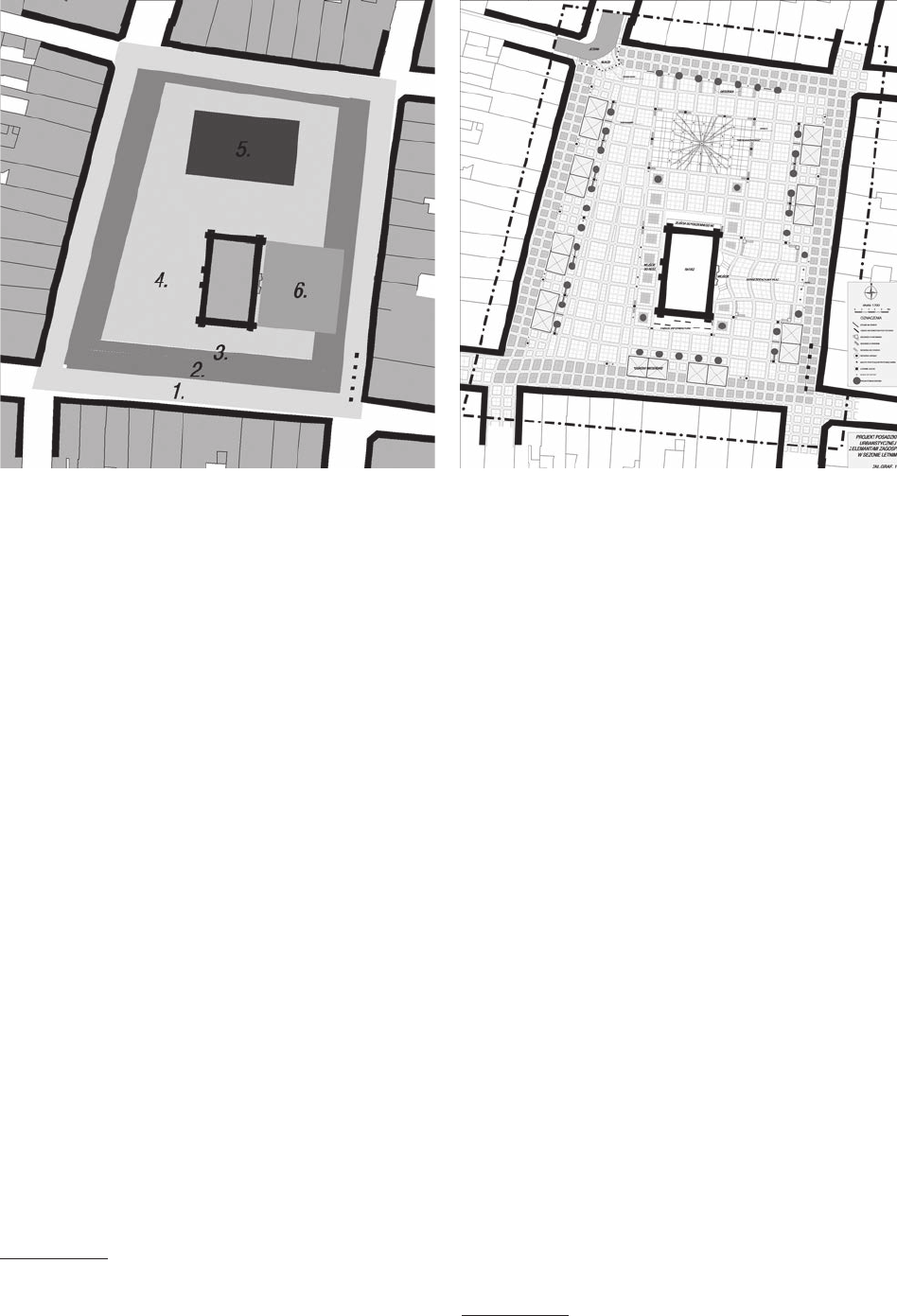
After the development of the functional utility program
accommodating the modern needs of the citizens, specic
urban functions were assigned in the space and the space
functional division diagram was developed (Fig. 6).
The plan introduced in those zones specic elements
of the development, suggesting and indicating a spe-
cic way in which this space would be used. Accord-
ing to the plan it was important for those elements not
to divide the market square space visually but only by
using adequately selected small architecture structures
which would form subtle boundaries between spaces
that serve different purposes. The restrictions assumed
in the plan regarding the locations and sizes of tempo-
rary “beer gardens” and season’s holiday stands should
prevent the total separation of the pedestrian street mall
from the rest of the market square. The shopping units
and recreation elements which are admissible in this zone
shall be located within designated distances, providing
a possibility of unrestricted moving around in all direc-
tions on the market square, without blocking the view of
4
The following elements were considered disharmonizing: build-
ing structures in the “beer gardens”, sidewalk along the market square
sides, “modernist” benches, owerbeds and trash cans, waste segregation
containers, some wall advertising items and signboards and elements of
technical infrastructure.
the town hall. Furthermore, the location and kind of trees
to be located in zone 3 shall correspond with the idea of
opening the view of the town hall and the houses around
the market square. The development of the remaining
area between the rows of trees and the town hall (zones
4–6) shall also match the functions and attractions pro-
vided there. The “Free Space” shall serve the pedestrian
and exceptionally vehicular circulation, and that is why
it should be minimally developed, unlike the “Forum of
Attractions” which shall be designed as the most attrac-
tive fragment of the “remodeled” market square. The
multimedia fountain to be installed in the market square
surface and the signpost showing the main directions in
the city shall be the magnet attracting both tourists and
citizens to the market square. This is also where special
events in the city life shall be held. Another section of
the market square, located nearby the town hall main en-
trance, shall serve the more representative purposes. The
broken orthogonal layout of the market square surface
as well as the small architecture structures located there
(benches, ag poles, lighting elements) shall emphasize
the signicance of the place and the prestige of the town
hall.
It is important for the operation of the market square
that the plan provides for different use of the market
square in different seasons of the year.
In respect of transportation the plan provides for
a restricted accessibility to the market square
5
. The new
market square development shall revive the unused space
around the town hall, which earlier was used by vehicular
trafc.
5
The market square would be accessible only for emergency vehicles,
city maintenance vehicles and delivery trucks at designated hours.
Fig. 6. Diagram of division of the market square space
into functional zones: 1) Pedestrian mall along the market square side,
2) Seasonal temporary structures zone, 3) Green Zone, 4) “Free Space”,
5) “Forum of Attractions”, 6) Representative town hall entrance
Fig. 7. Development plan of the market square in Leszno
in the summer season
124 Robert Masztalski, Paweł Pach
Forms of development adequate to modern times
The new market square development plan was sup-
posed to address the modern needs of the citizens of
Leszno and introduce the forms of development which
would be adequate to the urban lifestyle of the 21st cen-
tury information society. It does not mean that the plan
breaks the bonds with history. On the contrary, the plan
references to the history of the place are an important as-
pect of tourist promotion of the city and its architecture
6
.
It is important for the plan to attract to the market
square people who in fact shall make the city center vibrant
with life. For the market square space to be an attractive
place of recreation, it must be adequately equipped. The
location of all small architecture structures is the result
of assumption that individual zones shall serve specic
purposes.
At the request of the investor, one of the issues that
needed to be addressed in the plan was a possibility of
location of a monument on the market square. After con-
ducting composition analyses it was found that at this
stage it is impossible to indicate any specic location for
any monument due to the lack of information of its form,
size or style – features which greatly affect the context in
which any monument could be designed.
The following principles were followed while design-
ing the elements of small architecture structures: durabil-
ity of used materials, unied style, functionality and pres-
tige. Furthermore, it was considered important to support
pro-ecological activities by providing selective waste col-
lection containers.
6
Boards have been designed to be placed on houses with information
about their origin and history. Information about the development of the
city of Leszno shall be presented on free-standing boards.
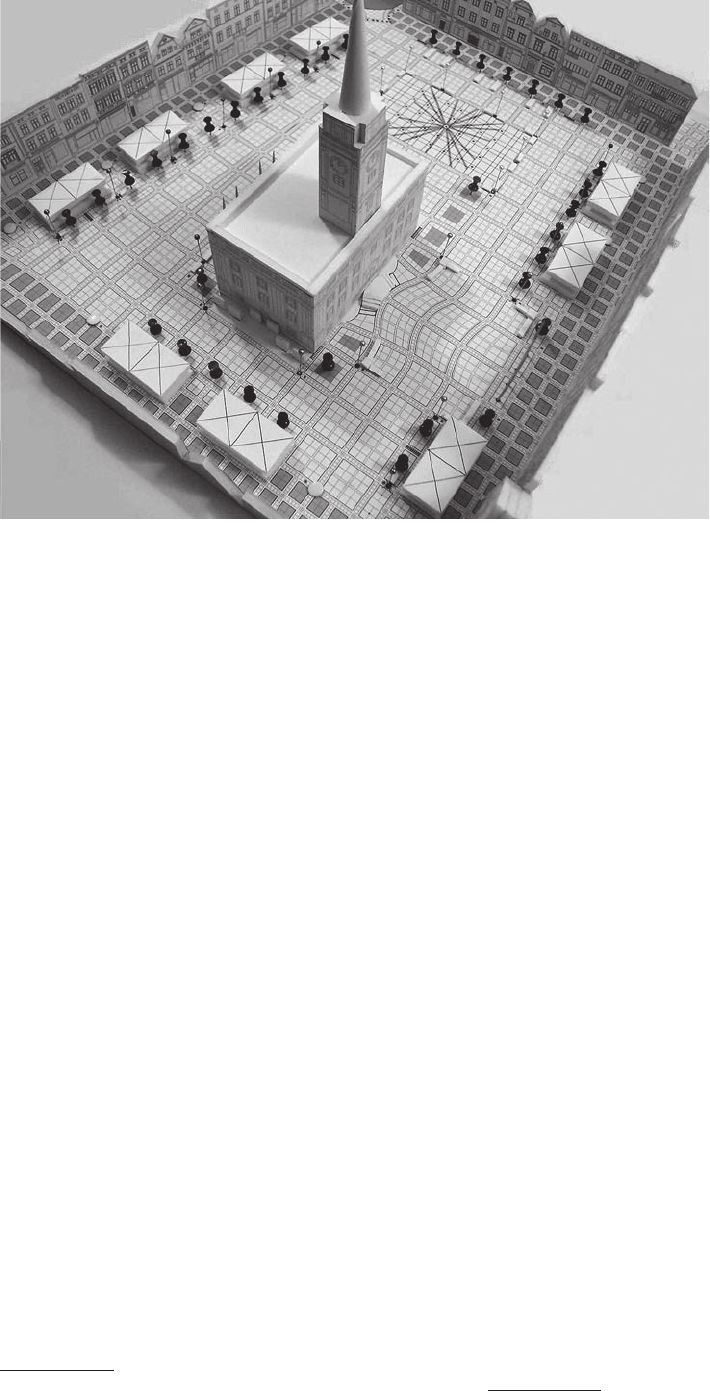
The plan assumes replacing the existing market square
surface. The new one, referring to the historical orthogo-
nal urban layout of the city, would be a matrix indicating
the functional division of the market square. As a result
of the assumed intensied pedestrian circulation on the
market square, its surface was designed especially for pe-
destrian trafc. The surface emphasizes the zoning lay-
out indicated by specic colors for specic functions. It
introduces geometric order for the market square space,
drawing attention to specic places e.g. the Town Hall
entrance.
The plan assumed the introduction of new rows of
trees along the market square sides, setting them back
more than now. The selection of appropriate species of
the trees in respect of the size of their crowns and root
systems as well as the speed growth and resistance to city
conditions shall assure their easier care and maintenance.
The plan allows for the location of so called “beer gar-
dens” on the market square, however, it also provides cer-
tain conditions on which they can be located there
7
. The
plan excludes the location on the market square of perma-
nent stands or other roofed structures and it imposes the
requirement to maintain a unied style. The provision of
the conditions for the location of the gardens is an attempt
at nding an appropriate form for the relatively new func-
tion of the market square as a recreation space. The adap-
tation of the market square space to changing lifestyle and
spending time in public space is necessary to maintain its
usefulness.
7
Their location is possible only within designated spaces 6 m ×
12 m.
Fig. 8. Model presenting
the new pattern of the surface
and elements of the development
in Leszno market square
Transformations of urban and architectural space of the market square in Leszno at the turn of the 20
th
and 21
st
centuries 125
Summary
The market square, as the urban organism heart,
changes along with the changes of lifestyle of its citi-
zens. Its development must address the citizens’ current
needs. These needs change in time so it is only natural
for the market square to follow the changes. The plan in
question is a unique example of adaptation of the mar-
ket square to the needs of modern citizens. The newly
introduced functions increase the attractiveness of the
market square as a recreation space both for its citizens
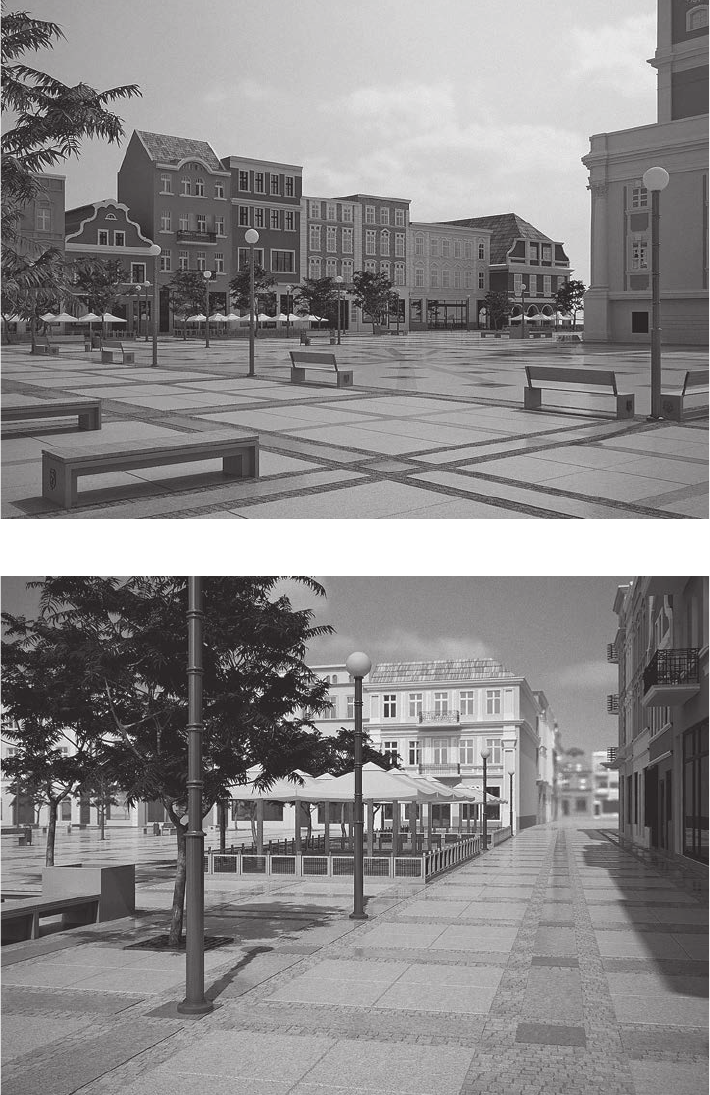
Fig. 9. Visualization
of the “Forum of Attractions”
and small architecture structures
and equally important tourists. A modern market square
is no longer only a place for commercial trading; it is
primarily a meeting place for the citizens to integrate
and have fun. The ‘city salon’ is also an ideal place for
presentation of the city culture, its history, and tradition.
Over the last few decades, the history of this place has
developed in the market space in Leszno the functions
contributing to creating there a cultural and entertainment
center.
Fig. 10. Visualization
of the “pedestrian street mall”
along the market square sides
126 Robert Masztalski, Paweł Pach
References
[1] Czerner R., Zabudowy rynków. Średniowieczne bloki śródrynkowe
wybranych dużych miast Śląska, Ocyna Wydawnicza PWr., Wrocław
2002.
[2] Domaradzki K., Urbanistyka dla architektów, czyli ciągłe nieporo-
zumienie, [in:] Architektura-Murator, No. 10, 2006.
[3] Koncepcja urbanistyczno-architektoniczna dla terenu rynku w Lesznie
– development plan commissioned in 2009 by the City Ofce in
Leszno from a team of designers: Wrocław University of Technol-
ogy, Professor Robert Masztalski, D. Eng., Arch, Ewa Masztalska,
M. Eng., Arch., Paweł Pach, M. Eng., Iwona Olanin, M. Eng. and
Łukasz Truchalski, M. Eng., Arch.
[4] Lubocka-Hoffman M., Miasta historyczne zachodniej i północnej
Polski. Zniszczenia i programy odbudowy, Bydgoszcz 2004.
[5] Topolski J. (ed.), Historia Leszna, Leszno 1997.
[6] Wróblewska G., Rozplanowanie nowożytnych miast wielkopolskich
od XVI do końca XVIII wieku, Warszawa–Poznań 1977.
Przekształcenia przestrzeni urbanistyczno-architektonicznej rynku leszczyńskiego
na przełomie XX i XXI wieku
Dynamiczny rozwój Leszna po drugiej wojnie światowej wiązał
się ze zmianami sposobu kształtowania przestrzeni jego rynku. Rynek
miasta średniej wielkości, jakim jest Leszno, będący częścią żywej, wciąż
zmieniającej się tkanki miejskiej ośrodka o znaczeniu regionalnym, pod-
legał przekształceniom estetycznym i politycznym, które zdarzyły się na
przełomie XX i XXI wieku w Polsce. Miasto, w latach 1975–1999 było
stolicą województwa, co w znacznej mierze przyczyniło się do zmiany
wizerunku rynku. Historia tego miejsca w ostatnich kilkudziesięciu latach
wyodrębniła w przestrzeni rynku leszczyńskiego funkcje przyczyniające
się do tworzenia tu centrum kulturalnego i rozrywkowego miasta. W świe-
tle owych przemian podejmowane współcześnie działania modernizacyjne
rynku zdają się mieć jedynie charakter „kosmetyczny”, czyli wyłącznie
porządkujący. Bardziej zdecydowane działania pozostają wciąż wyłącznie
w sferze koncepcyjnej.
Key words: Leszno, market square, urban transformation Słowa kluczowe: Leszno, rynek, przekształcenia urbanistyczne