Issue 2(86)/2026
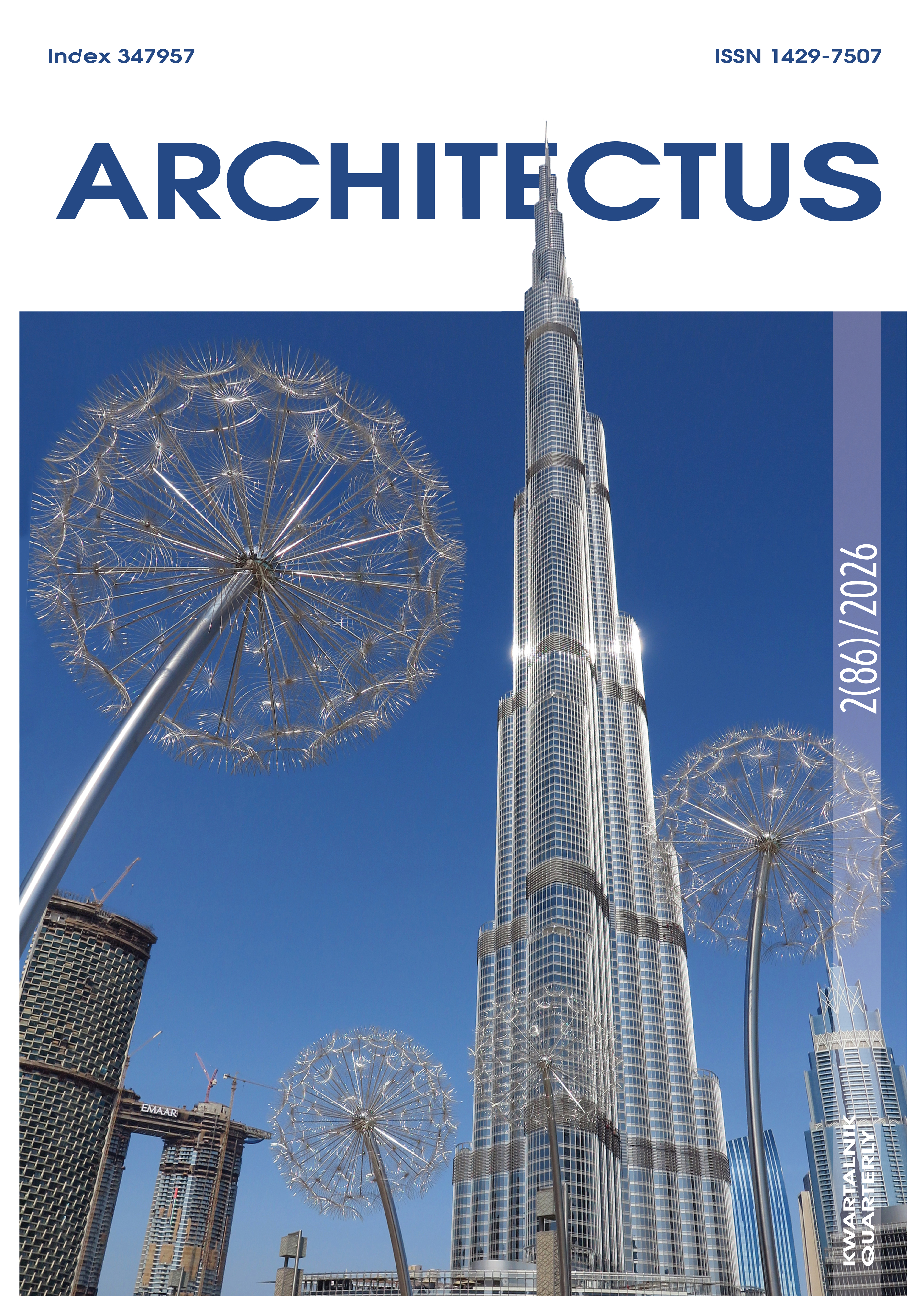
Table of contents
Open table of contents
- Cecilia Luschi, Marta Zerbini, Alessandra Vezzi, Novella Lecci - The ancient practice of reuse. From the Roman viridarium to the medieval church in the old Ashkelon (Israel)
- Jan Feliks Tomczyk - A sacred monument of the family. Unusual architectural sculpture of the Church of Our Lady of Sorrows in Nowa (Bolesławiec Municipality)
- Maria Jolanta Sołtysik - Gdynia Modernist City Centre as a UNESCO World Urban Heritage
- Ewa Angoneze-Grela, Diogo Tadeu Vargas Horvath - Jorge Zalszupin: between Brazilian Modernism and its alternative interpretations
- Yuriy Kryvoruchko - Architecture of new cathedrals in Ukraine
- Judit Lopez-Besora, Helena Coch, Antonio Isalgue - Adaptation and reuse of buildings: how do traditional and contemporary buildings perform thermally under real-world operating conditions?
- Barbara Widera, Katarzyna Chojnacka, Dionysia Kolokotsa, Marco Marseglia, Edoardo Brunelli, Tommaso Celli, Francesco Cantini, Jagoda Mrzygłocka-Chojnacka, Kajetan Sadowski, Carmelo Carbone, Francesca De Filippi, Aikaterini Lilli - Societal dimension of street furniture in European neighbourhoods
- Małgorzata Neumann, Adriana Krupa - Architectural standards of public kindergartens in Warsaw and supportive design for children’s development
- Mirosław Struzik, Jakub Skowron - Multiplication of forms in contemporary monumental sculpture
Articles
Cecilia Luschi, Marta Zerbini, Alessandra Vezzi, Novella Lecci - The ancient practice of reuse. From the Roman viridarium to the medieval church in the old Ashkelon (Israel)
doi:10.37190/arc260201
This study analyses the architecture and function of Santa Maria in Viridis in ancient Ascalona. Research by the AskGate Mission revealed that the medieval church reused a Roman viridarium with a complex water system and nymphaeum, transforming a space expressed through pagan architectural language into one marked by a Christian apse.
Keywords:
Download article
Jan Feliks Tomczyk - A sacred monument of the family. Unusual architectural sculpture of the Church of Our Lady of Sorrows in Nowa (Bolesławiec Municipality)
doi:10.37190/arc260202
The church in Nowa is distinguished among medieval rural churches of the former Duchy of Świdnica and Jawor by the richness and ideological programme of its stone sculpture. The study dates its construction to 1406–1423, identifies Nickel Hocke and Hedwig of Borsnitz as probable founders, and relates its exceptional heraldry to the family’s status, ambitions, and intended use of the church as a family necropolis.
Keywords:
Download article
Maria Jolanta Sołtysik - Gdynia Modernist City Centre as a UNESCO World Urban Heritage
doi:10.37190/arc260203
The article assesses the significance of Gdynia Modernist City Centre in global urban planning and architecture as part of its UNESCO World Heritage nomination. The findings identify it as an outstanding interwar downtown built from scratch and support its nomination under Criterion IV as an illustration of a significant stage in human history.
Keywords:
Download article
Ewa Angoneze-Grela, Diogo Tadeu Vargas Horvath - Jorge Zalszupin: between Brazilian Modernism and its alternative interpretations
doi:10.37190/arc260204
This study examines the architecture of Polish-Brazilian architect Jorge Zalszupin, particularly his residence in Guarujá, in relation to his biography and professional context. It demonstrates the hybrid character of his work, combining the carioca and paulista schools of Brazilian modernism with European Modernism and its alternative forms.
Keywords:
Download article
Yuriy Kryvoruchko - Architecture of new cathedrals in Ukraine
doi:10.37190/arc260205
The article identifies three fundamental archetypes of Ukrainian church architecture: the Princely tradition, Ukrainian Baroque, and the modern-era National Style. It argues that contemporary cathedrals should reinterpret these traditions through an authentic architectural language that integrates theological tradition, national identity, and contemporary culture rather than reproducing historical styles.
Keywords:
Download article
Judit Lopez-Besora, Helena Coch, Antonio Isalgue - Adaptation and reuse of buildings: how do traditional and contemporary buildings perform thermally under real-world operating conditions?
doi:10.37190/arc260206
Three years of continuous monitoring compared traditional and contemporary construction systems under occupied and unoccupied conditions. Differences between the systems were relatively minor, while occupancy had the dominant effect, indicating that traditional Mediterranean buildings can achieve thermal performance comparable to modern construction through targeted refurbishment.
Keywords:
Download article
Barbara Widera, Katarzyna Chojnacka, Dionysia Kolokotsa, Marco Marseglia, Edoardo Brunelli, Tommaso Celli, Francesco Cantini, Jagoda Mrzygłocka-Chojnacka, Kajetan Sadowski, Carmelo Carbone, Francesca De Filippi, Aikaterini Lilli - Societal dimension of street furniture in European neighbourhoods
doi:10.37190/arc260207
The article examines street furniture as a social interface that shapes accessibility, perceived safety, thermal comfort, and age-friendly use of public space. Evidence from European case studies shows that accessible design, shading, cooling, lighting, and participatory co-design can strengthen inclusion, place attachment, and shared responsibility for neighbourhood environments.
Keywords:
Download article
Małgorzata Neumann, Adriana Krupa - Architectural standards of public kindergartens in Warsaw and supportive design for children’s development
doi:10.37190/arc260208
The authors assessed ten classrooms in newly built public kindergartens in Warsaw against fifteen spatial characteristics associated with children’s development and well-being. An average of only 5.7 indicators were met, identifying design gaps and potential directions for systemic changes in Polish preschool design practice.
Keywords:
Download article
Mirosław Struzik, Jakub Skowron - Multiplication of forms in contemporary monumental sculpture
doi:10.37190/arc260209
The article examines multiplication of spatial forms as a strategy in contemporary monumental sculpture through realised commissions and photovoltaic concepts by Mirosław Struzik. It identifies the scaling of natural motifs, fractal modular replication, and perceptual multiplication as key mechanisms, tracing an evolution from purely aesthetic applications towards sculptures with energy-generating functions.
Keywords:
Download article