
2010
Nr 2(28)
The process of building the Central Industrial Region
(COP) was preceded by a period of intensive investments
aimed at improving the living conditions of the citizens
of the reborn state. The period from November 1918
until 1922 can be described as the time of building the
economic basis of new Poland. It was during this dif-
cult time that the administration and army were created
from scratch, provision control was organized by the state
and the agriculture and industry were reconstructed after
the war destruction. The basis for the state development
policy was formed. New migration processes from rural
areas to cities occurred. Despite all these activities, not
all the regions of the state developed equally. The rst
problems with the balanced level of life on the whole ter-
ritory of Poland began to appear. The basic components
of a change in the image of Poland were the agricultural
reforms and the reconstruction of the Polish industry. The
year 1923 can be treated as the end of the postwar indus-
trial reconstruction. The years of hyperination slowed
down these reconstruction processes, but very soon a sta-
bilization was achieved due to the scal reforms. In 1927
the government exempted the enterprises created or de-
veloped in Gdynia harbor from taxes and fees. In 1928
Poland reached the highest level of the industrial produc-
tion and the lowest unemployment.
The successful development of the country was in-
terrupted by the world economic crisis which appeared
in Poland in 1929. Starting from 1932 we can observe
a gradual growth in factory production whereas after 1935
there was a visible acceleration in production.
After the experiences of the Polish-Soviet war, in 1921
General Kazimierz Sosnkowski came up with the propos-
al to locate the Polish arms industry in the so called secu-
rity triangle, i.e. in the area of Sandomierz in the forking
between the Vistula and San rivers. The years 1923–1929
saw the newly erected arms industry plants on the areas
of the Old-Polish industrial region (Skarżysko, Radom,
Starachowice, Ostrowiec Świętokrzyski, Pionki).
Elżbieta Przesmycka*
Architecture of industrial complexes
of the Central Industrial Region (COP) in south-east Poland
Introduction.
Economic conditions of the Second Polish Republic
Central Industrial Region
In 1928 the concept of creating the central industrial
region was taken up again. It was then that special tax re-
liefs for the enterprises created and acting in the so called
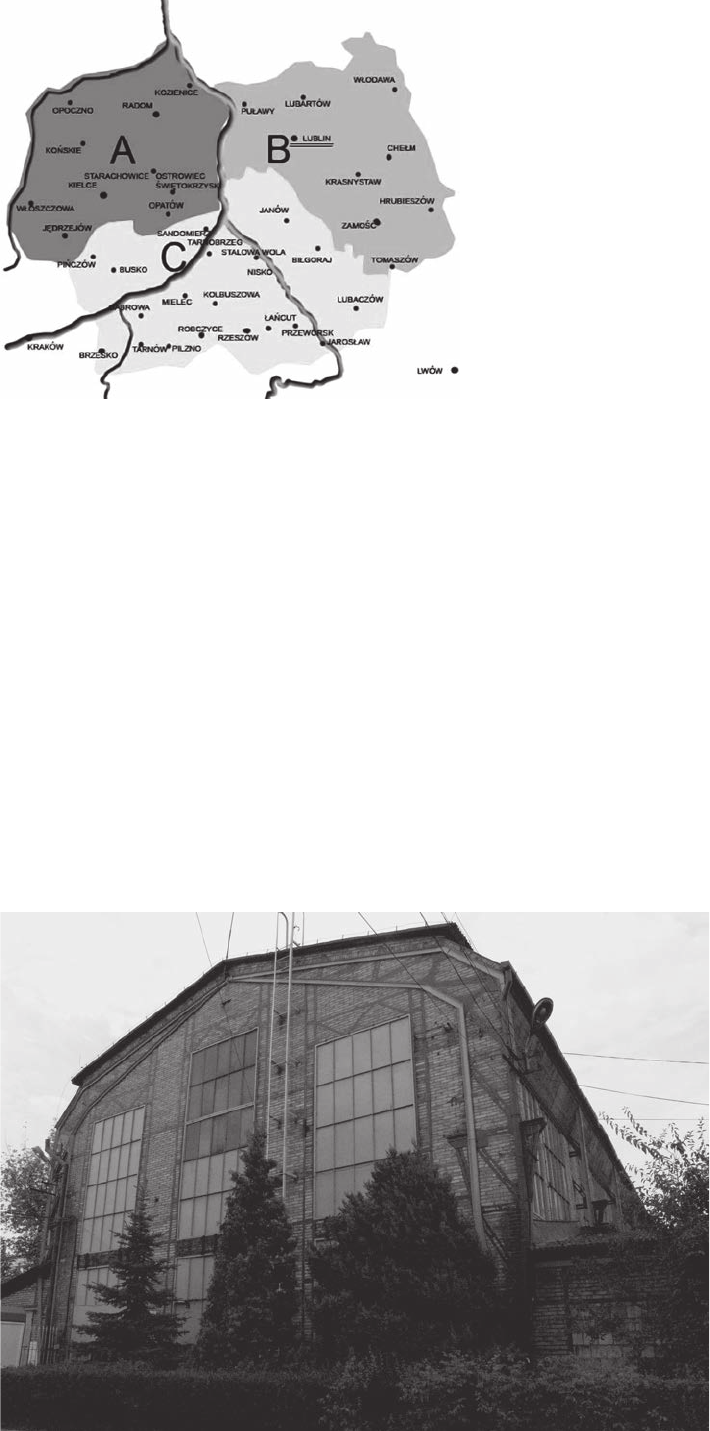
security triangle were granted. The COP was divided into
three regions: ‘A’ – Kielce resource region, ‘B’ – Lublin
provision region, ‘C’ – Sandomierz processing region – the
area in the forking between the Vistula and San rivers. The
planned borders of the COP underwent some changes and
nally they included forty four counties within the area of
four districts: Kielce, Kraków, Lublin and Lvov and com-
prised them only partially (Fig. 1, see p. 156) [2, 6].
Location of the COP resulted from a relatively great
geographical distance from Germany and USSR as well
as from the willingness to eradicate the geographical dif-
ferences between the territories of west and central Po-
land (the so called Poland A) and under-developed ter-
ritories of east and south Poland (the so called Poland B).
*
Wrocław University of Technology, Faculty of Architecture.
160 Elżbieta Przesmycka
The area of the region comprised 15% of the country’s
territory and 18% of the population. This idea could not
be quickly carried out due to the world economic crisis.
Its implementation was not possible until 1937 when
a new Treasury Minister Eugeniusz Kwiatkowski was ap-
pointed. Poland had to develop its own industrial sector
because only thanks to the own modern national indus-
try was it possible to provide the army with the neces-
sary technical equipment as importing the arms always
depended on the international political situation; on the
other hand, it was necessary to create working conditions
for the young people who were growing in number and
solve unemployment problems in towns as well as prob-
lems with rural agrarian overpopulation. Therefore, new
workplaces were constantly in great demand.
Eugeniusz Kwiatkowski prepared a four-year eco-
nomic plan comprising the period from 1936 to April
1940, which assumed the funding of investments mainly
in the scope of the infrastructure.
Within the framework of the COP, many architectural
objects were started or accomplished. As for the power
industry, construction works on the water power plant in
Rożnów were started as well as on the power plants in
Stalowa Wola, Mościce, Poręba, Starachowice and Lub-
lin. The power system was to be supported by the local
water power plants. At the same time, high voltage lines
connecting the particular COP plants with one another
and with Warsaw were developed. Also, a network of gas
piping was created. New railways were started to be built,
trafc capacity of 69 railway stations was increased and
ten new railway station halls were built. 1300 km of new
telecommunication connections were constructed, roads
were improved and works were begun in a water connec-
tion between Silesia, Sandomierz and Stalowa Wola.
While carrying out the program of the COP, many in-
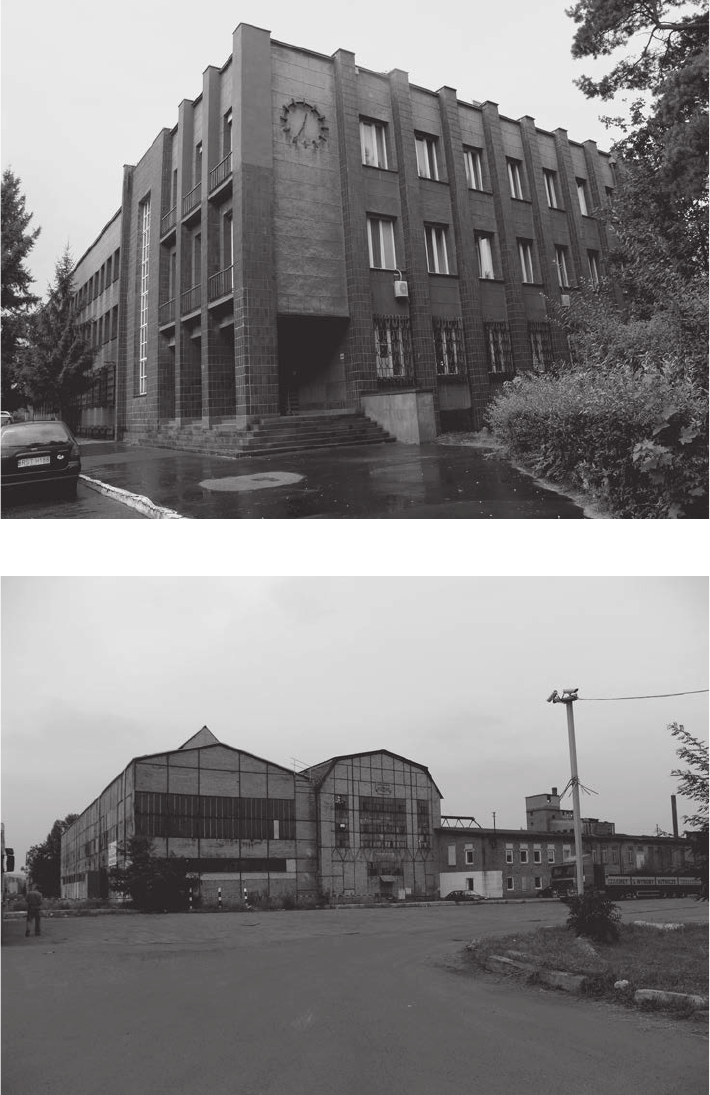
dustrial plants were started and completed. In Staracho-
wice, the factory producing cannons and ammunition was
developed (Fig. 2), in Radom an arms factory was built,
in Rzeszów H. Cegielski Machine Tool Factory which
was also supposed to produce 37 and 40 mm cannons,
Aircraft Engine Factory, Leszczyński light alloy foundry
and head-light factory. In Sanok M. Zieleniewski Arms
and Machine Tool Factory was built. A plane factory was
built in Mielec. In Dębica ‘Stomil’ Tyre Factory, Articial
Rubber Factory and Meat Processing Factory were built.
In Pustków an explosives, igniting devices and model-
ling paste factory was built and in Pionki Gunpowder
and Crushing Materials Factory was erected. A gunpow-
der factory was built in Krajowice, semi-precious metals
foundry in Gorzyce, colour metals rolling mill in Pusty-
nia, ammunition factories in Majdan-Dąb and Jawidz,
Fig. 1. Central Industrial Region (COP) boundaries.
Photo by author, 2009
Fig. 2. Starachowice,
factory of ammunition.
Photo by author, 2009
Architecture of industrial complexes of the Central Industrial Region (COP) in south-east Poland 161
chemical works ‘Nitroza’ in Sarzyn, cellulose factory in
Niedomice and a sawmill in Sędziszów Małopolski. In
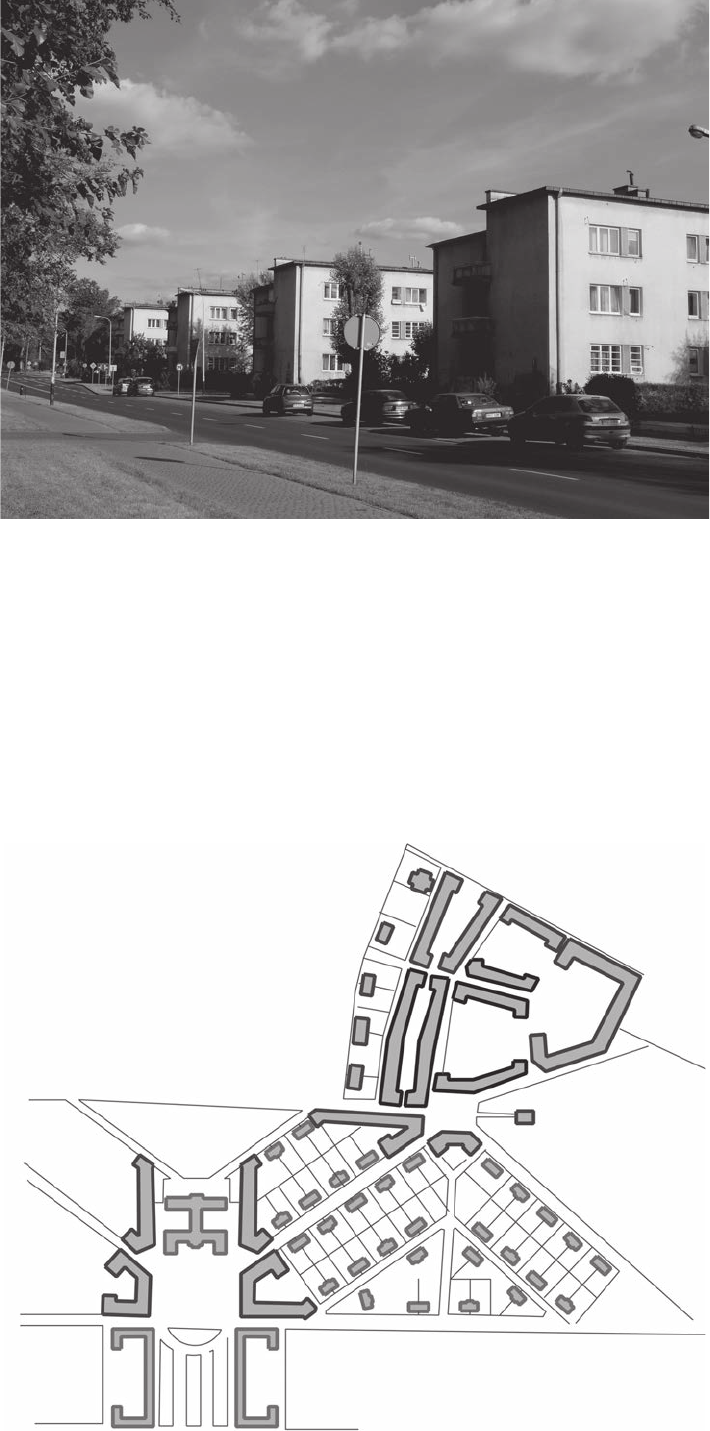
Mościce Nitrogen Plant was developed. In Stalowa Wola
works on Steel Plant along with a cannon factory were
commenced (Fig. 3) [13].
In Tarnobrzeg a copper renery was built. Mili-
tary Rocket Factory and magnet factory were created in
Bliżyn. A porcelain factory was built in Boguchwał. In
Sanok a factory producing storage batteries was built.
Such factories producing storage batteries were also
built in Łańcut and Tarnobrzeg. In Lublin a plane factory
‘Plage i Laśkiewicz’ was created as well as a gas mask
and barbed wire factory and works on a truck factory li-
cenced by General Motors were started [12]. In Kraśnik
a bearing factory was built and in Kurów a leather plant
was erected. An armoured tower foundry was built in Os-
trowiec Świętokrzyski (Fig. 4).
Near Dębica works were started on a copper and alu-
minum rolling mill while in Poniatowa a technical materi-
als and apparatuses factory was commenced.
In all of these places, the speed of carrying out the
investments was impressive. In the so called Southern
Works (Stalowa Wola) at the end of March workers start-
ed cutting down trees at the place of the future investment
Fig. 3. Stalowa Wola,
the management building.
Photo by author, 2009
Fig. 4. Ostrowiec Świętokrzyski,
the foundry of armored
towers building.
Photo by author, 2009
162 Elżbieta Przesmycka
and already in December 1937 the rst machine tool was
produced, in April 1938 the rst cannon red at the plant
shooting range and in December 1938 the rst precious
steel was melted down.
The building of the so called COP became the great-
est economic enterprise of the Second Republic. Today,
when assessing the implementation of these projects, we
can state that some structures which survived until today
reect the process of a comprehensive change in lifestyles
of many people. We cannot analyse the industrial build-
ings with no reference to the accompanying processes of
erecting residential estates, usually called colonies, along
with the necessary infrastructure.
The building of factories in the COP was accompanied
by residential buildings for the employees. In total, about
7100 residential buildings were started or accomplished.
Residential colonies for physical workers as well as es-
tates for ofce workers were built (Fig. 5).
Fig. 5. Stalowa Wola.
Factory workers district.
Photo by author, 2009
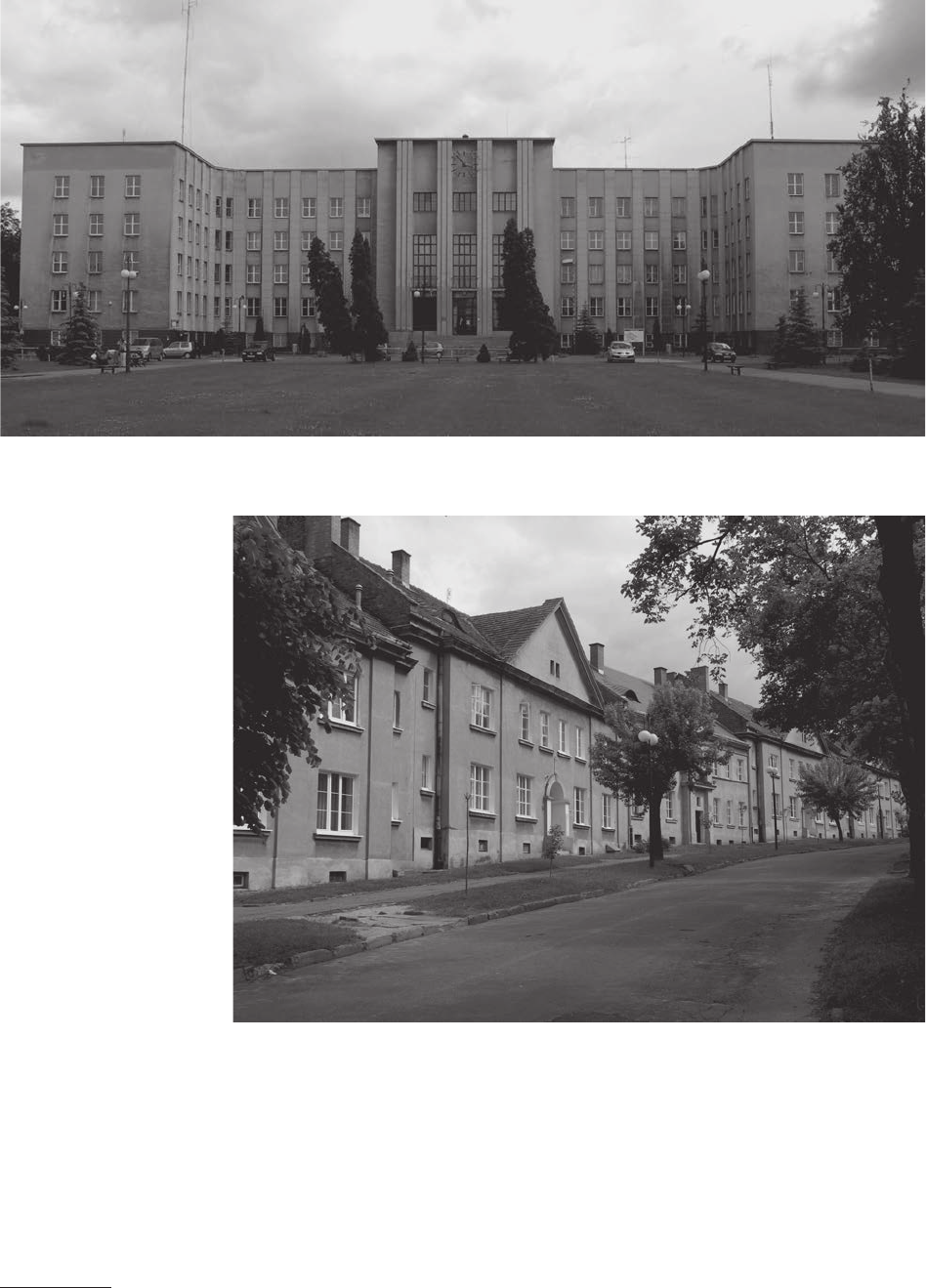
Fig. 6. Chełm. “The New City”
design, area 430 ha (arch. Adam
Kuncewicz, Adam Paprocki),
so called “The management”
for the railway workers which
were supposed to move there from
Radom (realisation 1926–1939).
Drawn by author [7]
Architecture of industrial complexes of the Central Industrial Region (COP) in south-east Poland 163
In 1926 the Polish authorities decided to transfer the
Polish State Railways Headquarters from Radom to Chełm
as it was situated more centrally within the present state
borders. Consequently, the local authorities ordered a land
development concept of a new railway district. The project
of ‘New Town’ was prepared by the architects Adam Kun-
cewicz and Adam Paprocki for the area of 430 hectares
1
.
1
Kuncewicz A., Paprocki A., Opis techniczny do szkicu rozbudowy
miasta Chełma, 1926.
The project implementation was started with building
a colony for ofce workers, the so called ‘Head Ofce’ for
the railway workers who were to move in here from Radom
(Fig. 6) [5, 7].
Lack of funds caused by the economic crisis and
a change of the government decision as to locating the
Railways Headquarters on the territory of Chełm sig-
nicantly extended the project. It was only in 1938 that
a modern estate was built with an explicit urban compo-
sition with residential buildings in the style of ‘eclectic
modernism’ mixed with national motifs. The develop-
Chełm
Fig. 8. Chełm,
a residential colony (1938).
Photo by author, 2009
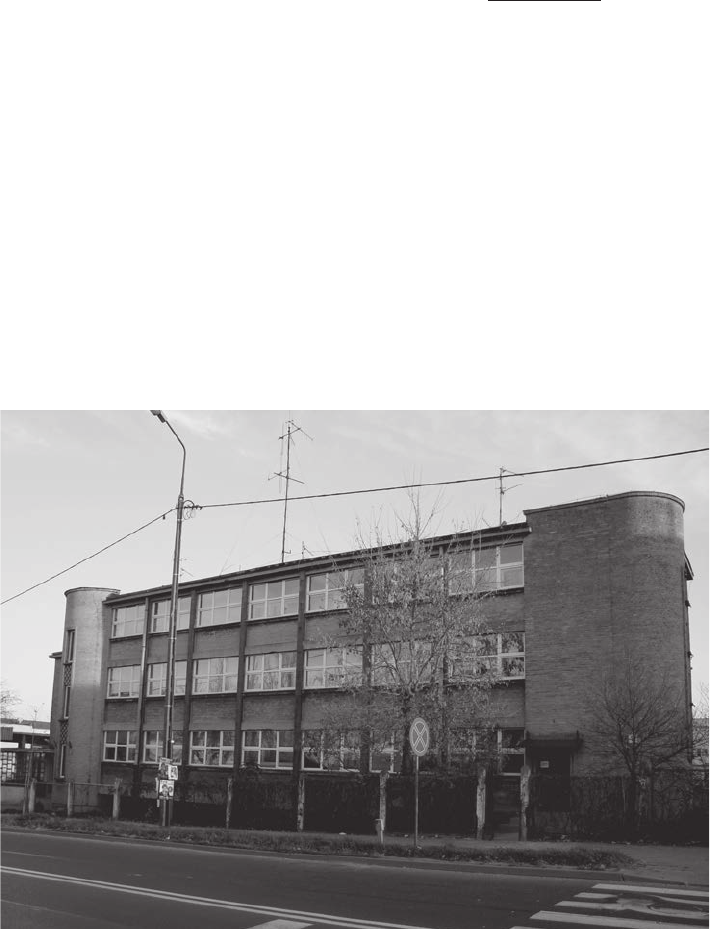
Fig. 7. Chełm, building of “the management of the state railways” (1938) designed by Henryk Gay. Photo by author, 2009
164 Elżbieta Przesmycka
ment plan of New Chełmno which was carried out from
1926 until the outbreak of the World War II was accom-
plished only partially. In accordance with the program
of the Ministry of Transportation, the area of 50 hec-
tares, situated east of the old town, was designated for
the needs of the investment; the land was given by land
owners for the benet of the state treasury. The axis of
the architectural structure was the Edice of ‘Head Of-
ce’ designed by Henryk Gay. Its modern form was very
different from the residential buildings which had been
erected some time before. It was designed on the pro-
jection of the letter H closing the axis of the main av-
enue which connected the railway station with the town
(Fig. 7) [9].
The residential colony consists of one-storey houses
with a utility attic and two-family houses whose form re-
fer to the Polish mansions as well as two-storey multi-
family houses and 3-storey blocks of ats situated in the
frontages of the main avenue
2
. All the residential build-
ings are equipped with characteristic high mansard roofs
covered with ceramic tiles having various fronton solu-
tions
3
(Fig. 8) [11].
2
According to the project, there were plans to build 533 ats in
dense development with an average at size of 94,5 m
2
(the smallest were
two-room ats of the area of 70 m
2
, then three-room ats of the area of
90 m
2
and the biggest ones – four-room ats of the area of 120 m
2
). In
addition to this, in 30 twin houses there were designs of 60 ve-room
ats of the area of 150 m
2
while in 3 twin houses 6 six-room ats of the
area of 175 m
2
. Together with the chairman’s house (not completed), 600
ats were planned to be built (State Railways Head Ofce Development
1929). Despite the numerous nancial difculties, the program of the
railway estate was carried out almost in full.
3
Przesmycka E., Pytlarz E., Chełm – „Nowe miasto”, modernisty-
czne założenie urbanistyczne, Teka Komisji Architektury, Urbanistyki
i Studiów Krajobrazowych, PAN/O Lublin, tom IVA, Lublin 2008,
pp. 244–260.
Lublin
The fact of including the southern part of Lublin Prov-
ince as a provision region into the program of the Central
Industrial Region in 1936 contributed to the development
of the agriculture and food industry plants existing in
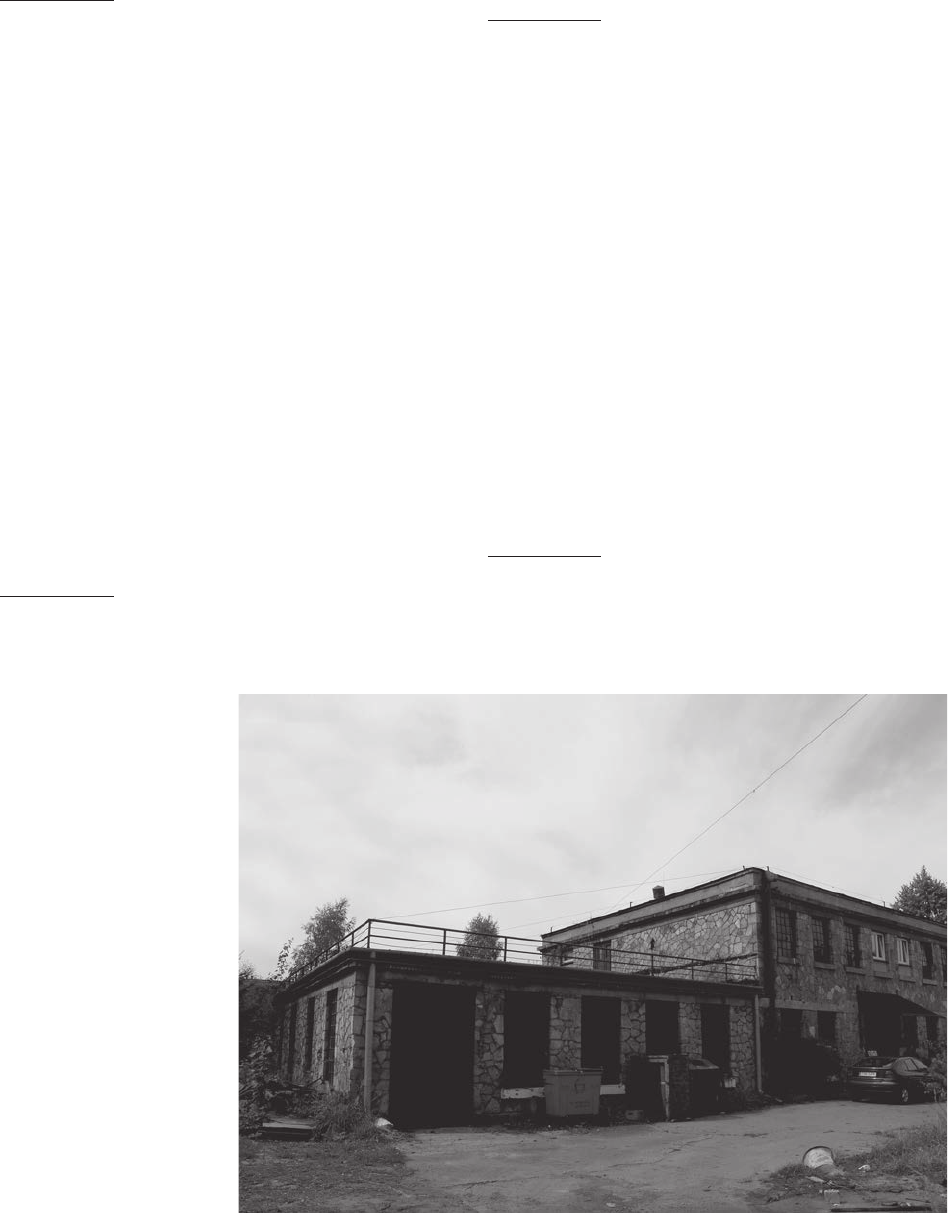
Lublin (mills were extended, a new slaughterhouse was
built and cold storage and tobacco plants were erected.
From 1930 the slaughterhouse facilities were partly tak-
en on lease by the company Poels & Co – producers of
tinned food. Due to this action, the slaughterhouse was
extended by another facility in the years 1936–1938
(Fig. 9).
Apart from the agriculture and food industry plants,
also various military sector works were built in Lublin.
The most important plant in Lublin was the Aeroplane
Factory (which continued the activities of the liquidated
plant Plage i Laśkiewicz. The rst planes were produced on
the Italian licence. They were monoplane ghters ‘Balilla’
– about 100 pieces were made and line biplanes ‘Ansaldo’
– about 120 pieces were produced. They were made for
the army. These planes were infamous because they were
very accident-prone. The airport, air-sheds and new pro-
duction halls covered the area of about 14 hectares. The
plane factory was situated at the junction of the transit
road to Zamość and the railway line on the route Warsaw
–Kowel and comprised more than 20 structures, among
other things: four brick air-sheds, one wooden air-shed,
Fig. 9. Lublin.
The ofce building of the city
slaughterhouse from 30-ties.
Photo by author, 2010
Architecture of industrial complexes of the Central Industrial Region (COP) in south-east Poland 165
workshops, warehouses, ofce buildings and auxiliary
facilities
4
.
The factory had its own railway side-tracks. In 1935
the company was nationalized and transformed into Lublin
Plane Factory producing mainly RWD-14 planes. A few fac-
tory facilities are preserved until today: air-sheds, workers’
residential building and construction ofce dating back to
the 1930s (according to the design by Tadeusz Paprocki).
4
Kierek A., Rozwój gospodarczy Lublina w latach 1918–1939, [in:]
Dzieje Lublina, t. II, S. Krzykała (ed.), Wydawnictwo Lubelskie, Lublin
1975.
The air-shed buildings are especially interesting.
Due to their particular function, large size constructions
had to be employed. Therefore, the most recent tech-
nological ideas appeared and they were characterized
by simplicity and neness of technological solutions.
The most characteristic one is the air-shed building pre-
served until today in the reinforced concrete construction
5
[10, 12].
5
Radzik T., W latach dwudziestolecia międzywojennego, [in:] Lublin
dzieje miasta, t. II, Lublin 2000.
Skarżysko-Kamienna
In 1922 in Warsaw the Design Bureau of Military
Production Central Management was created. This in-
stitution’s task was, among other things, preparation of
design documentations of the three big modern ammu-
nition factories based on the modern technologies; they
were completed thanks to receiving a nancial loan from
the French government. These factories were: Ammuni-
tion Factory in Skarżysko, Gunpowder Factory in Pionki
and arms factories in Radom. This region was referred
to as the security triangle
6
. In the subsequent years,
the main role in creating military sector factories was
played by the Military Production Central Management
in Warsaw. The budget of this institution was decided
by the Minister of Military Affairs in cooperation with
6
Juchnowicz B., Szkice o państwowej Fabryce Amunicji w Skar-
żysku-Kamiennej w latach 1922–1939, typescript.
the Treasury Minister in form of the so called additional
budget
7
[2, 8].
The location of the Ammunition Factory in Skarżysko
was decided long before the creation of the COP. It result-
ed from the analyses of the results of using military planes
during the First World War. That is why the factories were
located in hidden places in forests, but close to the rail-
way tracks. At the same time, these objects were perfectly
masked in case of air raids because the factory buildings
were specically planned in a form that was similar to the
urban systems of residential estates with streets and addi-
tionally planted trees if necessary as well as with roofs that
were masked by various plants growing there. There was
even a plant cultivation department with a gardener
8
[4].
7
Dziennik Nr 21 Rozkazów Ministerstwa Spraw Wojskowych z dnia
5 czerwca 1923 roku.
8
Kotarba Z.P., 1924–2004 Monografia Zakładów Metalowych
MESKO S.A., Skarżysko-Kamienna, 2004.
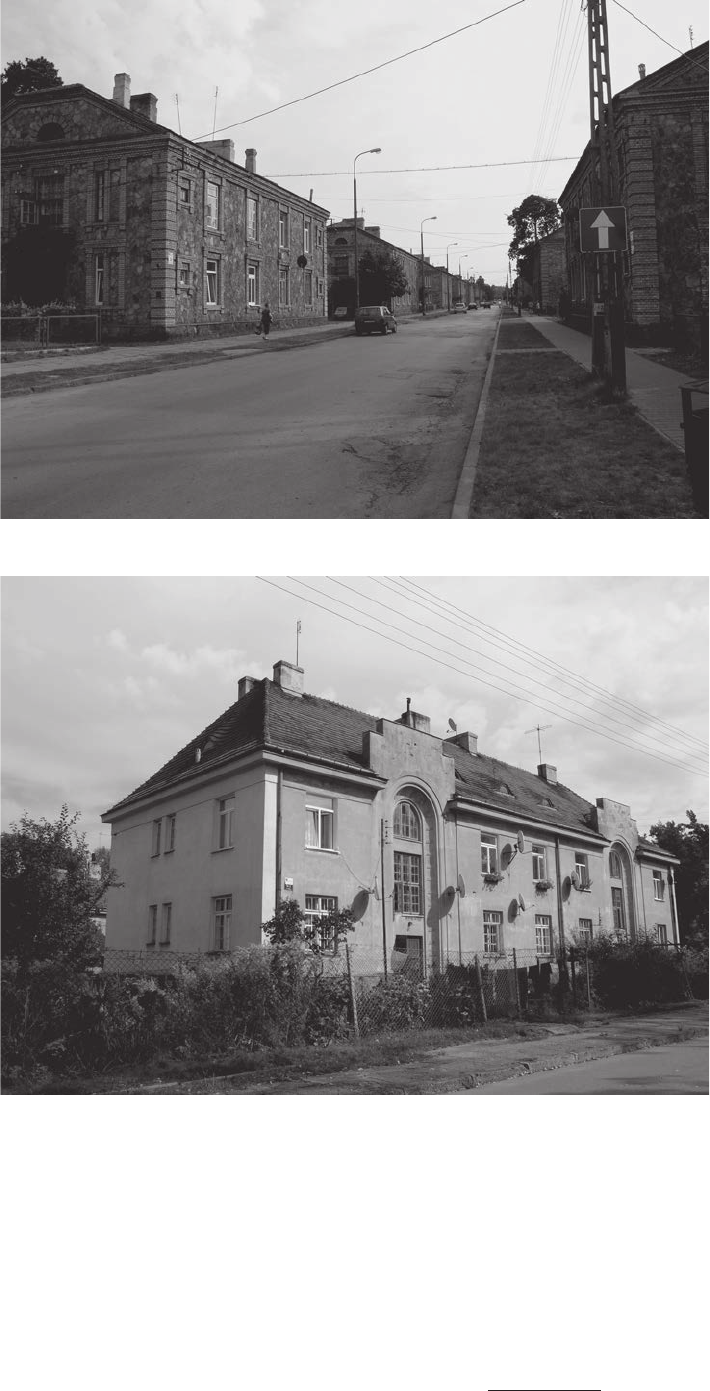
Fig. 10. Skarżysko-Kamienna.
The remains of postindustrial
buildings of State Factory
of Ammunition (PFA) localized
in the forest. Its urban layout
is specic for residential
with street planted with trees
and roofs covered by greenery.
Photo by author, 2010
166 Elżbieta Przesmycka
The factory buildings were erected by means of a frame
construction with the use of a steel girders. The most often
used material was sand brick and in the buildings with the
supporting structure of reinforced concrete the walls were
made of sand brick and joint sandstone plates (which is
identical with the façade nishing technologies employed
in residential buildings) (Figs. 10, 11).
The residential estates accompanying the factories
were located in their vicinity so that the employees did
not have to commute long to get to work. The urban sys-
tem forms of these estates as well as their architectonic
expression referred to the factory complexes.
In these factories, apart from military sector production,
civil products were also made because the factory capaci-
ties were higher than the demands from the army. Until
1939 in Skarżysko the factory produced machines, market
devices and articles as well as car parts for Polish Fiat
9
.
In the years 1938–1939 also ammunition, detonators
and air bombs were produced. Shooting took place in
a special closed factory shooting range.
9
In Radom bicycles were produced, a gun factory additionally
produced typewriters and in Stalowa Wola turbines were produced.
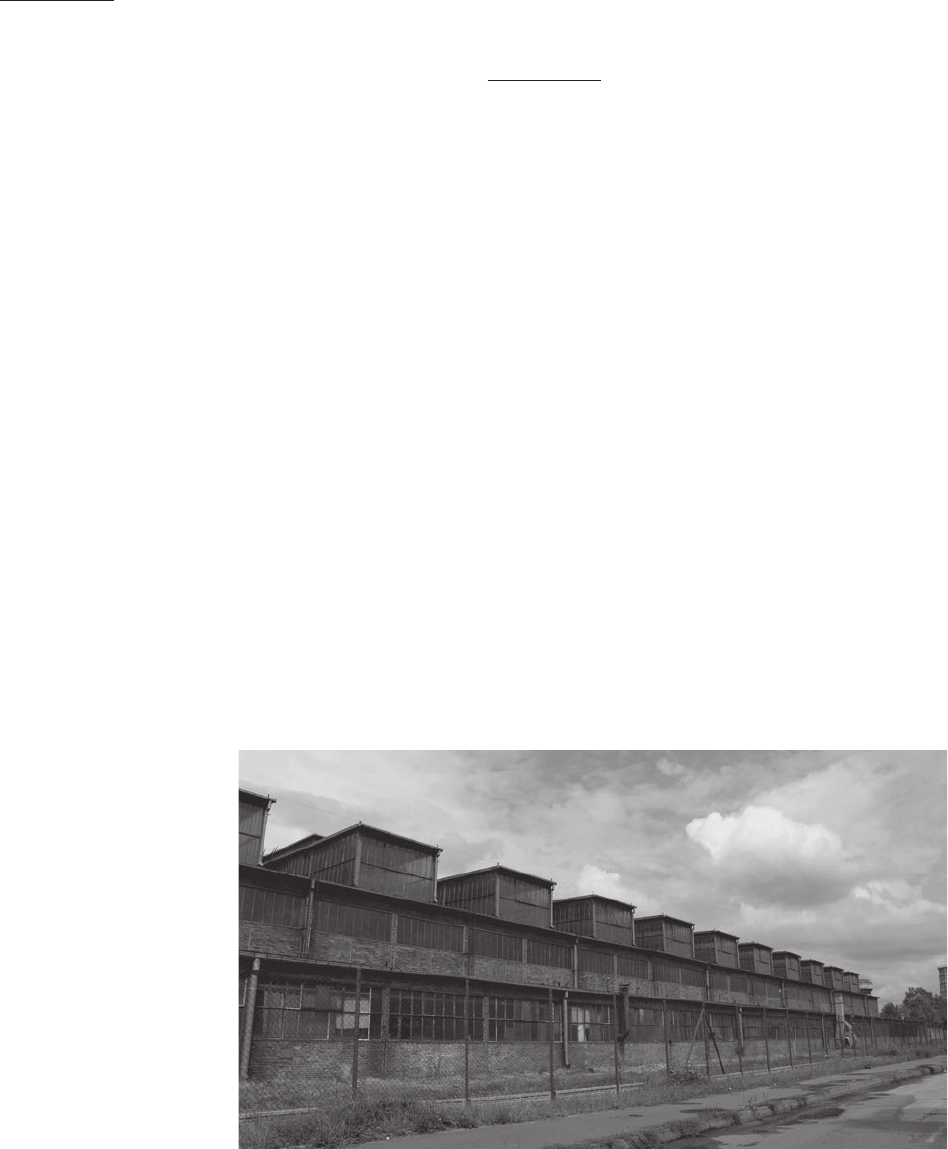
Fig. 11. Skarżysko-Kamienna.
A housing district built in the steel
frame construction system. Photo
by author, 2010
Fig. 12. Skarżysko-Kamienna.
Different types of housing
estate – Skałka (1934)
and Ofcial Colony (1924, 1925).
Photo by author, 2010
Architecture of industrial complexes of the Central Industrial Region (COP) in south-east Poland 167
In 1923 construction works were started on residential
houses for the management members in Kolonia Górna. In
1924 the building of the rst barrack was nished on Armii
Ludowej Street – this served as the director’s ofce. At the
same time, building works were conducted on an ofce, re-
station and factory buildings of the Military Rocket Plant. In
the distance of circa 1 kilometer from the factory residential
estates were built – Ofce Workers’ Colony
10
and Workers’
Colony
11
. In the subsequent years, several more barracks
and residential houses were erected (Fig. 12).
10
Estate for Ofce Workers (1924–1925) consisted of 10 two-storey
houses made of brick, in total 24 four-room ats, 18 ve-room ats,
8 six-room ats and 1 nine-room at.
11
In 1923 in Factory Workers’ Colony there were already 34 one-sto-
rey houses with tiled roofs, equipped with running water, WC, basements
and gardens. In ten houses there were 19 one-room ats, 210 two-room
ats, 19 three-room ats, 24 four-room ats (in total 272 ats).
Most of the buildings were made of sand brick with the
employment of joint sandstone plates for nishing façades.
Their architectonic form resembled ‘modernised’ tene-
ment houses, while the smaller ones referred to the national
forms. A very interesting form can be seen in the complex
Kolonia Rejów built as barracks situated on a hill slope
12
.
In 1934 next to the Military Rocket Plant which was
built in 1929 a residential estate was built and it was called
Skałka. The factory and the estate were surrounded by
a high barbed wire fence.
Concurrently with the factory and residential houses,
other building were also erected such as schools, kinder-
gartens, outpatient clinics, clubs, cinemas, sports centres
and Roman Catholic churches [3].
12
Kolonia Rejów (Colony Rejów) consisted of ten barracks, each with
8 two-room ats, two one-storey brick houses with 5 three-room ats and
one four-room wooden house.
Stalowa Wola
An example of a newly created plant is the so called
Zakłady Południowe – Southern Works Limited in Nisko
– a factory centre in Stalowa Wola erected on the territory
of the former village Pławno (in the northern part of San-
domierz Forest between Nisko and Rozwadów on the river
San). The owners of the shares in the company were Huta
Pokój (Ironworks) and Starachowice. The reasons for such
location of the metallurgical and mechanical works were
economical and social conditions as well as security.
The entire project of the works was prepared by a spe-
cially appointed team of experts supervised by Engineer
Roman Juszkiewicz. The factory buildings were designed
in the frame and steel construction. Pile foundations made
of reinforced concrete under the factory structures were
made already in May 1937. It was already during the win-
ter of 1937/38 that the rst steel constructions produced in
Huta Pokój were xed. The building works were accompa-
nied by laying railway side-tracks thanks to which building
materials could be delivered, building access roads, execu-
tion of water supply system, canals and power network.
The rst steel was cast on 5 September 1938 and the whole
investment was accomplished in March 1939 (open-hearth
furnace, two arc furnaces). The total area of all the factory
industrial facilities amounted to 89.868 m². Ofcially, the
Southern Works (ZP) started work at the end of February
and at the beginning of March 1939 – all the production
departments worked in full swing then (Fig. 13) .
In spring 1938 in the vicinity of the ZP, building works
on a power station were started where the rst 20 KW tur-
bine started working on 1 May 1938. The second turbine
and two boilers started work in August 1939.
In January 1937 a decision was made as to building
aluminum works near the ZP but it did not come to pass
until the outbreak of the war.
At the beginning the builders of the ZP as well as
its employees lived in various towns and villages in the
Fig. 13. Stalowa Wola,
industrial halls of Metal
Factory in the steel frame
construction system.
Photo by author, 2010
168 Elżbieta Przesmycka
area. In 1937 rst six barracks adapted for living purposes
equipped with sewage system and water supply system
were built for employees and in June 1937 works on the
rst residential houses were begun according to the ap-
proved urban plan elaborated by Architect Rudziński.
The estate was for 20 thousand residents and later this
number was to be increased to 50 thousand people. The
construction works on the houses were to be supervised
by the Military Quartering Fund. Later on, the building
works were to be nanced by the Social Security Insti-
tution (houses already erected) and the Working Estates
Association (workers’ districts and two-family houses). In
the beginning the residential estate consisted of two colo-
nies: one for physical workers and one for ofce workers
and they were divided by railway tracks. The estate was
managed by Estate Administration and Forest and Agri-
cultural Economy. Cutting down the trees at the estate and
in the ZP required a permit from the Forest Farm.
The houses were erected ‘in series’ – several residen-
tial houses were opened for residents’ use at a time. In
total, within the period of three years until the outbreak of
the war 970 ats were built. In the course of time, the fol-
lowing colonies were created: Workers’, Masters’, Ofce
Workers’ and Directors’ (Fig. 14) [13].
In 1938 two more hotels were built with 90 rooms,
later on one more hotel with 30 rooms was built.
Also in 1938 a multi-story wooden building was erect-
ed which was to serve as a temporary outpatient clinic and
in 1939 construction works on a hospital for 400 beds were
started. In mid April 1939 the building site for a lower sec-
ondary school was marked out and the school year could
begin already on 17 September 1938. The project of a so-
cial club was prepared at the beginning of 1939 but its con-
struction was not started before the outbreak of the war. In
March 1939 W. Kubicki began building works on a cinema
but they were not accomplished before 1 September 1939.
The building of a playing eld was commenced in the
autumn of 1937 and the stadium was completed in the
spring of 1939. In the summer of 1937 tennis courts were
started. At the end of 1938 four tennis courts were ready.
These investments were nanced by the FKW.
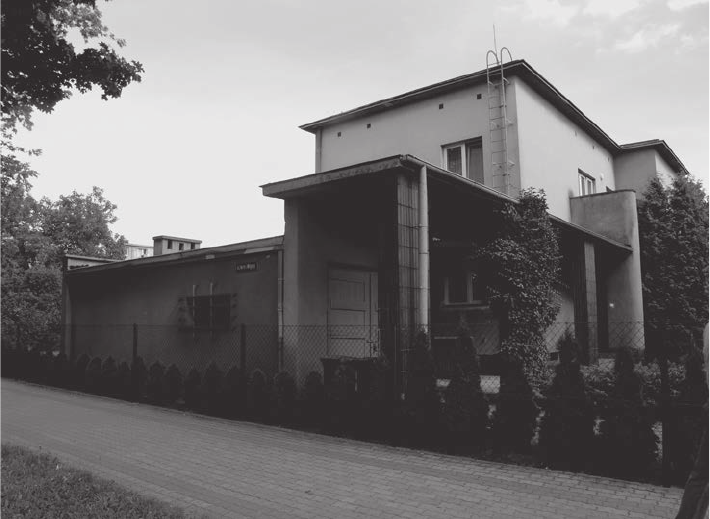
We can state that Stalowa Wola residential buildings
are the most stylistically consistent, with some features of
functionalism. The materials employed in the particular
buildings are similar, i.e. nishing façades with mineral
plaster, clinker faced pedestals, ashing sheet elements,
grating, interior terrazzo, oors and woodwork gave the
estates their consistent elegant character. The structures,
minimalist in their form and mass, create the late mod-
ernism architecture. Similar forms, although on a larger
scale, can also be noticed in the power station and metal-
lurgical works. [10]
Summary
Fig. 14. Stalowa Wola,
the building complex
of the Management Colony
(1937–1939).
Photo by author, 2010
The end of the war in 1918 and the rebirth of the Polish
state initiated the process of the economic development of
the country. It resulted in intensive investment and build-
ing activity and this inuenced the spatial development
of towns.
In most of the cases, the industrial and communal in-
vestments of that time performed their function for many
years in the future. The architectural structures located
on the outskirts of towns in the 1920s are now gradually
absorbed into the downtown zone. Economical, political
Architecture of industrial complexes of the Central Industrial Region (COP) in south-east Poland 169
and legal conditions of the recent years made these facto-
ries stop production processes and change their functions
and if there is no interest in further investment activity
of a given structure, it is abandoned which leads to its
technical death. This is what happens with the majority
of the industrial complexes discussed here. Fragmenta-
tion of these complexes which is introduced in order to
create new consistent forms of usage mostly leads to un-
controlled devastation of the buildings and physical de-
struction of those which are not needed at a given point
in time [10].
The residential buildings which accompany the facto-
ries change owners and forms of management. They un-
dergo thermo-renovation processes; roof covers as well as
window woodwork are replaced with the materials which
do not belong to the time at which the buildings were
erected. Divisions of windows are changed, risalits and
other architectural elements that are covered with heat in-
sulation materials disappear. Through the employment of
modern colours, facades of many buildings change their
articulation.
During the recent decades, right before our eyes, the
Polish architectonic style of the interwar modernism in its
regional variants has been disappearing. The architecture
of such structures, diverse as regards their size, form and
nishing materials, frequently associated with the features
of native ‘national’ architectural art, is changing its ap-
pearance and function, with no sign of respect from the
local communities.
In my opinion, it is high time we took some system ac-
tions aimed at protecting our architectural heritage dating to
the time of the rebirth of Poland. The technical condition of
the interwar buildings, despite the fact that they are already
seventy years old, is evidence of the high level of building
culture (which was lost under the Communist regime), high
technological quality as well as the employment of innova-
tive functional and spatial solutions which can still serve as
a model of rational space formation until today.
References
[1] Dzieje Lublina, Vol. II, S. Krzykała (ed.), Wydawnictwo Lubelskie,
Lublin 1975.
[2] Dziennik Nr 21 Rozkazów Ministerstwa Spraw Wojskowych z dnia 5
czerwca 1923 roku.
[3] Garbacz D., Narodziny, Stalowa Wola 1937–1939, Stalowa Wola
2005.
[4] Juchnowicz B., Szkice o państwowej Fabryce Amunicji w Skarżysku-
-Kamiennej w latach 1922–1939, typescript.
[5] KaczuraW., Struktura przestrzenna miasta Chełma, Chełm 1997.
[6] Kierek A., Rozwój gospodarczy Lublina w latach 1918–1939, [in:]
Dzieje Lublina, Vol. II, S. Krzykała (ed.), Wydawnictwo Lubelskie,
Lublin 1975.
[7] Kuncewicz A., Paprocki A., Opis techniczny do szkicu rozbudowy
miasta Chełma, 1926.
[8] Kotarba Z.P., 1924–2004. Monografia Zakładów Metalowych
MESKO S.A., Skarżysko-Kamienna 2004.
[9] Koziejowski W., Chełm – „Dyrekcja”, Studium historyczno-
-urbanistyczne, Vol. I., 1988.
[10] Przesmycka E., Problemy konserwacji architektury modernistycznej
w Polsce, Wiadomości Konserwatorskie nr 26/2009, Warszawa 2009,
pp. 415–426.
[11] Przesmycka E., Pytlarz E., Chełm – „Nowe miasto”, modernistyczne
założenie urbanistyczne, Teka Komisji Architektury, Urbanistyki
i Studiów Krajobrazowych, PAN/O Lublin, Vol. IVA, Lublin 2008,
pp. 244–260.
[12] Radzik T., W latach dwudziestolecia międzywojennego, [in:] Lublin
dzieje miasta, Vol. II. XIX i XX wiek., Lublin 2000.
[13] Stańkowski M., Myśliwiec M., Stalowa Wola, Architektura sztan-
da ro wej Inwestycji COP-u, Libra 2008, p. 28.
Architektura zespołów przemysłowych Centralnego Okręgu Przemysłowego (COP)
w Polsce południowo-wschodniej
W artykule przybliżono niektóre wybrane realizacje z obszaru Cen-
tralnego Okręgu Przemysłowego (COP) i pokazano charakterystyczne
cechy zarówno ich form architektonicznych, techniki wznoszenia, jak
i układów urbanistycznych. Do analizy wybrano reprezentatywne przy-
kłady z miast obszarów A, B, C, tj. z Lublina, Skarżyska-Kamiennej,
Ostrowca Świętokrzyskiego, Chełma Lubelskiego i Stalowej Woli.
Omówiono wybrane przykłady zabudowy związanej z tworzącym
się okręgiem przemysłowym w okresie 1918–1939. Realizując program
COP, w Polsce międzywojennej rozpoczęto i dokończono budowę wielu
zakładów przemysłowych. Po doświadczeniach wojny polsko-sowieckiej,
w roku 1921 powstała koncepcja zlokalizowania polskiego przemysłu
zbrojeniowego w tzw. trójkącie bezpieczeństwa – w widłach Wisły i Sanu.
W latach 1923–1929 w Polsce udało się zbudować kilka zakładów prze-
mysłu zbrojeniowego na terenach staropolskiego zagłębia przemysłowego.
Budowa tzw. COP stała się największym przedsięwzięciem gospodar-
czym Rzeczpospolitej. Oceniając dziś realizację tych zamierzeń, można
stwierdzić na wielu przykładach pozostałych jeszcze obiektów, iż był to
proces kompleksowej przebudowy sposobu życia wielu mieszkańców.
Budowie zakładów przemysłowych w COP towarzyszyło budownictwo
mieszkaniowe dla ich pracowników. Łącznie zbudowano lub rozpoczęto
budowę około 7100 budynków mieszkalnych. Wznoszono zarówno kolo-
nie mieszkaniowe dla robotników, jak też osiedla dla kadry urzędniczej.
Towarzyszące fabrykom osiedla mieszkaniowe lokalizowano w ich pobliżu
tak, aby pracownicy mieli blisko do pracy. Formy układów urbanistycznych
osiedli i ich wyraz architektoniczny nawiązywał do zespołów fabrycznych.
Techniki wznoszenia uwzględniały najnowsze rozwiązania konstrukcyjne,
ale jednocześnie respektowały miejscowe tradycje i materiały budowlane.
W artykule omawiono przykłady zabudowy COP powstałe w Polsce połu-
dniowo-wschodniej oraz przedstawiono ich stan zachowania.
Key words: Central Industrial Region (COP), industrial architecture,
housing, modernism
Słowa kluczowe: Centralny Okręg Przemysłowy (COP), architektura
przemysłowa, budownictwo mieszkaniowe, modernizm