2010
Nr 2(28)
Present-day issues
Introduction
rily a social space of its inhabitants. This is also where
the highest number of symbols identifying residents
with their “own space” is found. This space is certainly
shaping human attitudes and behaviours, it facilitates
building relationships, and thus affects the quality of
life.
Anna Bazan-Krzywoszańska*, Marta Skiba*
Culture of village public spaces
– exemplied by the commune of Krotoszyce
Public space is, by denition, accessible and serves
the general public. This is where intense life goes on. All
important social, cultural and symbolic objects are avail-
able in this space.
The village square is also the site of many behav-
iour patterns. Although it is a public space, it is prima-
The reach of private and commonly used spaces
In the hierarchy of spatial layout the most basic unit is
the house. Central village square is in a way second, after
the house, in line of other spaces. It is an outer space and
is commonly treated as an extension or supplement of the
house. Although every person measures space subjectively,
space regarded to be one’s ‘own’ has a dened limit, and
the owners identify themselves by taking responsibility and
caring about it [5].
Today’s country house owner perceives their space simi-
larly to an owner of a suburb or city house. They get into
their car on their driveway and go to work or school without
meeting or talking to neighbours. Reception of used space
by a rural resident has narrowed. Central village square with
a well, bus stop, church, PGR (State Agricultural Farm),
shop is nowadays usually only seen through the wind-shield.
Along with group interests, community bonds and the per-
ception of a village square as an extension and supplement
of the house have disappeared. Therefore, it can be assumed
that the lower the social capital possessed by rural residents,
the weaker the community bonds and the smaller the reach
of the house, i.e. space perceived to be ‘one’s own’ (Fig. 1).
internal space
external space
public
space
HOUSE CENTRAL VILLAGE SQUARE
Fig. 1. Space relations diagram
*
University of Zielona Góra, Civil Engineering Institute.
78 Anna Bazan-Krzywoszańska, Marta Skiba
Space’s impingement on people. Tradition
polarization of both space and society and it is usually re-
lated to social status. Therefore, the reach of public space
is dened by a ‘perceived’ private ownership, thus indi-
cating who, as a member of a given community, is entitled
to be in this space and how it ought to be used.
Socially accepted and traditionally sanctioned be-
haviour patterns have changed over the last few dec-
ades. Previously homogenous rural residents who were
engaged in the same type of activities, with similar spa-
tial habits, have become less traditional nowadays [3].
Social and cultural customs sometimes identied with
the social capital, specic to a given area have lost their
signicance. Traditional customs expressed in the fre-
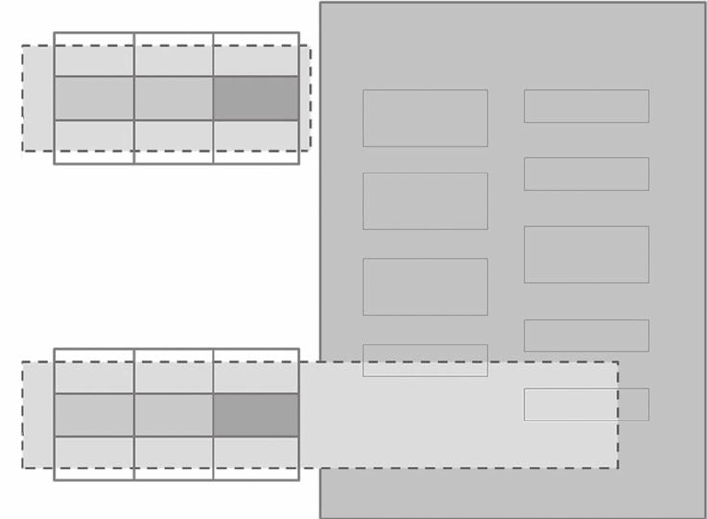
quency of contact with each of the elements of the ru-
ral environment such as church, well, bus stop, dirt track
to the pastures have changed similarly to the reach of
used space (Fig. 2). It seems that the biggest inuence
on this situation was the popularization of individual
means of transport as well as a visible increase in family
autonomy.
The village square, full of symbols, identies residents
with their own place and culture. Culture of space consists
of many behaviour patterns, which are customs of a given
community related to their beliefs, tradition and social or-
der. Although not every space is a human’s living environ-
ment, each territorial community must have its space in
which it can exist.
Space directly affects our senses and feelings. People
react to elements of spatial composition: closing, opening,
rhythm, light, colour, the vertical and the horizontal. Space
is experienced while watching and moving in it. Every
person reacts to space in their own unique way [4].
The very quality of public space depends also on the
current fashion. Tastes and preferences vary and they
change with time. In reality, they form and inuence the
reception of a given space. The quality of space is essen-
tial to determine the identity of a given area, it is usually
connected with a promoted and established vision.
Dehumanized space appears where no man’s land (or
space) exists [6]. The loss of identity contributes to the
Fig. 2. Relations between
public space (commonly used)
and home space (private)
social
club
farm
palace
VILLAGE SQUARE COMMON SPACE
health
centre
food
store
playground
school
church
state
agricultural
farm
REACH OF HOUSEREACH OF HOUSE
field orchard house
field orchard house
FIELD ORCHARD HOUSE
field orchard house
field orchard house
FIELD ORCHARD HOUSE
Planning entries
According to the legislative intention, public space area
should be distinguished in planning documents through
graphics and detailed entries allowing to shape it in a specic
direction. In the 2003 Site Planning and Land Development
Act, public space ground has been dened as an area ‘of
special importance in satisfying residents’ needs, improving
quality of their life and conducive to social contacts as re-
gards its location and functional and spatial characteristics’.
In planning documents, public space is identied graphi-
cally, which allows to distinguish it from other common-
access spaces. The way a public space is developed and
arranged is the key element deciding about the state, ap-
pearance and overall image of the village. The specicity of
planning entries determining the formation of a ‘space that
feels right to the recipient and user’ should be the selection
of such elements so as their co-existence could raise positive
Culture of village public spaces – exemplied by the commune of Krotoszyce 79
emotions and associations, based on the place’s tradition or
function. Appropriate scale, properly used material, colour,
accent or architectural dominants give such a possibility. The
existing construction development lines and building dimen-
sion limits arrange and form the borders of these spaces.
According to the act, a commune should not manage
space freely. During the planning procedure, commune’s
administrative organ is obliged to consider all interests at
stake, and the planning document is a common ground for all
interested parties, including the local community. Through
the competences given to a mayor (governor, president) by
law, this ofcial has a coordinating function and stimulates
spatial development according to predispositions, possibili-
ties and also traditions.
According to the current law, spatial planning should
be based on social participation. Participation can be mani-
fested in residents’ active role in creation of planning docu-
ments, e.g. proposals, participation in public debates, pres-
ence at municipal council meetings, as well as in indirect
ways, i.e. when people express their preferences, needs,
wishes and tastes through research, surveys, polls and other
forms of anonymous expression of opinions.
Krotoszyce municipality
Residential preference surveys of Krotoszyce’s resi-
dents were compiled by the authors of this article in spring
2010 – these surveys were aimed at nding out which
points are important for the residents of the municipality
and its individual localities
1
. They were formed as part of
a study of conditions and directions of municipality’s land
development. The questions pertained not only to the pros
1
87 surveys, each containing 19 questions.
and cons of the development of various localities, but also
requested residents to name central places associated with
celebrations, daily life, and worthy of showing to a new-
comer. The questions also asked to name “the heart of the
village”, a place associated with events, a charming but
also popular place or the one connected with recreation.
The survey aimed to pinpoint public spaces in different
localities of the municipality.
Unfortunately, answering these questions proved to
be very difcult for the residents of Krotoszyce. An im-
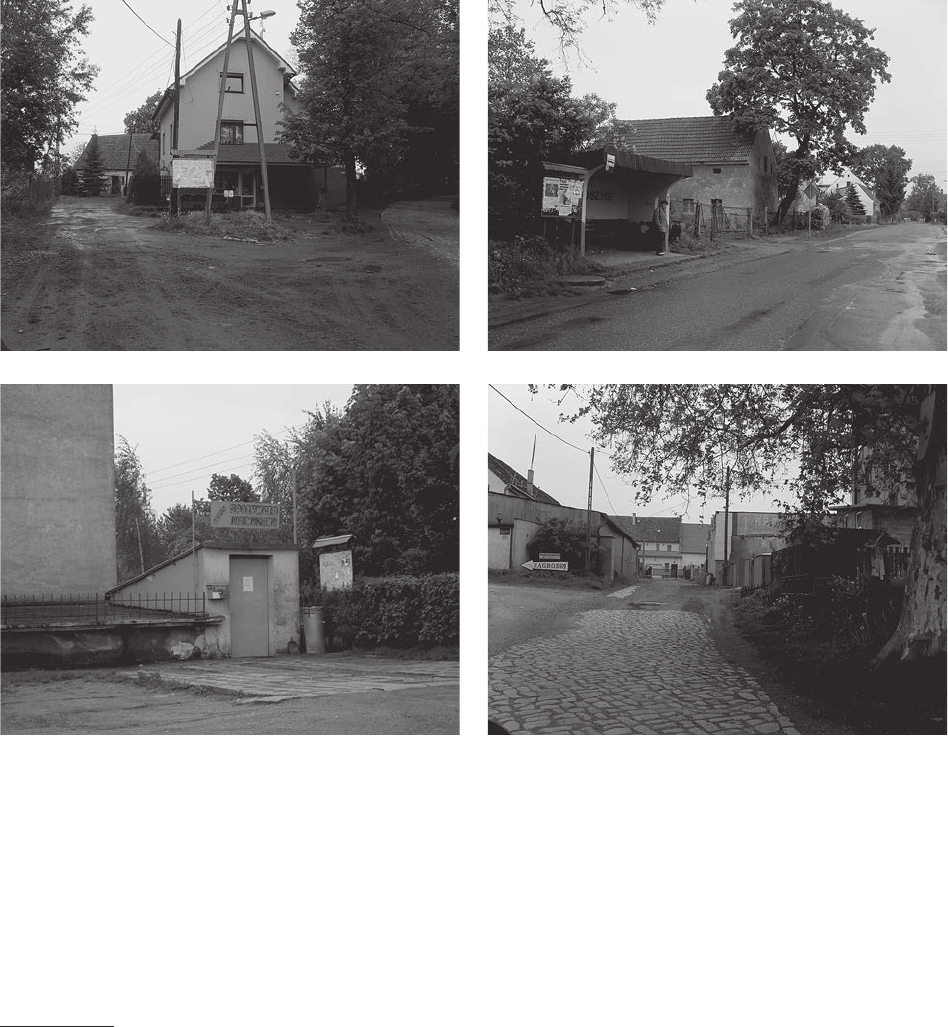
Figs. 3–6. Village central square in Tyńczyk Legnicki, Krotoszyce, Kozice, Złotniki

80 Anna Bazan-Krzywoszańska, Marta Skiba
age of a municipality with no public spaces accepted by
its inhabitants emerged from the survey. Localities
2
do
not have a meeting place accepted by the residents. It is
difcult to identify the central place of the localities. Per-
haps this situation is a consequence of many years when
the residents had no inuence on the space surrounding
the home or apartment. The residents do not identify with
the space, they ignore it. The constantly degraded public
space of those localities, does not correspond to the needs
and tastes, and is therefore mentally bypassed and pushed
out of consciousness. The young people are more likely
to identify with public spaces of shopping centers of larg-
er cities rather than with the space around their home or
school.
The authors of the publication assumed the vil-
lage square – the central place to be the space in which
they found symbols of worship, bus stop, shop or vil-
lage information boards (Fig. 3–6). In Krotoszyce there
is no established central place. The residents pointed
to several places important for them, and while older
residents pointed out: the eld – stadium, where “Kro-
toszyce Days” are held every year, the church, the mu-
nicipal ofce, the younger people mainly chose the bus
stop – a meeting place and a symbolic ‘window on the
world’, as if it were the rst step on the ‘path to a better
world’
3
.
There is no place that all the residents would consider
central, which would have cultural meaning and value.
The question about the ‘heart of municipality’ proved to
2
Krotoszyce Municipality comprises 14 villages: Krotoszyce, Wil-
czyce, Krajów, Czerwony Kościół, Winnica, Janowice Duże, Tyńczyk
Legnicki, Kozice, Warmątowice Sienkiewiczowskie, Babin-Kościelec,
Prostynia, Złotniki, Dunino, Szymanowice.
3
It is connected with the fact that the municipality is situated not far
from Legnica and this city is a place of work for most of them.
be one of the most difcult. The residents gave mostly
negative responses, and in other cases a specic location
could rarely be identied. As in the case of the question:
what is the symbol of the locality, answers ‘there is no and
‘none’ were dominating. It seems that a place that could
take over the function of a village square should be cre-
ated or rearranged and this ought to be the main request
to the urban plans.
Proposals included in the polls, indicating what the
municipality should remove, eliminate, what is the most
urgent need, what would residents donate to their city
– should be considered as proposals, suggestions to the
newly created local development plans. The aim should
be to expand the cultural, entertainment and recreational
activities offer to protect the needs expressed by the resi-
dents in surveys [1].
Commuting to work (on foot or by means of transport)
is the most common, usually rhythmic and daily move-
ment of the population, so any loss of time on the way
to work exceeding the necessary minimum is met with
disapproval of the working people. So it is not surprising
that the biggest nuisance for Krotoszyce residents is com-
munication, with about four fths of the respondents com-
plaining about it. In the polls, most complain about holes
in the roads, no sidewalks and overgrown side-spaces that
make people’s everyday functioning more difcult. The
Krotoszyce municipality not only lacks communication
links in the form of roads, but the quality of existing ones
raises reservations. Improving the roads is the most urgent
priority for the residents.
Interestingly, very few people claim the need to con-
struct new bike lanes, despite the declarations, in answer
to another question, of active way of recreation. Unfortu-
nately, this may indicate dominance of private car trans-
port and unrealized possibilities of alternative transport
options.
Conclusions
Each locality has its central place or places. The
larger the town the more likely it is that there are sev-
eral such sites. However, in the Krotoszyce municipality
there are no places which people could identify with. This
poll question was a clear sign that the indication of such
a place is problematic for residents. Most people did not
answer this question.
In the Krotoszyce municipality population has chan-
ged after World War II and the present inhabitants are new-
comers or their descendants, therefore, they did not inherit
the cultural manner of using public spaces. They were not
involved in recreating their surroundings related to the
eld of concepts, meanings, and ideas, and did not pro-
duce acceptable relations between common public spaces
and particular participants. Commonly personalized news
and entertainment (TV, video, computer, phone, etc.) re-
sult in even greater isolation of man and limited human
activity in public spaces. Today’s rural community is much
more diverse than it was several years ago. In addition, the
increased mobility of rural society causes the situation in
which village residents take completely different places in
the social division of labour, and they cross the barriers
resulting from the social status inherited by them [2].
Varied levels of culture of the residents, their different
habits, needs and preferences cause the ineffectiveness of
the functional programs implemented so far, which de-
pend mainly on the number of inhabitants. Until now, new
investments more often harmed the image of the rural ar-
eas rather than improved it.
An important role is undoubtedly played here by the
shape and records of the planning documents which relate
to communication, administrative and economic condi-
tions of everyday life. Currently, rural social space is not
created in relation between private and public space and
does not shape social behaviour. This space is created by
trying to protect the cultural and environmental values
contained in the specic regulations under the pressure of
economic interests of developing new jobs.
Culture of village public spaces – exemplied by the commune of Krotoszyce 81
References
[1] Bagiński E., Opinie młodego pokolenia mieszkańców o swoich mia-
stach, Ocyna Wydawnicza PWr., Wrocław 1995.
[2] Bartoszek A., Kapitał społeczno-kulturowy młodej inteligencji wobec
wymogów rynku, Wydawnictwo Uniwersytetu Śląskiego, Katowice
2003.
[3] Gzel S., Fenomen małomiejskości, Instytut Urbanistyki i Planowania
Przestrzennego PW, Warszawa 1987.
[4] Jałowiecki B., Szczepański M., Miasto i przestrzeń w perspektywie
socjologicznej, Wydawnictwo Naukowe Scholar, Warszawa 2002.
[5] Pawłowska K., Idea swojskości, Politechnika Krakowska, Kraków
2001.
[6] Trancik R., Finding Lost Space: Theories of Urban Design, John
Wiley & Sons, New York–Toronto 1996.
Kultura wiejskich przestrzeni publicznych – przykład gminy Krotoszyce
Kultura przestrzeni składa się z wielu wzorów zachowań funkcjonu-
jących w zmieniających się warunkach. Centralny wiejski plac to prze-
strzeń społeczna i publiczna, której symbole utożsamiają mieszkańców
z ich własnym miejscem. Jednak upowszechnienie się w ostatnim czasie
indywidualnych środków transportu, podobnie jak wzrost autonomii ro-
dziny, zmieniło zasięg użytkowanej zastanej przestrzeni. Przestrzeń dotąd
społeczna stała się niczyja, podobnie jak podtrzymujące ją wspólnotowe
więzy i grupowe interesy.
Na terenie gminy Krotoszyce ludność, po II wojnie światowej, wy-
mieniła się, a obecni mieszkańcy są przyjezdnymi lub ich potomkami,
zatem nie odziedziczyli kulturowego sposobu użytkowania przestrzeni.
Nie zaangażowali się także w wytworzenie swojego otoczenia powią-
zanego ze strefą swoich pojęć, znaczeń i wyobrażeń, i nie wypracowali
relacji pomiędzy przestrzenią publiczną (wspólnie użytkowaną) a po-
szczególnymi uczestnikami zdarzeń.
Nowe inwestycje najczęściej szkodzą wizerunkowi wsi. Jedno-
cześnie zróżnicowany poziom kultury mieszkańców – ich różnorodne
nawyki, potrzeby i upodobania – powoduje nieskuteczność wdrażanych
programów funkcjonalnych, zależnych w dużej mierze od liczby miesz-
kańców. Obecnie wiejska przestrzeń społeczna tworzy się w relacji nie
tyle przestrzeni prywatnej do publicznej, co pomiędzy próbami ochrony
wartości kulturowych i przyrodniczych a presją rozwoju interesów
ekonomicznych.
Key words: Krotoszyce, village, public spaces Słowa kluczowe: Krotoszyce, wieś, przestrzeń publiczna