
2025
2(82)
Maciej Jagielak*
Straw bale building – a sketch of the invention’s history
DOI: 10.37190/arc250207
Published in open access. CC BY NC ND license
Abstract
It is widely acknowledged that the technology of building with straw bales was invented in the 2
nd
half of the 19
th
century in Nebraska (USA). In the
1970s, this method of construction experienced a revival, followed by the export of related knowledge from the USA. However, there are sources of
information on the basis of which this linear view of the invention’s history can be challenged and a more complex narrative could be suggested. The
aim of this paper was to test the hypothesis that the history of straw bale construction as an invention is multifaceted and that the development of this
building technology may have occurred independently in multiple regions around the world.
The research carried out included a critical analysis of the literature on the subject and source documents (including patents), as well as correspon-
dence and interviews, all focused on identifying the earliest uses of straw bales in construction across dierent countries.
Based on the analysis of the collected documents and testimonies, it was conrmed that the history of the invention of straw bale building technolo-
gy should not be viewed as a linear process with a single point of origin. Instead, it reects a series of parallel inventions from various locations – some
documented through patent applications, and others emerging through trial and error on building sites.
According to the documents, it should be considered that the invention of straw bale construction may have originated in Indiana, rather than
Nebraska, as this state was the place of residence of the rst patent holder. The method of using straw bales as inll within a purpose-built wooden
frame was independently developed in France. The period of waning interest in straw bale construction took place between 1940 and 1970, although
individual straw bale buildings were still being constructed then in the USA, Canada and Europe. In the 1970s and 1980s, the export of know-how
from the USA was not the only direction of the ow of information; for instance, the transfer of expertise from Canada to France has also been
conrmed.
Key words: straw bale architecture, natural building materials, vernacular architecture, low-tech, plant-based insulation
Introduction
Research problem and justification
It is generally accepted that straw bale building techno-
logy […] emerged in the late 1800s in the Sandhills region
of Nebraska where trees were scarce and the soils were
not suitable for building the prairie-sod homes (Tilt, Arkin
n.d.)
1
. Many people describe its subsequent development
in stereotypical terms, e.g.: […] Like democracy and jazz,
this uniquely American innovation has since been exported
to countries around the world (Tilt, Arkin n.d.).
* ORCID: 0009-0003-3398-6283. Faculty of Architecture, Cracow
University of Technology, Poland, e-mail: jagielakmaciej@gmail.com
1
The source cited should be regarded as exemplary. The descrip-
tion of Nebraska as the place of origin is found in all books known to
the author containing information on the history of straw bale building.
However, there are sources of information that chal-
lenge this linear view of the invention’s history and sug-
gest a more complex narrative.
Hypothesis, aim and scope of the research
The purpose of our research was to test the hypothesis
that the history of straw bale as an invention is multifac-
eted and that the development of this building technology
may have occurred independently in more than one place
around the world.
The temporal scope of the study was limited to the pe-
riod from the 2
nd
half of the 19
th
century – marked by the
emergence of hay and straw bale presses in the USA – to
1992, which the author arbitrarily designates as the symbol-
ic end of the pioneering, experimental phase of the deve -
lopment of straw bale building. The study analysed infor-
mation from the USA, Canada, France, Germany, Denmark,

70 Maciej Jagielak
Sweden, Norway and England – countries where interest-
ing data could be obtained. However, it cannot be ruled out
that examples of straw bale architecture were also deve-
loped in other countries during the selected period.
Outline of content
This article attempts to organise the numerous but scat-
tered clues in the literature regarding where the rst straw
bale buildings were erected and the circumstances of their
creation, along with data from patent documents. It also
analyses these sources to determine whether the various
described instances of the invention of straw bale building
technology (in its variations) were interconnected.
State of research
Scientic publications on straw bale technology are
quite numerous, but mostly deal with technical aspects.
Texts of a cross-cutting and historical nature are very rare,
so the main point of reference remains Roger Welsch’s 1970
ethnographic article and its subsequent versions (Welsch
1973; 2020).
Interesting remarks on the development of straw bale
architecture are presented by an Australian researcher in
her work on the history of the Solomit straw boards (Jolly
1998). A description of the history of straw bale construc-
tion in Polish can be found in the doctoral thesis Straw
bale, czyli architektura z kostek słomy w Polsce [Straw
Bale Architecture in Poland] (Jagielak 2023, 27–35).
Due to the nature of straw bale building, which devel-
oped “bottom-up” in the 20
th
century primarily as a do-it-
yourself construction method – the main sources of infor-
mation are press articles, manuals and handbooks. These
include, above all, those created by enthusiasts: the maga-
zine The Last Straw (published intermittently from 1992 to
the present day), and books such as The Straw Bale House
(Bainbridge et al. 1994) or Serious Straw Bale. A Home
Construction Guide for All Climates (Lacinski, Bergeron
2000). A concise, international overview of the subject can
also be found in Neues Bauen mit Stroh (Gruber, Gruber
and Santler 2012) and Podręcznik budowania z kostek sło-
my (Minke, Krick 2015) published in Polish
2
. Published
memoirs, interviews and other written or recorded state-
ments by individuals involved in the development of straw
bale architecture (Knox, Myhrman 2008) serve as an im-
portant source of knowledge.
Methods
The research carried out included a critical analysis of
the literature on the topic, as well as a search for individual
press mentions and information on websites – concerning
the earliest uses of straw bales in construction across vari-
ous countries. Information on the earliest patents on straw
2
The Polish edition of this book is referenced here, as the most
easily accessible in the country of publication of this article. The original
edition was published in German as Handbuch Strohballenbau, Grund-
lagen, Konstruktionen, Beispiele.
bale construction was obtained from the online patent data-
bases (https://patents.google.com/ and https://data.inpi.fr/).
Additional information was gathered by the author
through correspondence with individuals and institutions
involved in the creation of (and/or research on) early ex-
amples of straw bale architecture. The results of the re-
search in draft form were presented in a talk at the “Euro-
pean Straw Bale Gathering 2023” in Branderup, Denmark.
Following discussions after the conference, it was possible
to complete the data presented in this paper.
The analysis of literature and other sources (e.g., patent
database searches) and correspondence leading to the arti-
cle took place between January 2023 and December 2024.
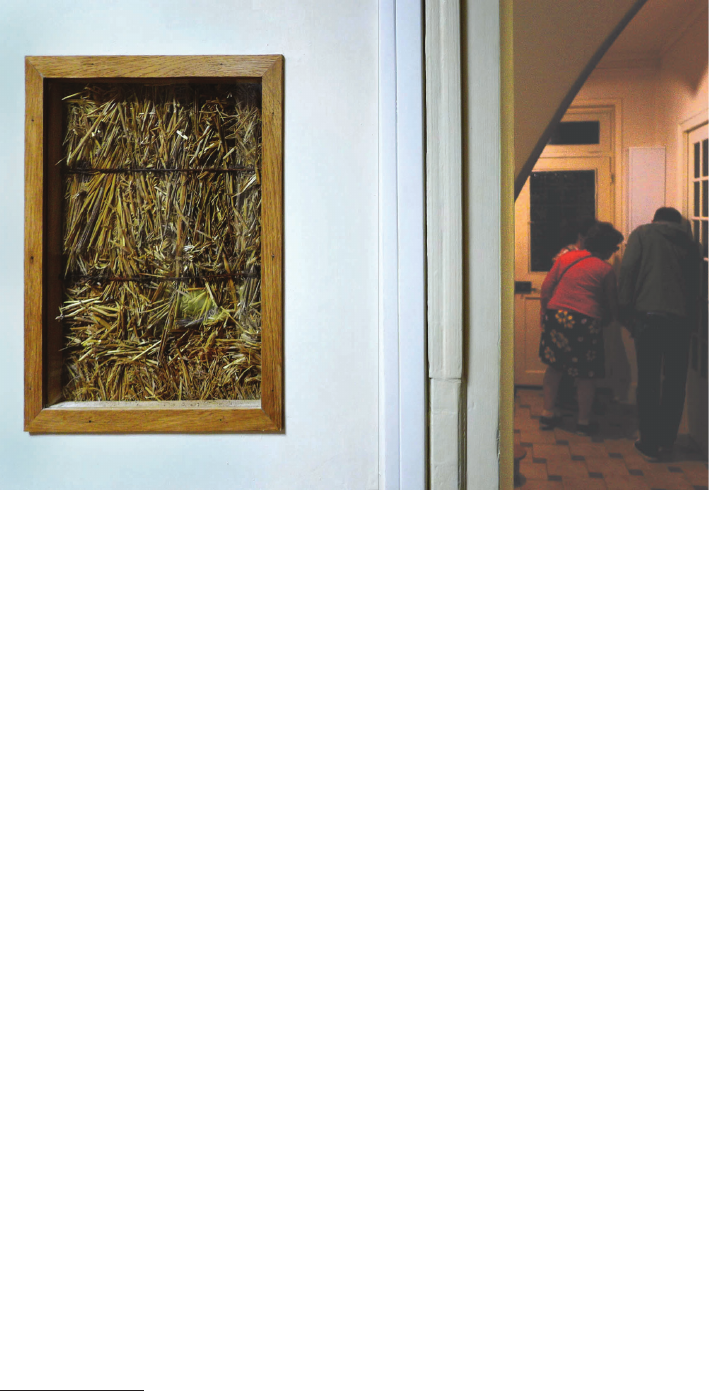
The photograph of the oldest known house in Europe
with wall insulation inll made of straw bales was taken by
the author during a study visit in August 2015.
For the purposes of this paper, the author has assumed
that the term “straw bale” can, aside from its basic mean-
ing, also function as an abbreviated form of “straw bale
building technology” or “straw bale” construction” and is
occasionally used in these senses in this text
3
.
Although nowadays straw bales are commonly used to
build houses, in the historic buildings in Nebraska (from
1886–1940) hay bales
4
were mainly used, so it is more
accurate to call the construction technology of the time
“hay bale”. For the sake of simplicity, the author has as-
sumed that this early episode of hay bale building falls
within the much broader phenomenon of straw bale build-
ing, since the way of working with either material is virtu-
ally the same.
Results
The main result of the work is a chronologically ordered
database of the rst buildings (or references to them) and
patents on straw bale building technology. Also includ-
ed are a selection of major publications and conferences/
meetings that may have had a signicant impact on the de-
velopment of straw bale. The summarised results are pre-
sented in Table 1.
Using the timeline presented in Table 1, it is possible
to quickly nd points which do not align chronologically
or geographically with the commonly accepted, simplied
history of straw bale construction. The following section
presents an analysis of selected issues.
Nebraska, Indiana… or perhaps Kansas?
The earliest US patents on straw bale building date back
to 1880 and 1885, and the inventors ling them in both cas-
es were from Indiana. The rst known printed reference to
the building of a temporary straw bale school in Nebraska
3
A broader explanation of the terms related to straw bale building
for Polish speaking readers can be found in the doctoral thesis on straw
bale building in Poland (Jagielak 2023).
4
Which was due to local conditions – prairie grasses were a re-
source available in great quantities in that area. Hay from the late autumn
harvest, the least valuable for fodder but the best building material, was
used for construction (Welsch 1970, 21).

Straw bale building – a sketch of the invention’s history 71
Table 1. Timeline of the invention and development of straw bale construction 1890–1992 (elaborated by M. Jagielak)
Tabela 1. Kalendarium wynalezienia i rozwoju budownictwa z kostek słomy 1890–1992 (oprac. M. Jagielak)
Origins of straw bale construction 1890–1940
Date Description Country/location Source
1880
J.M. Leeds patented the construction of straw bale buildings
(load-bearing use of straw bales in walls, i.e., loadbearing straw bale) (Fig. 1)
USA (inventor from
Kokomo, Indiana)
(Leeds 1880)
1885
William H. Orr patented the construction of straw bale walls
including compression with threaded rods and plastering (Fig. 2)
USA (inventor from
Carlisle, Indiana)
(Orr 1885)
1896 Construction of a temporary school building from straw bales Bayard, Nebraska, USA (Welsch 1970)
1897
Mention in the Australian Journal of Agriculture and Industry
of the possibility of building with straw bales [...] as in Kansas,
and of a barn in Australia (Fig. 3)
Australia
(+reference to many
buildings in Kansas, USA)
(South Australia
1897)
Circa 1900
Beginning of the period of popularity of straw bale building
in the Sand Hills region of Nebraska
Sand Hills region
(Nebraska, USA)
(Welsch 1970)
1903
George W. Pickin patented the construction of impregnated
straw bale walls with a method of compression and corner reinforcement
USA (inventor from
Eue Claire, Winconsin)
(Pickin 1903)
1905
John B. Clayton and Reno D.O. Johnson patented a composite wall and
roof construction in which straw bales are the infill of a concrete structure
USA (Missouri inventors)
(Clayton, Johnson
1905)
1920
First houses designed by Emille Feuillette, in which straw bales
were used to infill the timber frame
Existing: Montargis, Lille.
Probable but not certain:
Boulogne, Asine (France)
(Lamache 1921),
(E.W. 1921)
1921
Warren Withee built the only known house of this period in the USA
outside Nebraska. The building survived until at least the 1990s
Alsen-Fawnlville
(South Dakota, USA)
(Bainbridge 1994)
1922
Emile Feuillette patented a building system in France that included
timber elements in the form of trusses and straw bales or similar material
as infill (infill straw bale construction)
France (inventor from
Boulogne sur Seine)
(Feuillette 1922)
1923 Emile Feuillette patented his system in the USA
USA (inventor from
Boulogne sur Seine, France)
(Feuillette 1923)
1934–1938
Construction of the mansion of W.H. Burrit (construction time extended
due to fire in 1936). First example of the combination of timber frame
construction with straw bale infill in the USA
Hunstville
(Alabama,
USA)
(Herzog 1994)
Circa 1940
End of the period of popularity of straw bale construction
in the Sandhills region of Nebraska
Sandhills region
(Nebraska, USA)
(Welsch 1970)
Great pause 1941–1973
1943 The “Rulsche Hut” house – architect J.W.A. Gubbels Heeze (Netherlands)
(Czabanowski
2006, 90)
1944–1945 House “Huize Heivelden” – architect J.W.A. Gubbels Heeze (the Netherlands)
(Czabanowski
2006, 90)
Circa 1946 Construction of the modernist restaurant/dancing “The Lone Oak”
Lincoln area (Nebraska,
USA)
(Welsch 2020)
1950,
1953,
1955
Construction of several small buildings from straw bales
by Norwegian farmers; successively: stable, chicken coop, garage
Norway
(Piet Jensen,
email to author
23 August 2023)
1954
Construction of a straw bale church in Bad Heart on the initiative
of Pastor Francis Dales (description in press: 1960)
Bad Heart (Alberta,
Canada)
(Canada’s Historic
Places n.d.)
The beginnings of the straw bale revival 1970–1992
1970
Publication of an article by R. Welsch “Sandhill Baled Hay Construction”
in the Keystone Folklore Quarterly, in which he described hay
and straw bale constructions in Nebraska
USA (Welsch 1970)
Circa 1972 Bob Doolittle’s roundhouse; description in Mother Nature News (1973) USA (Doolittle 1973)
1973
Publication of an article by R. Welsch “Baled Hay” in Shelter,
which spread the knowledge that it was possible to build from hay
or straw bales, among those interested in low-budget construction
USA (Welsch 1973)
1974 The Hay House by Glen Gleason
Old Saybrook (New
England, USA)
(Lacinski, Bergeron
2000)
1976 Show house in the exhibition “ARARAT” at Moderna Museet Stockholm (Sweden) (Biernacki 1980)
1979 House of the organisation Le CUN Larzac (France)
(Bainbridge et al.
1994)

72 Maciej Jagielak
Table 1 continued. Timeline of the invention and development of straw bale construction 1890–1992 (elaborated by M. Jagielak)
Tabela 1 cd. Kalendarium wynalezienia i rozwoju budownictwa z kostek słomy 1890–1992 (oprac. M. Jagielak)
appeared in 1902 – it described a structure built in 1886
(Welsch 1970, 31).
As Bridget E. Jolly (1998, 31) mentions, it is also
known from an 1897 Australian publication that straw bale
buildings were being constructed in the state of Kansas
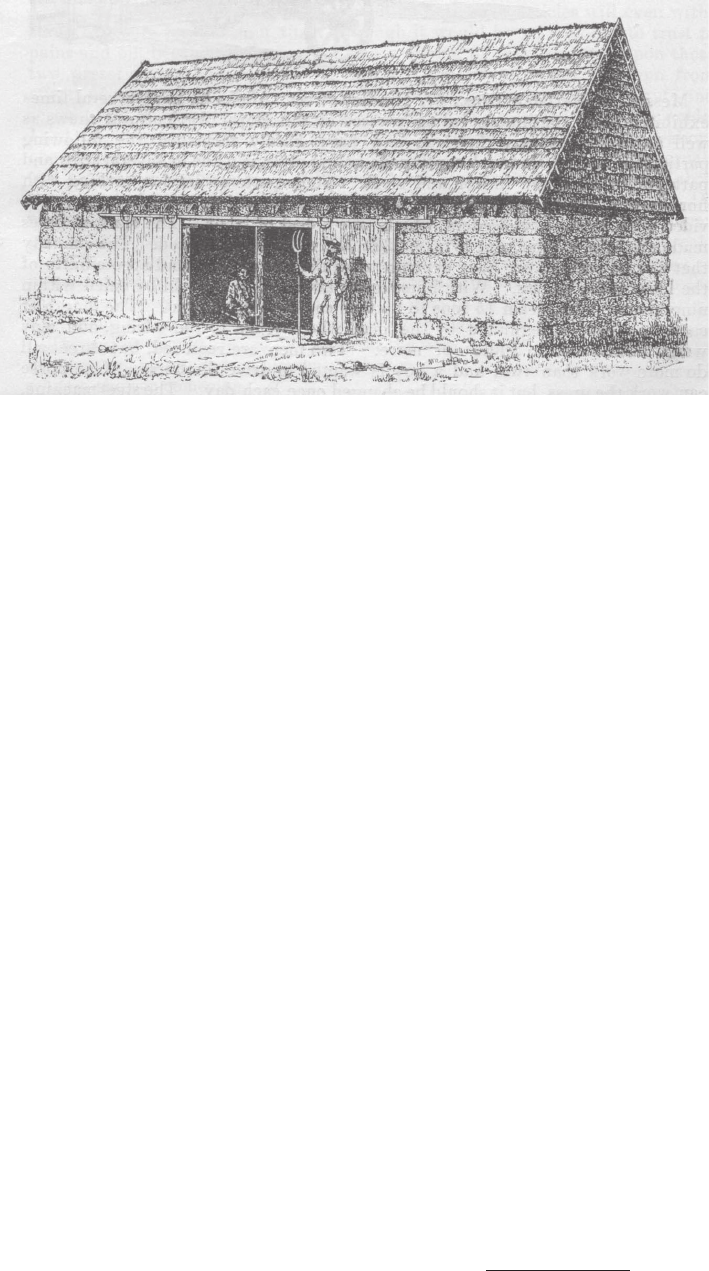
at the time. The article Buildings of Baled Straw (South
Australia 1897, 191) states: […] it has long been the prac-
tice to build barns and other farm erections with blocks of
baled straw, and even that there were many buildings of
this type in Kansas (Fig. 3). This issue denitely requires
further research.
Even more surprisingly, the text also mentions the con-
struction of barns with straw bales in Australia (one specif-
ic example is given – in the Goulburn Valley in the state
of Victoria, together with the indicative information that
the structure was built […] two or three years since, which
would mean a construction date in 1894 or 1895).
On the basis of an analysis of the documents referred
to above, it must be concluded that the method of erecting
buildings from straw bales was rst invented in the state of
Indiana, and that its authors were not anonymous pioneers,
but specic individuals known by name, who were su-
ciently aware of the signicance of the intellectual value
to have led patent applications (!). Of course, other sce-
narios cannot be ruled out on this basis, for example, one
that structures made of straw or hay bales had already been
erected in Nebraska earlier. On the other hand, the hypothe-
sis that knowledge of the invention from Indiana may have
been “carried” to Nebraska (and also Kansas) has both geo-
graphical and historical grounding – the west ward move-
ment of settlers continued throughout the late 19
th
and early
20
th
centuries. The area of the largest known concentration
of straw bale buildings in Nebraska, the Sandhills, was
designated for homesteading in 1904 (Welsch 1970, 17).
The existence of the aforementioned patent applica-
tions has been known in the straw bale building commu-
nity since at least 1998 – the year in which an article on
the subject was published in the The Last Straw magazine
(Raduazo 1998). However, it has not yet inuenced the
prevailing historical narrative found in numerous publi-
cations, in which the point of origin is in the Sandhills
(Nebraska).
However, an important unknown remains: did the pat-
ent authors put their ideas into practice? Did they construct
any straw bale buildings before making the applications?
And, if so, were these buildings constructed at their plac-
es of residence or elsewhere? The author does not know
the answers to these questions; however, some clues may
emerge from an analysis of the patent documents them-
selves. In the case of both the 1880 patent of Josiah M.
Leeds and the 1885 patent of William H. Orr, the descrip-
tions indicate a working knowledge of the material. It is
manifested, among other things, by the fact that informa-
tion about compression of the straw bales (and how to
control it) appears in the text. In the case of Leeds, the
patent description is formulated in the rst person (e.g.,
[…] I cut hay […]. In constructing my buildings, I set up
corner posts […]; Leeds 1880). It seems reasonable to as-
sume that both inventors carried out at least practical ex-
periments with making walls out of straw bales.
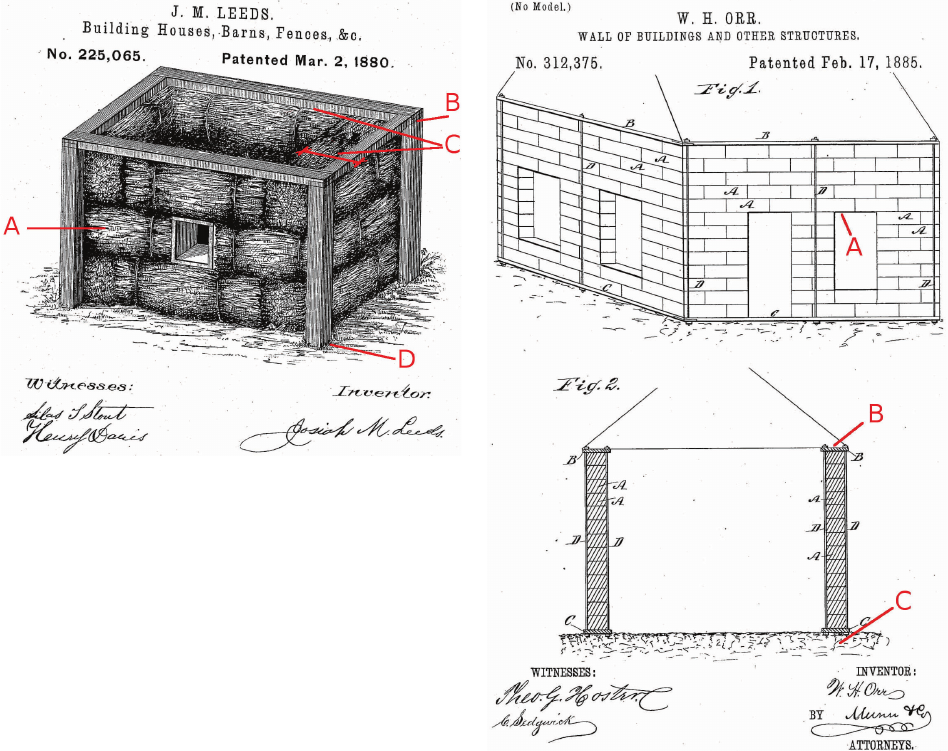
Incidentally, it is worth noting that the drawings accom-
panying the documentation contain errors and are less pre-
cise than the descriptions themselves (Figs. 1, 2). Leeds’
patent application is of a very practical nature and could
have served as a guideline on how to construct a basic tem-
porary outbuilding or dwelling using the simplest materi-
als and in a manner very similar to that used by settlers in
Nebraska.
The beginnings of the straw bale revival 1970–1992
Date Description Country/location Source
1979–1980 Experimental house “Biohaus” – architect Rudolf Doernach
(Hennef-Süchterscheid
Germany)
(Minke, Krick 2015)
1981 The home of Athena Swentzell Steen and Brian Reeves
Santa Fe
(New Mexico, USA)
(Bainbridge et al.
1994)
1981
Architect Jon Hammond’s house and studio
(described in a popular article in Fine Homebuilding in 1983)
Winters (California, USA)
(Bainbridge et al.
1994)
From circa
1984
Louis Gagne’s construction and testing, in which tested a method
of erecting the walls of buildings with straw bales and cement mortar
Quebec (Canada) (Gagné 1986)
1988–1989
Construction of the home of Steve and Nenna McDonald
(described in Permaculture Drylands in 1988)
Gila (New Mexico, USA)
(Myhrman, The Last
Straw 2022)
1989 Meeting of straw bale enthusiasts in Oracle Oracle, Arizona, USA
(Hammett, Hammett
2022)
1989 and
1991
Study trip by Judy Knox and Matts Myhrman to Nebraska
to confirm the durability of straw and/or hay bale buildings
Nebraska, USA
(Hammett, Hammett
2022)
1991
P.L. Brown’s article “Houses the Cows Would Love to Eat”
on new straw bale buildings published in the New York Times gains
unprecedented popularity and is reprinted in many countries
USA
(Myhrman, The Last
Straw 2022)
1992 First issue of the The Last Straw magazine Tuscon, Arizona, USA
(The Last Straw
n.d.)
Straw bale building – a sketch of the invention’s history 73
Subsequent patent applications were for other, more
complicated methods of building and stabilising walls and/
or roofs using straw bales, but these were not widely used
in practice.
Nebraska as the cradle of technology
– “Nebraska” as a type of construction
Welsch identied 1900–1940 as the main period of hay
bale development in Nebraska (Welsch 1970, 33). As part
of his research in the late 1960s, he found information or
heard references on about 75 buildings (Welsch 1970, 19).
In addition to houses and farm buildings, he also learned
of other structures, such as a church in Arthur, a large car
garage and even hangars for farmers’ aircraft (Welsch
1970, 26–29). In the early 1990s enthusiasts of the practi-
cal application of straw bale building set out to follow in
Welsch’s footsteps. Judy Knox and Matts Myhrman found
only some of the buildings indicated by Welsch during
their travels in 1989 and 1991, but additionally came across
others, not described in his article (Knox, Myhrman 2008,
ca. 5:30 min).
Fig. 1. Figure taken from patent no. US225065 filed by
J.M. Leeds; errors are notable:
A – the straw bales are too large in proportion to the building,
B – the walls are not of the correct thickness,
C – the corners made of boards support the ring beam,
which is contrary to the information presented in the description
of the invention, that this beam is to be laid on the straw bale wall
and that the corner posts can be removed after the walls
have settled under the load of the roof,
D – the drawing does not show that the corners should be
solidly fixed at the bottom, as mentioned in the patent description
(source: Leeds 1880, elaborated by M. Jagielak)
Il. 1. Rycina pochodząca z patentu nr US225065
zgłoszonego przez J.M. Leedsa; zwracają uwagę błędy:
A – kostki słomy są zbyt duże w proporcjach do budynku,
B – ściany nie mają właściwej grubości,
C – narożniki wykonane z desek podpierają belkę oczepową,
co jest sprzeczne z przedstawioną w opisie wynalazku informacją,
że belka ta ma być ułożona na ścianie z kostek słomy
oraz że słupki narożne można usunąć po tym,
jak ściany osiądą pod obciążeniem dachem lub stropem,
D – na rysunku nie pokazano, że narożniki powinny być
w dolnej części “solidnie umocowane” (o czym wspomina opis)
(źródło: Leeds 1880, oprac. M. Jagielak)
Fig. 2. Figure from patent no. US312375 filed by W.H. Orr;
note the unusually small straw bales in the drawing, other notes:
A – there is no information about lintels or boxes/frames
for window and door openings,
B – even with the smaller-than-typical dimensions of the straw bales,
the possibility of making the ring beam from a single wide plank
is seriously questionable in this case, as the forces occurring
in compression with threaded rods are considerable,
C – there is no mention of the use of foundations in the description
or drawing, which is a serious deficiency for buildings other
than temporary ones (source: Orr 1885, elaborated by M. Jagielak)
Il. 2. Rycina pochodząca z patentu nr US312375
zgłoszonego przez W.H. Orra; na rysunku zwracają uwagę nietypowo
małe kostki słomy, pozostałe uwagi:
A – brak informacji o nadprożach lub obudowach otworów
okiennych i drzwiowych,
B – nawet przy mniejszych niż typowe wymiarach kostek słomy
możliwość wykonania belki oczepowej z jednej szerokiej deski
budzi w tym przypadku poważne wątpliwości,
ponieważ siły występujące przy kompresji za pomocą
gwintowanych prętów są znaczne,
C – w opisie ani na rysunku nie ma wzmianki o zastosowaniu
fundamentów, co jest poważnym brakiem w przypadku budynków
innych niż tymczasowe (źródło: Orr 1885, elaborated by M. Jagielak)
74 Maciej Jagielak
whether the inventor knew that straw bale buildings were
already being constructed in the USA during that period.
Jolly (1998, 19–24) considers that the solution proposed
by Feuillette is a further development of the construction
methods known and used in the USA. However, this has
little bearing on the evaluation of his invention
5
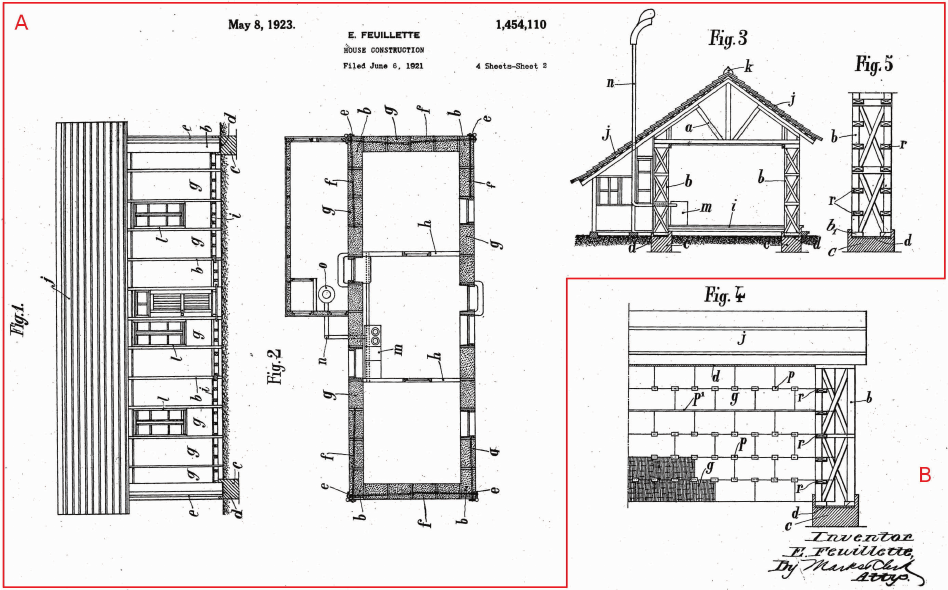
: he was the
rst to propose the use of straw bales as inll between the
elements of a ttingly designed wooden frame (Figs. 4, 5).
Similar solutions are now referred to in literature as “inll
straw bale”. The known buildings erected by Feuillette had
two overground storeys, presented high quality both tech-
nically and aesthetically, and were adapted to the urban
or small-town locations in which they were constructed.
When rendered, they visually resembled masonry build-
ings and, in terms of thermal insulation of the walls, they
had superior properties than those built using other com-
mon technologies of the time. Jolly (1998, 20) hypothe-
sised that the solutions proposed by Feuillette could have
been more widely adopted during the reconstruction of
areas destroyed during World War I. This guess was based
only on the warm reception of the invention by the press
and on an awareness of the immense housing needs of that
time. In conclusion, it should be noted that there is no con-
rmed information that the ideas of the French inventor
found a direct continuation in France or other European
countries or in the USA. Nevertheless – the ling of the
patent application in the United States may have been
a moment of intercontinental knowledge transfer. Unfor-
tunately, it seems that engineer Feuillette’s invention was
forgotten for many years, and the “revival” of straw bale
construction in France only began at the very end of the
1970s, triggered by an external impulse.
5
In doing so, the author proposes to take the construction described
in the patent and implemented in buildings in Montargis and Lille (Tur-
coing) as the basis for evaluating Feuillette’s system. Such a narrowing
down is needed because the patent documentation contains mixed de-
scriptions and illustrations of two not fully compatible solutions. One
of them is in line with that used in the mentioned houses. The other is
a kind of hybrid between the inll and load-bearing use of straw bales
and, from today’s perspective, seems far less practical (Fig. 4).
The buildings erected in Nebraska diered in details of
construction, including the orientation of the straw bales in
the wall, the use or non-use of mortar between the bales,
and the manner in which window openings were made.
However, they had some essential features in common:
straw bales were used as load-bearing elements (like bricks
in a wall) and were often plastered (at least in the case of
permanent buildings). This type of straw bale construction
is called “load-bearing straw bale”, “Nebraska-style” or
simply “Nebraska”.
The demand for straw bale structures dwindled as oth-
er building materials became increasingly available. After
1940, virtually no such structures were built in the San
Hills area any more. The Lone Oak Inn may be considered
to be the swan song of this period of development. It was
probably built in 1946 – outside the Sandhills, a few miles
from Lincoln (Welsch 2020). It was a two-storey build-
ing designed in the modernist style and was the rst clear
demonstration that straw bale building technology could
be applied not only to the erection of small rural buildings,
but also to public buildings. Sadly, it was demolished in
2012 (Welsch 2020).
From South America to Europe or vice versa?
The early 1920s saw another interesting episode in the
history of straw bale building. In 1920, the rst buildings
designed by engineer Emile Feuillette were constructed in
France. These were probably the rst European examples
of the use of straw bales in construction and, at the same
time, the world’s rst combination of modular wooden
structure and straw bales.
Shortly after construction, the building in Montargis (La-
mache 1921) was featured in La Science et la Vie (along
with numerous photographs of the construction), and four
buildings were mentioned in “Le Génie civil” (E.W. 1921).
Two of these still exist today – in Montargis and Lille (Fa-
bienne Pasquier, email to the author, February 14, 2023).
The engineer patented his solution in France (Feuil-
lette 1921) and in the USA (Feuillette 1923). The author
has not been able to nd conclusive evidence to conrm
Fig. 3. A straw bale barn
from Kansas (author unknown;
source: South Australia 1897, 191;
scan made by the National Library
of Australia, at the request
of M. Jagielak)
Il. 3. Stodoła z kostek słomy
w Kansas (autor nieznany;
źródło: South Australia 1897, 191;
skan wykonany przez
National Library of Australia,
na zlecenie M. Jagielaka)
Straw bale building – a sketch of the invention’s history 75
The rst straw bale insulated timber-frame building in
the USA was a mansion built between 1934 and 1938 in
Huntsville, Alabama. Its owner, William H. Burrit, claimed
in a 1950 newspaper interview that the method of erecting
the house was inspired by his personal experience of the
properties of straw to provide insulation against heat (Her-
zog 1994, 25). If he was indeed unaware of the buildings
constructed in Nebraska or France, he may be considered
another contender for the title of inventor of straw bale
building technology. All the more so, as the building incor-
porated a number of solutions not found elsewhere.
The great pause. The discontinuation of straw bale
building in Nebraska, new developments
in Canada and Europe
According to the typical narrative of American authors,
there was a pause in straw bale development after 1940s,
which did not end until the 1970s, when straw bale build-
ings were discovered and described by Welsch. However,
this break between the 1940s and 1970s was not complete.
Several isolated instances of straw bale building from this
period have been documented.
Between 1943 and 1945, in Heeze, the Netherlands,
during wartime restrictions and shortages of building ma-
terials, two houses were built from straw bales, designed
by the architect Johannes W.A. Gubbels (Czabanowski
2006, 90). There is no available data to support a link be-
tween these buildings and earlier developments in the USA
or France. However, it is worth noting that Heeze is only
200 km away from Lille, where one the houses built earlier
according to Feuilette’s design is located.
Another isolated case is the construction of a small
church from straw bales in Bad Heart, Alberta, Canada, in
1954, at the initiative of the experienced builder and pas-
tor Francis Dales (Canada’s Historic Places n.d.). It is not
known whether he was inspired by earlier buildings in the
USA, and if so, which ones. Information about it was pub-
lished in 1960 in the Grassland News newspaper owned by
the agricultural machinery company New Holland (Welsch
Fig. 4. Figures from patent no. US1454110 filed by E. Feuilette:
A – Figs. 1–3, 5 show a structure in which the truss posts “b” are spaced one straw bale “g” apart
(the module of the structure and the sizes of the bales are coordinated), this solution was used in practice in Montargis and Lille (Turcoing),
B – Fig. 4 view of the wall (left) combined with cross-section (right) show two different solutions. The distance between successive posts
in the wall is unspecified, but it is at least four bales lengths. The bales (“g”) are laid staggered, as in Nebraska, but with the addition
of horizontal wooden elements (longitudinal “r” and transverse “p”) to reinforce/stabilise the wall together with plaster reinforced with steel mesh
(source: Feuillette 1923, elaborated by M. Jagielak)
Il. 4. Ryciny z patentu nr US1454110 zgłoszonego przez E. Feuilette’a:
A – Figs. 1–3, 5 pokazano konstrukcję, w której kratownicowe słupki “b” rozmieszczone są w odległości jednej kostki słomy “g” od siebie
(moduł konstrukcji i rozmiary kostek są dopasowane do siebie), to rozwiązanie zastosowano w praktyce w Montargis i Lille (Turcoing),
B – Fig. 4 widok ściany (po lewej) połączony z przekrojem (po prawej) pokazują dwa różne rozwiązania. Odległość między kolejnymi słupkami
w ścianie jest nieokreślona, ale wynosi co najmniej cztery długości kostek. Kostki (“g”) są układane z przesunięciem,
jak w Nebrasce, przy czym dodatkowo wprowadzone są drewniane elementy poziome (podłużne “r” oraz poprzeczne “p”),
które mają wzmacniać/stabilizować ścianę razem z tynkami zbrojonymi stalową siatką (źródło: Feuillette 1923, oprac. M. Jagielak)
76 Maciej Jagielak
2020). The article may have been another example of inter-
national transfer of knowledge or inspiration.
In the 1950s and 1960s, at least four simple straw bale
farm buildings (stable, poultry house, garage, storehouse)
were built in Norway (Piet Jensen, email to the author, Au-
gust 23, 2023). These were small, in some cases temporary,
structures erected by farmers. What is remarkable here is not
only their creation, but also the fact that the architect Piet
Jensen managed to nd and record information about them.
The revival of straw bale in the USA and beyond
The 1970s
The eld research carried out by Welsch was the initial
impetus for bringing back into use the methods of straw
building practised in early 20
th
century Nebraska. His
work was published – rst in Keystone Folklore Quarter-
ly and then in Shelter, a publication that achieved great
popularity in the counterculture movement
6
. The book,
full of photos and drawings of traditional, vernacular and
DIY architecture from all over the world, has become an
important source of inspiration for many people looking
for a way to cheaply build a house with their own hands
and live close to nature. Sold in considerable numbers and
reprinted many times, it also found its way to Europe. At
rst, the article by Welsch’s in this publication triggered
modest actions. Individuals scattered across the USA built
some (mostly small, often temporary) structures out of
straw bales. Often they had only that one-page text from
Shelter or other articles
7
as a guide – or even just a ver-
bal message that it was possible to build with straw. The
only straw bale house of this decade in the USA known
to the author, well documented in the literature (Lacins-
6
Including the “Back to Land” movement.
7
E.g., in Mother Earth News or Permaculture Drylands magazines.
ki, Bergeron 2000, 25–27), and still existing today, is the
“Hay House” in Old Saybrook (David Brown, email to the
author, 4 September, 2023).
As in the USA, experiments with building with straw
bales were also being carried out in other countries during
this period. In 1976, such a house formed part of the
“ ARARAT” exhibition at Stockholm’s Moderna Museet.
The event was controversial and much attended by the
public (Jansson 2015). Interestingly – photographs of the
house from the exhibition even appeared in the Polish pe-
riodical Architektura (Biernacki 1980, 89, 90).
The author managed to nd a note stating that during
a search conducted in Canada in 1978 Jorg Ostrowski was
able to document several existing straw bale buildings, be-
side the church in Bad Heart (ASH-Autonomous… 2011).
In 1979, the rst straw bale house in France was built
after many years’ break (Bainbridge et al. 1994, 14). Lo-
cated on the Larzac plateau, it was an illegal building
(without a permit) – the work of members of the pacist
organisation “Le CUN”. They learned the building method
themselves, by trial and error, on the basis of just a verbal
hint that it is possible to build with straw. The information
came to them from Canada (Hervé Ott, email to the author,
February 17, 2023).
Between 1979 and 1980, an experimental “Biohaus”
house designed by Rudolf Doernach was built in Hen-
nef-Süchterscheid, Germany (Minke, Krick 2015, 13). The
author was unable to nd out whether the designer was
aware of the existence of other straw bale buildings at this
stage. However, the solution used suggests that this was an
experiment not supported by an understanding of the ma-
terial’s characteristics – the straw bales were covered with
foil, which led to fungi growth and decomposition (Gernot
Minke, email to the author, August 23, 2023).
These examples of buildings scattered around the
world, and mostly not very impressive, illustrate the phase
of slow development by trial and error, preceding the straw
Fig. 5. Interior of the building
“Maison Feuilette” in Montargis:
in the foreground, the “truth
window” providing a glimpse
inside the wall, on some
century-old straw bales
(photo by M. Jagielak, 2015)
Il. 5. Wnętrze budynku Maison
Feuilette w Montargis:
na pierwszym planie „okienko
prawdy” zapewniające wgląd do
środka ściany, gdzie znajdują się
około stuletnie kostki słomy
(fot. M. Jagielak, 2015)
Straw bale building – a sketch of the invention’s history 77
bale revival proper. At that time, the object of international
transfer was not so much the technology of building with
straw bales, but the basic information and the very idea
that it was possible.
If one takes into account the lack of developed networks
and the absence of manuals – it can be hypothesised that
many people were “inventing” the ways of building with
straw bales for themselves during these years. A similar
situation continued in the 1980s.
The 1980s
According to some sources, the actual watershed mo-
ment for the popularisation of straw bale building was
linked to an article published in 1983 in Fine Homebuild-
ing magazine. The text described a house and studio by
architect Jon Hammond (Tilt and Arkin n.d.) that had been
built two years earlier. A small building plastered in white,
with gently rounded corners and other sculpturally shaped
elements, aroused enthusiasm of numerous male and fe-
male readers and, for a long time, established the idea of
the desirable characteristics of a straw bale house.
Experiments with dierent ways of building were car-
ried out parallelly in Canada by Ostrowski in Alberta and
Louis Gagné, Francois Tanguay, Clode Deguise, Clement
Doyer and Michel Bergeron in Quebec, among others (La-
cinski, Bergeron 2000, 16). Gagné developed his own sys-
tem of building with straw bales with wide cement mortar
joints between. Bales were laid without staggering vertical
joints to create a “concrete grid” as a load-bearing struc-
ture (Gagné 1986), which was somewhat reminiscent of
the technology described in a 1905 US patent (Clayton,
Johnson 1905). Given today’s knowledge of the buildings
physics, this solution can be judged as a dead end in the de-
velopment of straw bale. However, it is possible that these
were the world’s rst straw bale building experiments con-
ducted in collaboration with governmental institutions.
Francis Tanguay’s role is not widely known but certain-
ly important as he also lectured and provided training in
France in 1985, 1987, and in 1989 (Bainbridge et al. 1994,
14). This was the rst known example of an organised, in-
tercontinental transfer of knowledge about straw building,
predating similar events in English-speaking countries.
It’s worth noting that the beginnings of the coordination
and organisation of the straw bale community in the US
did not come until the late 1980s and early 1990s. Of the
earlier period, Matts Myhrman said: It was not a revival at
that point at all. At the most it was dozens of people who
had built a handful of Nebraska-style buildings, many done
in Cochise County (Arizona) or other areas that required
no building codes (after: Hammett, Hammett 2022).
Early 1990s
It was not until the early 1990s that the straw bale com-
munity in the USA consolidated to such an extent that the
rst manuals could be published, education organised and
eorts made to include the technology in building codes.
There was also a noticeable increase in press publica-
tions about straw bale building. An illustrated text, print-
ed in colour, on the front page of the section on houses
in the New York Times, was a real milestone (Myhrman,
The Last Straw 2022). The interest generated by the ar-
ticle provided the impetus to accelerate the development
of straw building in the USA. The text was reprinted by
newspapers in many countries, which helped to promote
the idea of accessible straw bale construction. In 1992, the
rst issue of The Last Straw was published, a magazine
that became an important forum for the exchange of infor-
mation on straw bale construction – not only in the United
States, but also internationally. This moment was arbitrari-
ly regarded by the author as the symbolic end of the pio-
neering phase of straw bale building. At the same time, it
was not the end, but rather the beginning of the dynamic
development of this technology.
Summary
On the basis of the available documents, it can be con-
cluded that the invention of the technology of erecting
buildings with load-bearing straw bale walls was made by
J.M. Leeds from Indiana. It is therefore likely that the place
of invention was the state of Indiana and not Nebraska.
Nebraska, specically the Sandhills region, remains
the only known area where straw bale building technolo-
gy was applied on a larger scale in the 1
st
half of the 20
th
century. It is also the only known place in the world where
a group of such buildings has withstood the test of time,
and served as a source of knowledge for subsequent gen-
erations of builders.
The building technology of inlling a specially de-
signed frame structure with straw bales was invented in
France. The inventor, Emile Feuillette, led patent appli-
cations both in France and the USA. His solution – also
implemented in practice – diered signicantly from that
used in Nebraska.
During the period of waning interest in straw bale con-
struction between 1940 and 1970, individual straw bale
buildings continued to be built. Examples are known from
the USA, Canada, the Netherlands and Norway. Whether
these cases are connected remains unclear. It is possible
that some represent independent reinventions of the build-
ing method, developed without awareness of prior exam-
ples and patents.
In the 1970s and 1980s, attempts to build with straw
bales were made in various places around the world. Some
of these follow publications originating in the United
States, for others there is no such certainty. In the 1980s,
innovative experiments with dierent ways of building
with straw bales (including faulty ones) were carried out
extensively in Canada, and there are also documented ex-
amples of knowledge transfer from Canada to France.
Conclusions
The analysis of the timeline presented in Table 1, to-
gether
with the detailed description of selected events and
periods of development of the technology, leads to the con-
rmation of the thesis that the history of the invention of
straw bale building technology is multifaceted and should
not be seen as a linear process with a single starting point.
This is because it is made up of many inventions – both
78 Maciej Jagielak
those conrmed by patent applications and solutions
discovered on building sites and improved by trial and er-
ror, typical for vernacular architecture.
From the rst patent applications, it is possible to identify
at least two countries where straw bale construction tech-
nology has been invented, or rather two dierent technol-
ogies: in the USA, the load-bearing use of straw bales, and
in France, the inll use of straw bales. The available doc-
uments also show that the invention of load-bearing straw
bale was made by Leeds, who was from the state of Indiana,
not Nebraska. At the same time, it is worth remembering that
Nebraska is rightly regarded as the cradle of straw bale con-
struction since it is the place where this method of erecting
buildings went beyond the phase of isolated experiments.
In addition, the research results include instances in
which straw bale technology was rediscovered by people
building either with no information at all about the exis-
tence of earlier buildings constructed in this way, or with
only hints on the subject at their disposal.
This paper describes selected situations in which knowl-
edge transfer occurred (or could have occurred) between dif-
ferent centres of straw bale building development. Although
the collected information of this kind is incomplete, it con-
rms that the export of know-how from the USA was not
the only direction of knowledge transfer and inspiration in
the development process of straw bale construction.
The location of other early straw bale buildings should
be a subject of further research, which should include also
countries not covered in the article. The interrelationships
between successive instances of the invention of the tech-
nology combined with a detailed tracing of paths of de-
velopment and exchange of knowledge (especially in non-
English-speaking areas) could form another promising
topic for in-depth study.
For researchers in sociology and history, it might be in-
teresting to trace the social, economic and legal conditions
that led to the intensive development of straw bale con-
struction in certain regions at specic times.
The history of the evolution of straw bale building tech-
nology, including types of construction, ways of organis-
ing construction or the tools and materials used, requires
a separate study.
References
ASH-Autonomous & Sustainable Housing, Inc. “Bad Heart Historic
Straw Church.” Facebook. Published May 1, 2011. Accessed Decem-
ber 20, 2024, at https://www.facebook.com/media/set/?set=a.20845
88 69184383.57203.205006449529625.Bainbridge, David, Athena
Swentzell Steen, Bill Steen, and David Eisenberg. The straw bale
house. Chelsea Green Publishing, 1994.
Biernacki, Roman. “Co to znaczy tanio?” Architektura, no. 2 (1980):
89, 90.
Canada’s Historic Places. “Bas Heart Straw Church.” Accessed Decem-
ber 20, 2024, at https://www.historicplaces.ca/en/rep-reg/place-lieu.
aspx?id=11819.
Clayton, John B., and Reno D.O. Johnson. “Composite building struc-
ture.” [U.S. Patent 801361, issued October 10, 1905]. Accessed De-
cember 20, 2024, at https://patents.google.com/patent/US801361A/
en?oq=+US801361.
Czabanowski, Juri J.A. “Humaan-ecologisch georiënteerde woningbouw
: architectuurhistorische studie (1945–2000) met aanbevelingen
voor duurzame woningbouw: DUWOB + MODEL en MEMORIE-
TOETS.” PhD diss., Technische Universiteit Eindhoven, 2006.
https://doi.org/10.6100/IR615349.
Doolittle, Bob. “A Round House of Straw Bales.” Mother Earth News.
January 1, 1973. Accessed December 20, 2024, at https://www.moth-
erearthnews.com/sustainable-living/green-homes/house-of-straw-
zmaz73jfzraw/.
E.W. “Constructions en paille, système Feuillette.” Le Génie civil: revue
générale des industries françaises et étrangères 89, no. 18 (1921):
378. Accessed December 20, 2024, at https://gallica.bnf.fr/ark:/12148/
bpt6k6504203k/f18.item.
Feuillette, Emile. “Construction économique et hygiénique.” [French
patent FR523345, issued August 17, 1921]. Accessed December 20,
2024, at https://data.inpi.fr/brevets/FR523345?q=#FR523345.
Feuillette, Emile. “House construction.” [US Patent US1454110, issued
May 8, 1923]. Accessed December 20, 2024, at https://patents.goo-
gle.com/patent/US1454110A/en?oq=1454110.
Gagné, Louis. A Straw Bales/Mortar House Demonstration Project. Can-
ada Mortgage and Housing Corporation, 1986.
Gruber, Herbert, Astrid Gruber, and Helmut Santler. Neues Bauen mit
Stroh in Europa. Ökobuch Verlag, 2012.
Hammett, Jerilou, and Kingsley Hammett. “A History of the Strawbale
Resurgence. The Strawbale Search.” The Last Straw, January 1,
2022. Accessed December 20, 2024, https://www.thelaststraw.org/a-
history-of-straw-bale-resurgence/.
Herzog, Malinda. “The Burritt Preservation Legacy.” The Historic Hunts-
ville Quarterly 20, no. 1 (1994): 4–34. https://huntsvillehistorycol-
lection.org/hh/hhpics/pdf/hhq/HHQ-Vol-XX-1-Spr94.pdf.
Jagielak, Maciej. “Straw bale, czyli architektura z kostek słomy w Pol-
sce.” PhD diss. Politechnika Krakowska, 2023. https://repozytorium.
biblos.pk.edu.pl/resources/47080.
Jansson, Ulrika. “Introduction to ARARAT.” In search for ARARAT (2015).
Accessed December 20, 2024, https://insearchforararat.wordpress.
com/inspiration-to-ararat/.
Jolly, Bridget E. “House of Straw: the Adaptation of Solomit in Austra-
lia.” PhD diss., University of South Australia, 1998. http://resear-
choutputs.unisa.edu.au/1959.8/79686.
Knox, Judy, and Matts Myhrman. “Matts Myhrman and Judy Knox Inter-
view.” Film, 9 min., 50 sec. Published December 2, 2008. Accessed
December 20, 2024, at https://www.youtube.com/watch?v=N2q-
9JSBBSvI.
Lacinski, Paul, and Michael Bergeron. Serious Strawbale – A Home Con-
struction Guide for All Climates. Chelsea Green Publishing, 2000.
Lamache, Gustave. “Fraiches en été, chaudes en hiver, les maisons de
paille sont avant tout économiques.” La Science et la Vie, no. 56
Acknowledgements
I extend my sincere thanks to all the straw bale building enthusiasts who
have shared their knowledge and illustrations with me.
I dedicate this text to: Matts Myhrman (d. 10.11.2024), Roger Welsch
(d. 30.09.2022) and Judy Knox (d. 24.12.2011).
Straw bale building – a sketch of the invention’s history 79
(May 1921): 31, 482–6. https://rfcp.fr/wp-content/uploads/chiers/
La_Science_et_la_Vie_num_56_mai1921.pdf.
Leeds, Josiah M. “Building houses, barns, fences, & c.” [U.S. Patent
US225065, issued March 2, 1880]. Accessed December 20, 2024, at
https://patents.google.com/patent/US225065A/en?q=(j.m.leeds)&o-
q=j.m.leeds&sort=old.
Minke, Gernot, and Benjamin Krick. Podręcznik budowania z kostek sło-
my: podstawy, konstrukcje, przykłady. Translated by Zygmunt Bie-
liński. Fundacja Cohabitat, 2015.
Myhrman, Matts, and The Last Straw. “An Oral History of The Straw
Building Revival with Matts Myhrman.” The Last Straw, November 8,
2022. Accessed: December 20, 2024, at https://www.thelaststraw.org/
an-oral-history-of-the-straw-building-revival-with-matts-myrhman/.
Orr, William H. “Wall of buildings and other structures.” [U.S. Patent
US312375, issued February 17, 1885]. Accessed December 20, 2024,
at https://patents. google.com/patent/US312375A/en?q= (straw+bale)
&oq=straw+bale&sort=old&page=2.
Pickin, George W. “Fireproof wall or building.” [U.S. Patent US729,408,
issued May 26, 1903]. Accessed December 20, 2024, at https://
patents.google.com/patent/US729408A/en?q=(straw+bale)&o-
q=straw+bale&sort=old&page=4.
Raduazo, Ed. “The History of Straw Bale Construction Through Patents.”
The Last Straw, no. 21 (Winter 1998): 23, 24.
South Australia. Department of Agriculture. “Buildings of Baled Straw.”
Journal of Agriculture and Industry of South Australia 1, no. 3 (Oc-
tober 1897): 191–3.
The Last Straw. “About”. [n.d.]. Accessed December 20, 2024, at https://
www.thelaststraw.org/about/
Tilt, Anni, and David Arkin.“The Last Straw? Hardly!” Berkeley Built.
Systainable Living Design. [n.d.] Accessed December 20, 2024, at
https://www.berkeley-built.com/post/the-last-straw-hardly.
Welsch, Roger L. “Baled hay.” In Shelter, edited by Lloyd Kahn and Bob
Easton. Shelter Publications 1973 [reprint 2010].
Welsch, Roger L. “Sandhill Baled Hay Construction.” Keystone Folklore
Quarterly 15, no. 1 (1970): 16–34. https://archive.org/details/sim_
keystone-folklore_spring-1970_15_1/page/32/mode/2up.
Welsch, Roger L. “Sandhills, Nebraska: le berceau de la construction en
botte de paille.” Translated by Martin Paquot. Tophophile, March
2, 2020. Accessed December 20, 2024, at https://topophile.net/
savoir/sandhills-nebraska-le-berceau-de-la-construction-en-botte-
de-paille/.
Streszczenie
Budownictwo z kostek słomy – początki historii wynalazku
Powszechnie uznaje się, że technologia budowania z kostek słomy (straw bale) powstała w 2. połowie XIX w. w Nebrasce (USA). W latach 70.
XX w. rozpoczął się proces odrodzenia tego sposobu wznoszenia budynków, a później – eksport wiedzy z USA. Istnieją jednak źródła, dzięki którym
można poddać krytyce tę linearną wizję historii wynalazku i naszkicować obraz bardziej złożony.
Celem badań było sprawdzenie hipotezy, że historia wynalazku straw bale jest wielowątkowa oraz że powstanie tej technologii budowania mogło
nastąpić niezależnie w wielu miejscach na świecie. Przeprowadzone badania objęły: krytyczną analizę literatury przedmiotu i dokumentów źródłowych
(w tym patentów), korespondencję, rozmowy ukierunkowane na poszukiwanie pierwszych zastosowań kostek słomy w budownictwie w różnych kra-
jach. Dane zostały podsumowane w formie tabeli.
Na podstawie analizy zebranych dokumentów i relacji potwierdzono, że historia technologii budowania z kostek słomy była wielowątkowa i nie
powinna być postrzegana jako linearny proces z jednym punktem początkowym. Obejmuje ona wynalazki pochodzące z różnych miejsc i te potwier-
dzone zgłoszeniami patentowymi, i te odkrywane w warunkach budowy i doskonalone metodą prób i błędów. Biorąc pod uwagę dokumenty, należy
uznać, że miejscem wynalezienia budownictwa z kostek słomy mógł być stan pochodzenia autora pierwszego zgłoszenia patentowego, czyli Indiana,
a nie Nebraska. Wynalazku polegającego na zastosowaniu kostek słomy jako wypełnienia odpowiednio zaprojektowanej konstrukcji drewnianej doko-
nano we Francji. Okres zaniku zainteresowania budownictwem z kostek słomy przypadł na lata 1940–1970, mimo to pojedyncze budynki straw bale
wciąż powstawały w USA, Kanadzie i Europie. W latach 70. i 80. XX w. eksport know-how z USA nie był jedynym kierunkiem przepływu informacji,
potwierdzono m.in. transfer wiedzy z Kanady do Francji.
Słowa kluczowe: architektura z kostek słomy, naturalne materiały budowlane, architektura wernakularna, architektura low-tech, materiały izolacyjne
pochodzenia roślinnego